
The written record
Read the transcript
Read along with the recording · About 22 min to read
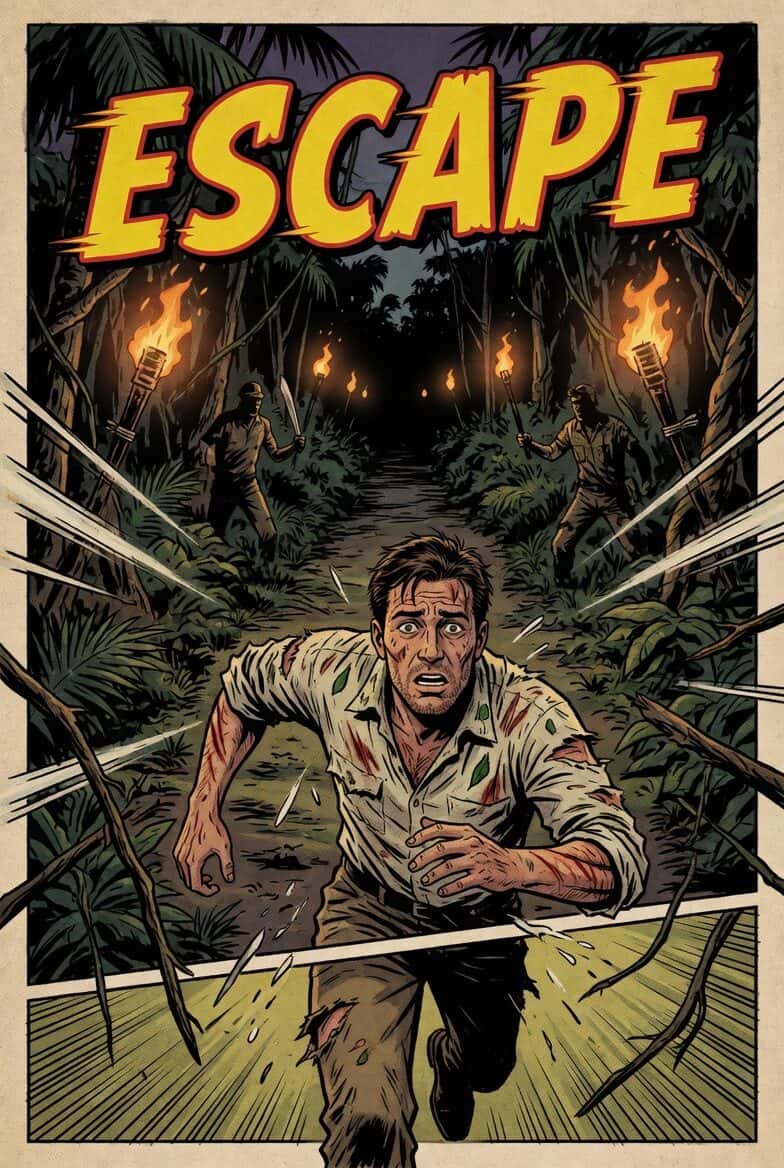
You are isolated on a remote plantation in the crawling Amazon jungle. And an immense army of ravenous ants is closing in on you. Swarming in to eat you alive. A deadly black army from which there is no escape. Escape. Produced and directed by William N. Robson. And carefully contrived to free you from the four walls of today for a half hour of high adventure. Tonight we escape to the Amazon jungle. And to a creeping, crawling terror. As Carl Stephenson told it in his gripping story, Leiningen vs. the Ants.
I first met Leiningen while performing my duty as district commissioner. As my boat neared his plantation landing, I saw him upon the riverbank, regarding me with mild interest. A great hulk of a man with bristling gray hair, bulky nose and pale eyes. His entire appearance somehow suggested an aging and shabby eagle. He escorted me to the terrace and had a drink brought.
I came quickly to the point of my visit and issued my warning. Leiningen puffed placidly at a huge cigar and listened as I told him, unless they alter their course, and there's no reason why they should, they'll reach your plantation in two days at the latest.
"Uh-huh. Well, it was decent of you paddling all this way just to give me the tip."
"Tip? Commissioner. Even a herd of crocodiles couldn't drive me from this plantation."
"Uh-huh. Uh-huh. But these aren't creatures you can fight. They're an elemental force, a gigantic catastrophe. Ten miles long, two miles wide, ants, nothing but ants, and each one as big as your thumb, and each of them a fiend from hell. Unless you clear out at once, there'll be nothing left of you but a skeleton picked as clean as your own plantation will be."
"I'm not getting out."
"But you can't fight."
"Yes, I can. I've got the best weapon there is, Commissioner. Intelligence."
"But can't I make you understand the hideous..."
"I think it is you who do not understand. In the three years I've been here, I've met and defeated more than one catastrophe. Flood, drought, a plague. Events which cost many of my neighbors to flee for their lives. No, Commissioner, all my life I have lived with one creed. The human brain needs only to become fully aware of its powers to conquer even the elements."
"Leiningen, your obstinacy is indelible. Endangering not only your own life, but the lives of your workers and their families. You don't know these ants. I tell you, you don't know these ants."
But Leiningen merely sat there puffing at his cigar and regarding me with a smug grin. And I knew it was hopeless. As I boarded my launch and cast off, I realized I'd never met a man like that.
And I could not help wondering about the strange look in the Commissioner's eyes as he boarded his launch and cast off. Undoubtedly, he thought me insane. Well, he would not have been the first to think so. But I, Leiningen, knew my own powers. I was sure of myself. I knew that intelligence directed aright always makes man the master of his fate.
That night I called my Indian workers together in front of the plantation house. I saw their faces go ashen with terror as I told them that the ants were coming. Watched them as they milled around, muttering. I said nothing more to them. Finally, one of the men stepped forward. Blas, the foreman.
"Patron, we have worked hard here for these three years. All of us. We have built the finest plantation in this district. We all share in it. It has been a home for all of us and our families. Now the ants come. So? Those ditches we dug last year. The pipe we put in the ground. That was for the ants?"
"Yes, that was for the ants."
"If we moved our families across the river, the ants could not reach them?"
"Yes, that's right."
"And you? The ants are mighty. We know what they can do. All of us think that you are mighty. Yes, patron. Patron, we will stay with you and fight against the ants."
I knew that the men would give me that answer. I counted on it. I thought of the commissioner and wondered what he would say in such unquestioning confidence. Would he still think I was insane? Or had he dismissed me? Out of my mind. One man who calmly evaluated his chances against a deadly menace coolly decided he could win and was willing to stake his life on it, to risk a horrible death for it. It was terrifying. And yet it was fascinating.
The next morning I sent for my assistant. Together we went to the huge map of the district, which hung from a wall of my office and checked the last reported position of the ants.
"Last night they had reached here, about 70 miles above this fork in the river."
"Traveling southeast?"
"Yes, directly toward Leiningen."
"Toward whom, sir?"
"That plantation at the bend in the river belongs to a man named Leiningen."
"When would you say the ants will reach there?"
"I don't know. I imagine about tomorrow noon."
"Tomorrow noon. Still time."
"Still time? What do you mean, sir?"
"Why nothing."
But what did I mean? Still time for what? For Leiningen to flee or still time for me to... Even as I rejected the thought with horror, I knew that the fascination of that man was more than I could resist. That Leiningen's fight was drawing me back toward that plantation and death. I knew now, past all doubt, that I was going back. I had to.
It was 10 o'clock in the morning when I rounded the bend and saw Leiningen's plantation before me. I put in at the dock and tied up the launch. Then I saw him standing on the bank above me, arms folded, stubby cigar in his mouth, and that same smug grin on his face. I made my way up to him.
"Back with another warning, Commissioner?"
"No."
"Back to stay a while?"
"Yes."
"You don't seem surprised."
"No, I'm not."
"You expected me?"
"I thought you'd be back. Come along. We'll get some horses. You'll want to ride around the plantation, take a look around. I'll show you the defenses I've rigged up."
"Yes, I'll want to see the defenses. And the ants."
"We'll be getting a glimpse of them before long, I should think."
"Yes, the ants."
The defenses Leiningen had devised were quite impressive. Surrounding three sides of the plantation, like a huge horseshoe, was a ditch 12 feet wide. The ends of this horseshoe-shaped ditch ran into the river, which formed the foreside of the plantation. At the upriver entrance to the ditch, Leiningen had constructed a dam by which the river water could be diverted into the ditch. A large handwheel controlled the floodgate of the dam, and apparently Leiningen had ordered it open immediately after my arrival. For as we now approached the ditch and rode along it, I could see that it was nearly full.
"Ah, how do you like my first line of defense, Commissioner?"
"It's reassuring, like a moat around a castle. Unless the ants know how to build rafts, they won't reach the plantation."
"But this is only the outer moat. There's a better one than this. Now, come along. We'll go up to the high ground, where the buildings are. We can get a view from there."
"Leiningen!"
"Yeah?"
"I didn't see any women or children around the plantation, or any animals."
"Yes, that's right. Moved them across the river."
"Then even you think there is danger."
"Not because of danger, Commissioner. Matter of efficiency."
"Efficiency?"
"Yes, cuts down on the efficiency of the men if they're worried about their families. Critical situations only become crises when oxen and women get excited."
"I see."
"Ah, here we are. Yes, see the ditch?"
"It's much smaller than the others."
"Yes, you've noticed how all the buildings are on this piece of high ground. The inner ditch surrounds them, and it's lined with concrete. But even filled with water, this is no barrier. It's not big enough. Why, if the ants get this far, they'll go..."
"They'll get no farther. This ditch wasn't built for water, Commissioner. You see the pipes leading into it? See those storage tanks on the hill? Petrol. They can throw up a wall of flame. Care to bet they won't like that?"
"I hope you're right. Leiningen, look. Over at the edge of the jungle, all those animals."
"Yes."
"Running like the wind. Everything from jaguars to monkeys. Good heavens."
"Remember, they don't have any ditches."
"But can they escape?"
"They'll be all right as long as they don't get caught between the river and the ants. They can outrun the crawlers. But if they get trapped, it's either the ants or the crocodiles."
"Ah, look, look. Up there over the horizon. There are your ants. Look at them."
It was a sight I will never forget. Over the range of hills, as far as I could see, crept a darkening hem. Ever longer and broader until the shadow spread across the entire slope, then downward. Downward, uncannily swift. And all the green herbage on the entire slope was being mowed as by a giant sickle. Leaving only the vast moving shadow extending, deepening, and always moving nearer.
"They're a hideous lot. Leiningen, we can't last against that. Look at them. Why, they will fill your ditches with their corpses and still have enough to destroy every one of us. We've got to run."
"Well, I..."
"No, they haven't gotten to us yet, and they never will."
The hostile army was approaching in perfect formation. No human battalions, however well drilled, could ever hope to rival the precision of that advance. Along a front that moved forward as uniformly as a straight line, the ants drew nearer and nearer to the water ditch. As they approached, two outlying wings of the army detached themselves from the main body and started marching along the sides of the ditch. No doubt expecting at some point to find a crossing. And during this hour-long flanking movement, the main army remained still. Across the scant twelve feet of ditch, I stared at them, and they stared back at me. Solid mass. Every one as big as my thumb, with reddish-black body and long legs.
Suddenly, a sound so unearthly as to freeze our blood jerked our heads in the direction of the jungle on the far side of the ditch. Coming toward the ditch at a stumbling gallop was a singular being. A writhing animal-like blackened statue with a shapeless head and four quivering feet. It was a stag, covered over and over with ants. Leiningen threw up his rifle, and the stag fell lifeless to the ground, its agonies at an end. Horrified as I was, my curiosity impelled me to glance at my watch. I had to know how long the ants would take. After six long minutes, only the white polished bones of the stag remained.
Now I could see a change in Leiningen. Gone was the sporting zest of the novel contest. In its place was a cold, violent purpose. He had to beat the ants, because he now knew how long it would take them once they got to us.
Around four in the afternoon, the ant scouts, having found no crossing, there was a stirring among the main army. And then, an immense flood of ants, about a hundred yards in width, commenced pouring in a glimmering black cataract down the flower slope of the ditch. Thousands drowned instantly, but the rest began using the bodies as bridges. Leiningen immediately swung into action.
"Open the floodgate a little more. We've got to get the water in the ditch moving faster."
"Si, senor."
"Look at them drown in the clouds. But they keep coming. Even though the current carries many of them away, they're advancing. Well, we'll fix them. Blast! How about those shovels and petrol sprinklers? You pass them out to the men?"
"Si, it has been done."
"Then get all hands here in a hurry. This looks like the spot for action."
"Hey, hey. Commissioner."
"Yes?"
"Beginning to see what I was talking about? What do you mean?"
"About intelligence being more than a match for anything it tackles. Take the ants. They've got no intelligence. If they had, they'd have attacked along the whole length of the ditch instead of a narrow front like this. They'd have been across by now. Too bad I'm not running their campaign for them."
"You can joke about it like that with ants halfway across the ditch."
"All right, men. Busy with the shovels now. Jump some sand and clods on them. See how they like that. You with the petrol sprinklers. Stop popping. Aha. Aha. They don't like it, Commissioner."
They don't like it a bit. Look at them.
Yes. But look at the ones on the far side of the ditch. Whole clumps of them rolling into the water. The rest are using them for bridges.
Yes. Smarter than I thought. And they're widening their front, too. Some of them are getting across. They're getting across. Some of them are getting across.
Grab a shovel, then, Commissioner. Make them regret it.
What's the matter? Let go of my shovel, señor. Let go of my hands. If the petrol ate their hands to the petrol, don't stop now, the rest of you. Club them. Club them.
We cannot hold it back, señor. We must run.
Keep at it. Keep at it. Don't stop now.
Aha. Ah, the water's moving faster. And now I've got the floodgates open.
Yes. They can't hold their own against the current now. Look at them, Commissioner. The water's carrying them. They're moving. Look at them, Commissioner. The water's carrying them away. We've beat them. We've won out.
It was true, Leiningen had won, at least the opening round. The floodgates were left open to forestall any night crossing, but when dawn came, the dark blanket was still there motionless across the ditch. Then we noticed a feverish activity on the other side of the plantation. Here a grove of tamarind trees lined the far end of the ditch, and every tree swarmed with the crawling insects. But instead of eating the leaves, they were merely gnawing through the stems so that a thick green shower fell steadily to the ground.
Well, it looks as if it's feeding time for our friends, eh? Blas.
Señor. Have all the petrol drums brought here. Get everyone over here except the lookouts on the other side. Then pass out the shovels.
Sí, señor.
Going to deprive them of a meal?
A meal? Aren't they cutting down the leaves for food?
No. I wish they were. It looks like I underestimated them when I said they didn't have intelligence.
What do you mean?
I said if they wanted to get across, they'd have to have rafts. And that's just what they've got. Those leaves are their rafts.
Even as he spoke, the leaves went tumbling down the firebank by the thousands. The current drew them away from the bank, and each leaf carried several ants.
Don't worry. As long as you can keep spraying them and shoveling dirt on their rafts, they can't land.
But there will be too many. Look. More leaves in the ditch all the time. Why, they'll have a solid carpet to walk across in a minute.
Not so fast, Commissioner. I've still got a trick up my sleeve for them.
The water! The ditch is drying up.
Yes. Yes. Of course it's drying up. That's the plan. Those are the orders I sent to the dam.
Are you mad? As soon as it's empty, what's to prevent the ants? Look. The water's way down. It's almost dry. They'll be able to come across the bottom.
They'll not make it. The man at the dam will have opened the gates by now.
To flood the ants?
Right.
But what a chance to take. If anything should happen, we can...
Here it comes. Here it comes. The water. Yes. We'll give the crawlers a ditch to ride in. Right out to the river. There. Look at them go!
Leiningen's tactics were successful. At first, the violent flow of water at the original depth raced through the ditch, overwhelming leaves and ants and sweeping them along. Three times the ditch was emptied. Three times the ants raced across its bottom. And three times the rushing water arriving just in time carried them away. But the fourth time, as the water lowered nearly to the bottom of the ditch, we waited in vain for the rushing waters.
Then what's the matter? What's going wrong at the dam?
Just as the man at the dam lowered the water almost to the bottom, the ants attacked. Before he could open the floodgate, he was almost surrounded. He ran. The ants kept coming. They hurried across the ditch.
Leiningen stood motionless, absorbing the news of his defeat without a word. Then he raised his pistol and fired three shots into the air, the prearranged signal for all the men to retreat instantly to the second line of defense, the concrete ditches more than a mile from the point of the invasion. Soon after we arrived there, the natives commenced straggling in silently. Leiningen waited until all of them had gathered. Then he spoke to them.
Well, lads, we won the first round and lost the second, but we'll smash the crawlers yet. Anyone who thinks otherwise can draw his pay and push off. There are rafts enough on the river, and plenty of time still to reach them.
You stay then.
Good. Thank you, lads. And you, Commissioner, I... I can't persuade you to give up the fight?
You cannot?
Then I stay too.
Yeah. I knew you would.
You... if you are the ants, read the ditch. They're trying to get across.
Nothing. I didn't think they would. There's plenty of food out there for them. My fields and orchards, the work of three years. Ought to last them until morning anyway.
Yes, we were safe for that night. But the next morning, the black swarm was solid around us, and their shock troops were hard at work. They were dropping shreds of bark and twigs and leaves into the petrol-filled ditches, forming a floating bridge across the surface of the liquid. Leiningen stood silently watching this operation, and I could see a grudging admiration in his face. Then, after several hours, the attack came. Down the ditch they poured, millions of them across the bridge of twigs, rapidly approaching the inner side.
Leiningen sat motionless, watching them.
Leiningen, for the love of God, don't sit there like a statue. They'll be on us in a moment.
Let them fill the ditch first. Now, all right, everyone back. Blas, hand me the torch. Now we'll see how our friends like a little heat.
Flames from the ditch shot into the air, devouring ants by the millions. It was some time before the petrol burned down to the bed of the ditch, but when it did, the devils came back for more. Again, Leiningen fired the ditch to destroy them, and still again they came on. But at each successive firing, the task of the ants grew easier because of the film of ash which now covered the petrol. And as they returned to the assault time after time, a slow, sickening horror crept into my mind. I looked quickly at Leiningen, then at the petrol tanks. He read my gaze and nodded slowly.
That's right, Commissioner. We could hold them off forever if our supply of petrol was unlimited, but it isn't. We've got enough to fill the ditch once more.
Leiningen, isn't there any way, any way at all? We've got to do something.
I know, I know. There must be a way. There must be.
Yes, yes. What is it?
We'll flood the whole plantation.
Flood? But how? The river's higher than any point except this high ground we're on now.
If the river was dammed all the way, it'd overflow that stone breakwater and flood the whole plantation. We've got to close the floodgate at the dam. That'll do it.
You're mad. The dam is more than a mile away. More than a mile away.
Lads, listen to me. Listen, lads. I'm proud of you. Now, there's still a chance by shutting the floodgates at the dam and flooding the whole plantation from the river. The moment I'm over the ditch, set fire to it. That'll allow time for the flood to wash away the ants. Then all you'll have to do is wait for me.
It's impossible. You can't get to the dam, let alone back.
That's why you're wrong, Commissioner. I'll get there and I'll get back. Take care of things while I'm gone, huh?
I watched him as he calmly pulled on high leather boots, drew gauntlets over his hands and stuffed the spaces between britches and boots, gauntlets and arms with petrol-soaked rags. He shielded his eyes with close-fitting mosquito goggles and plugged his nostrils and ears with cotton. Then the natives drenched his clothes with petrol. Blas, who acted as doctor to the men, smeared a salve over him, and finally, Leiningen was ready. As he stood calmly surveying for the run, I realized that this is as it should be. I, Leiningen, would meet the ants and defeat them, or be defeated by them. Leiningen versus the ants. Yes, it was right that it should be like this.
But now there was no more time for thought, only action. I took a deep breath and then bounded across the ditch and among the ants. I ran. I ran in long, equal strides with one thought, one sensation in my being. I must get through. I dodged the trees and shrubs. Except for the split seconds my soles touched the ground, the ants would have no opportunity to alight on me. I ran on. I was halfway to the dam before I felt ants under my clothes and a few on my face. I struck them mechanically, scarcely conscious of their bites. And the dam drew toward me slowly, and the distance grew less, less. Finally, only a hundred yards away. Fifty. Then I was there. I gripped the ant-covered wheel, and oddly, as I seized it, a herd of ants flowed over my hands and arms. I strained, and slowly the wheel turned, and turned more, and the floodgate was swinging slowly shut, and it was shut, and the water was rising, rising behind the breakwater, closer to the top, closer, and then it was spilling over, flooding over the plantation and the garden. I let go of the wheel and started back through the ants.
I was coated from head to foot with the fiends. Tongues of fire stabbed at me as they bit into my flesh. I almost lost my head with the pain as I ran, knocking ants from my body, brushing them from my bloody face, and then one bit me just below the rim of my goggles. I managed to tear him away, but the agony of the bite and its venom drilled into the eye nerves. I saw now through circles of fire into a milky mist. I was almost blinded, but I knew that if I tripped and fell... I ran on, my heart pounding as if it would burst, blood roaring in my ears, a giant's fist battering my lungs, and then I could see dimly that wall of flame at the ditch, but it was too far away. I could not last half that distance. I stumbled and fell, felt myself being swarmed over, devoured, tried to rise. A great weight... and then suddenly the vision of the half-devoured stag in my brain. Six minutes, then nothing but bones. I couldn't let that happen to me. I couldn't die like that. My feet, my feet. I dragged myself forward, toward the flame, the ditch, the ring of flame. Close enough, only a little...
It seemed we had waited for too long, for hours, when all at once, through the blazing ring around us, an apparition hurtled and fell full length on the ground. It was Leiningen, alive with ants, unconscious, with glazing eyes and lacerated face. We rushed to him, stripped off his clothes, and tore at the ants that covered him. His body seemed almost one open wound. In one place, I could see a white bone.
Later, as the curtain of flame lowered, I looked out where the blanket of ants had been and saw only a vast expanse of water, covering the entire plantation and working its way to within a few feet of the concrete ditch. The ants were gone, drowned, and Leiningen had won.
He lay on his bed, his body swathed from head to foot with bandages, but alive and still in command.
Everything in order?
Everything's in order. I told you I'd come back.
Uh-huh. Even if I am a bit streamlined.
Escape is produced and directed by William N. Robson, and tonight brought you Leiningen vs. the Ants by Carl Stephenson. Adapted for radio by Robert Ryf, with William Conrad as Leiningen and Lou Merrill as the commissioner. Music was conceived and conducted by Cy Feuer. Next week... You are groping through a dark alleyway in the French Quarter of New Orleans, with terror driving you on.
And always before your eyes is the malevolent stare of a voodoo man striking you with a deadly curse from which you must escape. Next week, we escape with William Irish's eerie story of a voodoo-haunted bandleader, Papa Benjamin. Good night, then, until this same time next week, when we again offer you escape.
This is CBS, the Columbia Broadcasting System.