
The written record
Read the transcript
Read along with the recording · About 23 min to read
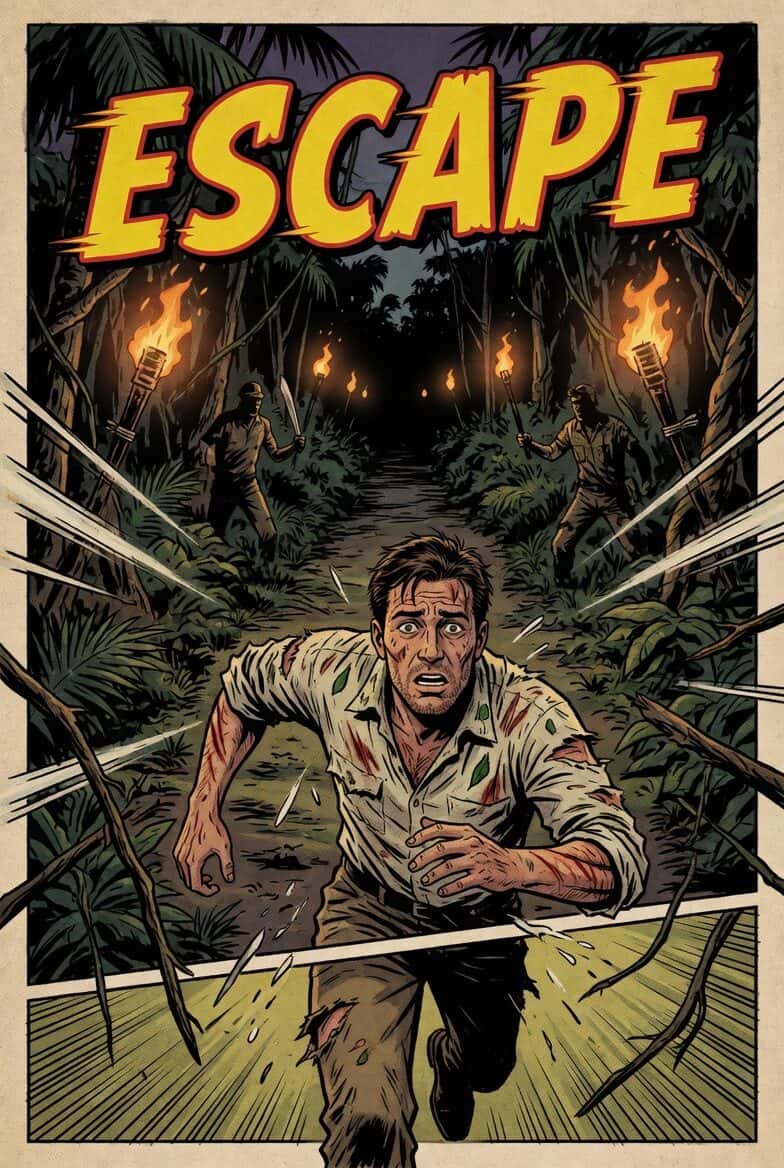
You are lying helpless in a rude hut in the deep interior of China, not knowing how you got there or why. And before you, you see the face of a beautiful girl, and the hard, ruthless figure of a guerrilla chieftain. And you know that in this room, there is danger for you. Perhaps death. We offer you Escape, transcribed to free you from the four walls of today for a half hour of high adventure. Today, we escape to China, and the story of a man who lost his memory and almost his life. As James Norman told it in his fascinating story, He Who Rides the Tiger.
The figures and faces would come and go. Sometimes I seemed to be floating along with them through endless space, but more often I could feel myself lying on a hard bed and watching, not moving, with sick and fevered eyes. There was a big man with brown skin and close-cropped hair, and an older man with a white coat. But best of all was the girl, a beautiful girl. Usually, her face would dissolve into a great lotus flower that would hang for a moment in the air, and then float slowly beyond reach of my thoughts and disappear. Part of this was a dream, of course, and part reality, but I was unable to separate one from the other. How long it went on, it's impossible for me to say. I had no sense of the passage of time.
One morning, though, I opened my eyes and looked at the bare walls of the room, the white-haired man sitting by my cot, the other man sitting a few feet away smoking a cigarette, and then I knew that the dreams had gone away and would not come back. This was reality.
Feeling better? Can you hear me? Understand me? Huh?
Yes. Yes, of course.
Good. Glad you're finally coming out of it. You've been a very sick man, you know.
Where am I?
Uh, Fengyang Mission Hospital. We're about 600 miles south of Peiping.
That's impossible. How did I get here?
You walked in, dropped unconscious in the courtyard, burning up with fever and suffering from malnutrition.
Malnutrition? But I ate lunch yesterday in Peiping.
I'm afraid I'll have to contradict you. You've been here for two months.
I don't understand. Doctor, I wonder if I could ask you... Can I ask your patient a question?
Why, yes. Yes, of course.
It's simply this. What is your name?
Why, it's Armour. David Armour.
Ah, yes. So you told us while you were delirious, but we could not be sure. And your business in Peiping, Mr. Armour?
I'm a member of the International Committee on Chinese Art Treasures. We've been investigating the policy of the advancing Japanese armies toward protecting and preserving art objects in newly conquered territories.
I see. And yesterday, you ate lunch in Peiping.
Yes. At the Wagons-Lits Hotel. I dropped my wife off at the... Adrian, where is she? Where's my wife?
Mrs. Armour is in San Francisco at present.
San Francisco? Well, why should... What's this all about? Who are you and what am I doing here? Why have I...
Mr. Armour, please. Mr. Kinto, I think any further questioning had better be postponed until tomorrow. Mr. Armour is in no condition for it.
I quite agree with you, Doctor. Very well, Mr. Armour. Until tomorrow, then.
Doctor, I don't understand. Who is this Mr. Kinto? What does he want?
Well, he's a powerful man among the Chinese. He's been following your condition very closely. I don't know what he wants.
If I could only remember what happened. I've got to send word to my wife, to Adrian, to the American consul. My wallet, my passport and papers. Do you have them?
Oh, Mr. Armour, when you arrived here, you were wearing a cast-off uniform of the Japanese army.
What?
You had no papers or identification. There was nothing in your pockets except... This. I haven't told Mr. Kinto about it.
It's a little porcelain figurine. A rabbit.
Yes, a rabbit. Does it mean anything to you?
No, I never saw it before in my life.
That's too bad. I was hoping it might help you remember. The last thing I remember is that lunch in Peiping. Seems like yesterday, and yet you told me it was two months ago.
Oh, no, no. I said that you came here two months ago. What was the date of that luncheon, Mr. Armour?
It was September 23rd.
23rd?
Yes.
Of what year?
1941, of course. What do you mean? What are you driving at?
Mr. Armour, apparently the last thing you remember is the lunch that you had in Peiping nearly eight years ago.
I understand the doctor has brought you more or less up to date, Mr. Armour.
Well, in a general way, yes. He told me about Pearl Harbor and the war and finally the Japanese surrender and the revolution in China and so on. Hasn't helped any as far as my memory is concerned, though.
It's too bad. Let me extend that memory by about 20 minutes.
What do you mean?
On September 23rd, 1941, you ate lunch at the Wagons-Lits Hotel in Peiping with a Mr. Ficking, the Far East correspondent for an American newspaper.
Yes, I know that.
You left the hotel with Mr. Ficking and engaged a rickshaw, naturally. Two blocks away, it was bumped by a Japanese army truck and overturned. You were thrown out and struck your head on a curbing.
But I don't understand.
Your companion became embroiled in an argument with the truck driver and a crowd gathered. And when the affair quieted down, you had disappeared. From that time until your appearance here at Fengyang two months ago, your whereabouts are unknown.
But how did you find out about this?
That is unimportant. I am concerned with what you did after that. A war was being fought in China. The whole country was under martial law by one side or the other. Yet, uh, I can find no record of you. What are you getting at?
You were not with the American or Chinese armies. And neither the Japanese army nor the puppet government list you as a war prisoner. You were not with the Chinese guerrillas. I was one of their leaders. I would have known about that. So, what were you doing, Mr. Armour? Collaborating, perhaps? With the Japanese? There would be no listing of your name in that case. They destroyed all such records before the surrender. And you were wearing a Japanese uniform when you came here.
You're right. You're mine.
Then suppose you tell me what you were doing.
I can't tell you. I don't remember. What do you want, anyway? What brought you into this?
Two simple words that mean a million dollars.
What?
Even when they are whispered by a man in delirium. Tang bronzes.
Tang bronzes? You've heard of them?
Yes, of course. The only two pieces in existence are in the Buckingham Palace collection in London. But what have they got to do?
No, no. Not those, Mr. Armour. I'm referring to the four Tang bronzes.
They are in existence, in China. Well, they've been lost for centuries.
Oh, no. A few Chinese in every generation have always known where they were. We were forced to move them for safekeeping several times during the war. The last time was a few days before the surrender. My men in charge of the job were ambushed and murdered. And the bronzes were stolen by whom I've not been able to discover.
Are you implying that I have...
I learned they were being taken to Shanghai. I traced them past Nanking and lost the trace. But they did not reach Shanghai. Of that I'm certain.
So? Why do I come in?
Well, from things you've said in delirium, I believe you have seen and touched those bronzes. Perhaps even you know where they are. If you could remember. I want them back. You want your memory back. Isn't it good to lose eight years with no accounting for one's actions?
Just what are you suggesting?
I suggest that I settle all suspicion by a public statement that you are a member incognito of my guerrilla force. During the entire war. Then the two of us will start from Shanghai and work toward Nanking. Hoping that some scene or association may serve as a key to unlock your memory. When that happens, we both have what we want.
I see. Well, there's only one thing wrong with it. I'm not going to do it.
What are your plans then, Mr. Armour?
The doctor says I'll be able to travel by the end of the week. I'm going to take a train to Shanghai and hop the first plane out to San Francisco.
Oh. I'm afraid you're making a serious mistake. But, of course, it's every man's privilege. At least, I hope you'll carry this with you on your trip.
Pistol? What for?
Because somewhere there is a person who may not stop at anything to make sure you do not regain your memory at some inconvenient moment. Had you forgotten about that, Mr. Armour?
Most of the long train trip to Shanghai was uneventful. I still carried the gun, mostly because I didn't know what else to do with it. But I had only one idea in mind, to get home to San Francisco and to Adrian just as soon as possible. At Nanking, the papers that came on board were carrying the story of my wartime association with Kinto's guerrilla forces. Apparently, he'd gone ahead on his own with that part of his plan. From Nanking on, I could hear the other passengers discussing me amongst themselves. And when some 50 miles out of Shanghai, a fat, smiling little Chinese merchant named Mr. Chen sat down in my compartment and began to chatter away about my heroism.
It's most remarkable, Mr. Armour, most amazing, that one who served our country in such a glorious way is not able to remember a single one of the illustrious exploits.
Well, as I told you, Mr. Chen, I was injured nearly eight years ago. I've been suffering from amnesia. It was only last week that my memory came back to me.
Oh, yes, it's too shame. And nothing, not one single hour of eight years can be remembered.
No, all that I know is what Mr. Kinto tells me.
It's true, whatever Mr. Kinto say is a muchly important man, very great leader, a very powerful fighter.
Yes, yes, he is. You know where is Mr. Kinto now?
No, he left Fengyang three days ago. I think he went to Peiping.
Oh, yes. And your honorable intention, Mr. Armour, they are what?
To get a plane to San Francisco, just as soon as possible.
Oh, it's most excellent plan. Shanghai, very troubled city, very unsettled. Would cause great lamentation in land if accident happened to illustrious hero of our country.
Accident?
Well, who can tell the ways of fate? In city like Shanghai, many accident can happen, even to brave fighter with loaded pistol and coat pocket. It's much better. You go away on plane very quickly, Mr. Armour.
In Shanghai, I took a taxi to the Cathay Hotel. When I started to check in, I got the first of several surprises. The clerk told me that I had a room already reserved and paid for by whom he didn't know. At any rate, it was a nice room, one of the best in the house. Picked up the telephone, called the American consul. Then I started the hotel clerk working on an airline reservation. Sent my clothes out to be clean, climbed into a shower. And by the time I'd finished, a boy knocked on my door with an envelope. I opened it, took out the note. Humble token of appreciation for illustrious wartime services, Mr. Chen. Attached to the note was a plane ticket to San Francisco and a seat reservation for noon the next day.
I should have expected the second note delivered 15 minutes later, but I didn't. It read, Please do me the honor of joining me in the American bar downstairs at your convenience. Signed, Kinto.
But of course, it was I who reserved the room, Mr. Armour. I knew you were planning to stay here at the Cathay, and I was only too happy to assist you with a small favor.
It won't do you any good, Mr. Kinto. I told you at Fengyang I'm going home right away.
Hasty decisions are often reconsidered. Anyway, I think you may have helped some already.
Oh? In what way?
You were approached on the train by Mr. Chen, who urged you, if I am correctly informed, to leave Shanghai at once.
He did more than that. He arranged for a reservation on tomorrow's plane.
Well, Mr. Chen becomes more interesting by the minute. And did you know that he also arranged to have you followed from the railroad station?
I don't care. I'm not interested in your game, his game, if he has one, or anybody else's.
I'm flying to San Francisco tomorrow.
What a pity. And without knowing a thing about a period of your life that covers nearly eight years. Well, whatever it was, it's over and done.
What's wrong, Mr. Armand?
That girl who just came in. The one who walked past our table.
Oh, yes. What about her? Do you know her?
I only wish I did. She's beautiful, isn't she? Can you find out who she is?
Of course. Although for a man so anxiously hurrying home to his wife. Waiter.
I sat there with my mind spinning madly while the waiter took the folded bill Kento handed him and went over to ask discreet questions. I was certain the girl had looked at me strangely as she passed the table. Even now she glanced back from the bar before moving on through the room and out the door. To the best of my knowledge, I'd never seen her before in my life. And yet, the face I'd dreamed of so often in my delirium had been the face of this girl.
This lady live here on hotel. It's known by name Etual.
Etual, huh? Uh-huh. All right. Thank you, boy.
Etual. Was she by any chance who you thought she was?
Um, no. No, I was wrong. I mistook her for someone else entirely.
I see. Merely a case of mistaken identity, hmm?
Yes.
That's very interesting. And you have this note.
What?
The waiter slipped this into my hand when he came back. It's addressed to, uh, Mr. Armour. So it isn't mine. But I don't... Why not open it and read it? Now, I for one am quite interested in finding out what a complete stranger has to say to you.
While Kento stared at me thoughtfully through the smoke from his cigarette, I unfolded the paper and read the hastily written lines and then crumpled it and thrust it into my pocket without showing it to him. The words danced in my brain. "My dearest David, why would you not speak to me when I came to your table? Have you forgotten me? Do the six years we spent together mean nothing to you? Please come to me at once. As always, your adoring wife."
Kento probed skillfully trying to discover the contents of the note Etual had sent me. But I had no intention of telling him. I left him still sitting there at the table and went to the lobby. I talked briefly with the room clerk and with the antique dealer who kept a shop in the foyer. Ten minutes later, I stepped into an elevator and rode up to the seventh floor. And an hour after I'd seen Etual in the bar, I was facing her again through the open doorway of her room. Her dark hair lay softly on her shoulders. Her skin was velvet and warm cream. The subtle scent of an amaryllis perfume hung in the air like a tender challenge. She was lovely. She was supposed to be my wife. Couldn't remember her.
David, my darling, won't you please come in?
Thank you. I, uh, suppose you're Etual?
Well, of course, David. And you did send me a note downstairs in the bar.
But who else, my dear? I... It's the old trouble again, isn't it?
Trouble?
The sickness of forgetfulness, my doctor called it. So often you suffered from it at Suchao, weeks at a time.
Suchao?
Yes. Suchao? Don't you remember Willow House? The beautiful estate that Uncle Liu gave us when we were... Oh, that's why you did not speak to me in the bar. You've forgotten all of it. Even me.
Yes, I... I'm afraid you'll have to bear with me. Etual, I don't mean to hurt you, but...
Oh, it doesn't matter, my darling. I... I understand. I've been so terribly worried since you ran away from Suchao four months ago. But now we're back together and... Everything is all right again.
Etual, tell me, when was it we were married?
In the month of December 1941. See, I... I carry the paper with me always.
Yes. We were married in the Chinese manner by Uncle Wang. And then Uncle Liu gave us Willow House. And we lived there all through the war?
Well, why weren't we bothered? I mean, by the Japanese.
Uncle Wang was very important in the puppet government. He was mayor of Suchao, before the guerrillas shot him.
I see. Why not come with me to Suchao tomorrow, David? Perhaps... Perhaps when you see Willow House again, you'll remember.
All right. Uh, suppose we leave around noon?
Any time you say.
Good, then I'll arrange to hire a car. Uh, there is one thing, David. I think it is better you know now instead of remembering later.
Oh? What's that?
Uh, your job during the war. Uh, Uncle Wang arranged it for you.
Well?
Uh, you translated captured American documents for the Japanese army. You didn't realize what you were doing, and we had to live.
I'm sorry, Etual. I'd better get out of here. I'll call for you tomorrow.
David! Even though you can't remember me yet as your wife, could you not at least kiss me goodnight?
Well, of course. Until noon tomorrow, darling. Good night.
Good night.
Early the next morning, I climbed into a hired car and headed out of Shanghai. Etual was not with me. I had to face this for the first time alone. I felt I was heading into a showdown. Etual's story was backed up by something else I'd learned the night before. The antique dealer at the hotel had told me he wasn't sure of the significance of the little porcelain rabbit the doctor at Feng Yang had turned over to me, but he was certain that it had come from Su Chao. A servant let me in to the Willow House. And he left me alone in a large room furnished sparsely in the Chinese manner. I wandered about idly, still finding nothing that said to me, you've been here before. Until suddenly I came face to face with a crude poster looking very much out of place against the dainty lacquer screen. It was an offer of reward issued by the Japanese army during the war. The photograph on the poster was blurred beyond all likeness, but the wording was clear enough. Fifty thousand dollars, dead or alive, for the guerrilla general, Hermenegildo Kento.
It makes rather an interesting souvenir, don't you think so, Mr. Armour? No? Do not draw the gun, you're covered, as they say. Well, welcome to my humble abode, Mr. Kento, or is it the other way around?
Neither, as a matter of fact. Willow House was an undercover guerrilla headquarters in this area during the war.
And this whole business of being married and so on was another of your ideas? Is that right?
I'm afraid so, Mr. Armour. Etual was a very capable operator, a guerrilla colonel, as a matter of fact. You were never married.
Come on in, Louis.
All right, you've fooled me into coming up here to suit your purposes, but what good's it going to do? Can't tell you any more now than I could have in Shanghai.
Perhaps not, but my little scheme also involves a certain Mr. Chen. If he has not followed you here already, I believe he will do so soon.
Then you're putting your money on Chen as the man who stole the Tang bronzes. Is that it?
His insistence that you leave China seems to me suspicious. I intend to question him.
Couldn't you have done it in Shanghai?
Not with his greater freedom. My questioning is always thorough.
Well, that's your business. As far as I'm concerned, I'm heading back to Shanghai right now.
I'm afraid that's impossible. Etual has already taken the liberty of paying off your chauffeur.
Etual?
Hmm? She rode up here with you under a blanket in the back seat. She's quite resourceful.
Now look here, if you think for one minute...
Please, Mr. Armour. There is an old Chinese proverb which says, he who rides the tiger finds it easier to get on than to get off.
Louis, I think you'd better get the gun from our hot-headed friend.
Your most excellent, Mr. Armour's suggestion is in this pocket, I believe. Ah, yes. Thank you, Mr. Armour. And look, General Kento. He has been collecting souvenirs. One of the little porcelain rabbits, huh? Etual didn't tell me you had stopped in Suchao to go shopping.
I didn't. I had that figurine with me when I stumbled into Feng Yang Mission.
What?
The doctor gave it back to me. Why did you not tell me these little figurines come from a temple right here in Suchao? They're given out to pilgrims during the annual festival. Mr. Armour, does the name Meiren Pagoda, Temple of the Moon, mean anything to you?
No. Meiren, Temple of the Moon? Wait. Yes, yes. It's coming back to me. And Mr. Chen, too. And the Tang bronzes. I remember now, Kento. I can remember.
It's much unfortunate that you can't, Mr. Armour.
Mr. Chen.
The gun General Kento dropped at once. Other one also.
So, Mr. Armour, lost memory has returned.
Yes. Yes, I only saw you a few times during the seven years. That's why I didn't recognize you. You were the abbot in the Temple of the Moon.
After previous abbot was disposed of early in 1942. Our temple served as excellent headquarters for operation of this lonely one. Also, very amusing, location being so near to your headquarters, General Kento.
I don't understand, then, that you were a collaborator.
Quite so. Among other things, of course, even Kung Fu Tse say men must live.
Yes, yes. I wandered here to the temple after that accident in Shanghai. The old abbot took me in without question and I became one of the brothers. I had no memory at all. It was out of my mind half the time. They called me the forgetful one.
What about the Tang bronzes, Mr. Armour?
Well, one night I couldn't sleep. I wandered onto the balcony of the great hall of the temple. Chen was there with some other men who were showing him the four bronzes they'd just brought in. I had a vague feeling that they were very important. I guess that's why I raved about them later at Feng Yang Hospital.
Mr. Armour, you know what was done with the bronzes after you saw them?
Yes, they were buried that same night under the tiles beside the seventh pool in the temple courtyard.
Mr. Chen, are they still there?
Oh, but of course. And in a matter of moments you may tell location to ancestors.
Mr. Chen, by your own admissions added to things of which I know already, you're apparently guilty of collaboration, theft, a number of murders and various high crimes against China. Have you anything to say in your defense?
Only to confess freely a much less satisfying feeling when confessors hold a gun in hand.
Then I find you guilty and the case is closed.
Oh, it's most amusing, General Kento. Colonel Etual, you will carry out the sentence of the court.
As you say, General.
Excellent shooting, Colonel Etual.
Oh, not at all. The range was nearly point blank. Man should be designed with eyes in back of head. Man should not try to ride the tiger.
This lowly man won muchly favored by having such beautiful executioner. Thank you, little Chen.
Mr. Armour, you have met Etual before under a false impression. May I now present her as my wife?
Your wife? Well, last night I thought she was my wife.
Yes, such are the remarkable ways of fate. You didn't mind it, did you, David?
Colonel Etual.
Oh, my Hermenegildo. But come, we must round up the men and enter the temple as quickly as possible. We cannot afford to lose the bronzes now.
You're quite right. You take care of the late lamented, Mr. Chen. Come at once.
You have served well, Mr. Armour. My advice to you now, go to San Francisco at once to your wife, your own wife. Adios.
Come and see us, David, when we are the rulers of China. Au revoir.
I stood there and watched her go, swinging along beside him and my love. She was kind and graceful and a sudden sharp feeling of loneliness came over me. Then the moment passed and I smiled at myself. She was only a part of all this, these stirring and exciting events. Nothing more. In San Francisco, the wife whom I loved was waiting for me. Adrienne, too, was a very beautiful woman.
Escape is produced and directed by Norman MacDonnell. Today, we have presented transcribed He Who Rides the Tiger by James Norman. Adapted for radio by Les Crutchfield with editorial supervision by John Dunkel. Starred as David Armour was Bill Conrad with Barry Kroeger as General Kento. Featured in the cast were Maria Palmer, Jack Kruschen, Ben Wright, and Edgar Barrier.
Escape has come to you through the worldwide facilities of the United States Armed Forces Radio and Television Service.