
The written record
Read the transcript
Read along with the recording · About 25 min to read
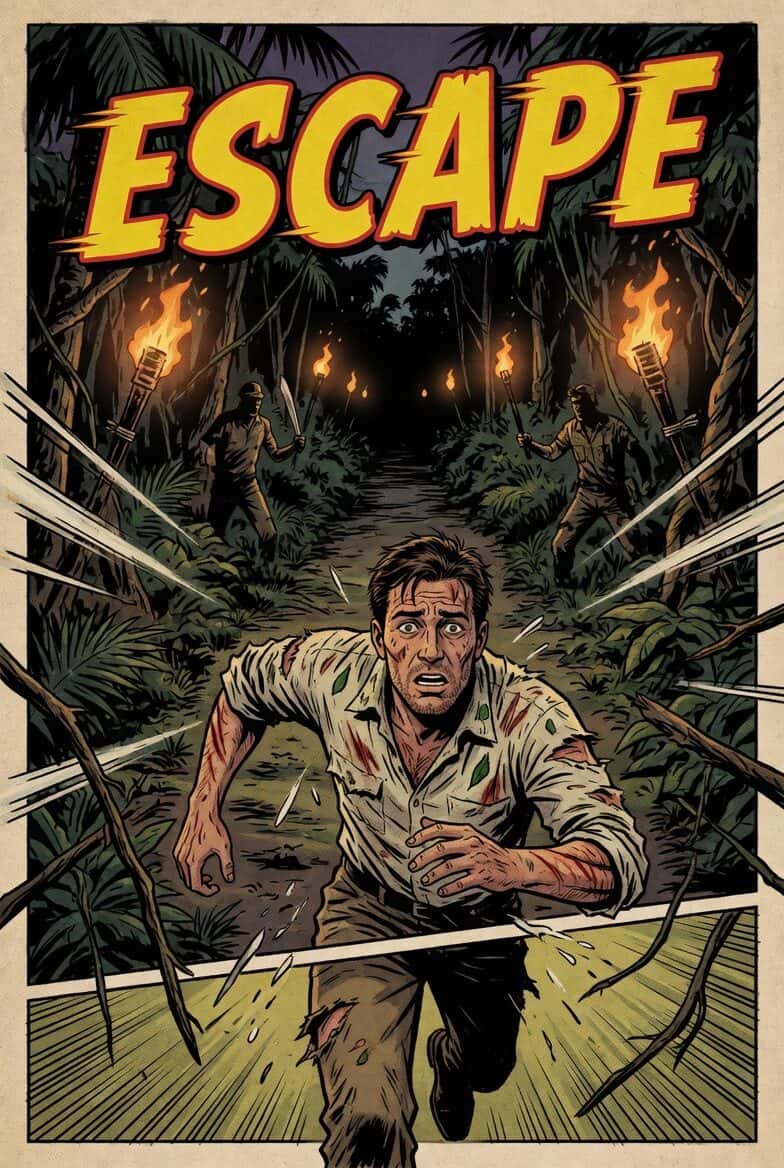
Tired of the everyday routine? Ever dream of a life of romantic adventure? Want to get away from it all? We offer you Escape! Escape! Designed to free you from the four walls of today for a half hour of high adventure.
We escape to the coast of Flanders in October 1914, into the story of a man chosen by a strange destiny to win the First World War. As Robert Buckner tells it in his classic tale, The Man Who Won the War.
Gentlemen, I have asked this board to meet by the authority vested in me as chairman. Chairman of the Naval Committee of the House of Commons. A great wrong has been done, gentlemen, and I have been asked by my colleagues of the House to see if it cannot be righted. An English naval officer was found guilty of treason by this board ten years ago. I have asked you gentlemen to meet and reconsider his case. I ask you to remove the stigma from the name of a man whom I consider to be one of England's greatest heroes. I refer to Commander Edward Bradman.
Now, see here, Mr. Ordway.
Yes, Admiral. I am compelled to say, Mr. Ordway, that it is a waste of the Admiralty's time and a sorry commentary upon the times in which we live when the Royal Navy is brought to heel by a parliamentary committee.
Hear, hear.
Bradman had a thoroughly fair court-martial. No single piece of evidence came to light to substantiate his fantastic story. There is no record of his action in the Belgian War Office. There is not a single witness to his weird adventure upon the Flanders beach that night. October 1914. Why, dammit, man. The Royal Navy itself tried to find the evidence, but we couldn't. And why couldn't we? Because it does not exist.
I have evidence, gentlemen. New evidence. That is why you have been asked to meet. And, um, as for the Navy's attempt to clear Bradman's name, I would like you to meet a young man and listen a moment to him. Edward. Edward, would you kindly tell the gentleman your name?
I'm Edward Bradman III.
How old are you, Edward?
Thirteen years and six months.
Who is your father, Edward?
Commander Edward Bradman, sir.
And your grandfather, who was he?
Admiral Edward Bradman.
And your great-grandfather?
Lieutenant Edward Bradman, sir. He was killed in action aboard the Victory at Trafalgar.
And you, Edward, what do you wish to become?
A midshipman, sir.
I shouldn't be surprised. And have you made application?
Yes, sir. At the Royal Naval College at Dartmouth.
And were you accepted?
No, sir.
Why not?
They... They said there was no place in... in the Royal Navy for... for traitors or their sons.
Well, gentlemen...
This is scarcely added proof. And I must censure you, Mr. Ordway, for bringing this lad in here wrapped in the Union Jack, so to speak, subjecting him to such an ordeal, a disgraceful cheap show.
Admiral, I am not on trial here. The Royal Navy is. You want added proof of Commander Bradman's innocence, you shall have it. Here. Here is a letter from the Commander, brought to me three days ago by the gentleman sitting here beside me. Commander Bradman is lying ill at Newport across the Channel in Belgium. Seriously ill of a tropical fever he contracted during those years when he fled the disapproval of Navy men throughout the Empire. This may be the last word you will ever hear from Commander Bradman, gentlemen. I charge you, listen carefully. It is dated October 24th. October 24th. October 24th. Oh, Berge de Dermatlo, Newport, Belgium, gentlemen. It is ten years ago tonight that I first set foot upon this Flemish beach. I have returned here tonight under a sort of compulsion, like a criminal returning to the scene of his crime. But I am no criminal, and what I did here ten years ago was no crime. I am tired of saying it and of being disbelieved. I am tired and I am ill. I shall not make this... I shall not make this statement again. I make it this last time at the encouragement of the man who brings it to you, the proprietor of this little inn, and the one man in the world who has ever believed my story.
When the war began, I was placed in command of the destroyer Firebreak attached to Admiral Hood's battle force on North Sea Patrol. On the night of October 28th, 1914, the Firebreak was cruising up the Belgian coast to join the main fleet. We'd taken aboard some extra shells and ammunition at Plymouth, along with several... cases of Scotch whisky. Since the fleet was looking forward to extended action. And I'm afraid those cases were uppermost in our mind that night as we sat around the wardroom after dinner.
I say, Commander, what brand of whisky did ship suppliers put aboard?
Oh, I don't know. Johnny Walker, I dare say.
I don't believe so, sir. Cameron Highlander, I think it said on the boxes.
Oh, come now, Mr. Ainslie. They always supply us with Johnny Walker black label.
Johnny Walker, Cameron Highlander, or essence of the Loch Ness Sea Serpent, so long as there's whisky aboard.
Now, that, um, wouldn't be a hint, would it, Mr. Gilliam?
Oh, no, sir. But it is nippy on deck tonight. Do you concur, Mr. Ainslie?
Oh, yes, indeed, sir. The wind's got a bite to it. Man could catch himself a nasty cold out there tonight.
Very well, you scoundrels. Hop out.
Aye, sir. Go down to the storeroom and break out a bottle of that whisky we took aboard this afternoon.
Aye, sir.
Anything new on the fighting in Flanders, Commander?
What there is, is all bad. General Haig has his hands full in the center. On the right, the French are just barely holding. But the real danger is right up there, to our starboard.
How's that, sir?
The left flank, the Belgian sector. Von Kluck's Third Army is pressing hard. If he breaks through the Belgian line, you can write off France.
I don't understand, sir.
Well, if the Belgians don't hold, Von Kluck will cut off the Channel ports, Calais, Boulogne, and Le Havre. There's nothing to stop him until he reaches the Atlantic. And that will also cut off our supply line to our troops.
Precisely. It's the Clausewitz strategy for the conquest of Western Europe. Paris would be bypassed and caught between giant pincers to be taken later at the Kaiser's leisure.
Thank you, pardon, sir.
Ah, here's Hopper with our wee drop.
Yes, well, you needn't have brought the whole case, Hopper. I wanted you to see it, sir. I've opened four of them, and the contents are all the same. You see, I was right. It says Cameron Highlander on the box. Yes, sir. But the contents are not Cameron Highlander whiskey. They're Cameron Highlander uniforms.
What?
Yes, sir. See here? The kilts, the Glengarrys, the sporrans.
But where's the whiskey?
Well, near as I can make out, there ain't any, sir.
What's that?
But I'd say them boxes contain nearly 200 Scotch Highlander uniforms.
Oh, well, I'm afraid that this will be a dry voyage, gentlemen. How could they have made such a stupid mistake?
Oh, blame it on the war.
Well, I just hope that our shells don't turn out to be coffee canisters.
What shall I do with these boxes, sir?
Oh, throw them out of the way until we make port again, Hopper. Meantime, I dare say there are some poor Scotch beggars somewhere in France who'll have to do without their old clothes a little while longer.
Well, there's the speaking tube, sir.
Bridge here.
Bridge here.
Bridge.
Oh, acknowledge, will you please, Mr. Gilliam?
Yes, sir.
What kind of trouble do you suppose Twiddle's run into?
Are you coming along, Ainslie?
Oh, might as well. Can't drink kilts and Glengarrys.
Freshening up a bit.
Yes, you'll be on a beam ends before morning.
Yes, Mr. Twiddle?
I thought you ought to see this, sir.
What?
Look out there on our starboard quarter. A tiny light.
Oh, yes, I see it. Here, take a look through the night glasses.
Oh, flashing on and off.
According to my reckoning, we're off the mouth of the Yser River. Now, if you look at this chart, you'll see that there are no lighthouses along this stretch of coast. Yet there's a flashing light where no light ought to be.
Perhaps it's a signal of some sort, sir.
Yes, undoubtedly, but whose? Germans can't have gotten this far.
How can you be sure, Mr. Ainslie?
Now, wait a minute. That light's flashing a message in Morse code. G-R-O-G. G-R-O-G. G-R-O-G. G-R-O-G.
Watermaster.
Aye, sir.
Change course to 1-1-0.
Change course to 1-1-0.
Aye, sir.
What are you going to do, sir?
I'm going to take a closer look.
But, sir, this might be a trap.
Yes, it might. But don't you recognize the code word GROG, Mr. Tweddle?
No, sir.
You, um, you didn't serve in the Royal Navy as a midshipman, did you, Mr. Tweddle?
No, sir. My apprenticeship was in the merchant service.
Well, then, of course, GROG wouldn't mean anything to you.
I don't understand, sir.
Well, Mr. Tweddle, G-R-O-G is a midshipman's joke. It means good rum on goose tail.
I still don't understand, sir.
When is goose day?
That's the joke, Mr. Tweddle. Goose day never comes. They're juvenile, I admit, but fascinatingly esoteric when you're 14 years old.
But why would anybody be sending a midshipman's code word from the coast of Belgium in the middle of a war?
That, Mr. Ainslie, is what we're going in to find out. Be good enough to pick off a landing party, will you? Number two, power launch. We'll go ashore in ten minutes.
But what? But, Captain.
You have your orders, Mr. Ainslie.
Yes, sir.
You can't be serious, Captain.
I am, Mr. Tweddle. This might be a trap. We have no way of knowing whether the Germans have advanced beyond this point or not.
Yes. It might be a trap, or it might be some poor beggar trying to escape the advance. Well, it's well worth looking into. If they were sending a plain SOS, I might be suspicious, but the choice of that half-secret, snotty code word makes me think it's worth looking into.
But suppose it is a trap.
Mr. Tweddle, it would be somewhat the reverse of the classic rules of warfare for a land force, no matter how large, to attempt the capture of a naval vessel on the high seas.
Nevertheless, the enemy is devilishly clever.
Well, don't you worry, Mr. Tweddle. I'm not asking you to go ashore. I'm leading the landing party myself.
Well, it's not a matter of fear, sir. Naturally. But one of caution.
Yes, of course.
Half-speed ahead.
Half-speed ahead, sir.
The fleet orders clearly state...
I am quite aware of the contents of the fleet orders, Mr. Tweddle. And they state that elements of the Royal Navy are to give all possible aid and assistance to shore positions. They also limit such aid to ship-to-shore communication in severe...
That is very true, Mr. Tweddle. Then we'll stretch the limits of that portion of the order a little, shall we? Furthermore, we're under specific orders to rendezvous with the French flagship at dawn.
Then we may be a little late.
Sir, I protest that this is not the...
Mr. Tweddle! Apparently, things are different in the merchant service. But in His Majesty's fighting ships, an executive officer does not protest to his commander. You will heave to and drop anchor. Now, if I've not returned within an hour, you will proceed to the fleet rendezvous. Is that clear?
Yes, sir.
Carry on.
I'd say we're about a half-mile down the beach from the light now, sir.
Good. Swing her inshore.
Aye, sir.
That light is getting dimmer and dimmer.
Yes, it's probably only a pocket torch. Battery. It's burning out.
All right, men. Now then, listen to me. When we get to the beach, we'll spread out ten feet apart and proceed toward that light. Now, you'll keep well down and walk with the utmost quiet. If you encounter a sentry, you try to knock him out before he challenges you. Use your firearms only as a last resort. We are not here to get into a battle, only to investigate that light. Now, if we should be engaged by the enemy, I will fire three rapid shots as a signal to return to the boat. Hopper and Spurgeon will remain with the boat.
Oh. Hopper.
Yes, sir.
If we have to retreat in a hurry, you wait until the last possible moment before you shove off.
Yes, sir.
Any questions?
All clear, sir.
All right. Brace yourself, lads. We're coming into the surf.
Move. Over the side and hold your rifles high.
In just a moment, we will continue with the second act of Escape. But first, you'll be hearing double on the CBS Crosby show this Wednesday night. For Bing will be joined by Brother Bob, who soon comes back to CBS with his own show. They'll team up for a couple of swell duets, and Bing will solo with Chattanooga Shoeshine Boy and A Dream is a Wish Your Heart Makes. The Bing Crosby show is a regular Wednesday night feature on most of these same CBS stations. And now we return you to the second act of Escape.
You may imagine the fearful anxiety with which our little landing party hit the beach that October midnight in 1914. We had no way of knowing whether the coast was in Belgian or German hands. We did not know indeed whether we were being drawn into a German trap by the tiny light we had seen flashing out to sea. That tiny weakening light toward which we were now slowly advancing spread out across the beach, alert for any danger, watchful for enemy sentries or patrols.
And then, not a hundred yards from where we landed, we encountered a German sentry. He was asleep. Poor beggar. I suppose he imagined no one would be around the sand dunes in the middle of the night. And he was undoubtedly done in. He was sitting on a log. He'd taken off his boots to bury his aching feet in the cool sand. I'm afraid he wasn't a very fearful example of the German military machine that night. But with no trouble at all, Mr. Ainslie and I crept up on him and had him bound and gagged before he would fight away.
There we are. I don't think you'll raise too much of a hue and cry now, sir.
No, I should think not. Now, my friend, bleiben Sie ruhig und Ihnen wird nichts passieren.
We'll take him along, Mr. Ainslie.
Aye, sir.
You put on this fellow's spiked helmet and remain at his post. If a relief sentry appears, you take care of him. But no shooting unless absolutely necessary.
Yes, sir. Now, let's get cracking, men.
Hold up, sir. What's that?
I thought I heard voices.
All right, men. Halt. Ah, they're speaking French. Then they're allies. Still, we must make certain. You take two of the men and come up on them from the rear.
Yes, sir.
I'll approach from the side. Now, I'll do the talking. If it's a trap, I'll give the signal to fire. After one volley, you break for it and grind it with the launch.
Yes, sir.
Evan, Stanley, come with me.
Aye, sir.
Wilkins, Rodman, Knorr.
Aye, sir.
You follow me quietly. Keep your heads down.
Allô? Qu'est-ce qu'on fait, là? Qu'est-ce qu'on désire? Attention. C'est là, cette voie. À gauche. C'est cette voie. Silence. Il est là? Vos amis. Anglais. Grâce à Dieu. Approchez, s'il vous plaît.
What do you say?
It's said to approach.
Aye, the Belgians are French. Come along, men.
Bonsoir, messieurs.
Bonsoir, mon ami. Est-ce que vous parlez anglais?
Comment? Why, yes, I speak English a little.
Well, I dare say your English is better than my French. May I introduce myself? I'm Commander Bradman of His Majesty's ship, Firedrake.
I can't tell you how glad I am to meet you, Commander. And I am Major de Lesseps of the 3rd Belgian Dragoons. This is Lieutenant Chapotin.
Enchanté, enchanté, Monsieur le Commander.
And here's one of my company. I'm Lieutenant Ainslie.
Bonjour, Lieutenant.
Bonjour, Monsieur.
And who is this bound and gagged?
Oh, that's an enemy sentry we picked up on the way. You can have him.
Thank you. We saw your light from the ship. Whatever made you flash the word grog?
Well, I thought a Royal Navy man would respond more quickly to grog than S.O.S.
Ah, it's an inspiration. But where did you learn it?
Oh, I used to sail in the regattas at Cowes when I was younger. And one of my best friends was Albert Hollister. He was a midshipman in those days.
Oh, Bertie Hollister. Yes, I knew him well. He's a three-striper now, gunnery officer on the Repulse.
Yes. We can go into that another time. What was the reason for your signal, Major?
Simply this, Commander. We're in trouble, serious trouble. We've been pushed back day after day until our men are completely exhausted. Our orders are to make a stand here at the Yser River long enough to give the sappers time to blow the dikes. Once the dikes are broken, the river should stop the enemy.
For how long? How long will it take to blow the dikes?
We must hold the line until sundown, roughly 18 hours.
And you can't do that?
I seriously doubt it, Commander. We've appealed to General Haig for help, but he's completely engaged on our right and can't send us any reinforcements. The French are too far south, and they have their hands full, too. It was my suggestion at tonight's staff meeting to seek help from the sea. It's our last chance.
Well, what do you want us to do?
Stand by us. Bring your guns to bear on the enemy's advance.
But we're only a destroyer, Major. Our firepower is too low to do any good whatsoever, and we haven't the range for offshore bombardment.
Alas, then we are finished, and so is the war. There is nothing between Von Kluck and Paris but us.
I'm sorry, Major.
Uh-huh. They are starting the barrage early this morning. I suppose they know this is the last day.
Yes, I suppose... Oh, wait a minute. I've an idea. Mr. Ainslie.
Sir?
The kilts.
The kilts, sir?
Yes. We can put a company of Cameron... We can put a company of Cameron Highlanders into the Belgian lines.
I'm sorry, sir. I...
Major, Major, we can help you. It's a long, long shot, but it might work.
What might work, Commander?
Well, somebody made a botch back in Plymouth and loaded us with eight cases of Scotch uniforms instead of Scotch whiskey. There are nearly 200 complete uniforms of the First Cameron Highlanders aboard.
Yes, but I don't understand...
We'll give them to you, Major. You put them on a company of your men. Let them show themselves in the front line. When the attack begins this morning, perhaps... Perhaps the Germans will think the British have rushed in a crack division to reinforce...
Yes, yes, it might work. Yes. We can let you have a few Lewis guns, too. But they will not be much help unless the uniforms do the trick. It's, as you say, a long shot, but let's try it.
Very well. Mr. Ainslie?
Sir?
You go back to the ship at once, fetch those cases of uniforms and four cases of Lewis guns with ammunition.
Aye, sir.
I'll remain here with the Major and help him get his men lined up. Oh, and, uh, Ainslie.
Sir?
Uh, should Mr. Tweddle inquire, you might tell him I'll be, uh, detained a while longer, uh, winning the war.
Yes, sir.
It was a sight I shall never forget. Two hundred men solemnly changing their battle-dirty green uniforms for the gay kilts and tartans in the pale light of the setting moon. Everything was done with the utmost dispatch and in utter silence. And it seemed to me that the bright plaid put new energy as well as hope into the battle-weary Belgians.
They look like the real thing, don't they?
Yes, they certainly do. You know, I believe this will work.
Oh, I, I nearly forgot, sir. What is it?
Mr. Tweddle asked me to tell you the flagship's been trying to... to reach you by wireless.
Oh, what did they want?
Mr. Tweddle didn't say, sir.
Well, they'll have to wait until this business is finished.
Mr. Tweddle said he'd replied, sir.
Oh, very well, then. Well, that's the last of them.
A thousand thanks.
Oh, not at all. Scotch kilts are precious little use to a ship full of sailors. But they may do a turn for you this morning.
I feel sure they will. Well, we, uh, we must be on our way. Less than an hour until daybreak. Goodbye, Major.
Goodbye, Commander. Now, you, uh, you must look me up after the war. You always reach me at the Navy Club in St. James's Square.
Thank you, sir. I'll do that. Au revoir.
Au revoir, Major. A, uh, bon chance. That sort of thing.
Huh?
Well, Mr. Tweddle, I think we can get underway now.
Finished with your visit ashore, sir?
Scarcely a social call, Mr. Tweddle. I think we may have been of some help to our allies this morning.
Of course, sir. Oh, Captain, the flagship's been trying to reach you.
Yes, yes, Mr. Ainslie said something. I signaled him that you'd gone ashore.
Oh, you did? Well, that must have intrigued them.
Well, I shouldn't say they were pleased. I just received this reply from them.
Hmm?
As senior officer present aboard, you are ordered to take command of Fire Drake and proceed to fleet rendezvous immediately.
Well, that's a neat double cross, Mr. Tweddle.
I'm sorry, Mr. Bradman, but my responsibility is to the ship on which I serve.
Yes, yes, I can see it is. However, since you're once more aboard... Oh, no, Mr. Tweddle. You have your orders from the flag. Follow them.
Meddling rulebook sailor. His captious wireless message had made an unnecessary embarrassment for me. But I had no doubts that my explanation of the night's work would fully satisfy the admiral. So, let Mr. Tweddle have his little moment of triumphant command. I stood out on the starboard bridge wing as we pulled away from the Belgian coast. And through my binoculars, in the grey dawn, I thought I saw the flashing red and yellow of the Cameron plaids. And then, as the last day of the First Battle of Flanders began, as I expected, the admiral made a thorough investigation of the matter, and a few days later, I faced him in his quarters aboard the flagship.
Mr. Bradman, your little adventure of a few nights ago involved some very serious breaches of discipline. You disposed of war material without authorization. You left your ship without authorization. You deliberately violated the fleet orders regarding assistance to land forces.
And I managed to stop the German advance dead in its tracks, sir.
Mr. Bradman, we know that the German advance has been stopped. But it was stopped by opening the dikes of the Yser River, a plan which has been part of the Belgian and French grand strategy for years.
Sir, the dikes would never have been opened if the Belgian lines hadn't held that last day of the battle. And they were held because the Germans' attack was slowed down. And it was slowed down because the Germans thought the Belgians were reinforced by the First Cameron Highlanders.
Mr. Bradman, I have given your story the benefit of every doubt. I have even queried the Belgian general staff to try to substantiate it. I have their reply. They have no record of any unit being outfitted in Highlanders' uniforms.
But this wasn't a general staff matter, sir. It was on a regimental level.
I may say there is even some doubt on the part of the members of your crew whether or not the men who received the uniforms were Belgians.
What?
Yes, Mr. Tweddle says...
Mr. Tweddle, that meddling fool from the cargo ship...
That is enough, Mr. Bradman. It is the decision of the fleet inquiry board that you be relieved of your command, placed in irons, and be returned to Hull to face court-martial at the earliest possible moment.
The court-martial at Hull sustained the board of inquiry's decision and I spent the rest of the war in prison. Afterwards, naturally, I had to leave England and wherever I went. Cape Town, Vancouver, Singapore, Melbourne. Sooner or later, the story, their story, followed me. Sooner or later, some ex-Navy man would turn up who recognized me and I would have to move on. At last, I have come back to this Belgian beach where it all happened. And here I have found the one man who believes my story. He is the proprietor of this little inn where I now lie ill and too tired to fight any longer. It is too late now to worry about my reputation. But he has persuaded me to write this letter that my son may not have to bear the undeserved infamy which I have been forced to endure. And he has kindly offered to carry this message to any who may yet be interested in clearing the record of Edward Tweddle. And Bradman, Commander, Royal Navy.
That's all very well, Mr. Ordway. But there is not a single statement in that letter that has not been entered as evidence in Bradman's court-martial. There's no new proof.
There's nothing here...
Excuse me, Admiral. I wish to present to this board the bearer of Commander Bradman's letter, Mr. Wolfgang Bechtel.
Guten Tag, gentlemen.
You are the proprietor of the Auberge des Deux Matelots where Commander Bradman is now?
Yes, I am. But your accent — you are German, aren't you?
Yes. And how is it that you own an inn on the Belgian coast?
After the war, I could no longer bear to live in Germany in the midst of the misery that I had helped to cause. So I, too, like a criminal returning to the scene of his crime, went back to the beach at Nieuport. I have been there ever since.
This is all very interesting, but I don't see what it has to do...
Sir, bitte, please. I am the proof you have been asking for. I swear that every word of Commander Bradman's statement is truth. Commander Bradman is indeed the man who won the war. I know, because I am the man who lost the war. I was the sentry who fell asleep.
Midshipman Edward Bradman.
Yes, sir?
Advance three paces. Midshipman Bradman has come undone to the Royal Naval College. It is my honor, by order of His Most Gracious Majesty George V, to ask you to receive this Victoria Cross, awarded posthumously to your late father, Commander Edward Bradman, for gallantry and intrepidity beyond the line of duty, and to try to accept the unbelievable apologies of a belatedly grateful empire.
Escape is produced and directed by William N. Robson, and as tonight presented, The Man Who Won the War by Robert H. Buckner, dramatized for radio by Mr. Robson. Featured in the cast was Ben Wright as Commander Bradman. Also heard were John Dehner, Terry Kilburn, Joseph Kearns, Barton Yarborough, Jeff Corey, Ian Wolfe, Paul Frees, Charlie Lung, and John Hoyt. Special music was arranged and conducted by Del Castillo.
Next week... You are standing on the floor of the sea in the middle of the sunken city of Port Royal with its fabulous chests of treasure waiting to be hauled to the surface. But your life depends on the ship above you where the treachery of your partners has left you with no escape. Next week... Escape will be heard at a new time on Friday evening. Next week we escape with the story of a diver who discovered an entire city beneath the sea, Port Royal, an exciting tale suggested by Lieutenant Harry Reisberg's book, I Dive for Treasure. Goodbye then until a week from Friday when once again we offer you Escape. Now stay tuned for the adventures of Philip Marlowe which follow immediately over most of these same CBS stations. This is CBS, the Columbia Broadcasting System.