
The written record
Read the transcript
Read along with the recording · About 20 min to read
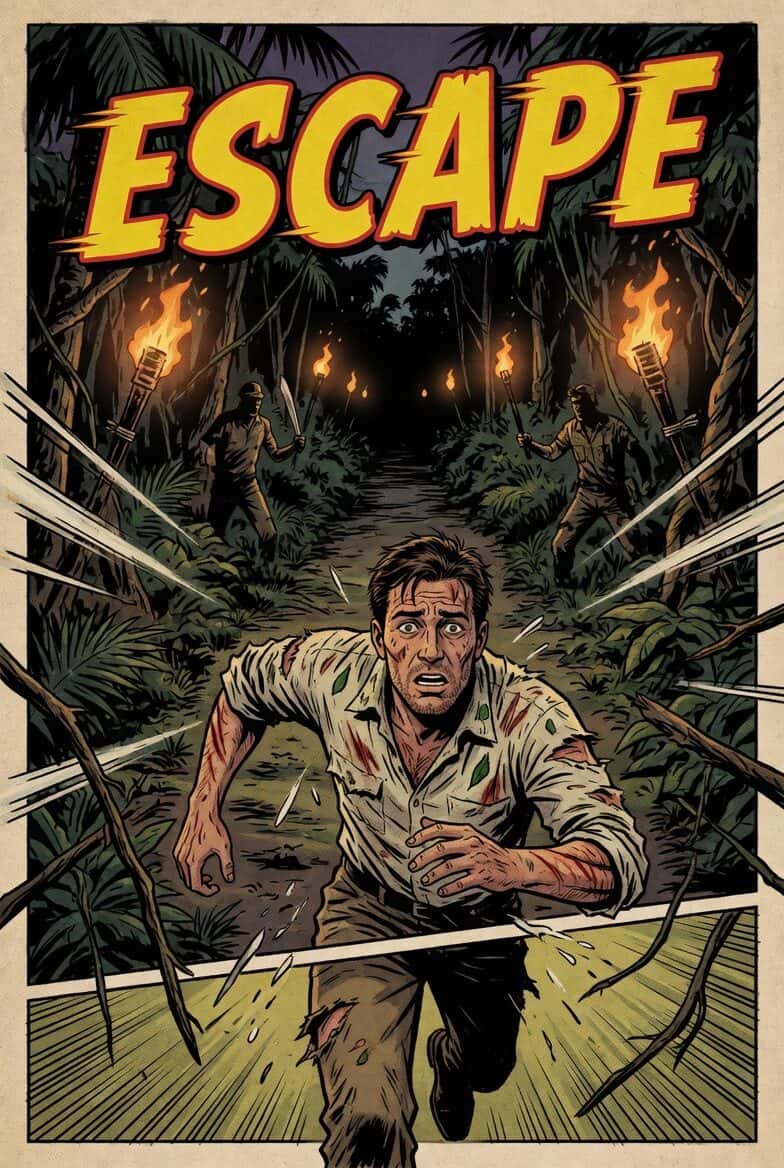
You, finding life rather dull, dreaming again of exotic places, wishing you were somewhere else, we offer you escape. Escape with us now to a small freighter in the China seas and a sinister traveler who brings destruction to crew and ship alike. As Ella St. Joseph tells it in his most unusual play, A Passenger to Bali.
The papers in my pocket read, steamship Roundabout, 9,000 tons, British registry, master and owner, Captain English. Stamped across the face was the clearance of port authority. I'd be glad to see the last of Shanghai, its smell and its waterfront filth. Cargoes had been scarce, now with our hold filled for the first time in months, I didn't want to waste time. I wanted to get underway before morning.
Mr. Slaughter.
Aye, Captain.
Would you step up here to the bridge, mister?
Aye, sir.
Are we ready to sail, mister?
All secure, sir.
All hands on board?
Aye, sir.
Good, let's clear port, Mr. Slaughter.
Yes, sir. Mr. Ingle, stand by the capstan.
Stand by.
Let go the stern spring line.
You there on the dock, heave that line forward. Forward, you lump of me.
Here, you can't board now.
But my good fellow, I am aboard. The ship is aboard. We're about to sail.
Who is it, Mr. Slaughter?
Oh, someone who insists he talk with you, sir.
Stay there. I'll be down.
Well, what is it?
Have I the honor of addressing Captain English of the Roundabout?
I am Captain English.
Allow me to introduce myself, Captain. I am the Reverend Walks, a missionary bound for Bali.
What can I do for you?
You can offer me your hand.
Come to your point, Mr. Walks. We're about to sail.
I am told your boat puts in at Budalong, the port of Bali. Is that correct?
Yes.
Good. Here, you will find my passport and papers of identification. If the papers and myself shall meet with your approval, we can settle the matter of money, and I shall sail with you tonight.
You've been misinformed, Mr. Walks. The Roundabout is a trading steamer. We've no accommodations for passengers.
You'll find I need little.
I'm sorry, but it's impossible. Good night, sir.
Name your price.
Hmm?
What's that?
A customary fare for two. The fare from Shanghai to Bali is $100. I'll double it.
Sorry.
Don't tell me there isn't room in your cash box for $200.
That's a lot of money, Mr. Walks.
Think of the reward for bringing grace to the pagan Balinese.
Let me see your papers.
Well, your passport seems to be in order. The photograph, new.
And the money, Captain English.
The money is also interesting. Interesting, is it not?
Where is your luggage, Mr. Walks?
On the dock. Two cases of Bibles.
I'll see to them. Mr. Slaughter, take Mr. Walks forward. And tell Mr. Rangel to get the luggage aboard.
Aye, sir.
Thank you, Captain English. You won't regret your choice. And now, if you'll just lead the way, Mr. Slaughter.
I watched him walk away, his monstrous bulk shadowing grotesquely in the foggy half-light on the pier. His great bull neck creasing into massive shoulders. His shaggy black hair, wild and unkempt. I didn't like this man, this missionary, strange in his ways and manners. Yet I found myself thinking that, after all, he was a man of God. Perhaps later I would come to understand him. The fog was thicker now. I shook myself free of the depression I felt.
Mr. Rangel.
Aye, Captain.
Prepare to cast off. We sail immediately.
It was the third night out of Shanghai when Mr. Slaughter brought the first trouble to my cabin.
A fan early after all, sir. Come on board in Shanghai.
Obviously, Mr. Slaughter. Come here, girl. I won't hurt you. Come here. What is your name, girl?
I don't think she understands English, sir. Probably Chinese from the looks of her.
I understand.
What are you doing aboard this steamer?
Must come on ship.
What do you mean, must come on ship? Why?
Must come.
Look here. Do you know what is done with stowaways?
Stow...
Yes, people who sneak on board a ship without paying.
I do not know.
There is no place to put her ashore, sir. Until we reach Bali.
No, and yet she can't have the run of the ship. We could lock her in the empty cabin, sir.
You forget Slaughter. There is no empty cabin now. Mr. Walks is in it.
Mr. Walk.
Mr. Walk. You know Mr. Walk's girl?
Oh, Mr. Walk.
Mr. Slaughter, would you ask Mr. Walks to step into my cabin, please?
Aye, sir. I'll order dinner.
Gentlemen, I couldn't help but hear my name being spoken. May I be of service to you, Captain?
I don't appreciate eavesdropping outside my cabin.
Eavesdropping? My dear Captain, you do me an injustice. I was merely passing by.
As you say, Mr. Walks. Mr. Walks, do you know this young girl? Have you ever seen her before?
What a charming child. What a delight. I'm sorry, Captain. I'm afraid I cannot help you. I have never seen her in my life.
Mr. Walk, you tell me now.
After all, Captain English, you could hardly expect a man like myself to know a girl from what must obviously be a... well, a sordid livelihood. I have never seen this girl before. She came aboard this boat to be with you.
Did she tell you so?
No, but it's obviously so. Even though I am dedicated as a missionary to aid and comfort the distressed, I do not feel obligated to lie merely to smooth the path for another's crime. This girl is obviously far beyond any spiritual help or material comfort that I could give her.
Ah, good, Captain. Girl, did you know this man in Shanghai?
Yes.
Did you know him well?
Very well. He was my...
Yes, very well.
Slaughter and I talked with the girl for a long while, but we could learn nothing further. After more questions, useless ones, I had the first mate take her forward, feed her and find her a bed. I would talk with Mr. Walks in the morning.
Slaughter and I were eating breakfast, and Mr. Walks came into the mess room. He sat down. His gigantic, obscene body overflowed from his chair across the table.
Good morning, gentlemen. I trust your nights were pleasant ones.
Mr. Walks, I want to talk with you about that girl.
A girl? Oh, yes, a tragedy, a tragedy.
I want you to tell me all you know about her. Then I'll decide what's to be done.
What's to be done? Captain, you're overstepping your bounds. This is God's work. Now...
What do you mean?
Oh, dear. Dear you, you haven't heard?
Heard what, Mr. Walks? What is there to hear?
About the girl, Mr. Slaughter, the poor, poor girl.
What of her?
It seems she met with an accident last night.
Accident?
Yes, at least so I presume. There is some small... There is some small evidence that she has left our ship now to ride in a mightier, more wonderful vessel. Perhaps even now she is riding across the heavens in a chariot of flaming gold.
What are you talking about?
The poor, demented girl sought succor in the depths of water about us.
What?
Her pitiful torn shawl lies amid the hawsers of the stern. She committed suicide sometime last night.
Well? Must I eat alone or will you gentlemen stay for a second cup of coffee?
In my own mind I knew what had happened and I'm sure Slaughter did. I felt certain Walks had killed her and thrown her overboard. But there was nothing I could do.
Four days later we dropped anchor in the harbor of Budalong. The ship's officers and I were anxious to get our cargo unloaded and to know that we were rid of Mr. Walks. I was in my cabin going through the routine of bills of lading and ship's papers when the port officer, Mr. Matzius, knew of the job and overcautious.
About your passenger, he is a missionary?
Yes, yes, he came aboard in Shanghai.
Captain, since there have been certain changes in Bali, we now have no need of such a person. This man's name is, is what?
Walks, the Reverend Mr. Walks.
You do not usually carry passengers, Captain?
No, no, we don't.
Could I speak with this man?
Yes, of course. Merely of formality.
Of course, I'll have the mess boy locate him, be only a minute.
Captain English.
Oh, I was looking for you, Mr. Walks. For you, the port officer would like to see me, I overheard. But first let me give you this.
Two hundred dollars, what's this for?
The use of a lifeboat.
What are you talking about?
A lifeboat, Captain, I need one to get ashore. You wouldn't have me swim.
The port officer wants to talk with you, come along.
Wait, Captain.
Walks, I am as anxious to have you off my boat as you are to leave. You can only go ashore in the proper way at the proper time. This is your last chance, yours as well as mine. Let me go ashore now and take the consequences. You'll search the four corners of the globe looking for this minute. Don't let it slip through your fingers, there's an eternity in it.
You!
Oh.
Captain English, this man is not a missionary. His name is not Walks. All Indonesia is close to him.
What?
You mean he can't land?
Oh, no, no, this is ridiculous, Mr. Matzius. This man doesn't belong to me. I refuse to be burdened with him.
You have no choice. He's on your ship. He belongs to you.
This man booked passage from Shanghai to Bali and I refuse to take him further.
I am sorry, Captain English. But this is not my concern. During the time you are in port, a police guard will be placed on this man. He will not be allowed out of his cabin. When you sail, he will sail with you.
Who is this man?
Call him a murderer, an anarchist, a revolutionary. It does not matter. During the recent trouble here, he fought on both sides and profiteered from both sides. As I said, Indonesia is close to him. Your papers are on order and stamped, Captain. Good day.
I warned you, Captain. You should have let me go. You should have let me go ashore in the lifeboat. For now, in the time ahead, you are going to see a great deal of your passenger to Bali. Yes, a great deal.
Escape under the direction of Norman MacDonald is bringing you Ella St. Joseph's great play, A Passenger to Bali.
It was the sixth week, 42 days before we had taken on a passenger in Shanghai bound for Bali. Three days after he boarded the ship, he had murdered a young girl, a stowaway. We all knew he had, but we could not prove it. Now we were anchored outside the harbor of Bangkok. I was in the deckhouse, and Mr. Slaughter rapped on the door.
Well, Captain, what's the news?
Bad, I'm afraid.
Walks hasn't been refused again.
Again?
Just as he was in Makassar and Lembang and Batavia. The same words, the same reasons as in Bali. In English, there was a fight in the fo'c'sle this morning. One of the men hurt bad, and it was because of Walks.
Who were the men?
Able Seaman Cowles and Duncan, sir.
Cowles and Duncan? They're friends.
Yes, sir, they were.
It's all Mr. Walks doing, sir. The three of them were arguing about something, and suddenly, like, the fight starts. Duncan was cut heavy in the chest. Walks just sat by.
Where is he now?
In the mess, sir. I'll be right back. Wait here.
Mr. Walks.
Mr. Walks!
Hmm?
Oh, Captain English, I didn't hear you come in. I was reading. The Bible, as a matter of fact. Did you want to speak with me?
I am told you are directly responsible for an injury sustained by a member of my crew.
Oh, yes, that tragic episode between Duncan and Cowles I'd almost forgotten.
I could have you put in irons.
For what reason? I did nothing. The men were discussing religion, and I was simply pointing out certain points to each. They went at each other with knives. Like children in the fever of the moment. Was there something else you wanted, Captain?
Mr. Walks, I...
Well?
No.
Walks had dismissed me. Dismissed me on my own ship. I had to get rid of this man. His personality was infecting us all. In the past month, he had come to order about the lesser members of the crew. He had his meals served whenever and wherever he wished. He drank liquor from my own locker. As I watched the harbour traffic of Bangkok, I knew there was only one thing to do.
Mr. Slaughter!
Aye, sir?
We will weigh anchor.
How do we ship our course, sir?
South-east by east, three-quarters south.
Aye, sir, south-east by... That's Shanghai, Captain.
Yes, Mr. Slaughter, that's Shanghai.
On the two weeks' return trip to Shanghai, I began to feel myself a stranger on my own ship.
The trim little China Seas freighter was becoming a floating prison, and the jailer was Mr. Walks. My Kanaka crew, emotional and superstitious, were in love with him. They worshipped him, worshipped his massive body and his liquor-fed eloquence. My deck officers and I could feel control slipping through our fingers, and we were powerless to do anything about it.
Then, finally, it was the last night. Tomorrow, we would anchor in Shanghai.
And so we're back to where we started from. But at least we'll be rid of him. I hope there's no slip-up this time.
There won't be. They won't, am I?
Yes, Shanghai is as anxious to capture him as every other port was to reject him. They won't risk his escape.
What's he done, Captain?
Walks has been mixed up in something foul, and every country he's touched. Heaven only knows what crimes he's committed. But shortly, we'll be free of him. Let's have a drink to that.
Don't mind, Captain. Get a new bottle out of the sideboard, will you?
Here are the keys, Major.
Good. Just put it here. And two glasses.
You should make it three glasses.
Well, gentlemen, surely you'll invite me to join you?
No, Mr. Walks. Will not.
Then I shall have to help myself.
I think I'd better get out on deck, Captain. He'll excuse me.
Wonderful, wonderful. Too bad poor Mr. Slaughter couldn't stay.
I'm glad you enjoy my whiskey.
You have good taste, Captain, good taste in everything. Whiskey, boats, the Roundabout is an ideal little steamer. You might almost say I've found a home here.
Are you packed, Mr. Walks? A comfortable cabin, good food, now that I've schooled your cook. A well-stocked liquor cabinet. Are you packed, Mr. Walks?
No. No, I am not packed.
You haven't much time. I will be anchored at Shanghai and you'll be taken away, my hope, to jail.
You could be wrong, Captain. It might turn out that I shall stay forever aboard your ship. Until eternity.
Walks, I've never liked you. Not since that first night when you came aboard in Shanghai. You're filthy. You're rotten, unclean. You're a murderer by your own influences.
This is no time for heated argument. Drink a toast with me, Captain.
You've gotten to the very core of this ship with your rottenness.
A toast, Captain.
You seduced the whole crew, the Kanaka deckhands, the mess boys. Every day they're becoming more slovenly, more lax.
Very well, I shall drink a toast myself. To the Roundabout, may the comforts I've come to enjoy be not lost too soon.
I'd sink my ship before I'd allow you to stay aboard her one day longer.
Perhaps Shanghai will present an answer to surprise us both.
When this ship leaves Shanghai, Mr. Walks, it will leave free of you. Now, good night, sir.
It was in the sweltering noon of the next day that Mr. Chisholm, the British consul at Shanghai, was seated in my cabin, a long drink in his thin hands.
Captain, the Chinese port authorities have told me of your predicament. I am to handle it in my own way, according to their instructions.
I don't understand.
Well, it's extremely simple. In every spot, every port, every town in which this man sets foot, some sort of trouble's broken out.
I know this, sir. I cannot be sure this man is responsible, but after all, the law of averages... Look, Mr. Chisholm, I want this man off my hands. How soon can you arrange this?
I'm afraid I didn't make myself clear. Shanghai does not want him. Neither does the British consulate.
But this man is a criminal.
Oh, Mr. Walks would certainly be arrested the moment he set foot on land, but he'll not be given that opportunity.
Now, look, Mr. Chisholm, you've got to take that man ashore.
Oh, I'm afraid your now famous passenger is a man without a country.
Am I expected to sail him around the world the rest of my days?
I'm sorry, Captain English. I'm sorry. You will depart at your earliest convenience. Good day, sir.
And so we sailed from Shanghai, the Roundabout and Mr. Walks. In the weeks that followed, a great shadow lay over the ship. Wrangle, the second mate, fell ill, stayed in his cabin. Slaughter began drinking even during his watches. The ship seemed to smell of evil. Mr. Walks became the real captain of the Roundabout.
Then, sweeping in from the edges of the China Sea, came an even more destructive power, typhoon.
The barometer had been falling for three days, and it was on the forenoon watch that the storm hit with its full impact. For seven hours, the Roundabout wallowed through the seething masses of water. Then an emergency call from the quartermaster brought me to the bridge.
I went into the wheelhouse.
The power unit and the rudder control has gone out.
Where's the mate?
Went out, sir. Trying to correct the trouble. We're on manual operation now, sir.
You'll need another man to help you. Get help.
But, sir, you can't take...
I can handle it till you get back. Hurry, man. If this thing gets out of control and starts spinning, the rudder will tear itself free in a matter of minutes. Now go on, man. Hurry.
Aye, sir.
With his steam-powered gears to help me, each wave that hit the shuddering ship made the great wheel come alive beneath my hands. I stood, feet braced against the wild pitching of the wind. The vessel, shoulders and arms straining to retain control. I tried to gauge the monstrous waves rushing toward us. Tried to ease the groaning ship through millions of tons of lashing water. My muscles pulled and ached as each grey-green monster hit. I could hear nothing over the scream of the storm. I turned, looking for the quartermaster. And in that second, it happened. I had been flung off the wheel like a marionette and now it spun free. Spinning one way and then the other with each roll of the ship. I tried to get to my feet. My leg was twisted under me.
Ship? What have you done to my ship?
Walks? Get a rope. Stop the wheel.
I'll stop it.
No, no, no. It will chop your hands off. Get a rope.
No time.
Get a rope, you fool. It'll kill you.
Walk. Stay away from it.
I'll stop it if I have to smash it.
You've done it. You've got the wheel on your back.
I've got more than the wheel. I've got the whole ocean on my back.
Can you hold it a minute longer, Walks? I'll help you.
Hold on until I get there.
Never mind, Captain. It will not be necessary.
What? What did you say?
The rudder has just snapped. I'm holding nothing.
The next morning the storm was gone. Gone as quickly as it had come. Replaced by a thick, yellow, clinging fog through which the Roundabout floated. Broken. Wrecked. Sinking. A wireless gone, half her crew dead. She might go in half an hour. It didn't last a week. But I had the safety of my crew to think about. My ship. I had given the order to abandon her.
Like rats, we leave the sinking ship. Leave room for me up forward. I have need to stretch my legs.
You won't be with us this trip, Mr. Walks.
My luggage is not aboard the lifeboat.
You're staying aboard the Roundabout. I've left you a sextant. There's plenty of food and liquor. Even enough for you.
I... I'm not going.
No, you're not going. The ship is yours now. Do with her what you want.
But that's murder. You're murdering me.
I've no idea how soon the ship will sink, or even if she will. You may be picked up today, or tomorrow, or you may float here for years.
Captain English, we...
Stay where you are. This gun can speak even above your voice, Walks. This is for the last time. Goodbye, Mr. Walks.
Wait, Captain. It's not man's province to judge. No creature under your wings shall be left to die.
Cast loose, Mr. Slaughter. Without mercy. Without compassion. Without...
All right, then. Row, you fools. Row. Even now you may not have seen the last of me. Row.
And so, I left the Roundabout. I left everything I owned. Everything except my freedom. The Roundabout grew dimmer in the fog. And the figure of a man, standing well forward in the bow of an empty ship, was the last thing I could see before the fog closed in on me.
Under the direction of Norman MacDonald, Escape has brought you A Passenger to Bali by Ella St. Joseph, especially adapted for radio by Mr. MacDonald. John Dehner was starred as Captain English, with Lou Merrill as the Reverend Mr. Walks. Featured in the cast were Lou Krugman, Michael Ann Barrett, Wilms Herbert, and Bruce Payne. The special music for Escape was composed and conducted by Ivan Ditmars.
Next week, escape with us to the Old West and the unusual story of a man who was a merciless professional killer, but who fought on the side of law, as Ernest Haycox tells it in his exciting story, Wild Jack Rhetted.
Stay tuned now for Make Believe Town, which follows immediately on most of these same CBS stations. This is Roy Rowan speaking. This is CBS, where you spend an hour with Frank Sinatra every Sunday afternoon on the Columbia Broadcasting System.