
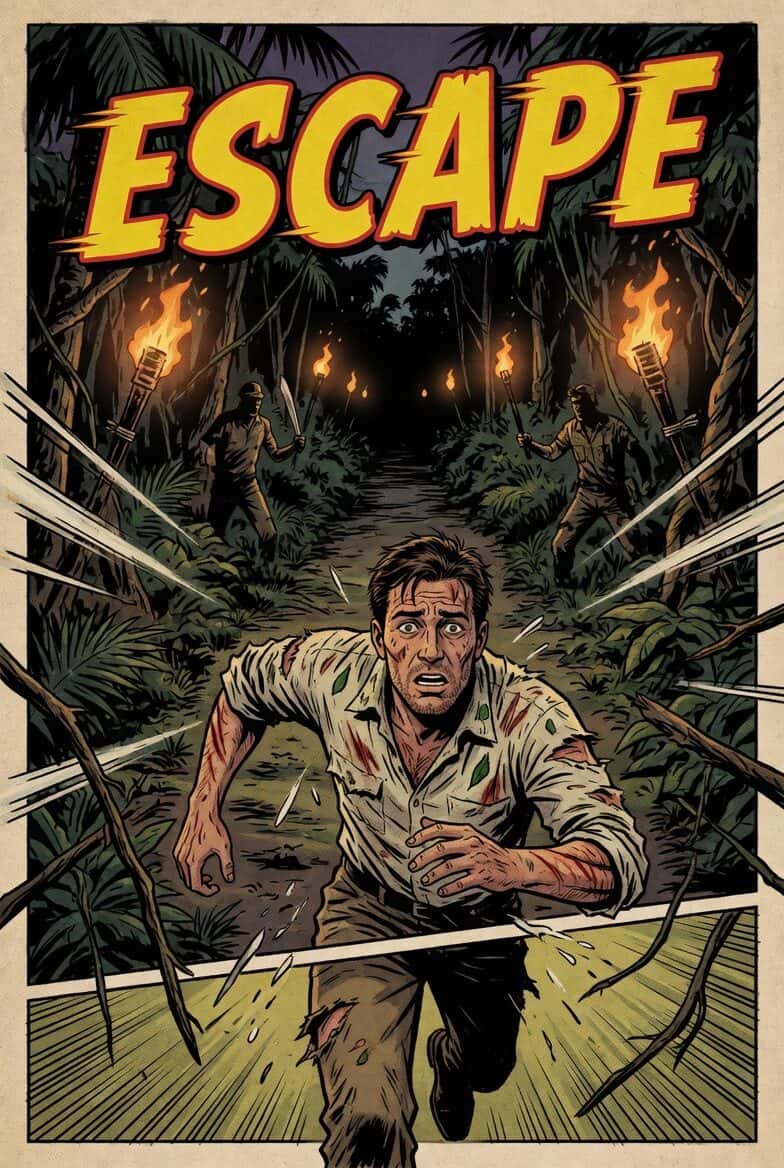
The written record
Read the transcript
Read along with the recording · About 18 min to read
You, finding life rather dull, dreaming again of exotic places, wishing you were somewhere else, we offer you escape. Escape with us now to the windswept peak of Mount Everest and the story of a man who sacrificed everything to climb it. As Leonard Lee tells it in his gripping story, Conquest.
You want to know what it's like up there? Well, I'll tell you. It's a constant torrent of wind and snow. It's jagged rocks iced as slick as a knife blade. No man has ever set foot on the place. It's as bleak and barren and lonely as the moon. But it's Everest. Mount Everest. And when you stand on its peak and know that every inch of the world is below you, there in the palm of your hand lies the final continent. Conquest.
We're not going to make the mistakes Norton and Somervell made. We'll spend the first night at Camp 5 and the second night at Camp 6. That brings us to 26,800 feet.
Are you going to make the north face to the col, Irvine, Mallory?
No, that's what they did. We're going to make a frontal attack direct. We'll follow the crest of the northeast ridge to the peak.
That's tougher climbing.
The only chance, Hamilton. And we'll take oxygen on the last dash.
Well, best of luck, Mallory.
Thanks.
We watched them as they left Camp 4, 23,000 feet on the face of Everest. Mallory and Irvine, stocked with their provisions. Pitons, carabiners, hammers, axes, pack boards, snowshoes. Two diminishing silhouettes against the powder snow of the Rongbuk Glacier, finally disappearing behind a jut in the North Col. We watched them and prayed for them. And we hated them. Because we weren't part of that final battle. The final run to the top.
Two days later, June 10th, 1924, a man crawled toward us in the snow. We ran out of the tent to get him. It was Odell, our geologist from Camp 6. He could hardly speak.
Challoner, brandy.
Yes, here. Here, Odell, drink this.
Thanks.
What happened?
I saw them. I saw the top.
Did they make it?
I don't know. They were about 800 feet from the peak. Mallory and Irvine. At the last step. The last step. Then the mist closed in.
It's only a matter of time they'll make it.
Hamilton. No man can live up there. There's nothing to breathe.
And that was the last word. Somewhere in that jungle of ice their frozen bodies lay. The peak was still unscaled. We looked out at the expanse of desolation stretched out before us. We looked out and up. The calm arrogance of the summit was wrapped in mist. From that moment on, there was only one purpose to my life. To climb that mountain.
I'm sorry, Hamilton. No more money.
Look, Ben, I can make it. I know I can. I've been up there. I know every crevasse. I know every rock up to Camp 6.
What's the point? So you reached the peak. So what? The bear went over the mountain. What did he see but the other side?
All right, all right. I don't expect you to understand why people climb mountains. It's a kind of insanity. Let's let it go at that. But from your point of view... From your viewpoint, look at the publicity. Grisham Sports Equipment used on the first ascent of Mount Everest, the highest mountain in the world. It'll be worth a million dollars to you.
You have a point there.
The initial expense, including everything, will be about $25,000.
$25,000? It's out of the question. The best I could do would be $15,000.
I knew you'd say that.
What?
$15,000 is plenty.
Well, what do you say, Challoner? Are you with us?
Well, the last time it was pretty rough, but I'm always fool enough to try again.
Fine. Who have you got lined up so far?
Langmuir. He's pretty young, but he's got a lot of energy and a lot of experience for his age. Newt Revere, you know him. Four of us will lead.
That sounds pretty good. How about financing?
The Mount Everest Committee can't supply it all, so I got most of what we need from Grisham. He makes sports equipment. It's a publicity deal.
I see. Well, it's March now. We ought to have our base camp established by mid-April, and then we'll have about a month of climbing before the monsoon hits.
Yes, that's what I planned. We'll be leaving in about ten days. Can you be ready?
Yes, I'll be ready, Hamilton. And so will Everest.
We arrived in Darjeeling on April 2nd. We hired Sherpa porters and Tibetan guides, bought more tents and scientific equipment, and headed toward Everest, a hundred miles away. But it was almost three times as far snaking through the gorges of the eastern Himalayas. Our second night out, we camped in the sweltering swamp jungle of Sikkim.
I can't sleep.
Try a wet towel.
I've tried everything.
Hamilton?
Yes?
Can you sleep?
No.
If you ask me, we should have taken the south slope. Gets more sun, less ice. Do you hear me, Hamilton?
Yes, I heard you.
Well, why didn't we try the south slope?
Because the north slope is explored and possible. Besides, Nepal won't grant permission. Let's try to sleep.
Can't sleep. Too hot.
Can you sleep, Revere?
Yes. I could try if it weren't for all this talk.
Hold it. There's somebody outside.
Yes, who is it?
Tishba Marani. The head porter.
Oh, you better tell him to come in, Hamilton.
Come in.
Yes, Tishba, what is it?
Not go. Not go to Chomolungma.
What?
Signs very bad for mountain. Death. Death, I see.
What signs?
Bend of the trees and the stars. No good. Not go to mountain.
All right, Tishba, how much?
Ha. I do not understand.
The bend of the trees is worth how much? Oh, signs are bad. Five hundred dollar.
Get back to your tent.
Four hundred dollar. Four hundred dollar, the blessing from Holy Lama of Rangbu.
All right. But that's the last holdup, you understand? I'm sure signs will be better. Now get back to your tent.
Oh, gladness. Ha, ha, gladness.
There's a Gurkha for you. The Shabbas won't come around for more money in the middle of the night. Well, good night, gentlemen.
It's too blasted hot.
Enjoy the heat, Langmuir. In another 48 hours, you'll wish you had every steaming bit of it.
We pushed on through the Sikkim to the Tibetan Plateau. The mercury plunged to zero. The wind and snow lashed at us. We'd begun to climb. We stopped at the monastery on the Rangbu for the Lama's blessing to satisfy the porters. Moved on up the glacier. Twelve below now. Oh. Then, in the momentary clearing of clouds, I saw it once again. Everest and the white plume flowing from its peak. We were at 16,000 feet. It was at this point we established our base camp.
All right, Challoner, tell them what we've decided.
All right. Camp 1 will be at 18,000. Camp 2 will be at 20. Camp 3 at 21. Camp 4 at 23. We will each carry oxygen. The tanks are light, but we'll have enough to last us for about a week if we use it right. When we get near the top, the routine will be 15 minutes of climbing, one hour's rest. We're not making the mistakes Mallory did. Are there any questions?
Yes. How do we pair off, Hamilton?
Challoner and Revere, Langmuir and myself. We'll travel together up to Camp 4, then we separate into doubles. The rest of the men will be dropped off at the camps as we move along to maintain relays.
Anything else?
Yeah. I think we're going to make it.
We climbed over the icy slopes establishing camps as we went. Finally, after days of driving forward inch by inch, we reached the North Col, just 7,000 feet from the summit of the mountain. The wind hurtled down in the slopes in a sweeping gale, hard and cold as rock. Mallory had camped here just days from his death. Night closed in. The lack of oxygen had numbed the mind and fired the temper. Our civility was suffocated. We were savages, nothing more. We sat around an alcohol flame, the four of us, breathing hard, staring at each other's bearded faces, while outside, the wind beat at the tent flaps.
I've got to have oxygen.
You've had plenty.
I can't breathe.
You can breathe. Just take it easy. Any more oxygen, your body will stop regulating to the altitude, and you won't be able to do without the stuff.
My heart's going like a trip, Hamilton.
It'll get worse. I've got to have some, I tell you.
Sit down. Stay away from that tank.
I can't breathe. Hamilton, I can't breathe.
I said stay away.
All right, come on, now get up. Oxygen, please. Sit up and behave yourself. I'm the leader of this expedition, and you'll do as you're told.
Here, Langmuir, give me your hand. Now, let him lie there, Challoner. You'll be all right in the morning.
In the morning, Revere and Challoner set out to establish Camp 5 at 26,000.
One, two, three, four thousand.
Langmuir and I watched them go, chopping their way up the ridge to the northeast shoulder. When we lay down waiting, trying to conserve our strength, Langmuir stared upward, his lips moving in prayer, deep sunk eyes, chest heaving.
The next day, we set out following Challoner's marks.
We're at your feet, Langmuir, then we can rest. Now, come on.
No.
Take a little more oxygen, then.
More. More.
No more. Now, come on.
Caught a shell to the camp.
Caught a shell.
He stood on my shoulders, and I boosted him to the narrow ledge. He grasped for the edge, his fingers clawing at the smooth rock. I felt his foot slip from my shoulder. I grabbed for his leg and missed. Black space sank below us, and he fell.
I'm okay! I'm okay!
Escape under the direction of Norman MacDonald. Returns in just a moment.
CBS wishes to call your attention to the debut of three programs today. Bill Goodwin's entertaining Dollar a Minute, a new 15-minute news program featuring Eric Sevareid, chief of CBS' Washington Bureau, and Charlie Wild, Private Detective, which has moved to CBS from another network. And now, back to Escape.
As Langmuir fell, I braced myself against rock, waiting for the rope around my waist to pull taut. And when it jerked, it burned into my flesh and tore me into space. I scrambled under the double weight, lunging desperately for a hold. I threw my arm around a snub of rock just at the edge and started to pull up. Slowly, I reached the ledge, gasping for air. I looked down. Langmuir was swinging at rope's end at a small arc above the yawning emptiness, just a hundred feet below me. The wind tore at my face. My arms were aching. I felt them slipping from the rock, and then I saw Langmuir grab a handhold and start to climb. And the rope loosened, and I relaxed. He was all right.
I sniffed at my oxygen, but it made me drunk. Three hours, I told myself. Three hours to Challoner.
Hamilton, you all right?
It's Challoner. Are you all right?
Yes. Yes. Yes, I'm all right. How did I get here?
Langmuir brought you in.
I must have passed out.
Yes, you certainly did.
Where's Revere?
A rock fell. He must have been killed instantly.
Three of us. Three of us left. We haven't even established Camp Six.
Look, Hamilton, I'm not a young man anymore. I'm 38. That's fine for selling shoes in a department store. Well, I'm not quite up to this kind of thing. I just about reached my limit, Hamilton. You, you and Langmuir, you two will have to climb alone from here on up.
I think we can do it. I'll stay here at Camp Five.
All right, Challoner. I hope I get a good sleep because tomorrow I've got a date with a mountain.
It's quiet outside. It's a wonderful day. The best we've had yet. What do you think of cutting the knife face across the col, Irvine? Making a final ascent directly up the western part of the north side.
No, no, we'll take Norton's route as we planned.
What about Camp Six?
Well, if we can establish it at 27,000, the final dash will be short. That'll double our chances.
Well, Langmuir, what do you say? You want to go on?
Look. Look up there.
What?
The mist is beginning to clear. There it is, Hamilton. The summit. The top of the world.
We started up again, up toward the summit. Our altitude was 25,000. We planned to camp at 27, leaving only 2,000 feet for the final spurt. We hung desperately to the sheer face of the mountain, the freezing wind whipping up from the great col, Irvine, tearing at our grasp. All the next day, we inched upward, our hearts pounding. By nightfall, we had only reached 26,000. We had to camp or die. I found a small recess. We pitched our tent over it, fastening the stays with pitons.
We huddled together in the cold darkness. Lagnier was exhausted. I heard him gasping in the weak air. My arms and legs were swollen with pain, my lungs bursting. The top seemed miles away. Every ache in my body urged me down, down to the firm, warm earth. But the peak. Only 3,000 feet. The White Plume Peak. 26,000. Only 26,000.
But we'll never make it, Hamilton.
You can see it in the daylight, the peak, Lagnier. We'll go like Mallory went up there. Suffocation. We'll make it.
Suffocation. No air. Nothing to breathe.
Stop it, Lagnier. We've got to go.
We're back.
We're not going back. We're going for the top.
We've got to go back.
3,000 feet. That's all. 3,000 feet and we're there. Mallory. He couldn't breathe. He's here. He's here. He's here. He's here. He's here. He's here. Somewhere. Dead. Frozen dead.
We'll make it. Tomorrow morning we're going back.
Lagnier, we've climbed tougher ones than this and the Rockies. The slopes aren't hard. From here on it's simple.
Hamilton.
We'll make it, Lagnier.
We've got to go back.
We're not going back. You understand? We're going to make it.
Hamilton. Listen. Listen to me. If you try to turn back, I'll kill you.
The mountain wasn't ice and rock to us anymore. It was a human force, an arrogant wild challenge. Defiant. Fighting conquest with choking cold and the constant earth pull downward. Death didn't matter. My life for Lagnier. That was the top and we were going to reach it.
In the morning we started up again. We moved like automatons, not daring to think or feel. Moved up by instinct. And then it happened. Lagnier slipped again and I plunged my pickaxe into a crack and waited for a sharp hit. On the waist rope, it came. I pressed myself against the rock waiting for the slack that told me that he'd regained his foothold. And suddenly, above the high wind, I heard a massive rumble. I felt the Earth shaking itself to pieces. Avalanche.
Listen to me. I'm going to beat you, Everest. I'm going to the top. Going to the top.
There was no time. There was no space. There was only the mountain and me. I climbed. I kept climbing. The sky darkened. The wind rose. The air was like a blade in my throat, but I kept going. And when it was too dark to climb, I dug myself into a hollow place. And I lay there, thinking of home, of the sanity of the open fire, of the comfort I'd left behind. Night on Everest. Night on Everest and the terrible wind.
Morning broke milder and clear. I left the hollow and looked upward through the glare of the sun. The slopes were more gentle. The holds easier. It was as if Everest had suddenly relaxed its guard, for there, just above me, lay the few yards of level terrain which formed my goal. I started again, moving on. I looked upward, senseless to pain. Hours later, the ground leveled and I stopped crawling. I lifted my head, and around me, in every direction, clouds and peaks. Below me, the black outline of the earth. I'd made it. I was the first man ever to reach the peak of Mount Everest.
I forced myself to my feet, weaving dizzily. All the pain, all the intense agony of the altitude and the climb was forgotten now. I looked down at the magnificent peaks of the surrounding Himalayas. I couldn't believe that I'd done the impossible. There was a small camera in my knapsack. I took pictures of every horizon. I walked around the summit, my summit, drunk with the knowledge of what I'd done. And then, suddenly, I stopped, for there, wedged into a crack of rock, I saw something bright and gold shone up at me. I bent down and pulled it out. It was a cigarette case. It bore the initials G.L.M. George Leigh Mallory.
I stood there trembling, the cigarette case in my hand. An instant before, I'd experienced the elation of the greatest possible triumph. And now, there was only defeat. Defeat and the indescribable hate for a dead man. Oh, how he must have smiled as he went to his death, knowing that the second man to reach the top would find his proof. The second man to reach the top. I was only the second man.
And then it came to me. Why must anyone know? Why must I tell the world what I'd found? Mallory was gone. He wouldn't hear the applause. It would be me, Chase Hamilton, the man who had conquered Everest. I took a small plate of metal from my wallet and wedged it into the rock. It read, Hamilton Everest Expedition 1925. Then I strapped on my sack. I looked below me. It would be a difficult descent. But there was only one direction to go now. Down.
They found you at about a thousand feet from the peak. Is that right, Mr. Hamilton?
Yes, that's right. Challoner found me. He brought me back to Camp Six.
How come Lagnier didn't go to the top with you?
He died, gentlemen. The rope broke and he fell. Lagnier deserved a lot of credit, though. Without him, I never could have gotten near the summit.
Well, how does it feel, Mr. Hamilton? How does it feel to be acclaimed as the first man to climb the highest mountain in the world?
Well, gentlemen, I feel as if... as if...
If you could just give our papers a statement of some kind, how does it feel to be the very first?
You don't climb a mountain just for fame and glory, gentlemen. You climb it for something more personal than that. And you can't lie to yourself.
I'm afraid I don't understand. You were the first.
No, gentlemen. Not quite the first. George Leigh Mallory reached the top last year. I found his cigarette case wedged in a rock on the summit. This cigarette case.
Well, gentlemen, under the direction of Norman Macdonnell, Escape has brought you Conquest by Leonard Lee, especially adapted for Escape by David Ellis. Bill Conrad was starred as Hamilton. Featured in the cast were Larry Dobkin, Ramsay Hill, Lou Krugman, Jack Kruschen, Larry Thor, and Ben Wright. The special music for Escape was composed and conducted by Del Castillo. Next week, Escape with us to Western Europe and the South, the story of a futile attempt to save a beautiful girl from the clutches of the most cold-blooded political organization on Earth, as Anthony Ellis tells it in his exciting story, A Bullet for Mr. Smith.
Next, here's the evening CBS has a big treat in store for all of you. Edgar Bergen and Charlie McCarthy, Amos and Andy, Bob Hope, Mary Martin, Judy Garland, and a raft of other stars will be on hand to salute Bing Crosby, who is celebrating his birthday. He's celebrating his 20th year in show business. Be sure and join them on Tuesday.
This is Roy Rowan speaking. This is CBS, the Columbia Broadcasting System.