
The written record
Read the transcript
Read along with the recording · About 14 min to read
The natives of the South Seas have a saying that when a man first hears the sound of the sea in a shell, he will travel to the ends of the earth and never find peace. This is the story of a man who heard that sound.
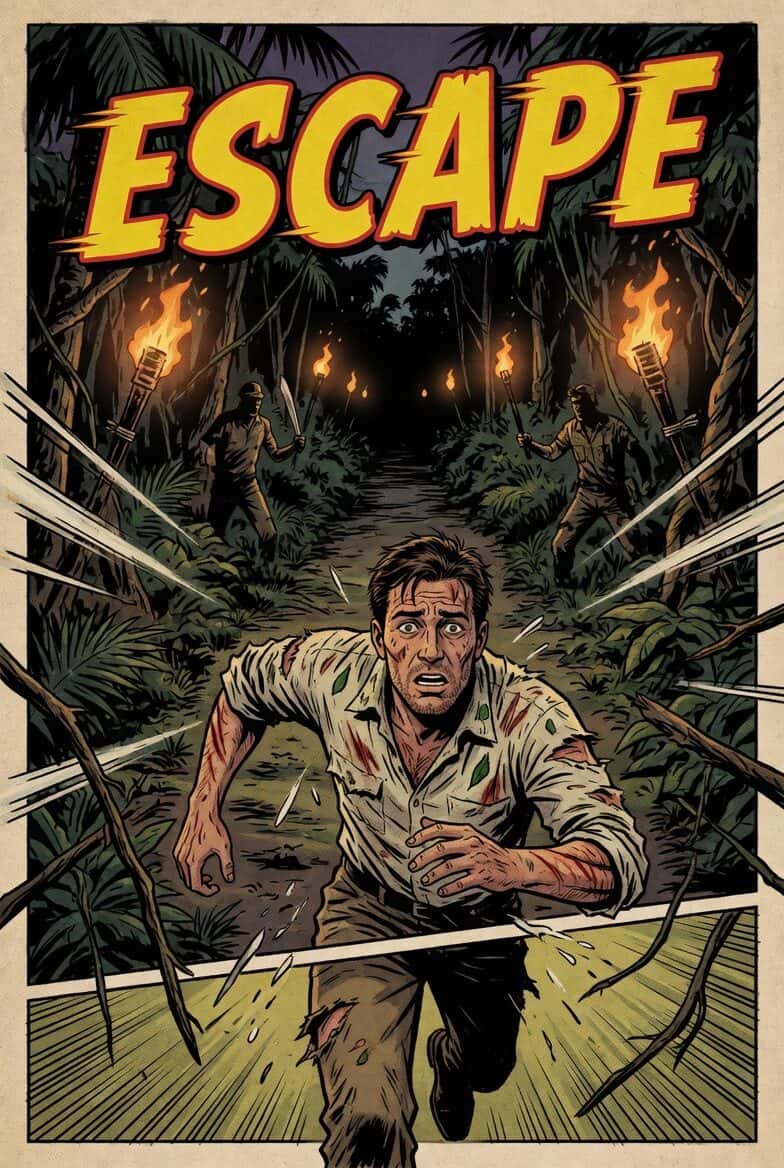
Escape.
Designed to free you from the four walls of today for a half hour of high adventure.
The Price of a Head.
Tonight's story was especially written for Escape by Richard Maibaum. It stars William Conrad and is produced and directed by Norman MacDonnell.
And now, the South Seas and a tale of a man who heard the sound of the sea in a shell.
The Price of a Head.
I was sitting in the bar of the Hotel Mariposa in Papeete, Tahiti, drinking a Planter's Punch and watching the rain. It had been raining for three days. The rain came down in solid sheets and hammered against the corrugated iron roof of the bar like a thousand mad drummers. The air was thick and steamy, and the electric fans only seemed to stir the heat around. I was bored and restless and thinking about taking the next boat out, anywhere, when the door opened and Johnny Chaplin came in.
He stood in the doorway for a moment, letting the rain drip off him, and then he crossed to the bar and ordered a whiskey. I hadn't seen him in six months, not since he'd shipped out on the Tropic Trader for the Marquesas. He looked older, thinner, and there was something else about him, something in his eyes that I couldn't quite define. He saw me and came over.
"Hello, Steve," he said.
"Hello, Johnny. Sit down. You look like you've been through it."
He sat down and stared at his whiskey for a long time before he answered.
"I've been through it," he said finally. "I've been to the end of the world, Steve. And I found out something. There's nothing there."
He picked up his glass and drained it and signaled for another. I waited. I knew Johnny. I'd known him for five years, ever since he'd jumped ship in Papeete and decided to stay in the islands. He was one of those men who are born restless, who can never stay in one place, who are always looking for something just around the corner, over the next hill, across the next ocean. He'd tried everything—copra trading, pearling, running guns to the rebels in Indonesia. He'd made money and lost it, and it never seemed to matter. The thing that drove him was something else, something he couldn't even name himself.
"I shipped out on the Tropic Trader," he said, "and we made the Marquesas in ten days. You know the Marquesas, Steve. Those volcanic islands rising out of the sea like the bones of the world. We put in at Nuku Hiva, and I went ashore with the captain. There was a German trader there, a man named Hoffman, who'd been in the islands for thirty years. He had a store and a plantation, and he was the only white man on the island. I got to talking with him, and he told me about an island, an island that wasn't on any chart."
Johnny stopped and stared at his whiskey again. The rain hammered on the roof, and somewhere in the back of the room a native was playing a guitar, very softly.
"Go on," I said.
"He called it Motu Iti," Johnny said. "The Little Island. It was about two hundred miles northwest of the Marquesas, a tiny speck of land, maybe five miles around. Hoffman had been there once, twenty years ago, in a schooner that was blown off course in a storm. He said there was a village on the island, maybe two hundred natives, and they had something that no other island had. Something that made them different from every other people in the South Seas."
He paused again, and I saw his hand tighten on the glass.
"Heads," he said. "Shrunken heads. Hundreds of them. The whole island was full of them. They had them in their houses, in their temples, hanging from the trees. Hoffman said he'd never seen anything like it. The natives were friendly enough, but there was something about them, something in their eyes. They were headhunters, Steve. Real headhunters, the last of them. And they had a tradition, a ritual, that went back hundreds of years."
I signaled for another round. The rain seemed to be coming down harder, and the bar was almost empty now. Just the two of us and the bartender and the native with the guitar.
"Hoffman told me that every year, on the night of the full moon in the month of their god of war, they sacrificed a man. Not one of their own, but an outsider. A stranger. They believed that the head of a stranger held the power of all the places he'd been, all the things he'd seen. The more a man had traveled, the more valuable his head. And they paid for it, Steve. They paid in pearls. Black pearls, the finest in the South Seas."
He looked at me, and I saw that strange light in his eyes again.
"I had to go, Steve. I had to see it. I bought a schooner in Nuku Hiva, a thirty-foot island trader with a native crew of three. I told them I wanted to fish for pearl shell off the reefs of Motu Iti. They didn't want to go. They knew about the island, knew what happened there. But I offered them enough money, and finally they agreed. We sailed on the morning tide, three days before the full moon."
Johnny lit a cigarette with hands that were almost steady. Almost.
"It took us four days to find the island. The charts were wrong, and we had to search by dead reckoning. But finally, on the fourth day, we saw it. It rose out of the sea like a green jewel, with a reef all around it and a lagoon inside. We anchored outside the reef and took the dinghy through the pass. The natives were waiting for us on the beach. Two hundred of them, maybe more, standing in silence, watching us come in. They were the most beautiful people I've ever seen, Steve. Tall and brown and perfectly formed, with tattoos that covered their bodies like lace. But their eyes—there was nothing in their eyes. Nothing human."
He shuddered and drank deeply.
"The chief came forward to meet us. His name was Tane, and he spoke a kind of pidgin that I could understand. He welcomed us to the island and said that we had come at a fortunate time. The feast of their god was approaching, and they needed a stranger's head. He said it as calmly as if he were asking me to pass the salt. I told him that I had come to trade for pearls, that I had guns and knives and cloth to offer. He shook his head. They had no need of such things, he said. But they would pay well for my head. A thousand black pearls, each one perfect, each one the size of a pigeon's egg."
The rain had stopped. I hadn't noticed when. The bar was very quiet, and the native had stopped playing.
"What did you do?" I asked.
"I laughed, Steve. I laughed in his face. I told him I wasn't ready to part with my head just yet, but that I'd be happy to trade for pearls in the usual way. He smiled at me. It was the most terrible smile I've ever seen. He said that the choice was mine, of course. But that the god must have his sacrifice, and if it was not me, it would be one of my crew. And then he turned and walked away, and the natives dispersed, and I was left standing on the beach with my three men looking at me with eyes full of fear."
Johnny's voice had dropped to almost a whisper. I leaned forward to hear him.
"I spent that night on the schooner, trying to think what to do. I could sail away, of course. But the wind had died, and we were becalmed. And my men—those three natives I'd hired—they knew the island, knew what would happen if we tried to leave. They were planning something, I could tell. I heard them whispering in the fo'c'sle, and I knew they were considering whether to kill me themselves and offer me to the chief. It would save one of their lives, you see. The chief had said that if it wasn't me, it would be one of them."
He crushed out his cigarette and immediately lit another.
"On the second day, I went ashore alone. I walked through the village, trying to seem calm, trying to think of some way out. And everywhere I looked, I saw the heads. They were in the houses, hanging from the rafters. They were in the temple, row upon row of them, hundreds of shrunken faces with eyes that seemed to follow me. Some were old, dried to leather, with lips drawn back from teeth in eternal grins. Others were newer, with hair still attached, with features still recognizable. And I saw—"
He stopped, and his face went gray.
"What?" I asked. "What did you see?"
"I saw a head that I knew, Steve. A head that I'd seen before, in Papeete, six months ago. It was a man named Henderson, a beachcomber who'd shipped out on a pearling lugger and never come back. I'd played cards with him, drunk with him. And there he was, shrunken to the size of a coconut, with his red hair still bright, his freckles still showing on his brown skin. His eyes were open, Steve. Open and looking at me. And I swear to God, I swear he recognized me."
The bar was very hot now, despite the rain. I could feel sweat running down my back.
"I ran out of that temple, Steve. I ran all the way to the beach, and I swam out to the schooner, and I locked myself in the cabin. I stayed there all that day and all that night, with my gun in my hand, listening to my men moving around on deck, wondering if they'd try to break in. But they didn't. And in the morning, the wind came up. A good steady breeze from the southeast. We could have sailed. We could have gotten away."
"But you didn't," I said. It wasn't a question.
"No," Johnny said. "I didn't. Because that morning, Tane came out to the schooner in a canoe. He came alone, and he brought a basket with him. He held it up so I could see, and it was full of pearls. Black pearls, the finest I'd ever seen, shining like drops of midnight in the sun. And he said to me, 'The god is patient. He will wait for the full moon. But I will make you an offer, stranger. A special offer, for a man who has traveled far and seen much. Give me your head now, willingly, and I will give you not one thousand pearls, but five thousand. And your head will be the greatest in our temple, the head of a man who came to us freely, who gave himself for the glory of our god. This is a great honor. No stranger has ever been offered it before.'"
Johnny laughed, a harsh, broken sound.
"And I considered it, Steve. I actually stood there on the deck of that schooner, with the wind blowing and my crew ready to sail, and I considered it. Five thousand pearls. Enough to make me rich for life. Enough to buy anything I'd ever wanted. And all it would cost was—this."
He touched his head, very lightly, with one finger.
"Why?" I asked. "Why would you even think about it?"
"Because I was tired, Steve. Tired of running, tired of searching, tired of that sound in my ears that never stopped. The sound of the sea in a shell, calling me to go farther, to find something that didn't exist. I'd been running from it for twenty years, and I was exhausted. And I thought—maybe this was the answer. Maybe if I gave my head to these people, if I let them shrink it and hang it in their temple, maybe then I'd find peace. Maybe then the sound would stop."
He was silent for a long time. The rain had started again, a soft drizzle against the roof.
"What happened?" I asked finally.
"I told him no," Johnny said. "I told him I'd sail with the morning tide, and that I'd take my chances with the wind and the sea. And he smiled that terrible smile again, and he said, 'The god is patient. He will wait. And you will come back, stranger. They always come back.' And then he paddled away, and we raised anchor and sailed out through the pass, and I never saw the island again."
He finished his whiskey and stood up.
"That was six months ago, Steve. Six months of running, of trying to forget. But I can't forget. I see those heads every time I close my eyes. I hear Tane's voice, telling me that I'll come back. And the worst of it is—I think he's right. I think I will go back. Because the sound hasn't stopped, Steve. It's louder now than it ever was. And I know that somewhere, on that little island in the middle of nowhere, there's a place for my head. A place where it will hang forever, with Henderson and all the others, looking out at the world with eyes that never close."
He walked to the door and stood there for a moment, looking out at the rain.
"I'm sailing tomorrow, Steve. On the Tropic Trader. She's making the Marquesas run, and from there—"
He didn't finish. He just stood there, and then he walked out into the rain, and I watched him go until he disappeared around the corner. I never saw him again.
But I heard about him, six months later. A schooner captain who'd been blown off course in a storm told the story in the Mariposa bar. He'd seen a white man on Motu Iti, he said, living in the village, eating with the natives, learning their ways. And on the night of the full moon, he'd walked into the temple of his own free will, and they'd taken his head. And it was the finest head in their collection, the captain said. The finest they'd ever seen. They'd paid him five thousand pearls for it, and he'd died smiling.
I still have the shell, Steve. The one he gave me that night in the bar, the night before he sailed. A small, perfect conch, with the sound of the sea inside it. I keep it in a drawer, wrapped in cotton, and sometimes I take it out and listen. And I wonder—wonder if Johnny finally found what he was looking for. Wonder if the sound ever stopped for him, there in the darkness of that temple, with his head hanging among the heads of strangers, looking out at a world he'd finally left behind.
The sound of the sea in a shell. The sound that calls a man to travel to the ends of the earth, and never find peace.
This is your announcer inviting you to be with us again next week when Escape brings you another story designed to free you from the four walls of today for a half hour of high adventure.
Tonight's story was especially written for Escape by Richard Maibaum. It starred William Conrad and was produced and directed by Norman MacDonnell.
Escape is produced and directed by Norman MacDonnell and features William Conrad.
This is CBS, the Columbia Broadcasting System.