
The written record
Read the transcript
Read along with the recording · About 23 min to read
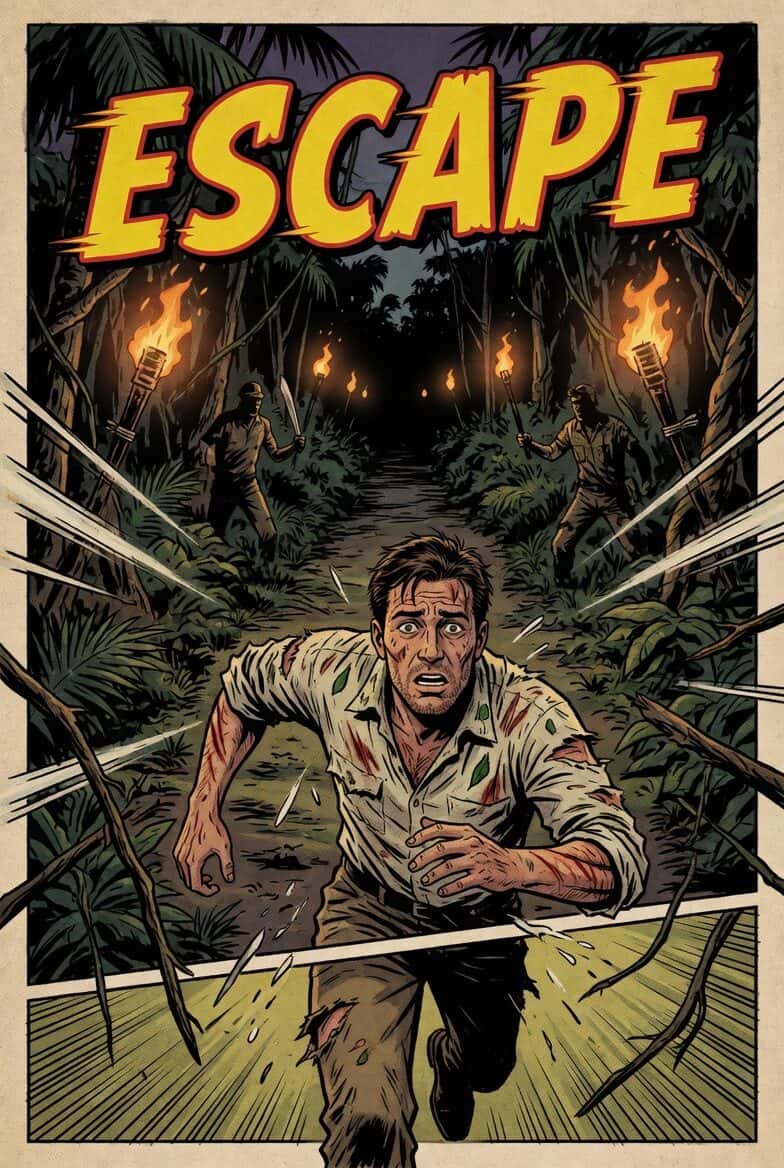
Tired of the everyday grind? Ever dream of a life of romantic adventure? Want to get away from it all? We offer you Escape. Escape, designed to free you from the four walls of today for a half hour of high adventure. Across a jungle savannah, your body flaming with fever, while behind you lies certain death, and ahead, the endless tortures of perpetual imprisonment. Listen now as Escape brings you Evelyn Waugh's classic story, The Man Who Liked Dickens.
You know what it's like with the English. We're forever going off on curious expeditions into the interiors of strange, dark lands, having unbelievable adventures and returning at last pale and a bit feverish, but triumphant. This we do. But we do not invariably wear rather longish, khaki shorts in the daytime, and no matter how primitive our surroundings, dress every night in black ties. I know this from the only exploration I ever went on, with Dr. Messenger, into the Amazon to find a buried city called Demerara.
I remember the night things started to go badly with us. It was our last camp on the river. Next day, we were to begin making our way south by foot and we'd gone to bed early in preparation for the rigors of the trail. I'd been asleep an hour or two, when I was waken by something tugging gently at my toe. I sat up and looked sleepily toward the foot of my hammock, and then I saw what it was.
Oh! Oh! Oh! Johnny! Oh! Johnny! What's up? What is it?
Something on my toe. A black beast of some sort.
Where is it? Did you frighten it off?
It's gone, Doctor. Flew away.
Oh. Did it bite you?
Yes, you see. On my great toe.
Yes. Vampire bat. Must have gone to sleep with your foot against the mosquito netting. It's a foolish thing to do. No telling how long he was at it before you woke up.
I thought the lamp was supposed to keep them off.
Doesn't seem to have, does it? No. Nasty. Hmm. It may have lost quite a bit of blood. I don't think I like the idea much. Better put some iodine on it. I'll get one of the boys to bring the medicine chest. Makusi! Makusi! Makusi!
What the devil? Well? What is it? Where's Makusi? Where's Makusi?
I'm afraid we're in for it, old boy. They've gone. The boys, all of them.
But why? Where'd they go?
I was afraid of this.
What do you mean?
Well, these chaps are river men. They don't like going into Indian territory. I meant to explain things to them in the morning with the help of some extra goods, you know. Mirrors, pomade and the like. Too late now, I expect.
You expect? This is a bloody fine way to run an expedition. Now we're alone. Absolutely alone in this filthy jungle.
What if we are? We need to move on. We have our maps. It takes a bit of poise, that's all.
Poise? Are you mad, Messenger? We can't even get back alone. How can we go on?
Well, the situation is grave, lad, I must admit. But not desperate. Not altogether desperate.
I wasn't sure whether Dr. Messenger had lost his mind or if he was merely displaying British calm in the face of disaster. In any event, by morning I was beyond caring very much. When I awoke, my head was flaming with fever. And by noon I was slightly delirious. The following day was no better. And Dr. Messenger was rather concerned.
How do you feel, lad?
Awful. I'm afraid I'm being a great nuisance.
No, that's not the point. Here, I brought you something to drink.
What is it?
Cassiri. The boys left some outside.
What's cassiri?
Oh, it's a local drink made of fermented cassava.
Oh, will it help me?
Well, it might. You know, it's rather interesting the way they make it. The women chew the root up and they spit it into a hollow tree trunk.
If you don't mind, Doctor, I think I'd rather not.
Well, as you like. Oh, look here. I think I've got the idea as to what best for us to do. Huh? Yes. I'm going to take the canoe downstream to see if I can find some Indians to help. Best to go immediately, don't you know?
Yes, yes, that's good. All right, I'll come and see you off.
You'd better stay quiet in your hammock.
No, I'll come straight back. But I want to see you off. It'll be good for my morale, you know, to get myself up a bit.
Perhaps. Well, anyway, I'll be back before tonight.
Oh, come along. You can sit on the bank and wave goodbye if you like.
I staggered down to the river's edge where I sat with my back against a tree and watched Dr. Messenger launch the canoe and paddle out to midstream. My vision was rather blurred by the fever, and I'll never know exactly what happened. But suddenly, the canoe seemed to pitch up and over, throwing Dr. Messenger out into the water. He must have smashed his head on a rock, for he appeared only once on the surface, and then, without a struggle, quickly sank and the water closed over him. I got to my feet. I swayed about helplessly for a moment and then passed out. I remember nothing more until Mr. Todd found me.
Can you see that house over there? Do you think you're able to walk through it? Well, if not, I can send some Indians to carry us. It's a rotten thing to watch a man drown. You've been talking to yourself a long time. Such strange talk. Glad to see you coming out of it. Careful there. I say, you're English.
I'm English, too. Last. Tony Last.
Well, Mr. Last. You've been very ill, and you've had a rough time of it, wandering about in the jungle. But I'll take care of you now.
Very kind of you to do this for an utter stranger.
Not at all. I like strangers. Don't get them often. Perhaps I can repay you somehow when you come to London.
I don't get to London, Mr. Last. But I think you might be able to repay me. Do come along, won't you?
My recovery was slow. But Mr. Todd proved the most patient of nurses. He was forever hovering about, giving me medicines, feeding me, talking to me. I learned that his house was in a village of Indians not far from the riverbank, about ten miles above the spot from where I'd watched poor Dr. Messenger drown. He owned a few cattle, some bananas and mango trees, a dog, and a single-barreled shotgun. In general, his way of life, like the medicines he gave me, was that of the Indians.
Of course my mother was an Indian, Mr. Last.
But I thought you were English.
My father was. He went to Guyana as a missionary, but soon came on here to look for gold. He found my mother instead and settled down. I was born here. Sixty years in this village. Very long and lonely times.
I can well imagine. Of course most of the men and women living in this savannah are my relatives.
Is that why you're more or less the ruler here?
That reason. And because I have the shotgun.
Of course. Tell me, Mr. Todd, can you read?
Yes, certainly.
Not everyone is so fortunate. For example, I cannot.
Oh, of course. Still, I don't suppose you have much opportunity here.
Oh, yes, that's just it. I have a great many books. I'll show you when you're better. My father left them.
Well, I'd be delighted to see them.
You shall. Of course. You see, my father was a man of education. He read to me all the time. But since he died... Oh, there was nobody for a number of years. And then another Englishman came. He read to me every day. Every single day.
Another Englishman? But where is he now?
I don't know.
Well, how long was he here?
Oh, I don't remember exactly. But he read to me every day. You shall read to me when you're better.
Oh, I'd be delighted to, Mr. Todd.
Oh, yes. You shall read to me.
Mr. Todd had a curious way of putting things. But he was much too kind and selfless in his attentions to me to allow my thinking any ill of him. Still, he did give me a turn one day when we were talking a short walk around the village. It was the first time I'd left the house since the fever had gone.
You'll find the Indians quite friendly here, but, um, I'd keep apart from them if I were you.
But why? If they want to be friendly?
Things aren't always quite as they appear to be here in the jungle, Mr. Last. Uh, I'll go slow if that's what you mean.
Uh, that's not exactly what I mean. I say. What's that?
What?
There. Between those mango trees, that mound of dirt.
Oh, yes. It seems to be a grave.
It is.
Oh, of course. Your father's?
No. Barnabas was buried there. Barnabas Washington.
Barnabas? Yes, the Englishman I told you about him. You mean the one who was here? Who read to you so much?
Oh, he read beautifully, Barnabas did.
But look here, Mr. Todd. You told me you didn't know where he was.
Well, I don't. Do you?
I see. That's an odd way of putting it, I must say. Tell me, Mr. Todd, how long was he here, Barnabas Washington? Quite a long time, I know, but exactly how long?
Oh, I don't keep much track of time down here, you know how it is. At any rate, he never got home. He died here. Oh, yes, and he was so very kind. And every afternoon for two hours he used to read to me.
Well, I suppose it was a good way to pass the time.
Ah, seems rather odd, though. I mean, reading here in the heart of the jungle, lost, so to speak, from the world.
Oh, I suppose it does, but one gets used to it.
Of course. No, it seems a pity poor Barnabas' grave isn't marked.
I think so. Yes, I think I'll put up a cross. In fact, I'll put up two of them. One to commemorate his death and the other your arrival.
A cross for me? I'm afraid I don't quite understand.
Well, it's just a whim, Mr. Todd.
I'm sorry, I don't mean to be rude.
Of course. And now, Mr. Last, I think you've recovered your strength sufficiently that we may begin. Tonight, what do you say?
Begin tonight.
Oh, my reading, is that it?
Yes, that's it, Mr. Last.
All right, if you like. You know I've been waiting a long time for this. A dreadfully long time.
And that night the horror began. My subtle, unbelievable enslavement to the strange madness of the gentle Mr. Todd.
We will return to Escape in just a moment, but first, when you hear a read about foreign propaganda against the American economic system, do you just feel resentment? Or can you answer the charges in your own mind with facts? Who our system has faults. It also has provisions for constant improvement. And our high production of goods and services has gone hand-in-hand with the preservation of our basic freedoms. Understanding our system ourselves is the first step toward combating propaganda against it.
And now, back to Escape.
That evening after supper, Mr. Todd led me into his room where we were to begin reading. From a loft at one end of the hut, he took down a number of small bundles tied up with rag, palm leaves, and rawhide. We carried them over to the fire, and he began to unwrap them with feverish anticipation.
You choose one, Mr. Last. It doesn't matter which one to take first. Please, choose.
What do you have there?
This thing. Pickwick Papers. Excellent. Let's begin with that. Shall we?
Well, uh, isn't there something a little more lively, perhaps?
Oh, I have everything here. How about, uh, Martin Chuzzlewit or Great Expectations?
Well, I was thinking of a more modern author somehow. I don't suppose you would have a copy of, let's say, South Wind.
South Wind.
I have everything Dickens ever wrote, but I've never heard of that.
Oh, but it's not by Dickens, you see.
Oh, worse than that case, I don't have it.
You mean all these books are by Dickens?
Oh, certainly.
Oh, you must be quite fond of Dickens.
Fond? Far more than that. Far more than that. You see, these are the only books I've ever known or heard. As I told you, they belong to my father, and he used to read them to me. And then later, Barnabas Washington. And now me.
And now you. But don't worry, I never get tired, even though I've heard them all several times by now.
You see, oh, there's always more to be learned and noticed. So many characters, so many changes of scene, so many words. It takes a long time to read them all. More than two years.
Well, in that case, they'll certainly last out my visit.
Oh, I hope not. I sincerely hope not. It's delightful to start again each time. I find more to enjoy and admire. But come, let's begin, shall we?
Well, all right.
Yes, and read slowly now. I don't want to miss anything. And you won't mind going back over certain passages, will you? I'll let you know when we're captured.
Of course.
The posthumous papers of the Pickwick Club. Chapter one. The Pickwickians. The Pickwickians. The Pickwickians. The Pickwickians. The Pickwickians. The Pickwickians. The Pickwickians. The Pickwickians. The first ray of light which illumines the gloom and converts into a dazzling brilliancy that obscurity in which the earlier history of the public career of the immortal Pickwick would appear to be involved is derived from the perusal of the following entry in the transactions of the Pickwick Club, which the editor of these papers feels the highest pleasure in laying before his readers as proof of...
As I continue to read, the old man frequently interrupted with questions or comments or requests that I reread a favorite passage. His delight was rather contagious. But by the time we were on the fourth volume, the novelty had begun to wane. In any way, I was feeling strong enough to be restless. More than once, I brought up the subject of my departure. But Mr. Todd seemed obtuse and paid no attention. Finally, one day, he actually became a bit menacing about it. I had just finished a chapter of Bleak House and was resting my eyes for a moment.
You know, Mr. Last, you read even better than my father. Even better, I might add, than Mr. Washington.
Well, we still have a lot to get through.
I hope I shall be able to finish it before I leave.
Oh, yes, don't disturb yourself about that. You'll have time to finish it, my friend.
Look, Mr. Todd, the time's come when I really must be thinking of getting back to civilization. I've already imposed on you much too long.
Not at all, Mr. Last. It's been a pleasure, a great pleasure.
I know. But still, how soon do you think I'll be able to get a boat? Yes, to go down river. Oh, you know I appreciate all your kindness more than I can say.
Mr. Last, any kindness I may have shown is amply repaid by your reading of Dickens. Do not let us mention the subject.
I'm very glad you've enjoyed it, but I really must be thinking of getting back.
Oh, yes, the other Englishman was like that, too. He thought about it all the time. But he died here.
Mr. Todd, how long was he here, the other Englishman?
Oh, now I don't recall exactly. We pay so little attention to time down here, you know.
Well, did he read all of Dickens to you?
A long time ago. But I do remember... I remember Dombey and Son three or four times.
Three or four times? Hmm. But you said it took two years each time to go all through.
Yes, about that.
Mr. Todd, why did he stay here all those years?
Well, I don't know. I never asked.
But there must have been some reason.
Well, he never said.
All right. But I really must press the point. When can I get a boat?
There is no boat.
Well, then the Indians can build one.
Well, you must wait for the rains. There isn't enough water in the river now.
Well... Well, how long will that be?
Oh, a month, two months.
All right, then. I'll wait a month or two. Of course. Now, let's get on. Now, it's so interesting what Dickens has to say about the law's delay. Bleak House has always been such a favorite of mine.
And so, in spite of everything, at least I knew what I was waiting for. And so it only remained for the rains to begin. I waited as patiently as I could, living with gaudy dreams of my return to England. Until one day, as we were reading, Mr. Todd explained all that away.
He said, I think Mrs. Jellyby does not take enough care of her children. But still, Dickens has great sympathy for her. He'd been poor himself, you know.
What's that? Listen.
Yes, shall we go on now?
Rain. The rain has begun, Mr. Todd.
Of course, this is the time for it. But do let's finish that chapter.
No, no, later. I must go and talk to the Indians about building a boat. I can leave now, don't you see?
Oh? Certainly, the river will be full soon, and in a week I'll be off.
Oh, I'm afraid that's impossible, Mr. Last.
Impossible? Why?
Oh, the Indians won't make a boat during the rainy season. It's one of their superstitions.
Is that true? Ask them.
I think you might have told me.
You didn't ask?
Why didn't you mention it then?
I don't know.
That's a pose. You've forgotten nothing, Mr. Todd. I'm satisfied now that you're holding me here against my will. I demand to be released.
Of course, you're perfectly free.
Now look here. You've saved my life. And when I get back to civilization, I'll reward you to the best of my ability. I'll give you anything within reason. But my...
My friend, there's nothing keeping you here. You're under no restraint.
I demand to be released.
Then go when you like.
Stop that. You know very well I can't get away without your help.
Then in that case, you must humor an old man. Read me the rest of the chapter.
No, Mr. Todd. I've read for the last time.
Oh, I hope not, Mr. Last. Oh, I sincerely hope not.
That evening at supper, only one plate of dried meat was brought in, and Mr. Todd ate alone. Next day at noon, a single plate was again put before him. But with it lay his gun, cocked on his knee as he ate. And so I resumed the reading of Bleak House, where it had been interrupted. And then, as though to make my situation even clearer to me, I came upon a scrawled note, stuck between the book's pages, and I read it with growing horror.
Hmm? What is it, Mr. Last? What have you there?
This document. It was here in the book.
Document? What document?
Document. Don't you know? Then I shall read it to you, Mr. Todd.
Oh, if you like. It seems a pity to interrupt Dickens, though.
Year 1930. I, James Todd of Brazil, do swear to Barnabas Washington of Georgetown that when he finishes this book, in fact Martin Chuzzlewit, I will let him return to civilization without delay. Then there's an X, and after it, Mr. Todd made this mark. Signed, Barnabas Washington.
Ah, yes. Poor Barnabas. He died before he could get out. And if I remember, the marker you put up, he died in 1942. Is that right, Mr. Todd?
Excuse me, Mr. Last. I nearly forgot something. I meant to mention it earlier.
Yes?
The Indians tell me that you were trying to speak to them this morning.
I was, of course. But may I suggest that it would be easier for you to say anything you wish through me. You realize, do you not, that they do nothing without my authority. They regard themselves, and quite rightly, in many ways. In many cases, as my children.
I have nothing to hide. I was asking them about a boat.
So they gave me to understand. And now, if we've finished, do let's get on with our reading. I'm quite absorbed in the book.
We finished Bleak House, and Oliver Twist, and Great Expectations, and Nicholas Nickleby, the Old Curiosity Shop, Little Dorrit, Edwin Drood. More than a year passed, and Mr. Todd began looking forward to starting all over again. The empty days followed one another in hopeless succession. Until one morning, a stranger suddenly arrived in the savannah. A prospector. One of that lonely order of men who wander for a lifetime through the forest, tracing the streams for gold. Mr. Todd was out, pottering about on business for the farm when the man appeared. I found him a plate of meat and fed him, and eagerly sat down at the table across from him.
Nice setup you got here.
Look here. Where are you bound for?
Manaus. Need a new outfit.
You've got to do something for me.
Well, sure, pal. What is it?
Here. Take this. Give it to somebody in Manaus. The police, the mayor, or somebody. Tell him you found me, and to get in touch with the British consul.
Well, I ain't going to get in trouble with this, am I?
No, no, no. This isn't my home. I'm a member of the Messenger Expedition. Dr. Messenger was drowned, and I've been held prisoner here ever since. You're my only hope of ever getting out.
Do you understand?
You sound like a jungle head to me, but I'll do it for you. If that's what you want.
You must. You must, please.
Well, one thing, though.
What?
Wouldn't it be simpler if you just came along with me?
No, I am afraid not.
Why?
First, there are Mr. Todd's Indians. I can't take two steps into the jungle without one of them after me. No. And then, Mr. Todd has a shotgun.
You, uh, mustn't mind Mr. Last, my friend. This is Mr. Todd.
Hope you see what I mean. I warned you about getting up too soon, Mr. Last. It's my guess you're going to have a time of it.
I had no fever, and you know it.
Will you boys settle this between yourselves? I've got to shove on. Thanks for lunch.
But you will...
Like I said, why not? Don't bother to see me off.
You're going to let him go?
Of course. Mr. Last, I believe we're going to begin Little Dorrit today. I'm most anxious to hear it again.
From then on, there was hope. And as the weeks passed, I endured each day in confident anticipation of what might happen on the morrow. I even felt a slight stirring of cordiality towards my jailer. And therefore, I quite willingly joined him when one evening he proposed that we attend a native feast. There was a lot of singing in an apathetic, monotonous manner. And then we were given a small calabash of kuwari to drink. It was a pleasant beverage with a flavor of honey and brown bread. An etiquette required that we drink it down without lowering the gourd. I had several, and soon after grew warm and drowsy, and dozed happily off in a hammock, dreaming of fine claret and the white cliffs of England.
Mr. Last, Mr. Last, you'd better come and eat something. You will starve to death here.
Oh, my head. I must have been quite tight last night.
Pleasant drink, that. How do you feel?
Rotten. That drink doesn't seem to agree with me.
Well, I'll give you something to make you better. The Falastaz remedy is for everything, to make you awake and to make you sleep.
I say, you haven't seen my watch anywhere?
You've missed it?
Yes, I thought I was wearing it. You know I've never slept so long.
Not since you were a baby. Do you know how long?
No.
Two days.
Oh, nonsense. I can't have...
Two whole days. And it's a pity, too, because you missed our guests.
Guests?
Oh, I've been quite gay while you were asleep. Three men from outside, Englishmen. It's a pity you missed them, and a pity for them, too. They particularly wished to see you.
No, no.
Yes, they came all the way to find you, all the way from England. But since you couldn't greet them yourself, I gave them a little souvenir.
A souvenir?
Your watch.
My watch? Oh, right. You gave them my watch?
You shouldn't mind. You see, they had to have something to take back with them. A reward is being offered for news of you. They seem very pleased with it.
You couldn't. Even you. That's like killing them. And they took some photographs of the little cross I put up to commemorate your coming, but not before I put another date on it, you know.
And you did. You killed me, didn't you? You killed me.
In general, they were quite pleased, but I don't suppose they'll visit us again. Our life here is so ridiculous.
You're tired. No pleasures except reading. I don't suppose you'll ever have visitors again. But come, come, your headaches. I'll get the medicine for you. You're just upset. Look, we won't have any Dickens today.
My whole life. But tomorrow and the day after and the day after that. Do let us read Little Dorrit again, Mr. Last. I tell you, there are passages in that book I can never hear without the temptation to weep.
The direction of Anthony Ellis' Escape has brought you The Man Who Liked Dickens by Evelyn Waugh, especially adapted for Escape by John Meston, and starring Terry Kilburn as Tony with Joseph Kearns as Mr. Todd. Featured in the cast were Ramsey Hill and Joe Cranston. The special music for Escape is composed and conducted by Leith Stevens.
Next week. A standing in a Mexican bullring. Your body wracked with fear. While in front of you, you'll find a man who's not afraid of you. While in front of you, the terrible horns of a huge fighting bull are waiting. The crowd is demanding that you move in, come even closer. Next week, when Escape brings you Anthony Barrett's exciting story, Nightmare in the Sun.
This is Roy Rowan speaking. Remember, America is listening with 14 million kitchen radios and listens most to the CBS Radio Network.