
The written record
Read the transcript
Read along with the recording · About 22 min to read
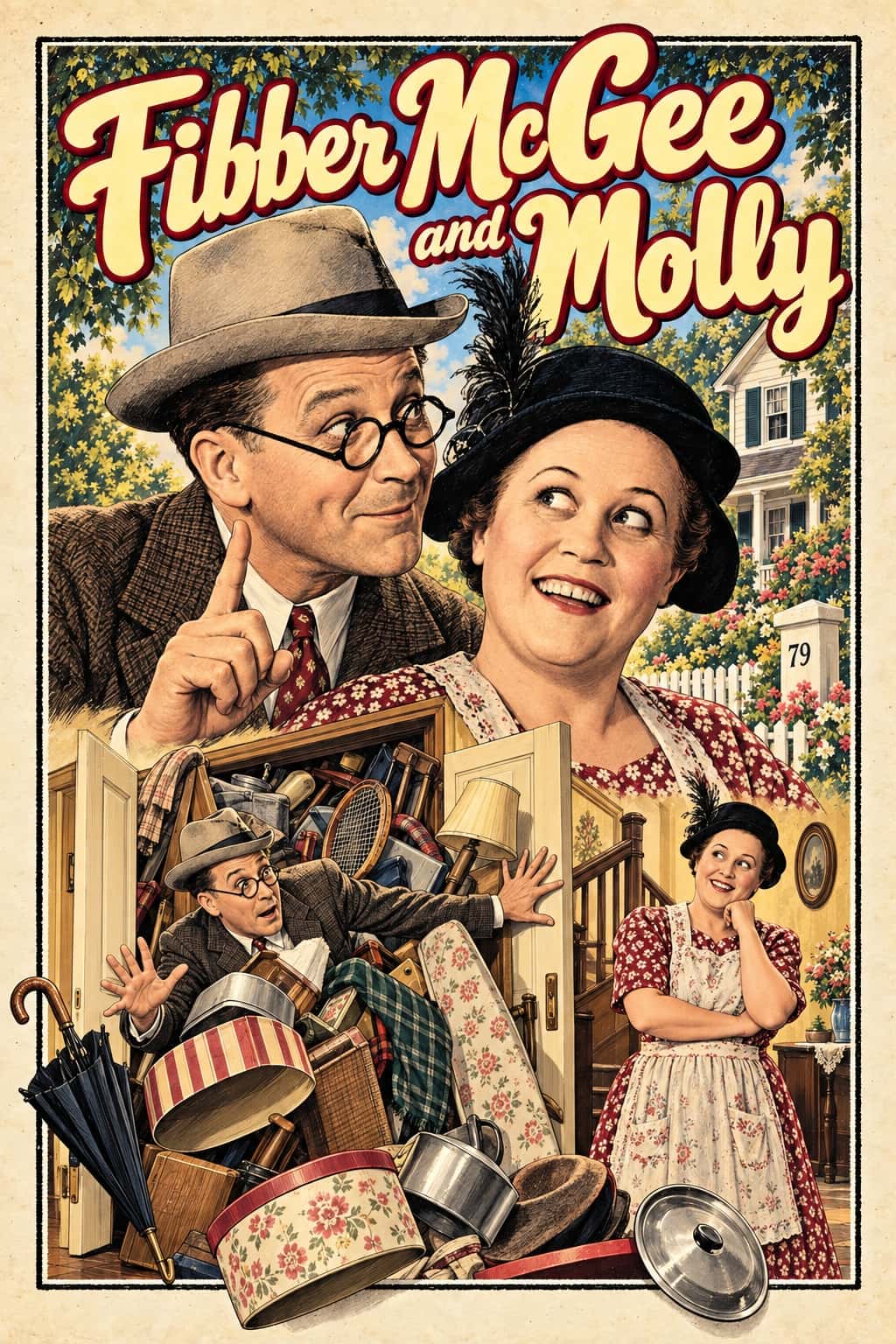
The Johnson Wax Program with Fibber McGee and Molly. The makers of Johnson's Wax and Johnson's Self-Polishing Glow Coat present Fibber McGee and Molly, written by Don Quinn, with songs by the King's Men and music by Billy Mills. The show opens with Swonderful.
This year, we're probably going to have more gardens in this country than ever before. You'll soon see many of your neighbors working out in their yards, taking care of young carrots and cabbages and beets. Of course, it's a good idea. It helps the individual families save and it helps the country conserve. But what has gardening got to do with Johnson's Self-Polishing Glow Coat? Well, I'll tell you. First, if your linoleum floors are protected with glow coat, you'll save hours of time during the year and that time you can very profitably use in your vegetable patch. Glow coat needs no rubbing or buffing. Self-polishing, you just apply and let dry. Second, when you come in from working in the garden, your feet just might be a little dirty. But if your kitchen floor is protected with glow coat, you won't worry a bit. Glow coat guards the floor against wear and soiled places are cleaned in a jiffy with a damp cloth. Now, I hope I've made it clear that people with gardens should all use Johnson's Self-Polishing Glow Coat on their floors.
Fibber McGee is writing a song. That's all, brother. Now meet Fibber McGee and Molly.
How you doing, dearie?
Great. I feel just like Stephen Foster, only he didn't have a typewriter.
Well, that may make you even with Stephen, but I'll bet Foster was faster. What's the name of your corny little cadenza?
It ain't corny and it's got a wonderful title. The Defense Stamp Stomp.
That ain't cooking with gas, I'll eat it raw.
Not bad, not bad at all. Are you going to write the music, too?
Nah, Billy Mills offered to do it and I didn't want to hurt his feelings.
Well, uh... Why don't you get somebody else to do the words, too, and save my feelings? Frankly, I'm kind of leery of your lyrics.
Oh, don't worry. I got a wonderful start. Though I got to fix up the verse some more yet.
Well, how does it go?
Well, it ain't exactly right yet, but I'm on the track. So far, it goes something like this. There's a long, long trail of winding...
Wait a minute.
Huh?
Wait a minute. That's been used.
It has?
Sure. You mean somebody swiped this already?
No, no. That's a song from the last war. You remember that. Yeah. Yeah. Yeah. Yeah. Yeah. Yeah. Yeah. Yeah. Yeah. Yeah.
Say, it did sound kind of familiar at that. Oh, well, I'll throw it out. I got plenty of ideas. How about this?
Wait a minute, McGee.
Huh?
On second thought, I don't like your title, The Defense Stamp Stomp.
Why? That's the best part of it.
Why, I know, but I read in the paper where they're going to start calling them war bonds. We're going to stop defending and start fighting.
Oh. All right. So we changed the title to The War Stamp Stomp. That gets that old fighting spirit into it. As it is, I think it's kind of offensive anyway.
Well, yes. Yes. Yes. It is. In fact, I think it's one of the most offensive songs I ever heard.
Gee, do you really?
Yes, I do.
Oh, thanks. You ain't just saying that because you admire me.
No. No, I'm not. I really think it's a very offensive song.
Of course, I may not be so hot at popular songs. I'd probably be better at serious stuff. Matter of fact, I've been mauling over in my mind a ballad called Ballad for Americans. It'd be great for somebody like Paul Robeson.
Well, there is a song by that name, and Paul Robeson does sing it.
Doggone it, that's always the way it is. Here I get these ideas, and just because I'm too busy to write them down at that particular minute, somebody always comes along and...
Hey, you better hide that song for a minute, McGee. This may be Gilbert and Sullivan.
Who?
Gilbert and Sullivan.
I heard of Sullivan. He's an old-time prize fighter. But who's Gilbert?
Well, he wrote the Mikado.
He did? Why? The dirty traitor. Just wait till I get...
Now, now. Calm yourself, McGee. It's only Mayor Latrivia.
Oh, come in, Latrivia.
Hello, Mr. Mayor.
Good day, Mrs. McGee.
Hello, McGee.
Hi, city father. What's all the bother?
When I was over here for dinner the other evening, McGee, I lost my Phi Beta Kappa key. Did you find it by any chance?
No. No, we didn't find any keys, Mr. Mayor. Did you lose your whole key ring or just the one key?
Just my Phi Beta Kappa key, Mrs. McGee. It was pinned on my vest.
Pinned on your vest? That's a heck of a way to carry a key, Latrivia. How do you carry your money? Tied into a corner of your hanky?
Please, McGee, let's be sensible. A Phi Beta key is usually pinned on the vest.
Well, what was it a key to, Mr. Mayor?
It wasn't a key to anything, Mrs. McGee. It was the visible symbol of my membership in the honorary scholastic fraternity, Phi Beta Kappa.
Oh, a key to the frat house. I didn't get it at first, Latrivia. I thought maybe...
Apparently, McGee, you still don't get it. You don't get it? A Phi Beta key has no utilitarian purpose whatsoever.
Well, then what good is it?
For that matter, what good is that American Legion button your husband is wearing?
What do you mean, what good is it, you big lint head? It shows I belong to the Legion. You think I wore it just to keep the wind from blowing through the buttonhole?
Ah, you see, the Legion button indicates your membership in the Legion. My Phi Beta Kappa key indicates my membership in Phi Beta Kappa. Is that plain enough or shall I spell it for you?
Understand, dearie?
Sure. He means he can't get into the Phi Beta capsule clubhouse. He can't get into the Phi Beta capsule clubhouse without using his key. They give all the members a key and when they unlock the door...
This key does not unlock any doors. Can't you get that fact through your Neanderthal noggin?
My what?
Never mind. Please keep an eye out for my key, if you will. It's a small pin about a half an inch in diameter.
Oh, you mean that's what the pin looks like that was on the key?
That is the key. The key is a pin.
Maybe you better make Latrivia a cup of hot tea, Molly.
I don't want a cup of tea. I just want to find my tea. I mean, my hot tea. No, neither.
Now, now, now, now, let's not all get excited, Mr. Mayor. I'm sure that we'll find your little pin with the key still on it when we do.
But, Mrs. McGee, there is no key. It's just a pin. They just call it a key.
Well, if you've got to unpin it every time you want to unlock the clubhouse door...
The clubhouse hasn't any doors. There isn't any clubhouse. The key doesn't unlock anything because it isn't the key. It's a pin. I just wear it.
Why?
Because I belong to Phi Beta Kappa.
Then why don't they give you a little button that says so?
Because the symbol of membership... ...to turn in my resignation today. I'm going to join the Elves.
Boy, is he dumb. He wouldn't be if he'd spend more time studying in college instead of running around with those sorority fellas. Well, I've got to get back to my song. Now, let me see.
Look, McGee, I've got an idea.
What?
Mr. Wimple is a poet. Say, why don't you get him to help you with the words to your song?
Oh, that's a... A great thought, Molly. Come on, let's go. I'll get Billy Mills to write the music and Wimple to write the words. What'll you do?
What'll I do? It's my title, ain't it? Come on, let's go. Over to Mills. Lovely spring day, isn't it, dearie?
Now, aren't you glad I made you walk?
No. I still think we should have hitched up Lillian to the sulky and drove over to Billy's house.
Oh, no, it was too soon after Lillian's lunch. She was taking her nap.
All that nag does is eat and sleep. Besides, she's getting too fat, Molly.
She's not fat. She's just filling out.
Maybe so. But she's the first horse I ever saw with a double chin.
Oh, look, McGee, here comes Abigail Uffington.
Correction. Lillian is the second horse I ever saw with a double chin.
Now, listen, Abigail hasn't got a double chin, McGee. She's just got a loose neck.
Loose neck and a tight fist. She's the most...
Oh, hello, Abigail, darling. So nice to see you.
Oh, how do you do, Mrs. McGee? And Mr. McGee.
Hi, Uffy. Say, we don't often see you walking, Abigail. Where's your limousine?
Oh, I'm economizing on tires, my dear.
Ah, good for you, Uffy. I always was a great walker myself. Why, when I was a kid, I used to walk nine miles to school every day.
Go on. It was only three miles, McGee.
I know, but they always sent me back home for my arithmetic book. That made three trips.
Well, what did a future songwriter like you want to waste his time on arithmetic for anyway?
Well, that's what I always tried to tell my teacher, Miss Fidich. I says, Miss Fidich, I said...
Songwriter! Oh, you dear boy. Don't tell me you've added songwriting to your other accomplishments.
What other accomplishments? Accomplishments? Name three, Abigail.
Okay, okay. Scoff, if you want to. Deride. But you'll change your mind when you hear my song played on every radio station in the country. And maybe even one or two in the city.
McGee's writing a song called The War Stamps Stomp, Abigail.
Oh, how splendid. And what a thrilling title. Oh, I do hope it will be a success, Mr. McGee. Although...
Although what?
Well, I... I just can't help remembering what a disappointment... I had. He was a musician, too.
What happened to him? Lose a button off his bolero?
No. No, he wrote a little thing which even now is played on hundreds of radio stations every day. And the poor lad never collected a dollar.
Oh. What kind of a song is it, Abigail?
Well, the name of it is Bong, Bong, Bong.
Bong, Bong, Bong. That's cute. How does the music go?
Oh, it goes like this. A-bong, a-bong, a-bong.
Heavenly days. Did your nephew write that?
Oh, indeed he did. Oh, well, I must be getting along. So you've decided to walk and save your tires, eh, Eppie?
Oh, yes. I walk all the way down to the Bong-Dong department store nearly every day.
Oh, and all the way back, too?
Oh, no, no. That would be too much, I'm afraid. So my chauffeur meets me with a car and drives me home.
I just know you're destined to be another Rinsky cop. Goodbye.
What a chic. What's the matter, McGee? What are you muttering about?
You heard what that old moose said, didn't you? He said I was going to...
I thought it would be a Ripsky-Korshka cough.
Well?
Well, what is a Ripsky-Korshka cough?
Well, I think they're a couple of songwriters. They can't amount to much. You never hear any of their stuff in the boxes. Besides, I can't...
Well, hello there, folks. Where are you going?
Hello, Mr. Wilcox.
Hi, Harlow. We're on our way over to Billy Mill's house. I hope he's home.
Oh, he is. I saw his galoshes on the front porch.
Oh. Well, how do you know they were Billy's?
He had them on.
You going over there for dinner?
No, I'm writing a song, Harlow. Billy's doing the score.
Well?
Well, what kind of a song is it? Popular?
Very. At least with McGee. He calls it the War Stamp Stomp, Mr. Wilcox. Is that a title or ain't it, Harlow? Or maybe you aren't any judge.
Sure, I'm a judge. I'm a composer myself, in a way.
Oh, really, Mr. Wilcox? What songs have you written?
Oh, nothing very famous, I guess, Molly. But I did one I rather liked. It goes, Now is the time to protect and preserve the things you own and cut expenses to the bone.
Cute lyrics.
Johnson's wax on your floors, furniture, woodwork, windowsills, lampshades will not only preserve and preserve the things you own and protect, but beautify as well. It's swell. Cuts housework to a minimum and saves you time and work. I'd be a jerk if I didn't tell you to use Johnson's wax and take a rest. It's the best. And on your kitchen floor, use Johnson's self-polishing glow coat. Just make a note. It's so easy, looks so pleasy. Pour it out and spread it around. Let it dry and I'll be bound. Your linoleum looks like new. What a view.
Oh, boy. What a joy. Floyd, Floyd. Moy, Moy. Oh, here, here. I think we have the idea, Mr. Wilcox. We got an idea of the words, Harlow. Now, how about the tune?
Oh, I don't need one. Just say Johnson's wax to a housewife. That's music to her ears.
Good luck, pal. Oh, what a songwriter. Old Jerome Korn himself. Another Minsky Corsica. Say, isn't this Billy Mills' house, McGee?
Oh, yeah. Oh, come on.
Hi, Skimp. Hello, Mom. Come on in. This is an unexpected pleasure.
Well, I thought you knew we were coming.
Well, a new febber was coming. I didn't know you were, Mom. Makes it a pleasure. Park your hat, Pat. Let me take the sable, Mabel.
Now, you're really jiving this afternoon, Billy.
Yes, I'm sending, Skimp. How's everything?
Just fine, Billy. How's my pal, Uncle Dennis?
Oh, same as ever.
He is, huh? Too bad.
You know, we've been trying to give him some good advice, but he wouldn't take it.
What advice, Mom?
She told him he ought to give up the little brown jugs till we lick those little yellow mugs.
Oh, Dennis. Well, he'd make a great air raid warden. Out all night anyway. Now, listen, you never mind, Uncle Dennis. Did you write some music for McGee, Billy?
Well, I'm working on it, Mom. Got the manuscript right here.
Hmm, so... How's it look to you, dearie?
Let me study it a minute, Mom. I mean, Molly.
You seem kind of doubtful about the opening chord, Billy. What do you mean?
You've got a question mark in front of it.
That's a treble clef.
Oh.
Oh, yeah. Treble clef. See this thing here, Molly?
Yeah. Treble clef.
Wonderful thing to have in a song, too. Some of our best music has got treble clefs in it.
Don't tell me. What'll they think of next? Is this finished, Billy?
No, I had a little difficulty about the piano.
Difficulty?
Yes, man from the finance company. I hurt my hand, too.
How?
Slugged a guy.
Who?
Man from the finance company. Well, that's tough, Billy. But when do you think you can finish it?
I kind of promised the manager of the radio station he could have it at six o'clock tonight. I'll have it done.
How about the lyrics?
Well, Mr. Wimple is going to do the lyrics, Mr. Mills.
Yeah, and when he gets the words done and you finish the music, Billy, I got a hunch that this is going to be the best song I ever wrote. Hey, that reminds me. I better call Wimple and see how he's getting along. Where's your phone, Billy?
You see that brown cord on the floor over there?
Yeah.
Well, follow that. There's a lamp on the end of it. Try the black cord. Never mind tracing it down with you. Here's the phone right here.
Let me take it. Thanks. Hello, operator. Give me Whistle Vista 7-2. Oh, is that you, Mert? How's every little thing, Mert? It is, eh? What say, Mert? Your brother shot it out with the cops, eh? Oh, heavenly days, McGee. What happened?
Mert's baby needed a bottle of milk in the middle of the night, and she called her brother at the creamery, and he shot it out with the cops. What say, Mert? Oh, you have. Oh, thanks. Hello, is this Wallace Wimple? Hey, what's the matter, Wimple? You got a cold? Your voice is deeper than usual. Huh? Huh? Oh, oh, excuse me, Mrs. Wimple. May I speak to Wallace? Thanks. Wimple started the lyrics yet, Mom?
Yes, McGee called him earlier today, and he said...
Is that you, Wimple? This is McGee. Yeah, look. Billy Mills is nearly finished with the music. Suppose you get them words done and meet me at the radio station about 545.
The King's Men sing Lanigan's Shalali. His name was Timothy Lanigan, he came from County Clark. It was on the 17th of March he landed in New York. The crowds were down to meet the boat, there wasn't room to stand. Sure, there was Timothy Lanigan, a-lookin' mighty grand. Oh, he carried his old shalali in his hand. Yes, he carried it all the way from Iowa. Oh, called Bean and sang the way to door, he carried his old shalali in his hand. You've got a job to do, we're on the trail now, of the guy who drew the overalls in Mrs. Murphy's chow. And if I ever find him, there will be an awful row. Oh, he carries me old shalali in me hand. And all over New York, he carried his old shalali in his hand. While Timothy Lanigan was leavin' his hotel, behind him had a voice he knew so well. He whirled around to take a look, and there upon the stoop was the man who threw the overalls in Mrs. Murphy's soup. He carried a big shalali in his hand. In his hand, yes, he carried a big shalali in his hand. In his hand. And he carried a big shalali in his hand. A big shalali in his hand. Swung their old shalalis and they circled all about. Through the afternoon they baffled and they still were feelin' stout. But when the moon began to rise, they knocked each other out. And they fell with their shalalis in their hand. I'll confess it to you now, I'm the mink who threw the overalls in Mrs. Murphy's chow. So, oh, oh, carried their old shalalis in their hand.
Meet him, McGee. Right here at the reception desk.
Hey, Bud.
Yes, sir.
I got an appointment to meet a guy here in a few minutes. Do you mind if we hang around?
Oh, not at all, sir. Uh, would you care to see a broadcast while you wait?
Oh, my, it might be fun, McGee. What's on now, sir?
Well, in five minutes we have Uncle Bunny and his seepy time tales. And, uh, then at 6.30 a news broadcast by Herman Sherman, the commentator who sees all, knows all, and guesses very badly. And then at 6.45...
Skip the schedule, Bud, skip the schedule. Thanks anyway, but... I don't think we got time... Oh, here he comes. Hey, Wimp! Here we are.
Hello, Mr. Wimple.
Hello, folks. How'd you get along with my song, Wimp?
Oh, quite well, Mr. McGee. Considering.
Considering what, Mr. Wimple?
Well, I had to stop every now and then and help Sweetie Face.
Oh.
She was practicing the shot put for the police games next month.
Hmm. Practicing the shot put? How could you help her do that?
Oh, she didn't mind to get the floor all dented up, so I had to stand across the room and catch the shot when she threw it.
My goodness. The woman is a human cannon. I'd like to send her away to General MacArthur. Or somebody. Well, uh, did you get the song done, Mr. Wimple?
Yes, I did, Mrs. McGee. When I got started on the lyrics, Sweetie Face thought I was a regular coal porter.
Hmm. She did, eh?
I guess so. Anyway, she kept me running down to the cellar for more coal for the fireplace.
Let's hear your words for the song, Mr. Wimple.
All righty. The War Stamped Stomp. Boy, what a title. Here's the chorus. Dig down deep into your rampers. Lay it on the line, you stompers. For the right. For right is might. Get into it. Don't be tight. And stomp. Stomp. The War Stamped Stomp.
Boy, that's very good, Mr. Wimple.
That's terrific, Wimple.
It's much obliged. Now, the second chorus goes. Oh, there's men behind the men behind the guns. To lick the joppies and the ities and the huns. So when you...
Now, hold it, Wimple. That's great. Much obliged. Now, you wait out here and I'll let you know what happens. Come on, Molly.
Where, McGee?
I gotta show this song to the manager. Hey, bud, is Mr. Strokes in his office?
Just a moment, sir. I'll see. Yes, sir, he is. Whom shall I say wants to see him, sir?
Fibber McGee, the songwriter. Tell him it's about that song I wrote that I spoke to him about over the phone.
Yes, sir. Extension 867J, please. Mr. Strokes, there's a Mr. McGee here who says... Oh, sir? Well, he's short and heavy set and... Sir? Oh, but he says he's already spoken to you about... Sir? No, but... Sir? Oh, I'm sorry, sir, but I already told him you were in and he... Sir? Oh, yes, sir. You may go in, Mr. McGee. Mr. Strokes said he was very anxious to see you. Third door to your left.
Thanks very much. Hot dog. What did I tell you, Molly? These guys are hungry for new talent.
Yeah, that's what the missionary said when the cannibals put the kettle on.
I bet they offer me a job on the staff here. Maybe head of the music department. They... Oh, here we are. Hi, Strozzi, old man. I'm McGee, the songwriter. This is my wife. Molly.
How do you do? I'm sure. Good day. McGee, somebody called me earlier today and said that you were the author of the greatest song ever written.
That was me, Chief. Now, look. Here's the song. I call it The War Stamps Down. Now, just look at...
The what?
The War Stamps Down. Isn't that a wonderful title?
It certainly is. It's an inspiration.
That's what it is, Strokes. Just popped into my head one morning and I says to myself, boy, is that a title. Then I get...
Now, wait a minute, McGee. Do you ever listen to station M-E-O-W?
Oh, say, he listens every night.
Yeah, that's right. That's why I come to you. My favorite radio station. Now, look, Strokes. You publish this on a royalty basis and I'll...
What's that?
Publish it. Why, you little pirate.
Huh? Why? What's the matter?
We've been featuring a song called The War Stamps Down over this station for two weeks.
You've been... Oh, that's where I heard it.
...every home has a few things finished with chromium. If you think of your own home for a moment, you'll remember those towel bars and perhaps other fixtures in the bathroom and kitchen. Possibly some chromium. Possibly some chairs or tables, not to forget the trim on your automobile. You know, of course, that chromium is scarce at present and should be protected. But do you know the easy, inexpensive way to protect it? Yes, with that same genuine Johnson's Wax you use to protect and beautify your floors, furniture, and woodwork. Apply Johnson's Wax, either paste, liquid, or cream, the same as you do on wood surfaces. The wax forms a protective shield that guards the chromium against the corrosive action of weather and fingerprints. Also against minor scratches. You'll notice, too, how the chromium is protected against the corrosive action of weather. And how the wax finish adds a soft beauty to the metal itself. Now, before another day passes, protect all chromium surfaces in your home with genuine Johnson's Wax.
I'm terribly sorry about your song, McGee. I really thought you had something there.
Yeah, me too. I still think my song was better than the one they've been playing. It had more zing, more patriotic oomph.
Yes, sir. And I'll bet if you ever published it and everybody started singing it, it would be an awful pain in the neck to Berlin.
Berlin, Germany?
No, Berlin, Irving. Good night. Good night, all.
This is Harlow Wilcox, speaking for the makers of Johnson's Wax finishes for home and industry, inviting you to be with us again next Tuesday night. Good night.
Will you do me a favor? Next time you get into your car, take a critical look at the finish. Doesn't it need a good cleaning and polishing? It's a cinch to do both these jobs now with Johnson's Carnu, because Carnu both cleans and polishes with one application. Two jobs at once in quick time. You've probably heard people say, Your car looks like new when you use Carnu. You'll be saying it yourself, first time you use Johnson's Carnu on your car. Carnu is spelled C-A-R-N-U. This program came to you from Hollywood. This is the National Broadcasting Company.