
The written record
Read the transcript
Read along with the recording · About 13 min to read
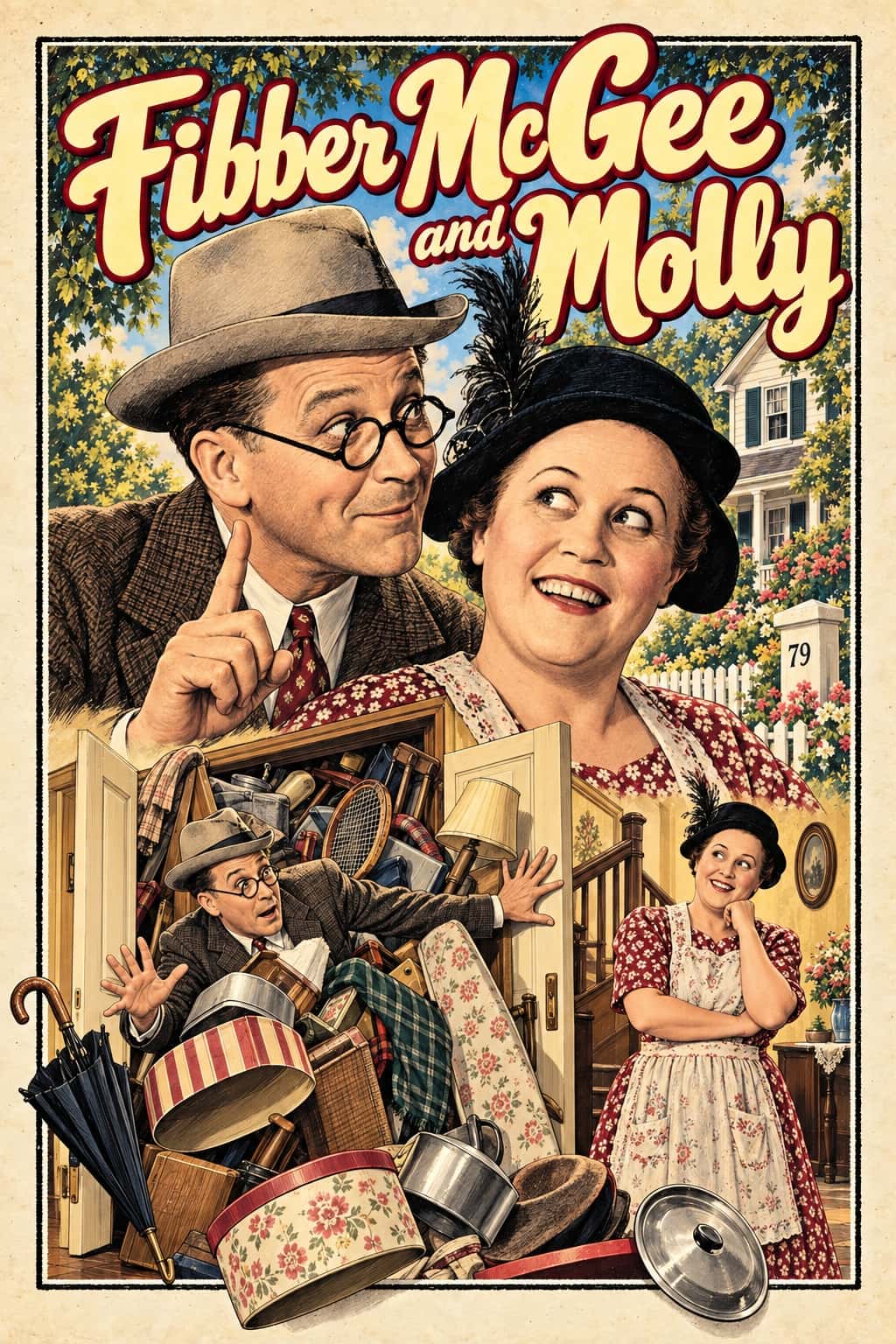
It's time for Fibber McGee and Molly. Sundays through Thursdays, NBC brings you Fibber McGee and Molly Transcribed. The show is written by Phil Leslie and directed by Max Hutto. Let's listen in on this conversation at 79 Wistful Vista before we begin tonight's story.
Who do you think is more important in a family, Molly? The mother or dad?
Oh, that's a loaded question if I ever heard one, McGee. But let me see now. The mother has to bring up the children, but dad has to bring home the bacon.
Kind of a fielder's choice, eh, gal?
Well, it sure didn't stump the Prudential Insurance Company of America. I guess that's why most people consider the Prudential's family income plan nothing short of a stroke of genius.
Come to think of it, you're right, McGee. It certainly does provide for both the bacon and the children. Let me explain it this way. You see, the family income plan is just the ticket for parents with growing kids. If anything happens to dad, the Prudential would send your family a regular monthly check, all during your youngsters' growing-up years. Money they'd need for groceries, a roof over their heads, and clothing. And that means mother wouldn't have to leave them and go to work. She'd be right at home with them, giving them all the care and consideration children just naturally need.
That's right, dearie. And because this plan covers the family during the youngsters' growing-up years, its cost is lower than you'd think. Ask your Prudential agent about a family income plan tomorrow.
Mr. McGee has been up in the attic this afternoon looking for his fishing tackle. And look what he just brought downstairs.
Yeah, a shoebox, Molly. It was down behind that old trunk up there. Full of old letters and old bills and stuff like that.
My goodness, we always did save more unnecessary junk. I wonder how long that box has been there.
I don't know, but I blew enough dust off the top of it to raise an acre of pretty fair potatoes. Most of this stuff is just circulars, you know, old bills, nothing important. Around the 1930s, from the postmarks. As I recall, the 1930s, that's all the postman ever brought us, bills.
Yep, and the 1920s, too. And the 1940s. Although we always had lots of fun.
What's that one? What are you looking at?
Here's a letter that looks like it never was opened.
Oh? What's the postmark on it?
Chicago. April the 15th, 1935.
1935. My goodness, been lying there. You've been hanging onto that box for 20 years?
Yeah, it looks like... Hey, it's from that radio station back there. You know, WMAQ.
WMA... Oh, the one you used to write to all the time with ideas for radio shows.
Oh, my gosh, listen to this. Dear Mr. McGee, we are interested in the idea you outlined for a husband and wife radio program. If you will bring your jokes and your wife to Studio C tomorrow at 9, we will give you an audition.
What? What? Well, for heaven's sake. Oh, for the gee whiz. An audition? Just think of that, Molly. This could have been the chance of a lifetime. Gone. Poof.
Hey, I wonder if I called that station long distance and told them the letter was delayed in the mail and...
No, dearie. 20 years later? No. They probably already got a show for that spot by now.
Yes. Say, wouldn't that have been something? If we'd have gone to see those people and they had put us on the radio, oh, Mabel Toops would have been so jealous she'd have hit Mort right in the head. I had a wonderful idea for it, too. What I wanted to do was just take a plain, average American couple, us, put us on the radio and sort of listen in on us and our friends. You know, just sort of a day in the life of that sweet, lovable couple next door.
Sounds pretty dull to me.
Dull? Would have been sensational. I even had a name picked out for the program. The Mr. and Mrs. Fibber McGee Show.
Hmm. Yeah, you could have just called it Fibber McGee and Molly. That's shorter.
Gee whiz, and I'd have had all our friends on it by now. Made them all famous, coast to coast. No telling what could have... Hold it, Terry. Come in.
Hello there, kids.
Hi, daughter. Hi, Johnny.
Hello, Mr. Oldtimer.
Hi, Oldtimer. Guess what happened? I got a letter here offering me a chance to go on the radio. Back in 1935, that is.
Is that so? 1935, eh?
Yep. Say, now, my girlfriend Bessie was on the radio around that time. Used to be heard every Saturday night over a station out of Chicago.
Oh. Oh. Out of Chicago, huh? That's where we...
Way out of Chicago, in fact. Oh. Chicken Gizzard, Arkansas. That's where the station was.
Yeah. Well, this letter...
Yes, sir, Bessie and her sister Essie. They had them a trio.
Oh. Bessie, Essie, and Tessie, they called them. Singers.
Bessie, Essie, and Tessie. Tessie was an Airedale. Beautiful voice, though. Sang like a bird.
Yeah? Trouble was, Bessie sang like an Airedale.
How about Essie?
She couldn't sing at all, daughter. Trouble with her teeth.
Crooked, were they?
Nope. Loose. She was all right on the low notes, but anything higher than a B-flat, she'd start to chatter like a stuck trigger on a rivet gun.
That must have been a fascinating program.
Yep. They'd be singing yet, I guess, if one of their fans hadn't kind of dropped a hint that the public was getting tired of them.
Dropped a hint, eh? What'd he do, write them a note?
Nope. He just snuck in one night and blowed up the radio station.
Well, I gotta go now, kids. Let me know if you go on the radio back in 1935, Johnny. I'll turn my crystal set back. So long, daughter. Bye.
There's more fun with the McGees shortly.
There's a saying that something out of sight is out of mind. Well, no wonder that buying United States savings bonds through your payroll savings plan is such an easy way to save. It's money you never see, so you never miss it. Your employer puts it aside for you before every payday. And out of sight, out of mind, these sums grow quietly without your reason. Before long, you have a stack of United States savings bonds. Money you never could have saved without this automatic way of having your employer save it for you. Savings bonds pay back $4 at maturity for every three you put in, too. So it's a most rewarding investment. If you have trouble putting money away for future savings, future spending, the payroll savings plan can be a great help to you. Ask your employer to enroll you before next payday. And don't forget, every dollar you invest in your payroll savings plan is an investment in freedom, helping to make your country stronger.
That dratted thing, I just can't stop thinking about this letter, Molly. Laying there all these years unopened, our big chance gone.
Oh, forget it. Personally, I've enjoyed every minute we've had together and...
Yeah, but when I think of my wasted life, well, I could have been rich. I could have been famous.
Famous for what, tallowhead? Your wife's good cooking?
Well, thank you, doctor.
Oh, so it's you, balloon britches. Well, come in, anyhow.
I can't stay. Just stopped to see if you want to bowl tonight, sonny. Eight o'clock. You and me against Kramer and Herb Travis.
It's a deal. I don't know just how I'll bowl, though, Doccy. I'm kind of upset this afternoon.
I know how you'll bowl, just like you always do. Lousy. Upset about what?
Oh, he found a letter today that we got back in 1935, doctor, and never opened. It was from a radio station offering him an audition.
No kidding.
Mm-hmm. Fate does watch over us, doesn't she?
Yeah. Imagine him. Imagine him on the radio. Oh, he's insufferable enough as it is.
What do you mean, insufferable? I'm as sufferable as you are, you big scoffer. And what's so funny about him asking me to be on the radio? I was in Vaudeville, wasn't I?
It's dead, isn't it?
Touché, doctor. Touché.
Touché, my clavicle. What does he know about the show business, anyhow, the big round square?
No kidding. Just think, Doc. If I'd opened this letter them guys wrote when it first came, back in 1935, and I'd have took their offer, and I and Molly had went on the radio, we'd have by now been famous, that's all. Made a fortune.
Where'd he go?
Out the front door, shaking his head.
Oh. Well, like I say, if I'd gone on the radio and took you with me, we could have made a couple of Doc backs already, what you want. Come in.
Oh, it's Mr. Wimple. Come right in.
Oh, hello, folks. Guess what I just saw. Oh, this is rare.
Yeah, what'd you see?
I was out in the woods with my bird book and binoculars, bird watching, and I saw a purple-crested, pink-rumped fluke bird.
A fluke bird? What the heck is that?
A very rare little creature, Mr. McGee. The fluke bird lives its entire life perched on telephone wires and builds no nest at all.
No nest?
None. At mating time, the little fluke bird lays its eggs on the gold ball on top of the nearest civic flagpole, where they immediately roll off and smash on the ground.
Oh, dear.
Once in a while, through some fluke, one of them hatches. One of them is on the way down, hence the name fluke bird.
But I almost forgot why I stopped in. I wanted to remind you that subcommittee PBG of the Elks Clubhouse Amusement Activities meets tomorrow night.
Oh, thanks, Wimp. I'll be there, boy.
Good. Goodbye.
What does subcommittee PBG stand for at the Elks?
Pinball games. I and Wimp and Snuffy Nolan are the committee, and once a month, we get to check all the pinball machines free with slugs.
Oh?
I'm kind of glad Wimp dropped in. You know, it took my mind off of that letter for a minute. Gee, when I think of what might have been, how different our lives might be.
What's writing down?
Well, I've just been jotting down your social calendar for the week, dear.
Oh?
Yes. You're supposed to bowl with Dr. Gamble tonight. Mort Toops wants you to shoot some pool in the morning.
Yeah.
Subcommittee PBG meets tomorrow night. You promised Teenie you'd straighten the wheel on her tricycle, and you've got to get your hair cut sometime this week. When would you find time to do a radio show?
Yeah, yeah, yeah. I am pretty busy at that. Besides, if we had gone on the radio in 1935, this would be our 20th anniversary. We'd probably be out in Hollywood going to parties every night. You'd have to wear your tuxedo all the time, and you know how tight that thing is.
Yeah, I guess it would be kind of a nuisance, wouldn't it? Never would have time to do anything we wanted, I guess.
You wouldn't have time to shoot any pool with Mort Toops, that's for sure.
Yeah, everything always sort of works out for the best at that, don't it?
Of course it does. I wouldn't trade the past 20 years for anything, sweetheart.
Well, I got work to do, so if anybody calls up here with any show business offers, just tell them Mr. McGee is too busy.
That I will do.
I'm going to get out my pool cue and give it a wax job, kiddo. Then put some laces in my bowling shoes, and then I'll get to work on Teenie's tricycle and try to have a...
We'll say goodnight to Fibber and Molly in a moment.
This is John Wald with a suggestion for the busy week. Why not cheer those tiring workday hours along by staying in tune with NBC's daytime lineup? In the morning, for example, you'll hear Mary Margaret McBride, your favorite woman commentator for many years, as she brings you items of interest on a wide range of fascinating subjects, from world affairs to household hints. It's a Monday through Saturday NBC feature that combines entertainment and information. And among the other morning favorites, there's the famous author of The Power of Positive Thinking, Dr. Norman Vincent Peale, who brings to listeners his expert guidance on spiritual and personal problems important to all of us. Then in the afternoon, dramatic entertainment to lighten your work as you follow the romantic and exciting stories of your longtime friends like Just Plain Bill, Stella Dallas, Lorenzo Jones, and Young Widder Brown. And for afternoon laughs, the delightful new serial Hotel for Pets. Tomorrow and every weekday, it's the best in listening here on NBC.
And now, Fibber and Molly, we have a young man here to see you two.
Oh? Us?
He's Mr. Jim Mitchell.
Jim Mitchell, president of the student body of Loyola University.
Oh, hi, Jim. How do you do?
Hello there. I have a very special message for Fibber McGee and Molly, and I'd like all your listeners to hear it, too.
Well, go right ahead.
To Jim and Marion Jordan, who for 20 years in the radio characters of Fibber McGee and Molly have brought hours of happiness beyond number to countless millions of listeners, and who, in the personal character of their whole life, have set an example of decency, dignity, patriotism, and integrity, the Associated Students of Loyola University of Los Angeles present this, a citation for their excellence as artists, and a token of our affectionate admiration for them as people.
Oh, that. Why, that's wonderful.
Yeah, thank you, Jim. We're very grateful to you and to Loyola. I hope we can always live up to this.
Yes. Good night.
Good night, all.
Fibber McGee and Molly is an NBC Radio Network production transcribed with Bill Thompson as the old-timer and Mr. Wimple, and Arthur Q. Bryan as Dr. Gamble. This is John Wald inviting you back tomorrow night to commence the 21st year with Fibber McGee and Molly. Join the great Gildersleeve for more fun in Summerfield tonight on the NBC Radio Network.