
The written record
Read the transcript
Read along with the recording · About 22 min to read
You're listening to the Old Time Radio Show on 71K News Talk Radio. Now back to Denver's old time radio history buff, John Dunning.
And thank you. We have reached Jim Jordan in California, and we're going to talk to him for a few minutes about Fibber McGee and Molly. Are you there? Are you there?
Are you talking to me?
Yeah, there he is.
I've been hearing those voices, but I can't, I don't know whether you're talking to me or not.
Well, I'm talking to you now. We were talking, we were just talking about Fibber McGee and Molly and some of the great stuff you did. You played Denver in vaudeville, didn't you?
Yes, I did. I played Denver a couple times in vaudeville. First time I played Denver was in 1917.
Uh-huh. I remembered reading that you had been here back around then.
Oh, yes. That's, we played, I don't know, there was the Pantages Theater. I was in western vaudeville. There were, I believe, was there an Ellis Theater?
An Ellis Theater? There were a lot of theaters like that down around on Curtis Street, I believe. I don't know.
Yeah. It was right in the theater district where the Orpheum and the Pantages and all of these were.
Yeah, yeah. I wanted to ask you, you made Fibber McGee such a part of Americana. I wanted to ask you if you were better known as McGee than you were as Jim Jordan. Did folks, did folks still call you Mr. McGee? Do they still?
Yeah. Yes, those who don't know me do.
Yeah. And the only people that don't are those that, you know, that I've known all my life.
Sure. I have a great picture of you standing at the microphone and, and Marian Jordan seated at the microphone and the caption under it says, Molly sits at the table, but Fibber, who is always keyed up, prefers to stand at the mic. Do you remember being keyed up for the broadcast?
No. That was in a Saturday Evening Post article around 1949.
Well, did they spell McGee correctly?
Wonderful. Um, you never had any mic fright at all, right?
No. You see, we started in radio in 1924 or 25. We can't remember which. And the microphone was, we just grew up with it, you know. So that when you, by the time you had 30 million listeners, it didn't bother you much. I mean, a thing that we found that out after we got through how many listeners we had, you know. As you, as you, it's a strange thing, but I saw a lot of people that came from vaudeville much later than we did, you know, that became big on radio and they were frightened to death of that microphone. And I, it was hard for us to understand that because we grew up with it. From the beginning, you know, it was supposed to be anybody listening and there wasn't because there weren't very many radio sets in those days.
Even movie stars were afraid of it.
Well, more than anybody else, they, they, they were actually, and I, I could never understand that, but that's how it was.
You know, when I go back and listen to some of those shows, I'm, I'm really struck by the, the wartime themes that you used around between the Pearl Harbor and the, uh, Pearl Harbor. And it seemed to me that Fibber and Molly was probably the most patriotic show that was on. You, you built them into the program.
Yes, that's right. Uh, was that, was, was it Johnson's Wax that decided to do that or, or your writer, Don Quinn or, or who?
Oh, I think everybody. Everybody. We didn't have any. You had Fibber grousing because he didn't have an A book or wanting to get black market beef.
Yes. Um, became a part of the show.
Oh, that's right. We did it because it was, it was, it was topical and it was easy to get laughs on that thing. Strangely enough.
How'd you always manage to start the show with a burst of laughter like that? Do you remember?
Start the show with a burst of laughter?
Yeah. The show always came in, in the middle of a laugh.
I don't remember anything like that.
You don't remember it doing that?
No. Um, you did Chico and the Man about five years ago, didn't you?
Yes. Uh, I was wondering how you could compare that experience with radio.
Well, I don't know. I don't know what, quite what, how to answer that or quite what you mean. Uh.
How was television to do in terms of difficulty?
I did. We did very little television, you see, because we, we stayed, uh, away from it as long as we could, you know, because it was, well, we just did because for what everybody said we should do, don't go into television until you have to.
Right. And about the time we decided to get into it. Well, that's when Mrs. Jordan, when Molly and Marian became ill, and so we never did get into it.
Um, they did have a Fibber McGee and Molly series on television, wasn't it?
Yes. It was, uh, Bob Sweeney and Cathy Lewis, I believe.
Yes. Uh-huh. Um, did you ever watch that show much?
Yes, I watched it some. Um, I don't know whether to ask you, but how do you feel it compared with the radio?
Well, I, I don't think, uh, I never thought of it in that way, never did compare it with the radio.
Well, I don't know. You all reached the top in the, uh, ratings around 1941, and the article, the same article that I read that couldn't spell McGee right said that, uh, that, uh, you had done it in, in a really, uh, strange way without ever getting into Hollywood society or playing that Hollywood game. Uh, was that accurate? You had never been in, uh, in with the Hollywood crowd much?
No, that's not accurate.
You had just come out from...
That can't be that fault. I'm sorry?
That just makes good copy.
Well, I'm sorry. We had all our friends here, and the same business we were in, the same as everybody else did.
You, the show started in Chicago, though, didn't it?
No. That's wrong, too.
Where'd it start?
New York.
Really?
Yes.
Uh, then, when you went on in April of 35, it started in New York?
Yes. We did four shows in New York, and then we went to Chicago.
Uh-huh. Did you do the earlier series in, uh, Smack Out in Chicago?
Yes, that was from Chicago. And that was what, uh, uh, grew, grew into Fibber McGee, right?
Yes. Well, that's what the, the people, that's what the Johnson Wax people really bought, that they started listening to Smack Out, and that's, they, that's what they bought. You know, they didn't, they didn't buy the name Smack Out, but they, that's, they listened to it for months, and then they decided that they would do something with it.
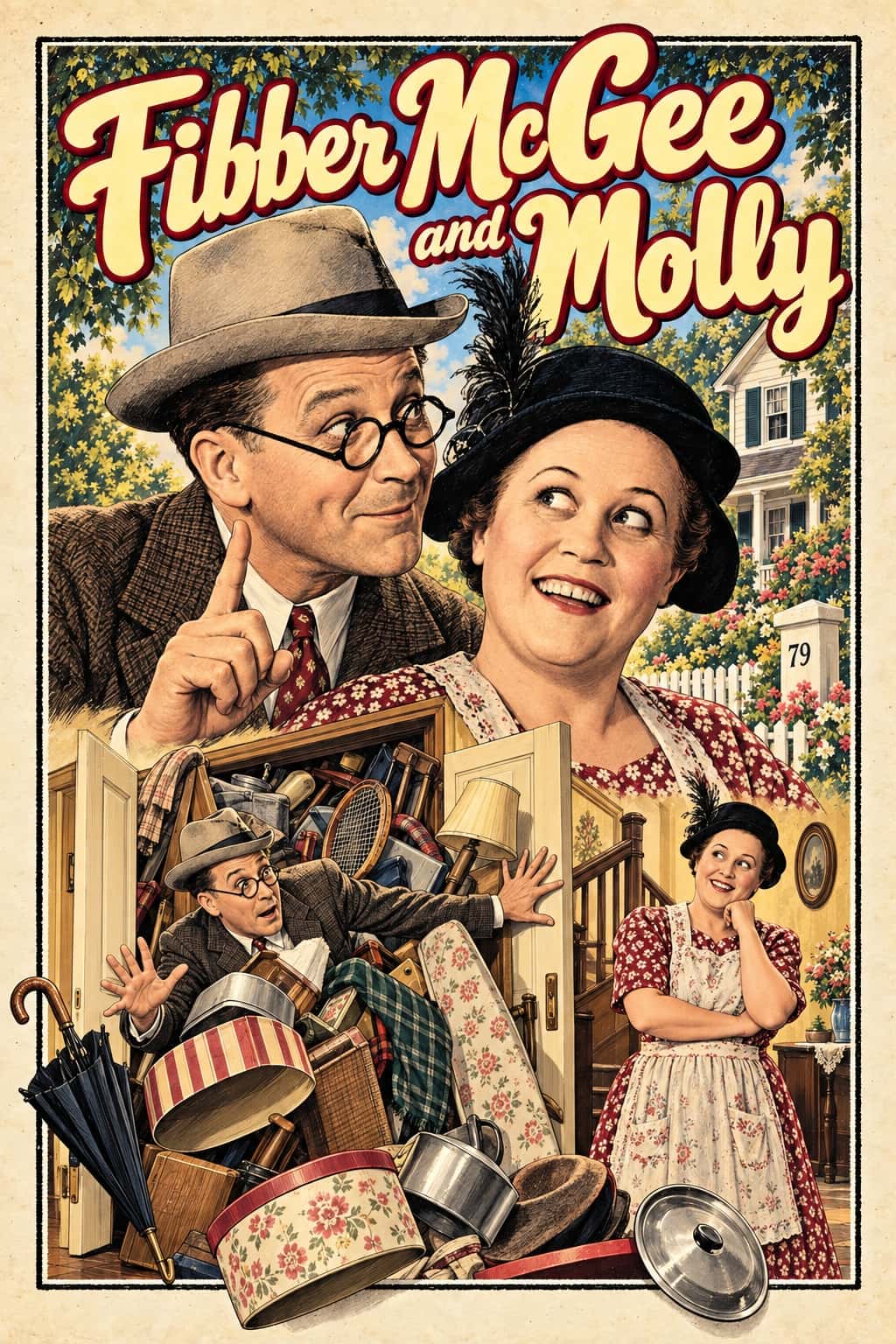
Uh, there was a, there was another line in there that, that I found really interesting. They said that the, uh, sound man who, uh, was identified in this picture as, uh, as Howard Tollefson, uh, was sitting there with all of this junk that you used for the closet, and he was constantly on edge, worrying about it crashing before the show ended, but it never did. He said nothing ever seemed to go wrong on the show, that it was kind of a charmed program. Uh...
That's correct.
Is that the way you remember it?
I don't remember. Tollefson? Howard Tollefson was the guy who was identified in the line as the, as the sound effects man. But it doesn't ring a bell.
No. It doesn't ring a bell with me. I know we had several sound effects men, but I don't remember anybody named Tollefson.
The, uh, the closet really was, is the one, is the thing that, uh, a lot of listeners remember, uh...
Yeah, that's correct.
...so much. But really, uh...
They say that the sound man sat there with all that junk around him. That's wrong. How did they do it?
We, it was, we used an eight-foot stepladder, you know, and we set it up on the stage and piled all the stuff very carefully on it. And then it toppled from, from the top. One, you didn't have to throw the stuff around or anything like people thought. It all came down the way we, the way you planned it to, most always.
And actually, the, uh, the closet was only used about one show in every ten, wasn't it?
Oh, toward the last it was. We used to use it quite a bit in the beginning, but toward the end, I think the last year we were on, we only did it two or three times.
Yeah. And the more we didn't do it, the more, more...
Yeah. The more popular it got, you know.
Yeah. Don Quinn was a wonderful writer, wasn't he?
Yes, he certainly was. Um, the, he, he used to listen to Vic and Sade. Did you know that?
What's that?
He used to listen to Vic and Sade. He used to, he used to, uh, love Paul Rhymer's work. Uh...
Paul did.
Yeah. That was a wonderful show, too.
Yeah. He was a great writer, too. Um... Paul Rhymer. He and I, we were very good friends. We all worked together, of course, in those days. We were all on NBC together when, before we, Smack Out was on, that was sustaining, and Vic and Sade was sustaining. We were all sustaining. Everybody. Because radio was, you know, it was difficult to sell in the beginning.
Yeah. Uh, you all had, uh, kind of a, a staff meeting, the three of you, you and Marian and, and Don Quinn, after the show to, to, to put together the theme for the following week. Is that how it went?
No. We did the show on Tuesday, and we took, Wednesday and Thursday, we took off. And we, we began to meet on Friday. We would meet with Don and, and the other writers and the director. And then we met periodically from then until Monday, uh, according to what, how things were going. And because we prepared, he had, the, the show was prepared for a staff, uh, the writers, the performers. Dress rehearsal, you might say, on Monday, you see.
Mm-hmm. And we had the show pretty much ready by, by then. You know, as we had the meetings and decided what was, what, what could be wrong, which is very seldom, we just went over it. And then if we had to do any corrections, we had time to get them done before Monday.
Who started the idea of building the sponsor into the show so that the, the mid-commercial became part of the show? Was that Don Quinn?
Well, no. No, I, I don't, I don't believe so. I think, uh, we, we knew how to do that when we started Smack Out.
Yours was the first show, I believe, to do that, though.
No, it wasn't.
Do you, do you remember who, who started it?
Yes. Gene and Glenn started it.
Gene and Glenn.
They, they did Quaker Oats, right?
That's right. And from Cleveland.
Uh-huh. With, with Jake and Lena.
Right. And they, they did integrated commercials. And all, uh, everybody started doing them.
Uh-huh. Uh-huh. And, uh, everybody started doing them along about that time. Benny did an integrated type of commercial, too.
He sure did.
Yeah. And, uh, I think he did it even before we did. I don't know. I don't, I didn't, I didn't know whether he had done that until he started with the Lucky Strike Show in, in the mid-40s, but I just, I just can't remember offhand.
Well, I can't either. Listen, um, I know you asked me not to keep you very long. I appreciate it.
That's all right. I don't care how long you keep me.
Don't you? Because I could, I could ask you questions for another, oh, five or ten minutes if you could.
You can stay on.
Oh, yeah. What, I didn't, uh, yes, that's right. I'm sorry I wasn't here. I forgot about it.
Well, listen, that's, that's fine. Um, I wanted to ask you, uh, I have an old radio guide in which you are standing on the cover with your bags packed as if you were hitchhiking a ride to California, and that's when you moved from Chicago to, um, to Hollywood, and I wanted to ask you, as you remember, what was the difference between Chicago radio and Hollywood as you found it when you got there?
Well, when we moved the show to Hollywood, we had, we had been to Hollywood, that was you, what you're talking about is 1939, right?
Right. And we had been in Hollywood for ten weeks in 1937, so that was not our first trip, actually, to Hollywood. We were here, well, we made a picture here in 1937, and it, the whole thing, I think it was about ten weeks, it was in the spring, anyway, several weeks, six, eight something, I forget exactly what. But, uh, I, uh.
But, uh, by the time we moved the show here, we, we had the experience in Hollywood before that, in other words.
Um, wasn't it, wasn't Hollywood more geared to movie stars when, when radio was, uh, being done about that time, though?
More geared to movies?
Yeah, Chicago was kind of a, uh, a serial mecca at that time, wasn't it? What is it? What was it? A serial. I mean, there was a lot of serials being done out of Chicago in the late thirties.
Oh, yes. Oh, that's where that, because, see, that was the hub, that was.
Yeah. The hub, that was, the reason for that was, it was central. You know, you go east and you go west.
So there had to have been a different kind of, um, of, of radio, um, atmosphere, I, I would imagine, wouldn't it? In Chicago?
Yeah. No. No, there, no. They, we had, uh, actually the first, Hollywood, uh, no. That's, that's right, I don't think. Uh, New York was real, was really the, was really the epitome, you know. That was, that was the epitome of, of, of radio in those days. And, uh, Chicago was, life, you see, that was for the, uh, soap opera and so on. And, uh, we did a lot of nighttime radio from there before we did Fibber McGee and Molly.
How did, um, how did Bill Thompson come on the program, do you remember? And he played all kinds of voices.
Yeah, he was a just a boy at this time and, uh, well we just met him. Uh, he, I, I can't, it just seems to me that he was there always, it was always there. He played Boomer.
Yeah.
And Wimple.
Yeah.
And, uh, the Old Timer.
I'm sorry.
Nick Dipholos.
Nick Dipholos, the, the Greek.
And the Old Timer.
Yes. And, um, Wallace Wimple.
Wallace Wimple, yeah. And, uh, he used that same voice, I believe, the Wallace Wimple voice, for Walt Disney in cartoons.
Well, he, yes, he used that, he used other voices too. He worked at Disney all the time in those days.
You lost virtually your whole show to the war, didn't you? I mean, they all went off in the war. Um, except for Harlow and the three of you. Uh, Bill Thompson was gone, Gale Gordon was gone.
Yeah.
And still you managed to come up with the same kind of quality all through those years. Uh, it had to have been the writing, wouldn't you think?
Don Quinn did, yeah.
Uh, were his scripts preserved? Preserved? Yeah, if they, if they've gone to some library somewhere, or no?
I haven't.
You have them?
Yeah.
Great.
Not the, not the scripts as he typed them, because he, he used the typewriter, but this is very different, difficult, you know, he wasn't a typist. But what I'm talking about is the scripts that were performed. As after we performed the script, we, we, we kept it, we saved it, and I have all of them.
Well, that's great. That's great.
That's not as Don wrote them, that's as they were performed. Between the original writing of the, uh, of a show and the performing of the show, you might, you know, there might be some changes.
How much last minute did you do?
Very little. Very little. We put the show to bed about two o'clock on show day, and that was it. We didn't have anything to do with it from that time until half hour before we went on the air. And that, we, our show went on at 6:30, and at 5:30, long about 5:30 somewhere in there, we had a, we had a reading around room, little conference room we had near our dressing room, and we just sat around there and read this. Every, you know, if we did the show right there. Right. And there you found, then you found any flaws. Many times there would be changes in the script between the dress and, and that reading, you know. And those were always typed and inserted into the script, everybody's script, so that everybody would have it. At that time, there wasn't so much there, but once in a while it happened that way, that changes, there could be quite a few changes. Generally there wouldn't be any, you know. But we never, we, nobody ran around and tore their hair or any of that. We didn't have any of that kind of business.
You worked the Breakfast Club too, didn't you?
Oh, yes, we did that.
Um, that would have been about what, early 30s?
Well, not regularly, we just went on.
No, as I recall, I don't know, I don't know how to answer that. Yeah, uh, we did that along at the same time we did it in the, when we were at the beginning of the Fibber McGee and Molly, perhaps the first year we were, perhaps probably on the Breakfast Club maybe four or five times during that year. We weren't on it regularly ever.
I have, um, probably everybody has now heard, uh, hundreds of episodes of Fibber McGee and Molly. I don't remember ever having heard any of the early show. I don't know if any transcriptions exist. Uh, Smackout, do you, can you tell me what the difference was?
No transcriptions of Smackout.
You didn't make transcriptions?
No.
What was the major difference?
Ever thought of such a thing.
Yeah, what were the major differences between that and Fibber?
Well, Fibber was done before an audience, and everything was geared to be faster and, and, uh, it was the difference between daytime and nighttime, that's about, that's about the main difference. And, and, and the presence of the audience. We didn't have an audience for Smackout. And, uh, then when we did Smackout, the, uh, I don't know if you ever heard that show or not. The reason you didn't is there's, there's no, there's no tapes of it, or there weren't. They didn't have tapes at that time, and there were no transcriptions made of it. It was sustaining, and NBC didn't care about having any tapes or transcriptions of anything. And a lot of the Fibber McGee and Molly early, trans, early shows were, were transcribed, and they were made, they were transcribed and they were made by the, made on big 33 and a third discs. I don't know if you ever saw any of those or not.
Oh, yeah.
Well, in the end then they were stored in the basement at NBC in Hollywood, and they warped. They got water down in there, something, and ruined whole raft of them.
Johnson's Wax kept a big batch of them, didn't they?
Well, I don't know.
Yeah, I think they had several hundred of them up there in Racine.
Well, I don't know. The discs, huh?
Yeah, yeah, yeah.
Well, I don't know. The discs are the, I think somebody went in and did something about those scripts that were ruined. Maybe they made tapes of them from the Johnson stuff. I don't know. But I know that they were down in there. A fair four years of them were pretty well loused up. Water got in down there.
It's five minutes to eight here in Denver, and we've been talking for the last 25 minutes to Jim Jordan, Fibber McGee of radio, and I want to thank you very much for coming on with us.
Well, I'm glad to talk to Denver. We always had a warm spot in our hearts for Denver. Back in that country, we've been, even since Mrs. Jordan died, Gretchen and I, we've been married now for 20 years, and we go to Salida.
Oh, yes.
We had friends in Salida that we were very fond of. It was Johnson. John Boyles. He's a lawyer. And he's, golly, I think he's in his early 90s now. His wife died just a few years ago. But that took us to Denver all down through the years. And then we had the basketball team, you know, the Fibber McGee and Molly basketball team.
I never heard about that.
Oh, yeah. We were in the Denver AAU tournament.
When was that?
Three or four times.
God, that's great. When was that? Do you remember?
Well, the last year was... 1952. I remember that because that was the Olympics. And we played the Denver Nuggets.
We just had a team called the Denver Nuggets.
We've got one here now.
That's right.
No, we played them in 1950. You had them then, too.
I don't know. I don't know. Is the pro team called the Nuggets?
Yeah, it is.
Well, in those days, there was no professional basketball. It was all amateur, all AAU. And the same club, that's right, the same team, went on and they just turned pro. I don't know how to explain that. But we had, in 1952, the pros were just beginning to be talked about at that time. Many of the players went from the amateurs into the pros right then. We had a couple of kids that did.
I would have loved to have seen one of those games. Did you bring them?
It was very exciting. They played basketball just as good as the pros played. You know, because they were amateurs, but they were all subsidized. They had to be, you know, to be able to spend that much time. Mostly, they were industrial. We were in an industrial league two or three years. And the Denver Nuggets were in it. And they weren't industrial exactly. And Fibber McGee and Molly certainly weren't industrial. But the big industrial companies that had teams in that league, they all broke their backs to, you know, for us to be in because, you know, because of the name and so on. And we, the top team in that industrial league, do you have time for all this?
Got about a minute and a half.
I'd love to talk to you some more about it. It's going to take an hour and a half.
Oh, gee. And they were the Phillips Oilers. And it was 1952 that we won the Denver tournament, the AAU tournament. And then we played Phillips Oilers in Kansas City for the right to represent the United States in the Olympics of that year. And Phillips beat us in three overtimes. But I just said that because of our association with Denver all down through the years. I would love to talk about this with you again. I'd love to get you on sometime when we have some time.
Okay. Can you do that?
Oh, sure. I would love it. I don't mind. I like it, too, as a matter of fact.
Well, we will sure. My trouble is setting it up.
Sure.
Doing it live. The other day I'd be here at 5 o'clock.
Yeah.
And at 5 o'clock, something else had come up I wanted to do, so I was gone.
Yeah.
Doing it live is a chore. And we've got a live newscast coming up in about 25 seconds.
Oh, okay. So I really appreciate you coming. Thanks much.
Well, thanks. We'll talk to you again.
Yeah, bye.
Oh, Jim Jordan, Fibber McGee. From California. And I've just got to get right out of here. We've got the news coming up at the top of the hour. We'll be back here tomorrow at 2 o'clock. We'll hear Suspense. And I forget what else. Some other stuff. And we'll have E. Jack Newman, the author of Inside the Third Reich, to talk about his work in radio. It is 8 o'clock, KNUS, Denver. We'll be right back.