
The written record
Read the transcript
Read along with the recording · About 18 min to read
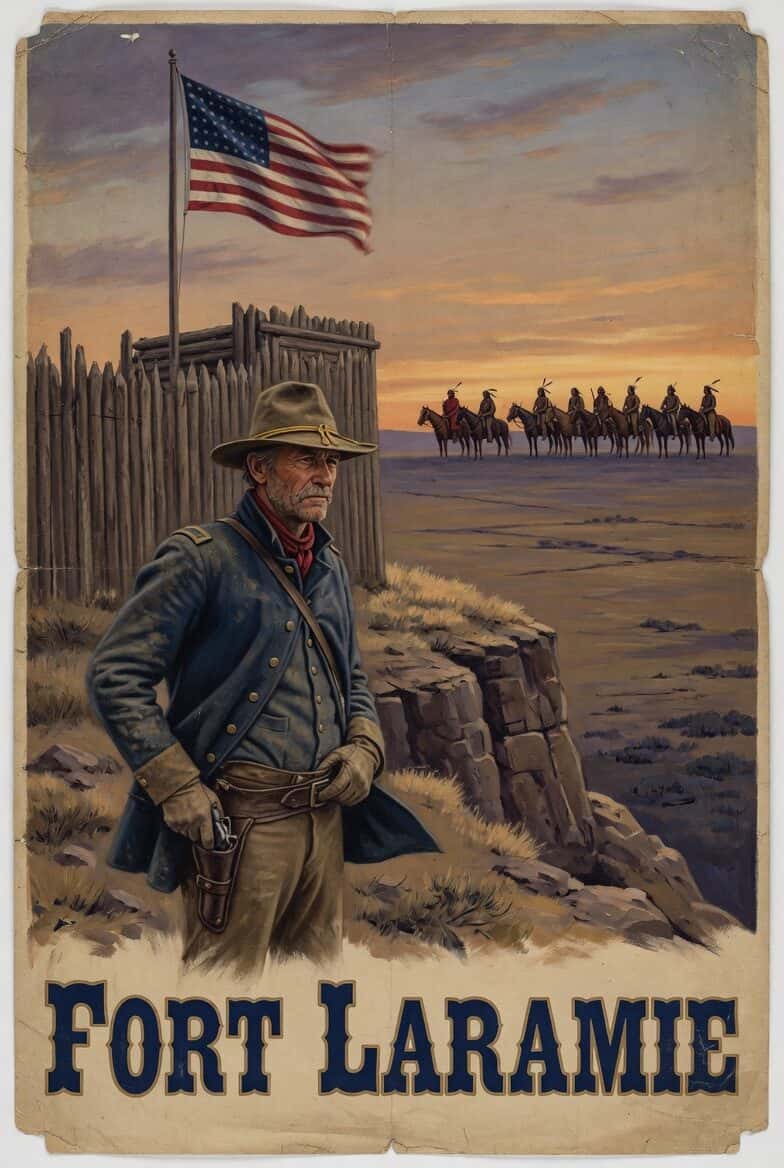
At the gallop, ho! Laramie, starring Raymond Burr as Captain Lee Quince. Specially transcribed tales of the dark and tragic ground of the wild frontier. The saga of fighting men who rode the rim of empire. And the dramatic story of Lee Quince, Captain of Cavalry.
You see that, Monk? I blew the top of his head clean off.
Beginning where?
Right at the eyebrows. Sliced him just as clean.
You figure that killed him then, huh?
Oh, sure, he's dead.
Well, I declare that makes a fair morning shooting, Harrison. Let me see now. You killed Crazy Horse, Black Leg, and American Horse just since I've been watching.
You ain't forgetting Roman Nose. You shoot him, too?
Oh, yeah, the last one. He was Roman Nose.
Well, now, ain't that peculiar. I'd have swore he was killed at the Beecher Island a year or two back.
No, I just now killed him. Hey, you think maybe they'll give me a stripe for that, Monk?
Oh, I don't know, boy. Seeing he's been dead that long, they might not figure it's worth no stripe.
Yeah. You ain't practicing much, Monk.
Oh, didn't you know? I was killed a while back whilst I took the time to reload my Springfield. Now, get me another.
Who'd you get, boy?
I missed the target. I guess I've been lying on my belly too long.
Yeah. Oh. It happens, don't it, Monk?
What happens?
Men get theirselves killed on account of having to stop and reload after every single shot.
Sure it happens. My daddy used a Springfield just like this one in the war between the states.
Your daddy used one in the Civil War, boy. Now, don't you start that up again. We both used them. Yankees and rebels alike. Now, if you're saying it's time we had a better firearm against the Indians, you're...
You're just right, Harrison. You are just right.
You tried them Spencers, Monk?
Sure. We had them in the war. They load right behind the bore. Their shapes are all right. Shorter, you know. Make better carrying for a trooper. But they ain't the answer.
I'd sure admire to try one. Captain Quince, him and them other officers, they got the answer, boy. Henry Rifles.
Yeah, them repeaters. You ever ask yourself any questions, boy, there'd be a good one for you.
How's that?
How come the only ones that's got them new Henry Rifles is some of the officers and most of the Indians?
I don't ask myself questions like that, Monk.
Make mighty interesting answers, questions like them.
Monk, you better hold your tongue. We ain't exactly alone.
Boy, you ain't never alone in the Army.
Don't stop talking in my account, man. I'm very interested in what you're saying. Must be. Seeing you was writing most of it down.
Oh, just making a few notes. Go on about the rifles.
What's he talking about, you suppose?
You got some business here, mister?
I have papers from Major Daggett giving me permission to move freely about the post.
Well, now, ain't that nice of the Major sending us a moving target to practice on? You some kind of spy coming around here in mufti, sneaking around in a rifle butts, writing down everything we say?
I'm a correspondent. I'm a correspondent for the New York Star. That's a newspaper.
You want to buy a paper, Harrison?
Who'd I get to read it to me?
All right, man. Maybe you can point out Captain Quince to me, then.
You're facing that way, Harrison. You point him out. He was up there at the head of the line. Now, I ain't saying he's there now.
I think I can find him. He would be the one carrying the Henry rifle, wouldn't he?
Harrison, I think I'm going to have to go. I think I'm going to pass that suggestion on to the Major. I think we'd do a sight better shooting at a living target, especially if he carried a notebook with him.
Yes?
Captain Quince?
That's right.
You're sure you are Captain Quince?
Something on your mind, mister?
I'll just take your word for it. I don't think I can walk anymore. My name is Harkness, David Harkness. I'm a correspondent. I'm from the New York Star. That is a newspaper.
Yes, I know. Did you walk out from New York, Mr. Harkness?
It feels like it. I think I have just been initiated into the Army, Captain.
Initiated?
Mm-hmm. The Major told me I would find you on the firing range. I walked there. The Sergeant said you might be at the cavalry stables. I walked there. From there, I walked to the saddlery on someone's advice, then to the corral, and to the post office. And finally, here to old... Old what is it?
Old Bedlam.
Old Bedlam. I think maybe your men wanted to be sure I had a long walk.
The men wanted to know who was listening in on private conversations, writing down what they said. I told them who I was.
After you made your notes.
That's right. The Major gave me a free hand on the post. I guess I used it a little too freely. I didn't mean any harm, Captain. Men will talk for you once they know you. And trust you.
Well, then you don't have any objection to my talking with the men.
No. Not if they don't.
Oh. Captain Quince, one thing I heard, uh, overheard, bothers me. Can I ask you about it?
Go ahead.
At target practice on the firing range, those men are still using single-shot Springfields.
Them and a few Spencer carbines.
Now, the men say they're outmoded.
They are.
The men are not issued Henry rifles?
We don't have them to issue.
But some of the officers have them. Am I right?
Some of us. I have one.
You have one, but your men haven't.
Mr. Harkness, my men make $13 a month. They can't afford to buy Henry rifles.
You mean to say you bought yours, Captain?
Like the rest of the officers who have them. At the sutler's store.
Well, shouldn't the army equip itself with the best possible arms?
Of course it should. But guns cost money, Mr. Harkness. So far, we can't afford the kind of guns we need.
Well, now, in Washington, they talk of nothing but appropriations for the army in the West.
Talk doesn't send us any guns.
Well, these Henry rifles, they are to be had. I mean, providing the army gets the money to pay for them. They're not in short supply.
A lot of the Indians have them, Mr. Harkness.
I heard that, too. I couldn't believe it.
I've seen it.
How do the Indians get them? Who in the world would sell guns the army needs to the Indians? Who are the Indians?
Oh, renegade whites, traitors, the kind of men who get rich in other men's blood.
I am a long way from home, Captain Quince. It's another world. I've got an awful lot to learn.
You never stop learning out here, mister.
Well, Captain, I'm here for a month. Can I learn enough in that time to give me a fair picture?
Well, you got a good start. You admit you got a lot to learn.
He sent for me, sir.
Sit down, Captain. Read this.
Well?
I'm just assuming that the anonymous captain in Mr. Harkness' story is you.
I talked to him, if that's what you mean.
I'd say you did quite a good job of talking, Captain. The men have outmoded equipment. The officers buy their own repeating rifles. The Indians have little trouble coming by Henry rifles. Do you want that printed in a large New York newspaper?
Do you?
I emphatically do not.
It's the truth.
Of course it's the truth. That's not my point. I'd like to know your point.
Ali, I don't want our tempers involved in this. I'm questioning your judgment, and I want some answers.
That's good. So do I. You sent this Harkness looking for me, right?
Yes, I sent him.
You knew he was a correspondent for a newspaper. You gave him the run of the post. That means he can ask questions and get answers, right?
Yes, that's right.
He asked me some questions. I answered him.
I see you did. It's an Army secret that we're short of equipment?
I've sent the same information on to Washington for months now. You know that, Captain? I've requested, I've pleaded, I've begged. And nothing's happened. They're a long way from the problem, Lee. The need diminishes with the miles between. This kind of newspaper article can stir up public opinion. I just wonder if it's wise.
If plain fact stirs them into action, I don't see it's unwise.
The Army moves its own way. I know you don't always agree with it, Captain, but if this article causes trouble, it's my trouble, not yours.
Then I'd say you'd better make up your mind, Major.
How's that?
Harkness, if he's got your leave to be here and take a square look at things, ask questions, get answers, you're gonna get articles like that one. If you don't want them, why, kick him off the post.
Did Mr. Harkness tell you how the people in the East feel about the Indians?
We talked about guns.
As I understand him, we're the villains, Captain. The Army. And the Red Men are all peace-loving hunters who never kill or plunder or raid.
Is that all, Major?
No, that's not all, Captain. The settlers along Fish Canyon have reported a rash of small raids. Take a patrol out tomorrow morning. Bring me a full report.
Right.
I want you to take Mr. Harkness along, Captain.
It's not my job to mind what he sees, who he talks to, what words he sets down. I want him to see all he can see and write all he can write, so long as it's true.
You'll tell him that?
I'll tell him.
Any questions, Captain?
No, sir.
Then move out.
Well, how are you riding, Mr. Harkness?
If I join the Army, Captain, I put in for the infantry. The other day, when you were walking, you wanted a horse.
Yeah, I'm hard to please.
You're a human.
How long will we be out, Captain?
Depends on what we find and who we find.
Major said we were going to talk to some settlers. About Indian raids.
Then we might find Indians, too.
Yeah?
Yeah. Or they might... They might find us.
I guess you never know, do you?
You never know.
Captain, will you let me know when we're in Indian country?
You're in it.
Oh? Oh.
Well, the settlers, I should think they'd want to live near a Fort Laramie for protection.
We'll be coming on some settlers soon. Ask them.
That was a deserted cabin along the creek, Captain. No Indian signs around.
What about the Callender place, Mr. Seiberts?
Straight ahead, sir. Fish Canyon.
Straight ahead? How far, Mr. Seiberts?
I'd say about two miles, sir.
Fine. Mr. Callender's the one I was telling you about.
I remember, Mr. Seiberts.
Oh, uh, you know Mr. Harkness?
We met last night.
Well, Lieutenant Seiberts was a big help, Captain.
That so?
I didn't do much, really. I...
What do you mean, Lieutenant? Those diaries of yours gave me a lot of valuable background.
Diaries, Mr. Seiberts?
Yeah.
Diaries, Mr. Seiberts. They're not much, sir. I... Well, it just gives me something to do sometimes.
I'd like to read yours sometime, Captain.
I... I'd have to write it first.
You don't keep any written record of your experiences out here?
No.
Well, I think there'd be a lot you'd want to remember, Captain.
Well, there's more I want to forget.
Two miles, Mr. Seiberts?
Two miles, sir.
Captain.
Do you want to meet a settler, Mr. Harkness?
I sure do.
Well, climb down, then.
All right. Oh!
It looks quiet enough here, Mr. Seiberts, but keep an eye alert.
Yes, sir.
Sergeant!
Yo!
Sergeant, take Harrison and Monk circle back by the barn, those sheds near the wash. Check the area for Indian signs. Report back.
Yes, sir. Harrison, you. Monk, come on, follow me.
Now, this would be Mr. Callender's place.
That's right.
Can't blame him for choosing this spot. Beautiful country.
That's as far as you go.
No need for the rifle, Mr. Callender. I'll be the judge of that. I have no use for the Army. Said so the last time. Say it again. Now, get off my land.
Guess you haven't been raided along here. Report said you had.
That's always your excuse, ain't it? Come snooping around. I'm on a man's property, claiming to look for Indians.
Seen any Indians, Mr. Callender?
Seen nothing. Now, you don't frighten me, riding up in numbers. I got my rights, and you're trespassing.
You don't have any trouble with the Indians?
Don't have no trouble with anyone, save the Army.
That one out there, young one, sitting his horse, so proud.
Lieutenant Seibert?
Their names no matter. Caught him here a week or so back, fired on him for snooping, sneaking up on a man's own land. Told him not to come back.
I know that. That one more bar you wear, don't make you any more welcome. There's still the Army.
Heard enough, Mr. Harkness?
No, no, I haven't. The Army is out here to protect people like you, Mr. Callender. What have you got against that?
I tell you, if you're too dumb or too greenhorned to know, there was no trouble out here till the Army came. Red men are all right. You know how to deal with them.
You'd better stop him.
Where is he?
That's far enough, Sergeant.
You all right, Captain?
You find anything, Sergeant?
No damage, Captain, but a lot of horses was here, backed by the corral. They're fresh marks, sir.
Got a lot of neighbors, have you, Mr. Callender?
All I need.
We didn't come on any settlers on our way here, Captain.
You heard him say it, Mr. Harkness. Red men are all right. You know how to deal with them. Guess maybe Mr. Callender, he knows how.
You're getting off my property now.
Thanks for the help, settler.
You better eat something, Mr. Harkness.
Oh, Captain, I can't. There's too much that just doesn't set well in my stomach.
Coffee, then. It goes down when nothing else will.
Thank you. Where are we camped?
Still in Fish Canyon? North end of it. We did a good job of covering the canyon today.
And tomorrow?
Well, we'll head back to Fort Laramie and report to Major Daggett. Five families slaughtered. And that's your report, isn't it?
That's about it. How do I do it, Captain? How do I show what I saw today to the people back east?
I don't know your job, Mr. Harkness. If I can write it just as I found it, maybe it'll jar them out of their complacency. Persecuted red men. Peaceful hunters. They're nothing but savages. They're butchers.
These Indians, yes.
What do you mean?
I'll tell you. I saw a slaughter once. The remains of one. Eighty men, women, and children huddled beneath a flag that was supposed to give them immunity. But they were killed anyway. Ridden down, slaughtered, hacked, shot. Indians don't put much value on human life, do they?
This was white men's work, Mr. Harkness.
White men's?
White army men. You saw this?
Some of us were sent out after it happened to move the dead to burial grounds.
Savage is a savage, Mr. Harkness. Color of his skin's no matter.
I'll try to remember that, Captain.
Once you see it, you don't forget.
What about a man like Callender? Indians have been at his place, too.
We think so. But he wasn't killed. His cabin still stands. Could be he trades with them. Horses, grain. Henry rifles.
Might be. Well, if you thought... If you thought he did...
I'd have to know he did, Mr. Harkness.
Yeah, you would, wouldn't you?
They're riding ahead. You, uh... You better get some sleep.
Captain, which... Indians. Help on the block. Mount and make for the rocks. Sergeant. Sergeant, pass the word.
Yes, sir. Mount and make for the rocks. Mr. Syverts.
Mr. Syverts.
Here, Captain. Harkness in your tent.
No, sir. You better mount, sir. Harkness. Harkness. Mount and make for the rocks.
You see him, Mr. Syverts?
No, sir, but he's armed, Captain.
Yeah, he'd better be. Now, let's go.
Dig in. Dig in and fire.
They're firing the camp, sir.
They can have the camp.
Any sign of Harkness, Captain?
I'm talking Indians right now, Mr. Syverts. Hold your fire, men. They're out of range. Now, let's see how we stood up, Mr. Syverts.
Right, Captain.
You all right, Harrison?
All right, Captain. I'd like to wake up this way every morning. That's the prettiest sight in the world. Indians riding away from you. Ain't that right, Captain?
Yeah, just right, Monk. I'll look on ahead, Mr. Syverts. You check the other way.
Yes, sir.
Over here.
What's the matter? You ain't never seen a little blood before, mister?
Captain, this man is hurt.
They get your gauze? Nick, that's all. Little Nick in the shoulder.
Thank you.
We had a thousand times, Captain.
Yeah, let's have a look. Oh, he's lost a lot of blood.
He's gonna make somebody a wonderful mother, Captain.
I think you'll live, Gorse.
I don't know. This sure ought to get me a couple of days in the hospital, don't you think? A couple of days of sleeping, spoon-feeding, maybe?
You, uh, you gonna live till you get to the hospital?
I can see I better save my real suffering for the medical officers.
Well, Captain, what do you think of it, Captain?
What's it supposed to be?
Oh, the account of the raid on our camp at Fish Canyon.
Yeah. Reads like the Battle of Bull Run with Indians.
Well, I colored it a little. You counted a hundred Indians, Mr. Harkness. I saw maybe 20.
Well, I did that on purpose, Captain. And Sergeant Gorse got a flesh wound in the shoulder. He didn't die a hero's death like the sergeant. You're a star here. Don't you see, Captain, the people back east, the people in New York and Washington, they've got to be blasted out of their beliefs.
It's lies about a pitched battle that never happened.
Well, you think they'll pay attention to the story as it really happened? You think that'll get you the guns and the equipment you need?
I don't know, Mr. Harkness. I don't know your business. When you came here, you said you wanted a fair picture of the West.
I still do.
You're getting it. We got settlers who get massacred. We, well, like the five families you saw in Fish Canyon. We get settlers like Mr. Callender who don't. We got red men who slaughter innocent whites, and we got red men who sit down at treaty tables and try to make peace.
Well, that, all that doesn't make exciting reading, Captain.
It makes life and death out here.
You're quite a realist, aren't you?
I live here, Mr. Harkness. The Army is always right?
Army's not always anything. Not always right, not always wrong.
You tore up the story, I didn't.
Well, I'm right back where I started, Captain.
Are you?
I've still got a lot to learn. And it's still a good sign, if you want to.
Fort Laramie is produced and directed by Norman Macdonnell and stars Raymond Burr as Lee Quince, Captain of Cavalry, with Vic Perrin as Sergeant Gorse. The script was specially written for Fort Laramie by Kathleen Hite, with sound patterns by Bill James and Ray Kemper, musical supervision by Amerigo Moreno. Featured in the cast were Lawrence Dobkin, Harry Bartell, Jack Moyles, Sam Edwards, Parley Baer, and Lou Krugman.
Company, attention! Dismissed.
Next week, another transcribed story of the Northwest Frontier and the Troopers Who Fought... ...fought under Lee Quince, Captain of Cavalry.
Many people who should know better sometimes use their automobiles to take out whatever is bothering them on other people. Keep this in mind. Driving too fast or trying to beat traffic lights doesn't prove you're better than the other guy. You can prove your superiority by setting a new safety record. Not only that, but you'll be around to enjoy it.