
The written record
Read the transcript
Read along with the recording · About 18 min to read
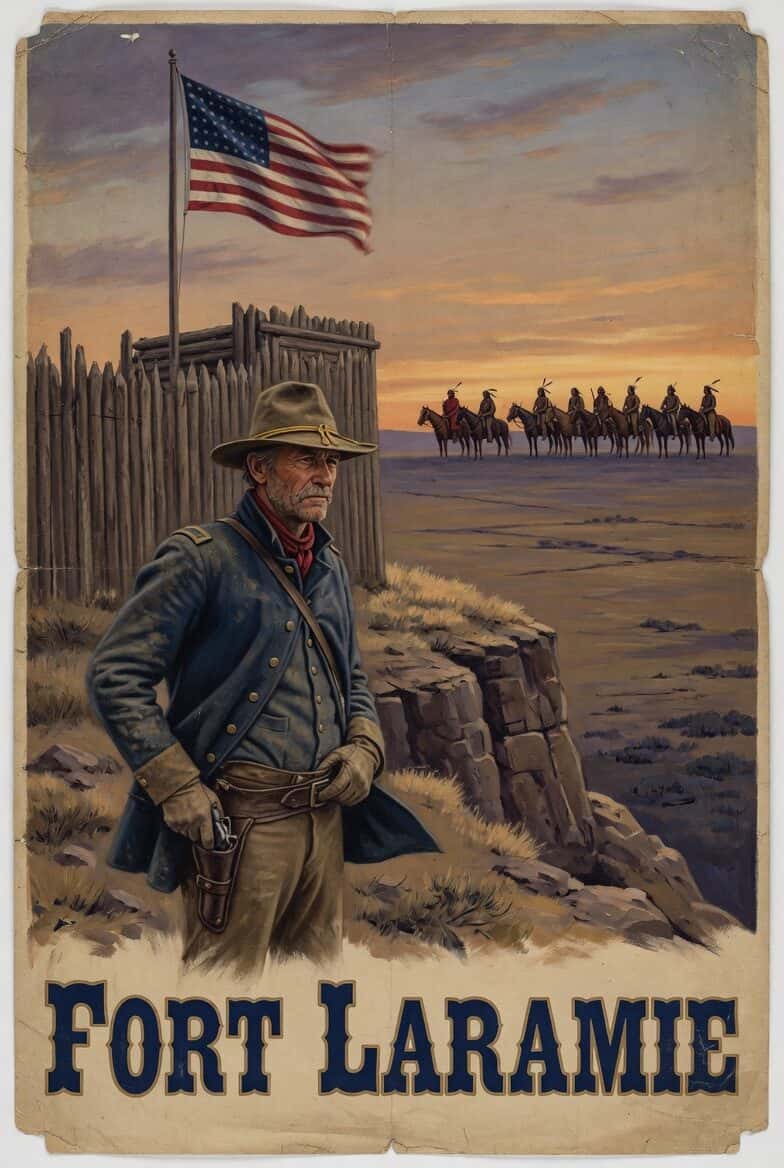
At the gallop, ho-ho! Fort Laramie. Laramie, starring Raymond Burr as Captain Lee Quince. Specially transcribed tales of the dark and tragic ground of the wild frontier. The saga of fighting men who rode the rim of empire. And the dramatic story of Lee Quince, Captain of Cavalry.
Is it White Dog's Camp, sir?
It's Shoshone.
That'd make it White Dog's. Unless there's more of a Shoshone migration than we know about.
You can tell from here it's Shoshone?
Look at their huts down there, Mr. Seibert. Made of grass and brush woven together, not skins like the Sioux and Cheyenne. Doesn't look like there are any lodge poles.
There aren't. They don't have any roofs, any lodge poles. Just a half circle of woven grass.
Harrison!
Yes, sir?
Bring on the white flag, Harrison. You and I are riding in.
Yes, sir.
You'll keep the patrol up here, Mr. Seibert. Keep your eye on Harrison's flag. As long as he flies it, there's no trouble.
Yes, sir. White Dog will understand. He'll understand that you've just come to powwow with him. Going in this way, he'll understand.
Ready, Harrison?
Yes, sir. Let's go.
Good luck, sir.
Thank you, Mr. Seibert. Watch it down through here, Harrison.
I'm watching. Major said a couple of hundred Shoshone. Looks smaller than that to me, Harrison.
I'll eat every one over a hundred we find, Captain.
I don't have your appetite, but a hundred's nearer right. Ah, they're beginning to notice us.
I'll lose all feeling in my arm if I hold it. I don't like this flag any higher.
Sooner the feeling than the arm, Harrison.
Yes, sir. Funny they wouldn't have no lookouts posted.
Well, either they're not expecting any trouble or they don't care.
You, lead me to White Dog?
White Dog in council.
In his hut?
Why White Army come?
We come in peace, to powwow with White Dog. Your flags say that. Will you lead me to your chief?
He talk with Ninambia. I not talk to White Dog when he talks to White Dog. He talk with Ninambia.
Just show me where he is.
You know Shoshone legend?
Yes, I know. There. In small canyon out by stream. Follow it. You'll find White Dog.
You going up into that canyon, Captain Quince?
Yeah, you stay here and keep that flag in plain sight. Feel it in your arm or not.
Yes, sir. Shouldn't have any trouble, unless it bothers you to be outnumbered by squaws and kids.
Long guns are not mine. They don't fret me, Captain.
Who's White Dog talking to?
Ninambia. Little people. The Shoshone believe they live in mountain canyons. Their medicine men counsel with them.
They can see them?
They believe they can.
You see any of them, you tell me, Captain?
I see any. Might be something I'd want to keep to myself.
Stand fast, Harrison.
Yes, sir.
Need counsel too, Captain?
I need your counsel, White Dog.
Sit, my son. You ride from Fort Laramie today?
Yes, sir. You and your people must be tired, as my people are tired. Your journey has been longer than ours, White Dog, and harder.
A journey is hard when a heart is heavy, Captain. We go to our home. This lightens our load.
You are moving your people without permission, White Dog. Shoshone cannot live in country meant for Ute, Hopi, Apache, Paiute. We are not root eaters. We know that. I think my people made a mistake putting Shoshone so far to the south in desert country.
Ah. But you have left the reservation, White Dog.
You come to take us back?
No. We have come in peace. And you find us in peace, Captain.
You have told me your people are tired, White Dog. Tired people, hungry people, sometimes break the peace.
Then you come to make us less tired? To feed us?
We have come to find out your needs. And to arrange for your safe passage to your home in the Wind River Mountains.
Good. And Ninambia told me of your coming. It was too much to believe.
There is no trick. I have always believed me before, White Dog.
You, yes. How long have you made your camp here?
Two suns have risen since my people put their huts by the stream.
Is it a good camp? You have water? Where is the hunting good?
My braves find game. Not buffalo, on which my people grow strong. They find bear, antelope, deer. In our camp, Captain, are many squaw, many papoose. And not many braves. Our number was more when we left Apache Reservation. But our journey was hot, dry. Now our burial ground is the length of these great mountains.
You have traveled too fast, White Dog.
Two enemies have pursued us. The blazing sun and the fear that when the White Army came, it would not come in peace.
When your people reach the valleys of the Wind River, when they are home, they will continue to live in peace?
You have my word, my son.
And I give you mine. We will grant your safe passage to your home. You will travel with us. We will camp with you tonight. Tomorrow, we will journey together to Fort Lyon. There will be orders waiting for us there.
Are you turning in, Captain?
It's a beautiful night, Mr. Seibert. Do you write about nights like this in your journal?
How can you put the Rocky Mountains into a journal, sir? It's kind of hard even to set them good in your mind and believe them. I never see them. I don't feel small. Trifling. The sky that clear and the stars so bright. I'm sure it must all have a meaning.
There's meaning in tonight, all right. Down there by the stream in White Dog's camp, the old man's telling his people that we've come to take them home. That the Ninambia told them of our coming. There's peace in their hearts tonight, Mr. Seibert. That has meaning.
I think it does. I think the men feel it, too, sir. White men, red men, bedding down under the same stars, nobody reaching for a rifle, nobody stealing up with an arrow.
Yeah, that's the way it ought to be. And every time it isn't, I get blazing mad inside.
Are you a religious man, Captain?
I got things I believe, Mr. Seibert. This, tonight, challenge of the mountains, peace of the stars, men living under them without fear. I guess that's pretty close to what I believe in.
That's a lot to believe, sir.
I believe something else, Mr. Seibert.
Yes, sir?
I've been working my jaw like an old woman. Must have used up a couple of years' words for me.
I was thinking I'll be able to put some of this night into my journal after all. Night, Mr. Seibert.
Night, sir.
That's just a coyote.
Just a coyote. You act like it meant something, Captain.
Not to me, but to White Dog and the Shoshone, the coyote is a trickster. You can count on it, Mr. Seibert. It'll mean something to the Shoshone.
We made counsel through the night, my son. My people will not follow White Soldier.
I heard the coyote, White Dog. My people heard, and I heard. In the legend of the Shoshone, it was Coyote, the trickster, who changed the color of our skin. Shoshone's skin once was white, Captain. You've told me. In the story of creation, when the Creator first breathed life into tufts of grass, the people called Shoshone were born with skin white as snow. Until one day, Coyote, the trickster, gave fruit to the white Shoshone woman, and since that day, the color of your skin has been brown. And since that day, Captain, Shoshone has known fear of Coyote, the trickster, and men whose skin is white.
Yesterday, White Dog, we spoke words of peace, you and I. We spoke of believing each other.
Yesterday, Coyote was silent. But the Ninambia, you said they told you of our coming.
You doubt the prophecy of the Ninambia?
My son, you find me here. I seek their counsel. Yesterday, they told of White Leader's friendship. Yesterday, you came in peace. Last night, Coyote warned. Today, Ninambia are silent.
White Dog. White Dog, you're a long way from home. I have orders to see you safely to your Wind River hunting grounds.
I have orders, too, from my people. We camped together last night. If we had come to harm you, we could have made quick work of it.
Last night, Coyote warned. My people listened.
You'd better counsel again with your people, White Dog. In one hour, we're moving on to Fort Lyon. All of us.
My son. Do you want to go by force?
I don't want to. Let us move our own way. Our belief is not your belief. And yet, we both believe in peace. You will keep peace if you go. Leave us alone. My people will look on that as a mark of trust. My son, believe me. A sign that we have your respect. This will bring much goodwill, much peace.
I'll do this much, White Dog. My patrol and I will report to Fort Lyon as ordered. I will powwow there with white chiefs. Tell them your wishes. If we do not return in two suns, you will know you are free to move in your own way.
Thank you, my son.
You'll need some sign that says you travel with the army's permission. I will leave you with two flags. A white flag and an American flag. When you march, see your braves hold them high. When you make camp, fly them in full view above your huts. You will accept the flags. A totem of trust between men.
You will not be sorry, my son.
I hope neither of us will have cause to be sorry, White Dog.
You seem worried, Captain. Is it White Dog or the Major's orders to return to Fort Laramie?
I'm thinking, Mr. Seibert. I always look worried when I think. You know, sir, I thought the commander at Fort Lyon was very cooperative. He seemed to agree with everything you told him about White Dog.
I'm not worried about him or White Dog or Major Daggett, but it's a long way to Wind River from here. White Dog and his people are a long way from home.
You figure him to be about two days behind us, sir?
About that.
That would be Harrison riding in, Captain. Must have come on to something.
Must have. Patrol, halt!
Captain Quince, sir.
What is it, Harrison?
Up ahead, sir, in the basin. Cavalry. Must be a full company of them.
They camped?
More like they've just stopped for a while. No real camps, sir. No pickets out.
Wonder what company it is, sir.
Well, it's not from Fort Laramie or Fort Lyon. We'd know about them. Might be someone from Kansas or Nebraska. I'll ride on ahead with Harrison for a check. Move the patrol up after us.
Right, sir. Let's go, Harrison.
Yes, sir.
He's still talking, Captain.
Talking, Harrison?
Like he was when I come on him. The tall one. And the rest listening. Must have a lot on his mind.
We'll leave our horses here. Walk on in.
Yes, sir.
Thank you, Harrison. The voice of God Almighty telling you, as he tells me, this is the glory road. God knows it is, brothers. I call you brothers. You are my brothers. And we travel this road together. Not as a company of cavalry. Not as a commanding officer and trooper. But as brothers. Soldiers in the arms. The glory of God Almighty. With just one supreme commander. So be it, brothers. So be it. And in the battles that are to come, we shall hear the voice together, you and I. We shall follow his orders to the death. And whosoever shall come between us and the voice shall perish. World without end. Amen.
Captain, is he a parson, that Major?
Might be, Harrison. Or maybe it's just like you said. He's got a lot on his mind.
You, Captain, do you pray?
I might.
Then pray now, brother, for the salvation of your soul. And for those of your brothers.
You in command here, Major?
God is in command here, brother. I'm Captain Quince, B Company, out of Fort Laramie. My respects, Major. Major Petrie, A Company, Fort Pierre.
You're a long way from Dakota country, sir.
I hope you're not questioning my right to be here, Captain.
I'm not questioning anything. But I'm interested in your being here. I take it you're not going on to Fort Lyon.
We shall go where our mission takes us.
At Fort Lyon, they think my patrol is the only cavalry between there and Fort Laramie.
You guard your territory jealously, Captain. Abase emotion, jealousy. As base as suspicion. I shall pray for your deliverance.
I don't want you praying for me, Major.
Ignorance is sin, brother. Ignorant, jealous, that may be. But suspicious I am of any man who talks about God and wears half a dozen scalps hanging from his belt.
I make a practice of reporting men who have no respect for rank, Captain. My commanding officer is Major Daggett at Fort Laramie.
I'd appreciate your reporting this incident, Major Petrie, including the six scalps.
I'll welcome you in Dakota territory any time, Captain. I'd say you have a lot to learn.
I was thinking the same about you, Major. We're at peace with the Indians in this part of the West. Are you? There's a band of Shoshone a couple days behind us. They have the army's leave to move to their home along the Wind River. Our paths may not cross at all. If they do, you'll find them flying two flags, a white one and the American flag. We've told them the flags will guarantee their protection.
We look differently on the American flag in Dakota territory, Captain.
That so, Major? Out here, it means liberty and justice for everyone. Come on, Harrison.
What kind of man is that, Captain?
The kind of man that scalps Indian women, Harrison.
Here's all the answer we can get out of Fort Pierre, Captain. Colonel says Major Petrie's on a reconnaissance mission.
Scalping Indian women's called reconnaissance nowadays, Major? You want to read the telegram for yourself, Lee?
I don't need to. I know what I saw. I know how you feel, Lee. We've got troubles enough without the army fighting us. Major, if you'd have seen his men, wild-eyed, frenzied, he was whipping them with his words.
What words they were?
Every officer has his way of stirring up his men.
Stirring them up for what? That's all I want to know. From the North Platte as far south as the Cimarron, the Indians are at peace. I don't know what his aim was. When you telegraphed Fort Pierre, did you ask the Colonel if Major Petrie's a minister?
The answer's there, Captain. He's a self-ordained minister.
Six scalps, Major. All right, all right. What do you want me to do? I had to call you back here. Captain Mathewson's got two companies detained in the Black Hills. We've got a garrison to secure, Captain. White Dog's two days late. If he was moving at all, he'd have been through here two days ago.
Maybe they're traveling a different route.
To get to Wind River? I don't know, Lee. I don't know, except I can't spare a patrol right now.
You can spare me.
For what? What would you do?
Step back, look for White Dog.
Not alone, Lee.
All right, give me Harrison, then.
Suppose you find White Dog and his people. They're not likely to feel any different. You offered them the protection of a patrol before. They're not gonna fear two men.
Maybe they're not. You, uh, you feel responsible for them, don't you?
I gave them the flags, Major. We don't know that they had need for any other protection. They're two days late.
All right, Lee. You and Harrison.
Thank you, Major. I'm not finished. When you find White Dog, I want you to make this clear to him. When he's off the reservation, he's entitled to Army protection. And by heaven, next time he'll accept an Army patrol, whether a coyote howls or not.
I'll tell him, sir. I want to be just, Lee. I want to treat Indians fairly, civilly. But when their superstitions get in the way, I lose patience with them.
I feel the same way, Major.
I'm glad to hear that. About an Indian superstition and a white man's fanaticism. Blind spots don't have a color, Major.
Well, I don't mind telling you, Captain. Gave me a turn at first. Seeing them come straggling up and make the camp right there on our creek. They didn't bother you?
No, no bother at all. Excepting just that they was there and they was Indians. It don't make a man feel real comfortable. My woman now, she just let out one long war whoop and made for the fruit cellar. Like never got her out of there.
She feeling better about it now?
Yeah, fine. Yeah, we got so we just sat by and watched them. They was cooking, cleaning their young, the creek. Never made a move toward us. Nor us toward them. Well, now, I got to be honest about one thing.
What's that?
I said we just sat by and watched. That ain't the whole truth. My woman turned her head more than one time. Them Braves don't wear much more than they're born with, do they?
Not much, mister.
Well, sir, the sight to end them all for me was when they first come in. Now, right away, they run up them flags as high as they could. I tell you, Captain, that flag looks mighty good, no matter who's flying it.
You say they left here day before yesterday?
Let's see. Yes, sir, I'm sure of it.
Heading north?
North along the creek.
Well, thanks very much, mister. We must have passed their camp during the night, Harrison.
Don't seem like we could have, Captain.
It doesn't. Is it just the two of you after them this time?
This time, mister?
Yes. Now, yesterday, there was lots more troopers. And the Major who talked to me, I think he said he was a Major. Well, anyways, he asked the same kind of questions. Only...
Only what?
Only when I told him about the Indians, he didn't smile the way you did, kind-like. This Major, he didn't smile at all.
Let's go, Harrison.
What kind of a lunatic are you? You are still in need of prayer, brother. You're rotten, foul, evil. You came upon the Shoshone camp? I never saw such a slaughter. Old men, old women, babies. Why? Why?
My report will say that we were attacked, Captain.
How many men did you lose, Major?
Oh, we were very lucky. And all the attackers were killed.
Do you like it, Major, killing women and children?
You'll... You'll get court-martialed for this. An investigating party should be at Owl Creek by now. We'll see who gets court-martialed.
Is that for killing Indians? They'll find the flags waving high over a hundred cut-up bodies. They'll find the rifles that were never fired. And there's no mistaking the fresh scalps around here. You call yourself a white man? Indian lover? I've no time for your kind. Women and children, yes. Nits make lice. An Indian that never grows up is a good Indian. Because... Because he's a dead Indian. And a dead squaw can't bear any more papooses. Not a solitary one. The killing's just begun. The Indians you haven't killed will massacre innocent whites because of you.
Savages answering savages. But your killing's the worst kind. Killing in the name of God.
Fort Laramie is produced and directed by Norman Macdonnell and stars Raymond Burr as Lee Quince, Captain of Cavalry. The script was specially written for Fort Laramie by Kathleen Hite with sound patterns by Bill James and Tom Hanley. Musical supervision by Amerigo Moreno. Featured in the cast were John Dehner, Lawrence Dobkin, Sam Edwards, Lou Krugman and Tim Graham. Jack Moyles as Major Daggett and Harry Bartell as Lieutenant Sibley.
Company, attention! Dismissed.
Next week, another transcribed story of the Northwest Frontier and the troopers who fought under Lee Quince, Captain of Cavalry.
You there, don't let that newspaper blow into the street. It costs us millions of dollars each year to hire people who will go around picking up after you. That us includes you. For trash collecting and rubbish disposal come right out of your pockets in taxes. CBS Radio urges you to help keep our streets and countryside neat and clean and less expensive to maintain.