
The written record
Read the transcript
Read along with the recording · About 20 min to read
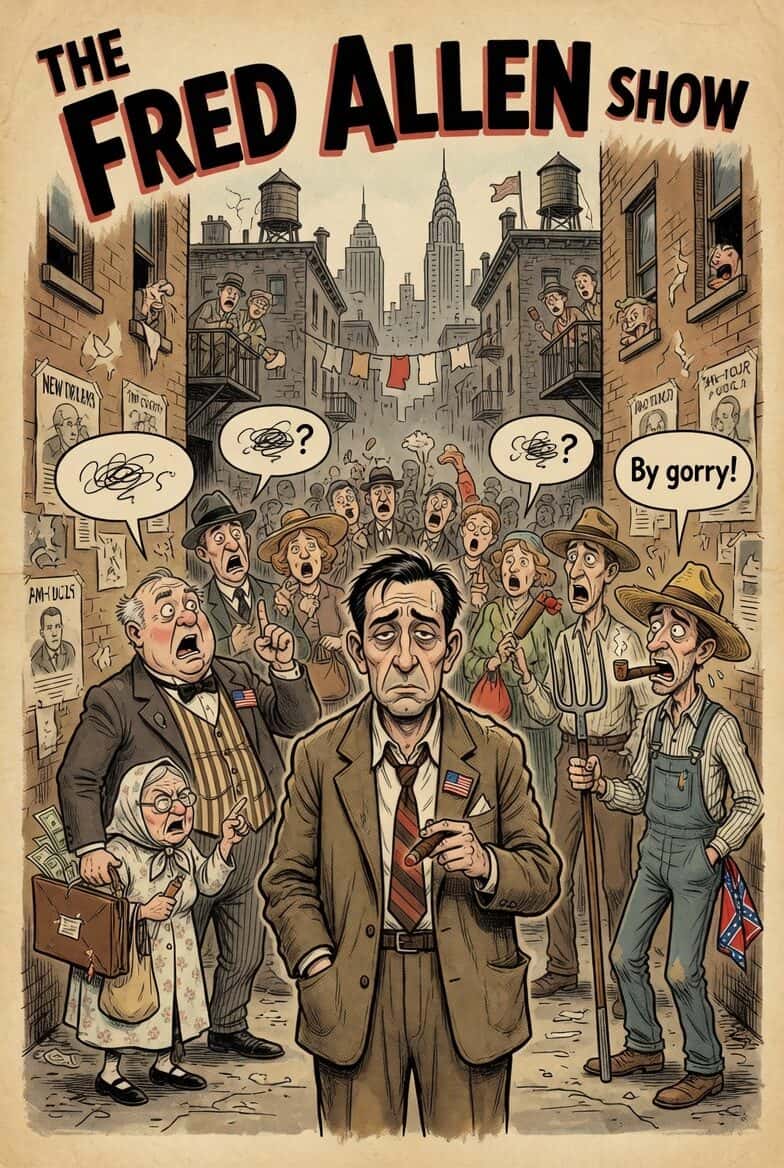
I can't think of anything tonight, kiddies. The makers of Blue Bonnet Margarine and Tenderleaf Tea present the Fred Allen Show, with Fred's guests, Orson Welles, Portland Hopper, Minerva Pius as Mrs. Nisbaum, Alan Reed as Paul Staff Openshaw, Parker Fenley as Titus Moody, the DeMarco sisters, and Al Goodman and his orchestra. And until I show up as Senator Claghorn, my name is Kenny Delmont. This week, ladies and gentlemen, a new book. The Weight of Vocabulary, Power, and Culture was published. We bring you now the new literary lion, whose name appears twice in this work. He's Fred Allen. Thank you. I'm laughing already at last week's show. Thank you. Thank you, and good evening, and good evening, ladies and gentlemen. Kenny, I'm really happy that you mentioned Dr. Funk's new tome, The Weight of Vocabulary, Power, and Culture. You know, I am now a part-time intellectual. If you ever pass Brentano's, look up.
I may be in the window. Well, have you noticed any difference since your name was mentioned in Dr. Funk's book? Well, yes, Kenny. I'm the talk of the literary set in subdued voices for the nods. On Fifth Avenue yesterday, Elsa Maxwell blew me a kiss. Elsa blew you a kiss? Yes, she was a little short-winded. It fell in the gutter, but I went over and rescued it. You know, you should expand your vocabulary, Kenny. Get hepped to words like tessellated. Tessellated. What does it mean? Well, thanks to Dr. Funk, I am now in a position to tell you. Kenny, tessellated means adorned with mosaics. Oh. What does mosaics mean? Kenny, don't press your luck. I'm only up to page 12 myself. When I get up to the mosaics, you'll hear from me by phone. Don't let me go on. Let me stand there reading punctuation. What is new? What's new, Portland? Mama said...
His name is in Dr. Funk's new vocabulary book. That is correct. And I would like to add at this time that Mr. Jack Benny's name does not appear in the book. Hasn't Jack... Two people from Waukegan. Well, the weather's breaking. Hitchhikers are out again. Jack, a large vocabulary. Two words he uses on his program. Yipe and hmm. You know, Benny takes spelling lessons from Red Skelton. I think Jack is pretty smart. Smart? He's always teaching Phil Harris new words. Phil Harris? Phil Harris is the moron's messiah. And he is still smarter than Mr. Benny. You know, when Benny finished grammar school, he was so old, instead of a diploma, they gave him a pension. Mama said you were the only kid in kindergarten with five... Well, look, when Benny went to school, he had to have a tutor to get through recess. The longest word Mr. Benny knows, you can get out of a no-bow player's mouth sideways.
Do you know any words? Big words? Have you ever heard the word tessellated? Yes. It means to be adorned with mosaics. Who asked you what it meant? Do you want to know what mosaic means? Never mind, never mind. You're reading the book from the back. I can see that. You women are making too much trouble today, Portland. I read that women want equal rights in the world under the UNO. Mama says behind every successful man, there's a woman. Oh, poppycock. Who discovered America? A man, Columbus. Columbus borrowed the money to make the trip from a woman, Queen Isabella. Who was the first mayor? Well, she's been dead a long time. Nobody knows. Who was the first mayor to have his own radio program? A man, Mayor LaGuardia. How did he reach the microphone? How? His wife put him up to it. Well, touche, and I don't mean that hand lotion, Portland. And speaking of hand lotions, we have a date with a couple of chaps in Allen's Alley.
What is your question tonight? Well, wait till the page boys laugh. Let the boys... My question this week... This week... This week, the department... I'll be glad when we're working on the street again. People going by, lads. Perfect. All indoors. It's confusing. Well, this past week, my question, Portland, the Department of Agriculture, concerned about the chicken surplus, called a conference to get housewives to buy more poultry. And so our question this evening is, have you heard about the chicken surplus? And if you have, are you eating more chicken to help reduce it? Shall we go? As the saw in the sawmill said to the knothole, I think I'll buzz along. Ah, it's good to get back to Allen's Alley, Portland. Well, I guess the senator's just finished dinner. There's a big catfish head on the lawn. See the flies off? Well, let's, uh, let's knock. Hey, somebody knock. Yes, I'll knock. Claghorn's the name. Senator Claghorn.
You're from the South. When I play bridge, I never sit north. Now, wait a minute, Senator. You know, Senator's best, it's quag on six and seven-eighths to three. Now, look, Senator. I shot a robin this morning. You shot a robin? I caught the little feathered traitor flying back from the South. Well, tell me, Senator, what is the reaction to this poultry surplus down there in Washington? Every time, I say, every time I mention chicken, Senator Hatch eggs me on. Oh, yeah. Hatch eggs, that's a jest. Son, you're just a dumb dodo. You're extinct, that is. Now, wait a minute. Let me get in here. Tell me, Senator, are you doing, personally, are you doing anything about this chicken surplus? I'm eating chicken every day. Good. I have my own recipe, chicken a la Claghorn. Chicken a la Claghorn. How do you prepare your fowl, Senator? First, I soak my chicken overnight in Kentucky bourbon. Uh-huh. Pardon me to go on here. Louisiana corn. Yeah.
I'll baste it with Mississippi mint julienne. Yes. Then I'll leave it in the skillet over a slow fire for two days. And the chicken's ready? I don't bother with the chicken. No? When I get through lapping up that gravy, I'm southern fried. Well, the senator certainly knows his culinary stuff. Well, let's see if Mr. Moody is here. Howdy, Bob. You look a little tired, Mr. Moody. Yeah, I had to shut up all night in the pig pen. Oh, really? One of my pigs had toe mane. Oh. Well, how could a pig get toe mane? I don't know. Must have had a piece of tainted swill or something. Oh! Oh, is something wrong? Yeah, I got the rheumatism in both arms. Just got a crick. Oh, that's too bad. Well, doesn't the rheumatism bother you working? Just milking. I can't move my arms. Well, how do you milk? Well, first I sit on the stool. Yes. I get a good grip. I see. Then I just hold on. And?
The cow jumps up and down. Well, tell me, Mr. Moody, what about this chicken surplus? Oh, there's only one way to stop a chicken surplus. Nip it in the nest. Nip it in the nest? You mean... Stop the hen from setting, from having more chickens. Well, how? Do what I done last week. What? Well, I put a dozen Chinese eggs in one nest. China eggs? And what happened? That hen hatched out the prettiest set of demitassi cups I ever seen. So long, brother. I've never heard of a hen and her cups before. Oh, well, that's, uh... Let's try this next door. No. Not Mrs. Nussbaum. You are expecting maybe Ronald Goldman? Tell me, Mrs. Nussbaum, are you doing your bit to help reduce the chicken surplus? I'm sending to Washington a slogan. Oh, what is your slogan? The war is over. We're through with bullets. Now is the time to start and pull it. Very good. Excellent. Are you, uh, beside the slogan, are you using poultry at home? For every...
meal in my house, I'm serving chicken. No kidding. For breakfast, I'm making wheaties. Uh-huh. Concealed in the wheaties is chicken gizzards. Chicken gizzards. You have coffee, too? Oh, instead of coffee, I'm serving piping hot cup of chicken fat. Oh, yum, yum. For lunch, I'm cooking chicken in style. Chinese chicken? This is egg for young. Uh-huh. Instead of I'm putting in chicken giblets. Oh, instead of the pho. Well, that should improve the taste. And you serve it Chinese style with chopsticks? No, with drumsticks. Oh, with drumsticks. What is for dinner? Roasted chicken is a boiled chicken. After dinner is coming chicken coffee. Well, what is chicken coffee? Instead of sugar, in the coffee I'm dropping two lumps of white meat. Well, chicken three times a day isn't your husband complaining. Complaining? Pierre is wanting even more chicken.
Well, how do you know? Yesterday, I'm catching him a bit too blonde. Don't you? Well, here we are at the end of Allen's Alley. What can happen at this last shanty? Hi-ho, all. It isn't Rudy Vallee. It's the poet laureate of Allen's Alley. Ah, I hope so. You have new poems for us tonight? Oh, indubitably. Have you heard that Mayor O'Dwyer to Mr. Quill surprised the subways are running still? No. Or, uh... Life said the worm didn't give me a break. If I was three feet longer, I'd be a snake. Well? Mother's spirits are low. They've almost hit bottom. She knows Gable is back and Garson has got him. Now we... This is the straw that sent the camel to the osteopath. Tonight we are discussing... Tonight we are discussing the chicken surplus. I know. I have prepared...
And what is your chicken surplus quatrain called? In rebuttal. In rebuttal. How does it go? The rooster flew to the hen house roof and crowed to the world at large his message conceived in rebuttal to the chicken surplus judge. We give up our lives, crowed the rooster, and I speak for each chicken and hen who has died and been fried through the ages to grace the tables of men. Today you proclaim there's a surplus, yet to death you continue to doom us. Your cold storage warehouse is cluttered with fowl and none, none to consume us. The real reason there's a surplus of poultry is the population has shrunk in New York. So don't go around blaming us chickens. Go take it up with the stock. Thank you, Paul Staff. And now from the fowl boulder all of Paul Staff, we turn with pleasure to the Chickery Chick Choir, the five DeMarco sisters, accompanied by Maestro Al Goodman and his surplus symphonist, the DeMarco sing Atlanta G.A.
And now a man with some details about a topic. When the topic is food, we all want details, so this is of special interest. How do you like your breakfast toast? Very thin and crispy, thicker and just lightly browned? Whatever kind you favor, it tastes extra good with Blue Bonnet. Yes, Blue Bonnet, the margarine that gives you flavor, nutrition, economy, all three. Blue Bonnet has a delicious flavor. Fresh, delicate, country sweet. And it keeps its delicate, delightful flavor even when half-melted on piping hot foods. Blue Bonnet margarine is packed with nutrition, too. Rich in food energy, rich in vitamin A. As for economy...
Bluebonnet saves you real money. It costs so little, you can spread it on twice as thick. And boy, you'll want it. Bluebonnet margarine is the product of the makers of Fleischmann's yeast. That fact alone tells you it must be good. Because shortages of table spreads limit your gross supply, he may be out of Bluebonnet temporarily. But keep asking. He'll have it. Remember the letters F-N-E for Flavor Nutrition Economy. Bluebonnet margarine gives all three. Flavor Nutrition Economy.
That was a miniature version of personality played by Al Goodman and his Union Squares. Say, um, say, Portland. Yes? You know, we have to get busy. Our guest tonight is Orson Welles. Is the gold mesh carpet ready? The gold carpet is ready? The man from Tiffany's brought the jade microphone. The jade microphone. I told him the turquoise microphone. Yes. Can the... preparation we have to make for Orson. Did you rehearse the Orson Welles fanfare? Oh, gosh, I forgot. Mr. Goodman, with that special Orson Welles fanfare, have your men chew on a little sen-sen before they blow their trumpets. Mr. Welles likes to smell something as he comes on. In fact, I would... Hey, this must be Orson now. Mr. Goodman, the fanfare, please. Stop, stop it, please.
You're not Orson Welles. No, no, I'm Mr. Welles' personal psychiatrist. Yes? I'm afraid Mr. Welles cannot appear on your program tonight. Can't appear? No, Mr. Welles is suffering from a complete breakdown of personality. But, doctor, you are a doctor. In some states, yes. Doctor, you mean the great Orson Welles, the brash, impetuous exhibitionist? Today, he is a cringing, beaten milquetoast. Oh, what happened? It was that role he played in his new picture, Tomorrow is Forever. Yes? He appeared as Eric Kessler, a frustrated, elderly Dutchman. Yes? It took eight months to make the picture. For eight months, Mr. Wells lived as Eric Kessler. Uh-huh. He still thinks he's Kessler. Eric Kessler? He has Kessler's Dutch dialect. He has Kessler's inferiority complex. Orson Welles with an inferiority complex? I can't believe it, Doctor. You must help him, Mr. Allen.
I have Mr. Wells in a rest home on 52nd Street. Uh-huh. But, uh... Doctors Leon and Eddie is the place I've seen. What then? What can I, uh... If you can induce Mr. Wells to face an audience again, he might conquer his focus. I shall do it. Let's go to the rest home, Doctor. But there's no one in here, Doctor. Quiet. Mr. Wells is hiding in the closet again. Be careful, Mr. Allen. If you upset him, this Kessler complex returns. He starts talking Dutch. Good luck, Mr. Allen. Thank you, doctor. Get a pitiful case. Orson Welles hiding in a closet. Orson. Orson. Come out of the closet, Orson. Nobody will hurt you. Come out, Orson. Ah, the door is opening. Orson, where? Orson, you remember me, Fred Allen.
Was you ever in Cincinnati? Look, Orson. Excuse me, the name is Eric. Eric Kessler. Orson, I'm your old friend. Was you ever in Cincinnati? Orson, you must snap out of it. Oh, everything is so confused. Think hard. Back in the dim, hazy past, you knew a man named Orson Welles. Orson Welles. Think. Think. Orson Welles. I seem to recall. Orson Welles used to walk down Fifth Avenue with a marmoset riding his arm side saddle. A fawn prancing by his side and 20 giant butterflies on silken leashes flew ahead, spelling out the name Orson. I saw Orson Welles one day carrying a cane. It was the hind leg of a gazelle. Orson used to strut into the automat, stand in front of those little windows and say, open.
Every single window would fly open. Well, listen, Mr. Kessler. That man with the 20 butterflies and the hind leg of the gazelle was you. You were Orson Welles. You're still Orson Welles, star of stage, screen, and radio. Fred. Yes? You left our television. That's the old Orson, the old blowhard coming down. You mean... You mean I'm not Kessler, the weakling? I am Orson Welles, the blowhard? Yes. You have got to convince yourself. Say to yourself, I am Orson Welles. I am Orson Welles. Good, good. Say it again. I am the great Orson Welles. I am the great Orson Welles. Let it ring out. I am the great Orson Welles. You're cured. The old power, the old ego, the old ham is back. Now you know who you are. I am Eric Kessler. Orson. Weren't you ever in Cincinnati? Orson. You're slipping. Orson. Oh, it's no use, Fred. It's nice of you to try and help, but now if you'll excuse me.
I'll go back into my little old closet. Now, Orson, we can conquer this complex. If you give one performance in public, your past would return. A long time ago, we did a play together, remember? Oh, yes, it was Les Miserables. Let's do it again. Oh, Fred, I'm frightened. Buck up, Orson. All right, if you insist, I'll do the play on one condition. Yes, Orson. You must be the star. You must do all the acting. All the acting. Just let me appear for a second, no more. Good. Fred. If you only speak one line, it will bolster your courage. Now, as we start, you can announce the play. Fred. It means mentioning my own name. I'm afraid. Steal yourself. You must conquer this inferiority complex. You can do it, Orson. Music, Mr. Goodman. Les Miserables. Is that all right? Can I go ahead? All right.
Go ahead, Orson. Victor Hugo's immortal story of a soul transfigured and redeemed through suffering. This is an Orson Welles production. Radio version of Les Miserables prepared by Orson Welles. Directed by Orson Welles. Starring Orson Welles. Orson Welles will be assisted by... Now, hold it. Now, hold it. Wait a minute. Wait a minute. Fred, did you hear I said my name? I said my name. And you said it plenty, too. What about my name? Well, I announced you, Fred, the music cut in too quickly. Now, watch that music, Mr. Goodman. Orson, you said you wanted me to be the star of the play. Now, if you're going to take all the credit, Orson, Orson. Well, if you ever envision that, it's... Yeah, he's slipping again. I am Eric Kessler. No, no, you are Orson Welles. That's right, I am, I am. I'm Orson Welles. What happened? You raised your voice to me, Fred. Remember my condition. Oh, I'm sorry, Orson.
Well, let's start the play. The play? The play? What play? Play Miserable. You remember? Yes, yes. I am Jean Valjean, the hunted convict. You are Javert, the detective, that merciless minion of the law, always on my trail. You do all the acting. All the acting. I'm the star. You just come on for a second. That's right. Fine, let's go. The first scene is a dingy garret in the slums of Paris. The story opens, I, Jean Valjean, am hiding out. I think I have escaped you. As we first see Jean Valjean, he is soliloquized. At last, Jean Valjean, you are safe. There is no cause to fear the Javert who has hounded you so long. Javert, your nemesis, that merciless bloodhound, always in pursuit of you, is finally thrown off the track, completely baffled.
But hark, that sound upon the stairs. Footsteps, those same plodding footsteps. Javert, what is to be done? Ah, this window. Jean Valjean will never be taken. Goodbye, Javert. Stop the music, Mr. Goodman. Fred, did you hear that? That was I, I, the old Orson Welles. I'm not afraid anymore. No, now I'm starting to get a little frightful. Now look, Orson, later, Fred. Now we start the second scene. Never mind the second scene. What about the first scene? It was wonderful, Fred. I'm getting that old feeling again. And I'm getting that old business again. Orson, you said I was going to be the star. But you are the star, Fred. What stole that whole scene? What? It was that knock on the door. And who knocked on that door? Javert. Never mind Javert. Well, you motivate the entire story.
If you hadn't knocked at that door, I'd still be in the garage. We'd have no place. Now, don't give me that. I'm supposed to do all the acting. I haven't even had one line. Must you ever listen to that? Take it easy, Orson. Watch that, Fred. Yes, sir. Yes, sir, I will. Well, what happens now? Well, in the second scene, you dominate the whole thing. I am just the stooge. The stooge. Well, that's more like it. What is the second scene? Well, it's years later. This time, you, Javert, have me trapped. Cosette Fabantou, a demimonde. is concealing me in the back room of a bistro. I, Jean Valjean, am pacing up and down. When you stop pacing, you're up and down. This is the end, Cortez, my farewell to freedom. Instead of liberty waits the galley crew, the iron collar, the chain at my foot, the dungeon, the plank bed, all the horrors I know so well. To submit morning and evening to the hammer of the round men who test the fetters. Time is short.
The net is tightening. Javert. Merci, Cosette. Jean Valjean will never be taken again. Au revoir. Javert. Now look, Orson. You were magnificent. Never mind that. Stole that scene right out from under my nose. Now look, let me tell you. Gaff, that suspense, man. Orson, please. I've seen Javert played a hundred times. The Theatre Guild, Moscow Art Theatre. At Grossinger's? Dan Johnson has played Javert. But I've never heard a Javert get the tone out of that police whistle that you got tonight. Now, look, I don't mind playing the schnook to help restore your ego. But now my ego is going. In two acts, all I've done is knock on a door and blow a whistle. Were you ever... All right, all right, all right, all right. The next... Go ahead with the play. The next scene is all yours, Fred. As you started to say, you trail me through the sewers of Paris. You finally corner me single-handed. And there we stand, face to face. I just have a few words, and then you... I finally speak. Well, it's about time. Let's go. Mondew, tell situation. Alone in this sewers. Rap like a rap.
The gloomy darkness. This narrow archway above me head. These two slimy corridor walls. The hark that's blushing through the muck. At last you cornered me, Javert. Don't talk, Javert. Or you seal my doom. I would speak for the last time. You will never take Charbel Char alive, Javert. The water in this sewer is rising. I am six feet nine. You, Javert, are four feet two. The water rises. No, no, not yet, Javert. Don't speak. The water. Higher. Higher, higher. Now, Javert. You have, Jean Valjean, your mercy. Pronounce my doom. Now, Javert. Speak. Speak. And now, Penny Delmar. His subject, the American woman. Everybody knows that American women are the most beautiful in the world. The best dressed and most charming and the best managers, too. Yes, Mrs. America is practical.
That's why she buys more tenderleaf tea balls than any other kind. They are so practical in daily use. Better in every way. They give you richer, more flavorful tea because they're made with tenderleaf brand tea. Famous for its flavor. That finer blend of choice tea leaves is put up in crisp, white, individual packets. Little envelopes made of tasteless filter paper. They're appealing to see, dainty, convenient to handle, and absolutely insoluble in the hottest water. Your tea is filtered crystal clear as it's being made. And it's made in a hurry. When you want a cup of quick comfort, just pop a Tenderleaf tea ball into a cup, add boiling water, and there you are. So be practical for every good reason. Ask your grocer for Tenderleaf brand tea balls. Now, before we pack away the Tenderleaf tea and Blue Bonnet margarine for tonight, here's a final word from Fred Allen. Wash you ever in Cincinnati. Thank you, Eric Kessler. Next week, Eric Kessler's guest will be Carmen Miranda. Who knocked all this?
This is NBC, the national broadcasting company.