
The written record
Read the transcript
Read along with the recording · About 29 min to read
My name is Richard Lamparsky, and as I promised you a couple of months ago when Al Hodge was on this program as Captain Video, he'd come back and be the Green Hornet. So thanks very much. That was my pleasure. Do you feel more like the Green Hornet today? I am not really sure what I feel like today. You're a little of both. You were the first, right? The first Green Hornet, that's correct. Which began in 1936? 1936. And you were on until how long? Until 1951 when I went in the service. And then I think the program itself went on until around 1951 or 1952 after that. I did go back, though, after I held his charge in the service and did it for about five or six months before I came to New York. You did the title role again? Yes, I did. Was it always done from Detroit? Yes, always. Right to the end? Right to the very end. Yeah, I remember very well on WXYZ, which would be the Blue Network or ABC, I guess now. Well, that, as you well know, of course, was the home of the Lone Ranger. Yeah.
Challenge of the Yukon. Who is Sergeant Preston? Well, Sergeant Preston originally was Paul Sutton. And then later, when the Lone Ranger went off the air, Brace Beamer, who played the part of the Lone Ranger, stepped in and played Sergeant Preston for a while. Brace Beamer, I think, is dead now, isn't he? Yes, he passed away a little over a year ago. Amazing. That had enormous popularity in the Midwest, because I remember the Lone Ranger was on Monday, Wednesday, and Friday. It was a Tuesday or Thursday with the Greenheart. The Greenheart was on both days, Tuesday and Thursday, so we had a strip at the same time, 7.30. That was a half hour. That's right. The opening, I have a copy of the opening, but it was put out by two whole programs, as a matter of fact, put out by Special Recordings, which is a firm in Detroit, Michigan. I'm not going to do a commercial, but if anyone wants to write me for the address, you can buy these things.
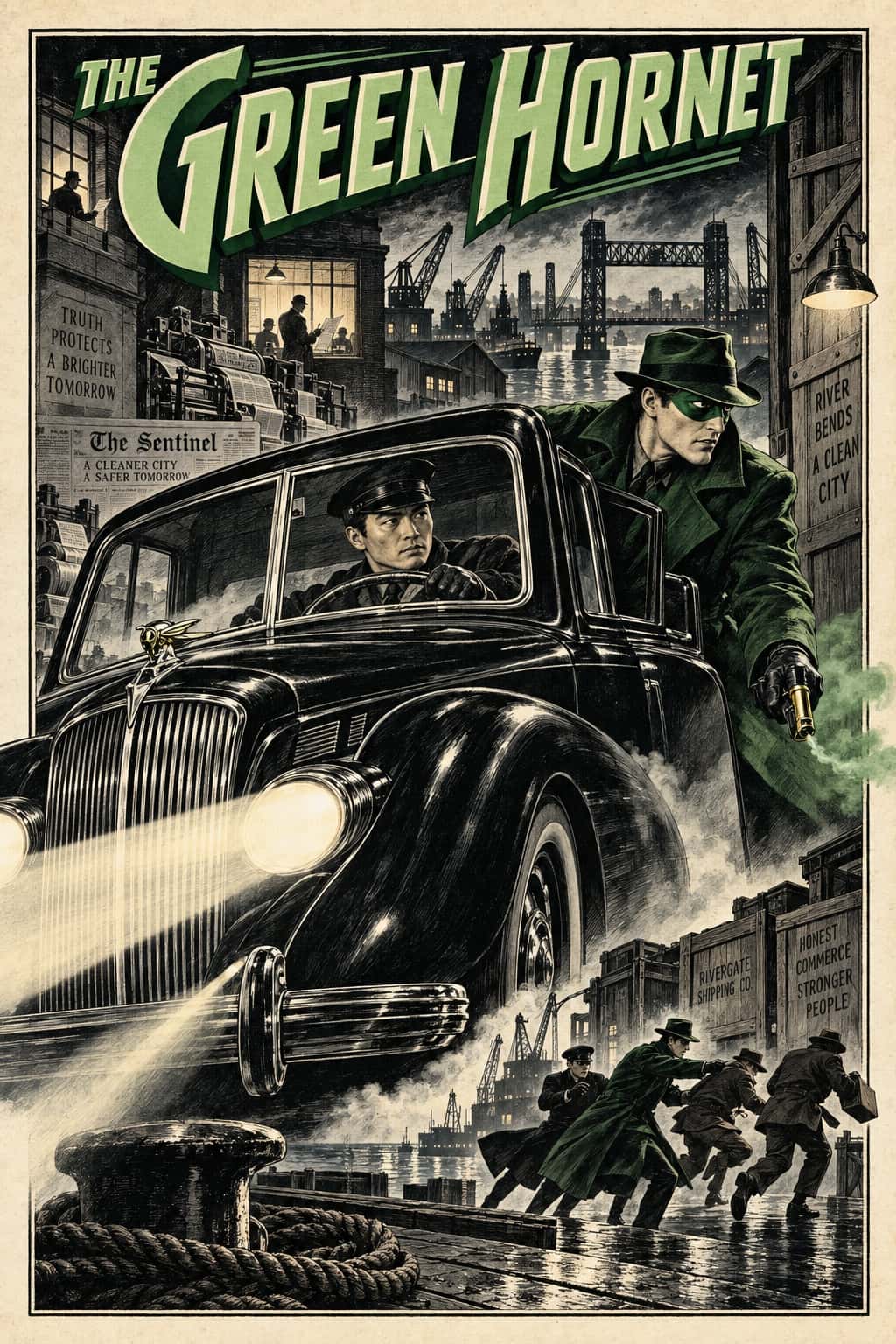
They have an album of the Lone Ranger, which is an original, two original Lone Ranger programs, and one of the Green Hornets. Let's play the opening now, so people get an idea of how it began. One Green Hornet. The biggest of all game. Public enemies who try to destroy our America. With his faithful valet, Tito, Britt Reid, daring young publisher. Matches which with the underworld. Risking his life that criminals and racketeers within the law may feel its weight by the sting of the Green Hornet. Ride with Whitreed in the thrilling adventure of A Matter of Evidence. You were doing takes when that was on. Now, what were you thinking? Brings back a few memories, Richard. It has to. That ending, I think, is a little bit different than the one I remember. I'm sorry, I don't mean the ending. I mean the introduction. Yeah, I know. The biggest of all games. That's right.
public enemies that even the G-men could not trace. That's right. The one I recall. Yeah, there was a story, which I think you mentioned when we were discussing this before, that the FBI objected to this slanderously because there were a few crooks around, apparently, that the G-men couldn't reach. But that really was not the intent of the statement. You see, George W. Trendle, who owned the program, the same gentleman, of course, who had the Lone Ranger for so many years, was an attorney. And he got some of these cases from his original file. And when he said that G-Man cannot reach, he meant that they were operating inside the law. So legally, they had every right to operate. And as such, of course, the G-Man could not touch them. It didn't have anything to do with their inefficiency. It meant that because of certain legal tricks, they could not arrest these people. That's right. It was G-Man could not reach, not G-Man could not trade. Exactly right. So I rather doubt the authenticity of the story about it.
J. Edgar Hoover or the FBI objecting to this. It's possible. Of course, legends arise as time goes on about so many things. That came from the great radio hero, the Jim Harmon book, I think is what I got that story. It was a complaint by the FBI that changed it. Could be. I read some things in the book, and it's a fascinating book. Of course, he has three chapters on WXYZ and these three programs that came out of that. I didn't realize it was, for a while, a local program. How long was it just in Michigan? I don't remember, Richard. It started out that way, only on the machine radio network. They had a seven or eight station network. And as I remember, it did go to Toledo and then eventually, of course, went coast to coast. Because it really was required listening. I think any kid who grew up in that era, in that area, also, you know, the other ones like Tom Nix and his Ralston straight shooters or Captain Midnight or Jack Armstrong, you'd listen to either one or the other.
My friend Eugene, who lived next door to me, or my cousin Bob, they would listen to one, and I would listen to the other, and we'd discuss the next day. But in the evening, you would listen to the Green Hornet. There was just nothing else. Like the Lone Ranger. Yeah, that's true. Of course, they were stripped five days a week right across the board, and sort of got in the WXYZ habitat eventually. I never watched the TV version. I guess it isn't on anymore. No. Yeah, do they have a black beauty? I think they are doing some repeats on it now somewhere, but no, they're not making any more. Do they have a black beauty? Oh, by all means, a beautiful kind. You know, I always thought the black beauty was the Tucker. Oh, yes, with the cyclops eye in the front. When that first came out, I thought they copied the Green Hornet. Well, we made a picture of it. We did a serial of it in Hollywood. I say we, I didn't. Well, I did in a sense. I did the voice over on the film. Actually, Gordon Jones.
who his picker named Jack Jones' uncle, Alan Jones' brother, was the Green Hornet in the first serial film made of it by Universal in Hollywood. And they had the thing all shot and in the can, and he was excellent as Britt Reid, but he didn't seem to have enough toughness or guts, if I may use that word, in his voice as the Green Hornet. So they asked me to fly out there. This was in 1938. I remember taking a DC-3 and hopping like a barnstormer across the country in this thing. go to Hollywood and do the voice on it. And we did it on 40-foot loops. I never saw the picture. All I had was the soundtrack to listen to and a headset on. Oh, I think I saw all 13 chapters at the Cinderella Theater on Curtisville Avenue. Sure. But I did the voice on the thing then. What were you telling me about the people who own special recordings, the ones that... Oh, yeah, that's owned by the Two Front Feet of Silver, the Lone Ranger's famous stories. Two Front...
being two gentlemen named Ernest Winstanley and Fred Flowerday, who have special recordings now. And that is their company. It's funny, you know, that a lot of programs, not a lot, but a number of them came from Detroit, Chicago, and Cleveland. I guess none do now. Don McNeil's Breakfast Club still comes from Chicago. I can't think of any other national program that comes from the Midwest. Can you? I'm thinking, and I honestly can't... Either TV or radio. I can't think. Of course, there's a little network radio now, Richard. I don't... I can't think of one, frankly. But there's no TV show either. But I know. They used to do the... What's the show that's now out of Philadelphia that came from Cleveland? Mike Douglas. That's right. He came from, I think, Cleveland. But that'd be that syndicated show. There's nothing close to COVID. I don't think there is at all. And there were a number of them that came a lot from...
chicago yes i think the battle of the sexes the one that julius anderson used to do with frank crummett i think was from well that used to be kind of an actor's progression if you wanted to work as an actor in network radio you would start out doing the local work somewhere and then you never came directly to new york you went probably first to detroit if you could and played bit parts because of course detroit had its own stock company and this was pretty hard to crack it seems amazing going back You know, to Detroit now, because I was there about a year ago. Because there's nothing that would suggest there was anything like that ever went on. Of course not. It's all gone. I mean, just 30 years. I love some of the things that they had on that Green Hornet. I didn't listen to this recording, which you can buy, by the way. If anyone wants it, just write it to me. I'll give them the address of either the Green Hornet or for the Lone Ranger. They're both available. But the gas gun.
I just remember they always said, take it, rat. That's right. Is that the stuff they sell in pencils now that Gerald Sturt and the Mashers stays? Oh, I don't know. I think this is probably just as efficient. He never killed anyone. He left people out cold for the police. That's true. You know, this happened to me twice. It's very strange because in the Green Hornet, I had a gas gun which simply immobilized people until you managed to either tie them up or make an escape. And later on, when I got into television, they did Captain Video. The ape was the same sort of a gun. I had something like a stun gun. And again, you simply immobilized people. Never let me kill anybody. A stun gun? That's right. Flash Gordon had the paralyzing ray. That's right. Speaking of Flash Gordon, did you look much at that book before we began? A friend of mine named Woody Gellman sent me a book. He's a big nostalgia nut. And this is an enormous book. I wonder what it measures. It's called...
Flash Gordon, a classic from the golden age of the comic. It's a beautifully done book in a rather peculiar shape. It's huge with the old Flash Gordon comic strips in it. It's amazing all this interest lately in these comic book characters. But this is very nicely done. I guess it's out in the bookstores now. I don't know who the publisher is. It's by Alex Raymond. And I know Doubleday has it because I saw it in there the other day. Flash Gordon. I guess you just go in and ask for Flash Gordon. You can pick it up there. It's amazing, all this interest. Now they put the Batman on television, and they had Green Hornet for a while. It's funny. I wonder why that is. These were closer to a space age now. You'd think they'd be less impressed by people who could go from one planet to another. Well, that's true. Maybe the answer is that since we are now really doing it in so many areas, it may have more interest because of that, because it used to be pure fantasy.
And now a lot of science fiction is more science than fiction. Yeah, it's funny. I asked when we had the group on from the, did the old Buck Rogers show. Did Buck Rogers and the girl who played his girlfriend and the doctor, you know, always the, not the mad doctor, the good doctor who was on a select flash court and a Dr. Zarkov. And I said, did you ever think that you'd live to see the day when these things would become within the realm of possibility? And they all said, no, they didn't. They thought it would come about, but never within their lifetime. It's amazing how things have changed. Tell me, if you would, the story about Cato, how Cato was changed as the political climate in the country changed. Well, there's some argument as to this. Now, in this book to which you just referred, it is indicated that Cato had actually been called a Japanese of Filipino descent far back as 1940.
Now, that's possible now, but I do remember when we were casting for Kato, and we were looking for an authentic Japanese to play the part. It could be that there was some mention later on, around 1940, that he was a Filipino somewhere, but believe me, when we started with the Japanese, and we did definitely change him to a Filipino as soon as we became involved in this conflict with Japan. But his name was Tokutaro Hayashi, and he owned a sukiyaki restaurant on Grand Boulevard up near the Wilding Picture Studios. You know that area, Richard. You know, I know it very well. I'm married to Dan Bolivar. What happened was, in casting it, James Jewell, who was the director of both The Lone Ranger and The Green Hornet at that time, called Wildling Pictures to see through their casting department if a Japanese actor were available. And they had used one, and they found him because the Sukiyaki restaurant was next door. And one day, they just happened to wander in and found a Japanese. They needed one in a picture they were making over there. And he was fine.
And they were looking for a couple of Chinese actors at the same time. We happen to have a couple of Chinese actors in our file, so it was a very funny story. We said, fine, I'll make a switch. Two Chinese for a Japanese, and we're both in business. And that's how we got a holy kato. He was a wonderful little fellow, and I remember he invited the cast up to the sukiyaki restaurant one time for a dinner, and we were all delighted to go. We'd have some wonderful authentic Japanese dishes, and of course, a special Japanese red carpet service. He went out of his way to get sweet corn steaks, mashed potatoes, and gravy because he thought all of us lovely American people liked something with which we were totally familiar. We didn't even see a glass of sake. I am amazed that they even had a Japanese restaurant in Detroit because they didn't go much for the foreign food in the Midwest. You know? No. Katsu-i is about as far out as they got where I lived. Yeah, I was pretty successful with it as a matter of fact. Well, there might have been some sophisticates around that area, but I sure didn't know them when I lived back there.
I remembered when I looked at the back of the album, the Green Hornet album, something I'd forgotten. He was the great, the grandnephew of the Lone Ranger. Oh, you'd forgotten that? Oh, my, certainly. Dan Reed, the Lone Ranger's nephew and Britt Reid's father. He had much more to do with girls, though, than the Lone Ranger. The Lone Ranger had no truck at all with pretty girls. Well, that's in the typical Western fashion now. Hop a long cast, Eugene. You couldn't. Oh, my goodness. But Brett Reed, like Brett Morrison, the shadow, had a girlfriend. Well, no, Brett Reed never really had a girlfriend. Well, she had a crush on him. She had a crush on him. In this case, his secretary had a definite crush. Well, no, a case. That's right. That's right. That was Jim Jewell's sister, the director's sister who played the part. But he was, when he was his real self, he was the handsome playboy.
Yes. Yes, he was supposed to be out and around hitting all the night spots. Although there was never, to my memory at least, a scene in a night spot anywhere indicating that he did any of this. No, he was an awful lot from his mansion. Oh, yes. Yeah. It's funny how we believe that. Of course, I think radio had a great deal to do with it. You were really able to imagine an escape. Well, as I've said so many times, Richard, radio was such a wonderful medium in that area because... You know, you could do the fall of Rome on radio. All you needed was a good narrator. They did. What was that wonderful program that CBS had called You Are There? Yes. One of the most exciting things I ever heard. The eruption of Mount Vestuvius. Now, remember they had the sound effects of the hot ashes falling on the sound truck. Yeah, yeah. But can you imagine trying to do that on television? I mean, it wouldn't be at all the way you would imagine it. But you can visualize this thing totally if you hear it.
and make up your own idea of what the characters look like. And, of course, your impression of what Britt Reid looked like and somebody else's impression of what he looked like might be two totally different things. Well, in fact, he looked just like he does on the drawing on the back of this album. Do you? That's exactly what he looked like to me, yeah. And Kato, of course, looked Japanese. And the detective, what was he talking about? The Green Hornet. The Green Hornet. The paper was the Daily Sentinel. Right. I'm not saying I'm not recalling all these things. I have some notes in front of me. But a lot of them I would remember. The Green Hornet seal, I remember he always left that to let the police know that he was the one who did it. And we stamped it on people's foreheads and arms and everything else. Sometimes they'd simply wake up after having a whiff of Hornet gas and see that the seal of the Green Hornet was stamped on their forehead. Was the announcer Mike Wallace when you were on the show? I see he did a turn on that. Yeah, we had a number of announcers. Mike did it for quite a while.
I didn't really even realize you went back that far in radio. Oh, yes. Yeah. Yeah, we had a number of... Mike was there. I think Doug Edwards had just left, though. Doug was there at the same time. You started to tell me a story the last time you were on this program, off-mic, when we were, I think, taking a voice level. I wish you'd tell it now about how Mutual was formed. Yeah. Well, the Lone Ranger actually was responsible for the founding of the Mutual Broadcasting System. The Lone Ranger originally went on. went again locally and then later on the michigan radio network for them to work up bread and they had breakers in chicago cincinnati and in new york and they wanted coverage of some kind to put the program in all four stations of course in those days there was no tape although we were making acetate recordings of the thing but in order to get the four stations together they had to have some sort of a cue indicating that the program was off the air that same reason of course didn't need to use the chimes and the other networks have some sort of identifying cue. So since this was not a network per se, that is an incorporated situation. They did need some sort of a sign to indicate that the program was over, and since it was done for their mutual benefit, they simply decided to call it the Mutual Broadcasting System, and that's where the whole thing started, which included at that time WGN in Chicago, WOW in Cincinnati, and WOR in New York. Oh, actually in Newark at that time, which was a Bamberger station.
It's funny because I always remember, again, the Lone Rangers being WXYZ, which was Blue Network and ABC. That's right. And it originally was on the Mutual Broadcasting System. And, of course, we did a repeat show on the West Coast every night as well. And this turned out to be quite a problem because we also made an acetate recording of it in Chicago, which ICA did for us, on the feed to the West Coast. And while we might take a break in the script for a middle break while we were doing it ourselves, we could take it at any time we wished. That is, any time within a limit, somewhere in the middle of the program. But since you were limited to somewhere near 14 to 15 minutes on an acetate disk, we had to sometimes rewrite the middle of the program in order to find a break at the right time so we could get it the whole half hour on two acetate disks. Acetate? Describe to me how they work. Well, that's simply an aluminum disk with an acetate coating on it.
of course you can go ahead and then you can make a master or mother and a wax impression like you would but the actual recording was done on an acetate disc was it like wax would you call it a wax disc because jim amici was telling me as you probably know he was jack hamstrung for years he told me that the earliest recordings he remembers were on wax and if you made any mistake at all you began again and they would put them with a large razor which would shave you know so much of the the top of the disc off Is this a different recording? This will be a little different. You can do that with a wax. I might be able to do it with acetate. I'm really not that sure. This was very early. I think about 32, 33 he's talking about when he did the Jack Armstrong out of Chicago. I think that's where that began. That could have been on wax, which would be a different process then. You're not in radio or TV anymore. Why don't you tell them what you're doing in case they didn't hear Captain Video? Well, I have a very interesting job now, Richard. I'm working with Olsen Temporary Services.
And, as a matter of fact, I meet a tremendous number of actors and old friends of mine in New York who, either between shows or because they need to pick up some extra money here and there, come into Olsen and take part-time temporary assignments, either office work or clerical work. And a lot of the gals with whom I used to work are with our sales boosters division, which is our marketing services. And we send them out to trade shows and conventions where they act as demonstrators. But a large part of my work is done in recruiting. trying to interest a housewife who's had some previous office experience. Stop her typing and shorthand and scenographic abilities again and come back and work a day or two on a temporary assignment. It's amazing the number of people who do this. About 80% of the people that we have that we send out are housewives, and the average age is around 38 years because their families by this time are pretty old. But they do it not primarily for the money, Richard, which I think is an interesting thing. They get sort of housebound, you know, and once they get out...
and get the hair curlers out of their hair and a housecoat off in the morning, and they discover they're really a different person again. They take on a new personality or find one they had before. It's an interesting thing I'm doing, and I'm trying to transplant the whole thing. Well, I think it's good for anybody to keep busy. It's probably very healthy. It gives me a chance, too, to be a little ham, you see, because I go out and talk to these women's clubs. Whenever acting I would like to do, I get a chance to make a speech here and there, so that helps a little bit. Al Hodge and I met, when was it, about two, two and a half months ago, one Friday afternoon. We went up to the after offices and tell them some of the people we met. We took a photograph to begin with, the back jacket of my next book, whatever it became, a volume two. But tell the people who met. Oh, I remember. We had Cliff Carpenter there, I think, didn't we? No, no, he wasn't. I remember the characters' names. Oh, well, I remember the people. Virginia Payne. Virginia Payne.
Pepper Young. Yeah. Well, that was Cliff. And then we had Jackson Beck. Jackson Beck. And John, isn't that awful? He played Ethelbert. John Gibson. John Gibson. Ann Elsner. The crowd photographer. That's right. Stas Cotsworth. Ann Elsner, who was Stella Dallas. Right. The only ones I think we missed were Helen Trent, who couldn't make it that day. Yeah. and our gal Sunday, who had some other appointment. But there were 13 of them there, which is, I thought, a pretty good turnout. It wasn't a bad turnout. I had worked on the circus with people whom I used to work and hadn't seen for years. How long in advance did you see them? Oh, golly, I don't know. Because, you see, after I finished working at Green Hornet, I spent a great many years in New York doing soap operas and practically everything. Not only soap operas, but anything on radio that came out of New York, I think I was on it one time or another. So a lot of these people were so familiar to me.
Oh, golly, I don't think I'd seen Ann Melsner in 10 or 15 years anyway. She's an amazing woman. I always think she really halfway believes that she's Stella Dallas. I remember people telling me that. She goes into that character so easily in her restaurant. She has a restaurant in Lambertville, New Jersey. Have you been over there? I know she has. Oh, yes, a delightful restaurant with very good food. It's right on a river on the Delaware. It has a big glassed-in porch, and you can look at the river. There's an aviary. inside of the restaurant. So you can have your table around the A.D. area. It's all glass. Look at some very beautiful exotic birds. But people come in there, I'm sure, every day because it says Stella Dallas's River's End, River's Edge Restaurant. The signs up and down the highway, you couldn't possibly miss it. You are coming close to Stella Dallas's River's Edge Restaurant. Does she use Stella Dallas in there? Oh, yes, she does. Oh, I didn't know that. She told me that she got... I said, how can you do that?
because Stella Dallas is a name, it's copyrighted. She said she knew the author, a name I can't remember. It was a woman, and the woman gave her permission. So that's what it's called, Stella Dallas. And people come in from all over the country because it's near Bucks County. It's right on the line from Bucks County. They say, gee, I remember you and your lolly baby. She goes right into that character. I have to tell you a funny story. You just mentioned Helen Trent, which brought this to my mind. But Julie Stevens played Helen Trent. One of the prettiest ladies I know. Doesn't she? And David Gothard was her boyfriend on this thing all the time. Gil Whitney. Gil Whitney, that's right. I remember the real people. You remember the name. But they played this part. It was the Waldorf. So Frank and Ann Hummer decided they would like to get a good spread of it coming out of the Waldorf and getting into a Cadillac, a carry, of course, but it looked like it was his with a chauffeur and everything. Believe me, people in soap operas didn't make this kind of money.
They'd got a beautiful picture, and it ran in one of the radio magazines, full-color page. But in the cut line underneath the picture, they lost a stick of type somewhere. And when it came out in all its glory, it said, if I can remember this correctly, David Gossett, conceived by Frank and Ann Hummert. And they left out the line about Star of Hell and Trent. And this was so funny. And we never, of course, left this for a guy with a thousand. Very funny. Very funny indeed. Ann Hubbard is still living here in New York, you know. I'd love to get her to do one of these programs. I think she'd be delighted to. She's a charming person. She certainly must have stories. Amazing what they produce. I think they had 30-some shows. I was going to say 24, going on 24 per week. Yeah. And many of them were daily, right? Well, I think they had three nighttime shows, and I believe the rest were strip shows. Well, I think Mr. Keene was a Hubbard show. Mystery Theater.
Mr. Chameleon. Mr. Chameleon was. There was one other one I'm trying to think of that was a Hummert show. It may have been Famous Jury Trials. Missing Heirs. I always listen to Missing Heirs. Well, they used to find people, you know. I always thought that someone of old would have left me. I love that. The theme music of Mr. Keene. Well, that incidentally went into a half-hour show, I believe, Nighttime. Yeah, I always remember that. And their theme song always... They absolutely killed me. They had two theme songs, though. Now, which one do you remember? Someday I'll Find You. Someday I'll Find You. But the other one was I'm Always Chasing Rainbows. Now, that's what I'd love to ask her. Why they changed that? Because they were both funny. Very funny. I think it ended with you. That was the last one in the last years. It was Someday I'll Find You, the Noel Coward tune. I remember I'm Always Chasing Rainbows. I remember the switch. It must have come sometime in the...
In the 40s, because it was a good show. He's dead, the fellow who played Mr. Keene. I think the fellow who played Pat Patton. It wasn't Pat Patton. It was a name like that. The detective who helped him with the Irish brogue. He's still around someplace. Well, Carl Swenson did Mr. Chameleon, of course. He came quite often on television. I think he was mostly from the coast. He does. Totally from the coast now. None of them have... have moved out there. One of the Mr. and Mrs. North people did. I can't think of which one because I tried to put together a Mr. and Mrs. North show and a Thin Man show. I think one of them are out there, too. They're like all those people I meet. They really love radio. Oh, sure. I had such a kick out of reading this book. What are you referring to? The Great Radio Heroes. Well, another one that's very good. I've always referred to it. I've got it here. Radio's Golden Age, which is by two friends of mine, Frank Buxton and Bill Owen. Oh, yes. Of course, quite a bit, too.
There are a couple of things I noticed in this book that you mentioned, and a couple of statements with which I take some exception. Oh, well, mention them. All right. I think it was mentioned that the Green Hornet was named because green hornets allegedly had the angriest dispositions and the most liable to stink. It does say that. So the truth of the matter is that it was originally called the Hornet, and we discovered we could not copyright the name without an adjective in front of it. And that was the reason we had to pick one. So it could have been blue, purple, or anything. Of course, a pink hornet wouldn't fit very well. They suddenly decided upon the word green. To my knowledge, there isn't any such thing as a green hornet. I'm not that familiar with hornets, but I don't know. It was never on the air by the name of the hornet, was it? No, no. It was a working title. That's right. What were some of the other things? Well, I think you also mentioned that an actor named Gil Shea had played the part of Michael Axford.
when actually it was played by a real wonderful little character actor named Jim Irwin. And he was an old pal of Victor Herbert's. That's how far back he went. He used to go up to Saratoga and hang around with Victor, and the stories he told were delightful. But Jim was the original Michael Axford in this thing. And we did talk about Kato. And in the book they mentioned the part was played by Raleigh Park. Well, that was much later on, because my little Japanese friend Tokutaro Hayashi, who had a sukiyaki restaurant, of course, was the one who played the original Kato. No matter what the book says, he was cast as a Japanese. I'm a lawyer. You were there. Good. Well, we've had Al Hodge today, everybody, and some of the statements made of the great radio heroes, and he should know where he speaks because he was the original Green Hornet while we were playing a lot of other soap operas during the 30s and 40s, and then he was Captain Video, if anyone knows who listened to this program a few months ago. Thanks very much for being here, Al Hodge. It's my pleasure, Richard. Always a pleasure.
Thank you very much.