
The written record
Read the transcript
Read along with the recording · About 16 min to read
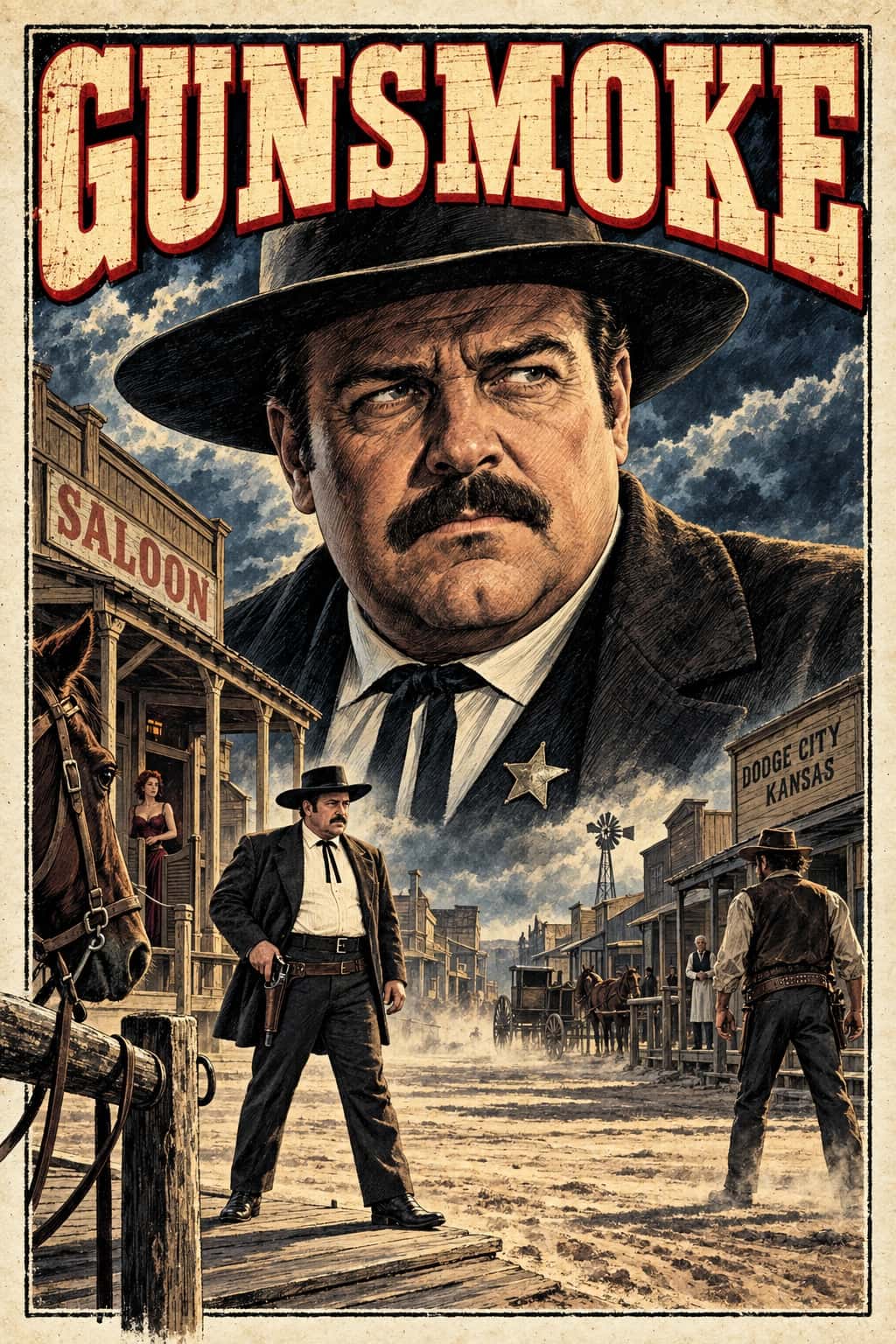
Dodge City and in the territory on West, there is just one way to handle the killers and the spoilers, and that's with a U.S. Marshal and the smell of gun smoke. Starring William Conrad, the story of the violence that moved West with young America, and the story of a man who moved with it. I'm that man, Matt Dillon, the United States Marshal. The first man they look for and the last they want to meet. It's a chancy job. And it makes a man watchful and a little lonely. Mr. Thatcher, just you tell us once more about this here stud colt you've got. He's a good colt, Mr. Butler. Oh, he's a running colt, you tell me. He can run some. Yeah. About the fastest thing in these parts of here. Now you're making fun of me, Mr. Butler. Well, I don't know why you'd think that. Out here, we're all interested in good horse flesh.
Especially if it's some sort of a fancy new breed. Quarter horse, you call it? Excuse me, my grandson's waiting for me. I understand these horses you raise have rumps so high they look like they're going down here. Oh, now, Hank, it ain't polite to call his colt that way. Of course, his withers do run right into his coat. Now, look here, you ain't got no... Look, boys, I do believe we got Mr. Thatcher upset. Here, let me pour you another drink. No, no, thanks. I'll be going. That just ain't sociable. Here, have a drink. I said no, Mr. Butler. Drink it up or I'll pour a whole stinking bottle down your throat. All right, Butler, that's enough. That's some Marshall Dillon. Mr. Thatcher, your grandson's waiting outside in the buckboard. You better get along home. Thank you, Marshall. Thank you very much.
Oh, you missed the fun, Marshal. We're just having old Thatcher on about his stock. You know, Butler, when you torment an old man, it makes you cheap. Real cheap. From now on, you'll leave him alone. Chester, would you run these papers over to Mr. Hightower? Yes, Mr. Dillon. Another wanted sector on Johnny Ringo. Mr. Hightower's waiting for him, Chester. Yeah, but Johnny Ring goes way out in Arizona. He don't never come back this way. Chester. Yes, sir? Oh, yes, Mr. Dillon. I'll take him right over. Oh, excuse me, Mr. Thatcher. It's all right, Chester. Marshal Dillon. Morning, Mr. Thatcher. Marshal, I want to ask a favor of you. Well, sure. Come on in. Mr. Hightower is waiting, Chester. Oh, yes, sir. Sit down, Mr. Thatcher. Hiya.
I want to thank you for what you did last night over at the Long Branch. Butler and his crowd just had a little bit too much to drink, that's all. I guess I did, too. Maybe you shouldn't go to the Long Branch. Seems like every time you do, Butler takes his pleasure in riding you. That's what I wanted to talk to you about. Oh? Ed Butler's always saying he's got the best horses around dogs or anywhere else. Well, maybe he does. Mine are better. Well, I don't know anything about your stock. Marshal Dillon. Ed Butler's having breakfast right down the street at the Dodge house, and I want you to walk down there with me. Oh, look, Mr. Thatcher, I don't want to get mixed up in any personal problems between you and Ed Butler. And I've got something here, and I want you to take it. Uh-huh. Here, the deed to my ranch. Well, why are you giving it to me? Because I'm going to challenge Ed Butler to a grudge race. My quarter horse cold against the best horse he's got. You mean you're putting up your ranch on this race?
Yes, sir. And I want you to hold the stake. Left, Mr. Thatcher. It's no business of mine, but you could lose, you know. No, sir. I don't figure I can. You mean you're putting everything you got on the race. What's so special about your colt? He's a little special most every way, Marshal. Daddy was cold deck and his mother was the best mare in Missouri. Oh, I know why Butler and others laugh at him. His head is small and he carries it low. He's built close to the ground, and his muscles bulge, and his legs are short. But I'll tell you one thing. He's just gone four. As he stands now, he's the most harsh west of St. Louis. There's some like him in Texas now, too. If I have my say, one day, quarter-harsher, it'll be all over the west. I believe in this quarter-cold. He's sleepy, and he's quiet. But he can unwind like lightning.
Hmm. You got a feel for these horses, haven't you, Mr. Fetch? Will you walk with me down to the Dodge house? Yeah. Sure, I'll walk with you. The hundreds of highway deaths and thousands of highway injuries can be avoided, provided that every single motorist does his bit. That bit means driving safely and sanely at all times. There's positively no excuse for excess speed. By observing all speed limits... You'll get to your destination almost as soon, whereas if you speed, you may never get there. Just as important is the necessity of paying strict attention to traffic signs and those white lines on the highway. They were put there for your protection. Never pass unless you're absolutely certain it's safe, that the road is clear ahead. Never pull out of line, slow up, stop, or turn without first looking in your mirror, then signaling clearly well ahead.
And don't be afraid to give the other fellow the right of way. If you let him go, you won't crash into him. At all times, drive with caution and courtesy. You'll live longer. Well, that's it. Sure, I'll race. And it's afternoon then across the river. That's good enough for me. Make it two o'clock. I'll have Doc Adams there to look over the horses. They'll both be sound. There'll be no race. Agreed? Why, sure. All right with me. And they run the way they are, shot or barefoot. The way they are. Mr. Thatcher wants a distance of 400 yards. 400 yards. That ain't hardly worth running. But the bet stands. Well, since you accept the match, Mr. Butler, you better come to some agreement with Mr. Thatcher. All right. What do you figure your ranch with everything on it is worth, Thatcher? Maybe it's $4,000. Oh, that's high for just five, six hundred acres and a couple old milk cows. But I'll put $4,000 against your deed. Thank you. I'll bring it over to your office, Marshal. Good. Have it there by noon.
You know, Matt, there's been horse races and guides lots of times, but never seen one like this. The whole town's betting one way or the other. Yeah, I know, Doc. You're worried about Thatcher putting his ranch up on the race, aren't you? He could lose it, Doc. Mr. Dillon? Oh, hold up. Yeah, Chester. Say, I was down at the bridge a few minutes back watching for Butler to take his horse across so as I'd know which one he was running. Well? Ed Butler ain't putting in no cow pony, Mr. Dillon. He's running a thoroughbred. Ah, so Thatcher's betting everything he has on this quarter horse of his to beat a cow pony, and now Butler is running a pure racing horse, a thoroughbred. Well, it's past one. Let's get on over to the other side of the river. Half the dog is over here on flats, Mr. Dillon. See if you can find Ed Butler and Mr. Thatcher, Chester, and bring him over here. Yes, sir. Hello, Matt.
I haven't seen this many people in one spot since Eddie Floyd played the opera house. Kind of a fiesta, isn't it? I don't know why you'd think it to look at you. Where's the finish line going to be, Matt? I want to see real good. Back up there about 50 yards. Oh, I'll go find a place. Okay, Kitty. Matt! Say, uh... Matt! Oh, here you are, Matt. Hello, Doug. Say, Matt. Thatcher's getting all liquored up. Well, that's his affair, isn't it? Yeah, but he's got a skinful. And you know how edgy he gets when he's that way. Hey, Mr. John, I found Mr. Butler. Afternoon, Marshal. Where's Thatcher? Well, I wouldn't know. Last time I saw him, he was pouring down some red-eye. Those losing won't hurt so bad, I guess. Butler, Mr. Hightower, and Doc here are going to act as judges.
Chester will fire the starting gun. Marshal, this is all terrible fancy just to butter up that old fool Thatcher, ain't it? Yeah, you might think I'm an old fool now, Butler, but you'll think different after this. You're drunk, Thatcher. Stay out of this, Butler. Any law say a man can't win a horse race if he's drunk? Mr. Thatcher, your grandson's writing for you. Is he all set? Yes, sir. All right, how about you, Butler? We're ready. And get your horses down there to where those two buckboards are. That'll be the starting line. You thought you'd fool me, didn't you, Butler, bringing out that third bridge around me? Well, I can still beat you. You're talking awful lot for a man who ain't worried. Don't rag me, Butler. I've had enough. Oh, listen to me, Thatcher. All right, that's enough out of both of you. You just see to what you do wins, Thatcher. Or I'll have your ranch and that colt you think so much of. What did you say? You heard me. What did you say about my colt?
What do you mean? Just what I said. If my bay mayor wins, I get your ranch and everything on it. And that includes your coat. No. No, that ain't right. Well, what about it, Marshal? You were there when we made the bet. Butler's right, Mr. Thatcher. That's the way you made it. You're no good, Butler. You're no good at all. All right, both of you move your horses down to the starting line. Yes, sir, Mr. Butler. Hey, move that bay down those markers. Okay. Go on down, Mr. Thatcher. Chester, you walk with him, huh? Give him five minutes, and then you can start him off. Five minutes. All right. Yeah, you see? I was right, wasn't I, Matt? Thatcher's been drinking some. Yeah. Come on, Doc. We don't have much time. We'll look up Mr. Hightower. Yeah. You know, Matt, this is like a holiday.
It's like a fiesta. Yeah, that's what Kitty said. Oh, she's out there, too, huh? Well, I guess maybe outside of Mr. Thatcher, the only person not enjoying himself is you. Do I have to enjoy it, Doc? Come on, Doc, run. Mr. Dillon, it's Mr. Thatcher. He's been shot. Let me through. Let me through. Let me through. Let me through. Let me through. Let me through. Let me through. Let me through. Let me through. Let me through. Let me through. Let me through. Let me through. Let me through. Let me through. Let me through. Let me through. Let me through. Not much use, Doc. I know where it is. Easy. He's a bad man. Mr. Thatcher? I won't see him run. Mr. Thatcher, listen to me. I'll never see... Chester, what happened? You were with him. Well, I don't know. I was walking along, and Thatcher and Butler was up ahead arguing, and then suddenly Thatcher drawed on Butler. He tried to kill him. I shot him, Marshal.
He was self-defense. He was drunk. He tried to kill me. That's right, Marshal. What Ed says is right. That's true. That's why it happened, Mr. Jones. Doc, will you take care of things? Get him into a wagon and back into town. I'll see you back there. Yeah, sure. Here, a couple of you men. Give me a hand. Marshal, what about the race? It's forfeit, huh? It's a very safe pocket. I'll still run it. It's the factory boy, Mr. Jones. Yeah. Come here, son. Look, Lonnie, with what's happened, maybe we shouldn't put the race off. I'll agree to put it off. We'll race now. All right, if that's what you want. It's what I want. All right, then get on down to the starting line, both of you. Hometowns in America have a lot in common, and yet they're each one of a kind.
Take, for example, Huntington, West Virginia. It never was a big town as metropolitan cities go, but the largest in the state, unless you ask someone from Charleston. Just under 100,000 live in Huntington, chosen by Look Magazine a few years back as an all-American city. And down on 9th Street, the Chamber of Commerce is still busy keeping it all-American, with Marshall, now a university, and the Interstate Highway coming through. Huntington still is very much all-American. Meanwhile, the downtown merchants are busy trying to keep downtown from moving to the suburbs. But out at Eastern Heights, the shopping center is flourishing. People are still taking summer afternoon drives through Ritter Park, out to the galleries to see Herman Dean's gun collection. There's a new Kroger up on Route 60. And more and more talk about where to put the new bridge over the Ohio.
But if your hometown is Huntington, you already know that. We only wanted to remind you, it's still there. Are we going to have the race? Yeah. That's a good thing, you know. There'd be a lot of people disappointed if it didn't come off. And we wouldn't want that, would we, Mr. Hightower? How's that? Well, a killing's hardly enough to make the day complete, is it? Now, Marshal, I didn't mean anything wrong. It's just... Yeah, sure, sure. Forget it. You move on up to the finish line, and I'll get a couple of these riders to clear the lane. All right. Hey, you. You there. Yeah. Will you ride down toward the start and move everybody back to clear the lane? Yeah. All right. All right, everybody. Would you get back, please, to clear the lane? Move back, will you? It's time, Marshal. Yeah.
Well, what's Chester waiting for? Looks like that colt's acting up. I've never seen two different breeds of horses run against each other. That colt's sure kicking up a storm. Make a good column for the paper, maybe. Get a hold of him, kid. Don't they make a good column, Marshal? I guess there was no question about it, Matt. I was the colt by half a length. A quarter horse beat a thoroughbred. Now that's something to see. Well, Marshal, you should be happy. Because the boy won? Yeah, for that I'm happy. Yeah? I got no complaint, Marshal. It was Barron's quarter. Uh-huh. About what happened this afternoon. About Thatcher. I didn't really hold anything against the old man. I'm sorry it happened. You know, Butler, I told you sometime that you'd push him too far. Now he's dead. Look, Marshal.
I'm not saying you're a murderer, Butler, but you're responsible for the death of that man today, and yet there's nothing I can do about it. Sound like you're blaming me for everything. Oh, it's not you, I guess. Just people. Good day, Mr. Butler. You better get to walking that horse. Yes, sir. Lonnie, I got $4,000 for you here. You want to take it, or should I give it to Mr. Blackton at the bank? I'll take it. Might be better to leave it in the bank. I said I'll take it. All right, son. Here you are. Thank you. You, uh, got any plans? Yes, sir. What? I'm gonna do what my granddaddy always wanted to do. I'm gonna raise horses like this stud colt. I'm gonna breed them. At your granddaddy's place? Yes, sir. That's kind of a big spread for a boy to handle alone, isn't it? I'll manage. I've got $4,000 to help him. Yeah. And you know something else, Marshal?
When men in these parts get sense enough to be interested in new stock and want good mounts with a fine way of going, they can come buy their quarter horses from me, Lonnie Thatcher. The boy's eyes were glistening as he turned and walked away, leaving his stud coat home. Most of the crowd had left and gone back into Dodge to rerun the race over a drink or two and talk about this new kind of a horse, the stocky... Heavy-muscled, quick as a lightning quarter horse. Had it come to dodge. That old political character, Elijah Cuddlestone, was a fighter. The rougher the going, the harder he fought. And once when it looked pretty bad, here's what he had to say. It don't make me no never mind. I say, I don't care what the pollsters say. I am going to win at the polls. At the polls, I mean, I will have the last laugh.
I believe the final poll of the voters. I have never. I say, I have never let the voters down and I know they are with me now. Public opinion poll or no? He bandied that word poll around a bit, didn't he? You know, in Middle English, poll meant head. To be exact, the top of the head. That was the part seen uppermost above the crowd and so used for a count of heads. A count of heads is how poll came to have its political meanings. A poll tax was a head tax. A poll of voters is a head count. During the campaign of 1948, President Harry S. Truman popularized pollster as a nickname for those who conduct public opinion polls, implying contempt and ridicule for their methods and results.
Produced and directed by Norman MacDonald, stars William Conrad as Matt Dillon, U.S. Marshal. The music was composed and conducted by Rex Corey. Sound patterns were composed by Ray Kemper and Bill James. Featured in the cast were Parley Bear as Chester, Howard McNair as Doc, and Georgia Ellis as Kitty. George Walsh speaking. Join us again next week for another story of the western frontier of America in the 1870s on Gunsmoke.
This is the United States Armed Forces Radio and Television Service.