
The written record
Read the transcript
Read along with the recording · About 14 min to read
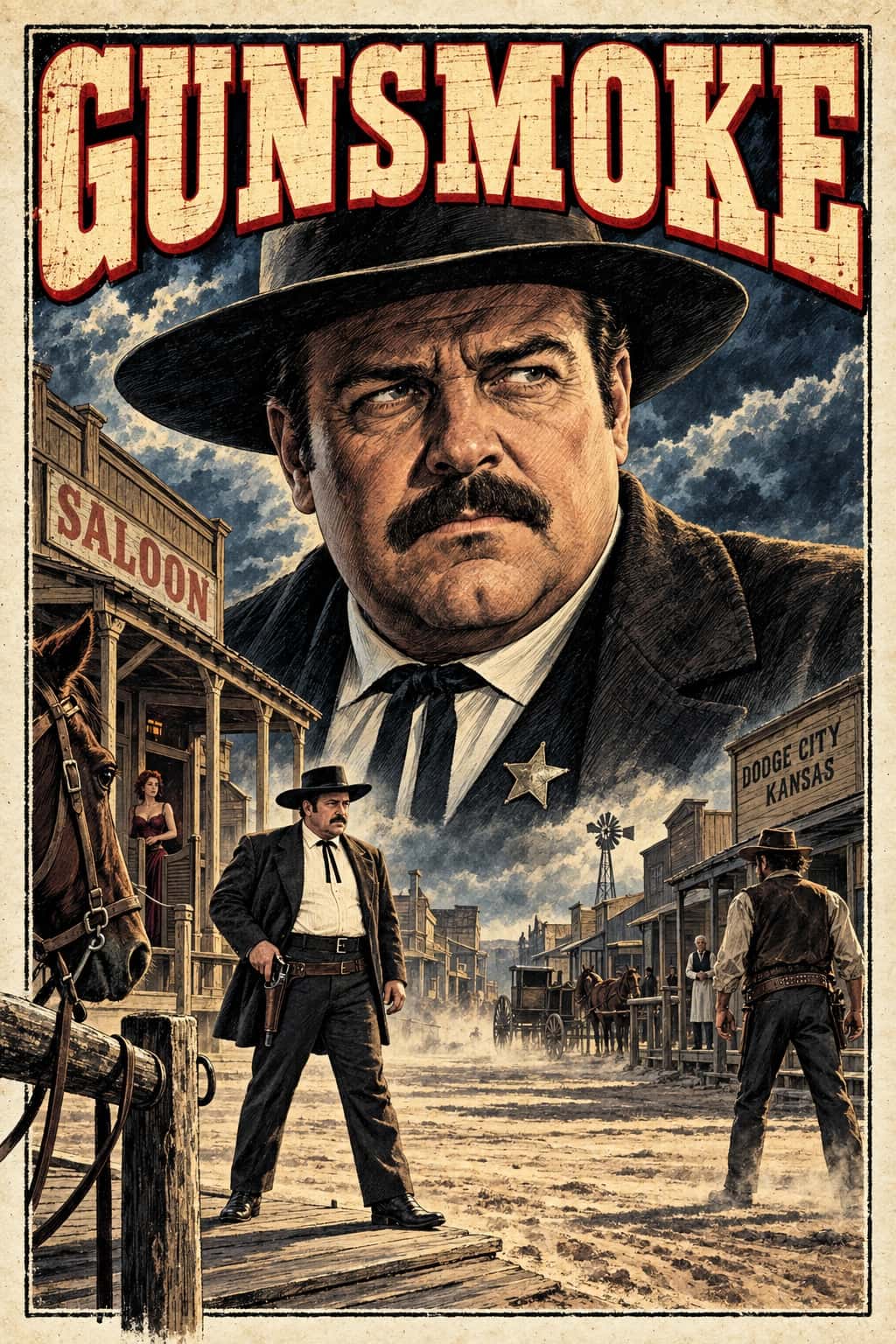
and in the territory on west, there's just one way to handle the killers and the spoilers, and that's with a U.S. Marshal and the smell of Gunsmoke. Gunsmoke, starring William Conrad. The story of the violence that moved west with young America and the story of a man who moved with it. I'm that man, Matt Dillon, United States Marshal. The first man they look for and the last they want to meet. It's a chancy job, but it makes a man watchful. But a little lonely. You want some more pie, Kitty? You might as well, since Doc's paying for it. No, thanks, Matt. I've had plenty. What happened to make you such a big spender, Doc? Some forgotten relative leave you something in his will? Might as well. What do you mean, Doc? Well, you remember that cowboy got himself shot up in a long branch brawl? That was a year or two ago. And more than one of them. I know that, but Kitty might remember that.
She helped stop the bleeding until I got there. Oh, I remember, Doc. You didn't even have enough money to buy a beer. And we figured he never would have. Well, what happened to him? Well, sir, I had a letter from him this morning. He's had some kind of a payoff in California. And he sent me a $20 gold piece to pay me for what he called my medical services. Oh, that's fine, Doc. I'm glad he made up. Yes, men like him don't often do it. And you don't often get paid either. Well, you never know in my business. Mr. Dillon. Mr. Dillon. I checked him out of the door. You do, Doc. Hurry up. He means it, Doc. Excuse me. He's gone back outside. Somebody must be hurt. I didn't hear any shooting. There are other ways to get hurt, Doc. We're here for the stage, Mr. Dillon. That man has been hurt, Mac. That's the shotgun message, Doc. Somebody must have held up the stage. Mike got shot, Mr. Dillon. He's hurt pretty bad.
Let me take a look. What happened, Chester? Well, I don't know for sure. The stage came in just now and Mike was driving. Mike was driving? Yes, sir. So I knew something was wrong. Then I could see he was hurt, too. Mike. Yeah, Doc. He's trying to say something. Make it fast, my Doc. I got to get him up to my office. Mike, it's Marshal Dillon. Are there any passengers? No. He's going out, Matt. Mike. Mike. What had happened? How many men? No.
I'll find a couple of men to help you, Jack. Chester. Yes, sir. And hurry. How long here right now, Mr. Jones? Cracked shoe, throws up real plain. Yeah, they've been riding hard, too. Slowed down our stop for a while somewhere. Well, I hope they didn't get no more sleep last night than we did. What's the matter, Chester? You getting old? I don't know, sir, it ain't that, but my gracious, two hours sleep. It just don't seem worth bothering about, that's all. Well, I hope our friends bother a little about sleep. If I was carrying $20,000 in bills, I wouldn't never stop. Yeah? You'd have to be riding a pretty unusual horse. Well, I guess you're right. Wait a minute. Hmm? Looks like they did stop after all. What? They built a fire over there. Yeah, it was them, wasn't it? I think we picked up a little on them, Chester. Pick up some more. The shoveling started at the little town of Rome in New York State back in 1817. And on July 4th, 1967...
The post office released a special sesquicentennial stamp there in honor of the big ditch they dug, which it says on the stamp in my album here was the Erie Canal. Now, in case you don't know, that canal went all the way from Buffalo on Lake Erie to the Hudson River, connecting the Great Lakes with the Atlantic Ocean, the biggest waterway ever built in the United States at the time. and it was done mostly by the Irish just over from the old country, who did their digging with spit and mussel. Made lots of money for years on tolls, and the traffic and freight and people through the canal was mainly responsible for building up the Midwest and keeping business in the East busy doing it. Well, of course, the Erie Canal ain't what she used to be, because the railroads do most of the job now, but the big ditch is still there.
And so is all the history that went through it. I swear, Mr. Dillon, them men are riding like they're stuck to the saddle. It's starting to get dark again. They'll have to stop someplace along here pretty soon, huh? I don't know. Hold up, Chester. These tracks are heading down to those bushes along the creek. Let's go easy. Yes, sir. Off yonder, above the stream there, there's a track. Yeah, I see it. You think there might maybe a hit out in it? Maybe. I'm not going to ride straight up to find out. We'll leave the horses here. Yes, sir. We'll circle around back. Just keep low. There's two horses tied up there. Mr. Dillon, they're the others. Yeah. All right, hold it, children. They're heading for the horses. You got him. Yeah, but the other one's getting away. He's out of range. Chester, you go bring the horses up. I'll see about the man I shot. Well, ain't you going after the other one? He's got a pretty good head start and it's near dark. I'm not going after him blind. Morning's soon enough. Now, go on. You get my brother. You get wrecked. Not yet.
You hurt bad? Yeah. Yeah, I sure am. Chester! Yes, sir? Get up those horses and come here. We'll carry him into the shack. Be right there. Mr. Dillon? Yeah. This fellow's horse. Well, what about it? Well, his leg's broke. He must have stumbled and it's time to get away. You reckon I better shoot him? All right, you can do it as soon as we get this man out of the shack. All right. Easy, easy. All right, open the door, Chester. I'll keep hold of him. It's locked. You suppose somebody lives in this forsaken place? Well, we'll find out. Go ahead and knock. Anybody in there? Open up! There's no need for any more noise at my door. Just finished telling you men you can't stay in my house. You don't need that shotgun, ma'am. We don't mean any harm. I intend to defend my home, sir. No rough men are going to tramp around amongst my fine things. You open the door a little wider, ma'am, and you'll see we're not the same men.
I don't open my home to any strangers. I'm Marshal Dillon from Dodge City, and we got a badly injured man here. A United States Marshal? That's right, ma'am. Well, then I guess I'll have to let you in. But I don't hold with your Yankee government, I want that clear. All right, ma'am, fine. Come on, Chester. Now, you'll just show us where you want us to put it. He hurt bad. Not bad enough. Well, I suppose even a rough man has a right to die in a bed. But mind you, be careful of my things. All right, ma'am. We'll mind you. Here, a Miller's horse, Mr. Jones. I've brung the saddle. All right, bud. Ain't things a little strange in there? A little. What about not hurting her fine things? Ain't nothing there that's worth carting away except maybe that old pine. Yeah, I know. Everything else is all cracked and broke. Most ladies wouldn't give that stuff house room. You gentlemen would care to join me. I fixed a small supper. Well, that's...
Very nice of you, ma'am. How do you say it's nice? Mr. Hanford. He's my husband. Mr. Hanford always said I could spot a gentleman right away. I could see you two were gentlemen as soon as we exchanged pleasancies there in the entryway. Well, thank you, ma'am. Mr. Proudfoot, ma'am. Please take your hat off my cherry wood piano. My land, ma'am, it can't hurt nothing. I do not allow anything to mar the finish of my beautiful cherry wood pine. Yes, ma'am. Thank you. Here's your plate. Please sit down. Thank you. I don't imagine your wounded friend will be able to partake. No, Miss Hanford, he's not likely to come to for some time.
As if he ever does. I can't imagine how he got his wound. I'd seen him just a few minutes before you gentlemen. Miss Hansard, ma'am, didn't you hear the shooting right outside your door? I have trained myself not to see and hear the ugly things of life. I just live here alone among my friends. But you said that you have a husband. My husband has been gone for two, three, four years now, Marshal.
I'm sorry to hear that, ma'am. Mr. Hanford would never be content to live a quiet life. He thought he could when first we came here directly after the war. I had in mind he'd build me a new plantation. Mr. Marshall, just between you and me, Mr. Hanford didn't appreciate my lovely thing. And one day, well, one day he just moved on west. Oh, that's too bad, ma'am. I do not need your pity, sir. I'm content. Well, sure, of course. I'd be obliged if you gentlemen would sleep out there on the veranda. Veranda? Oh, that's all right, Chester. We'll sleep on the veranda. I am going to have to keep an eye on Miller, though, ma'am. I will watch over him, Marshal. Well, no, that's not your job, Miss Henry. I'm mistress of this house, Marshal Dillon. I will watch over him. I will call you if there's any change.
As a matter of fact, I'll look to him right now. Well, all right, then. Mr. Dillon? Mr. Dillon, is that slanty old portrait random? It's to her. My, if she don't be all. Hometowns in America have a lot in common, and yet they're each one of a kind. Take, for example, Voltaire's Alaska. Since the earthquake on Good Friday in 64, folks have been building all over again. Folks like Max Wells. whose hardware store reared up and moved back two feet. In those awful hours, fuel tanks exploded, there were scattered fires, and the entire dock disappeared. Men drove to 35-mile roadhouse for help. But that was then. Now, Valdez is moving to solid ground five miles around the bay. New houses are up, the city hall and the freight dock are in, and children are buzzing over to the new Grodin Harrison Elementary School.
Valdez is pretty much well again. Jurors come to this ice-free harbor and visit Valdez and Columbia Glaciers, over which early adventurers climb to the gold field. But if your hometown is Valdez, you already know this. We only wanted to remind you it's still there. Every time I dig a grave, the ground seems harder than the last time. Grave digging isn't supposed to be easy, Chester. It's too permanent. Funny how many men dies at daybreak, ain't it? I mean, when everything else is starting up and all. Well, I guess when you have to die, it's as good a time as any. Where do you reckon his brother is by now? Rack? I don't know. We're sure gonna have a long ride to catch up with him. Sure ain't one to hurry up a man about his dying, but I sure would have been glad to have been shut of this place by now. What's the matter, Chester? Don't you enjoy southern hospitality?
Mr. Dillon, I have to walk around in that old shack on my hip toes. She's after me every minute about not hurting her things. Gracious goodness, I couldn't hurt them old things if I tried. Well, we can be leaving soon, now, Chester. We've done about all we can do. Get up! Mr. Dillon, in them bushes. Yeah, and my guns are in the house. Come on!
I believe it cost me... Will you get out of the way, please? I want my gun over there. What do you think that crazy fool's thinking of? I don't know, Chester, but he must have a good reason for sticking around. His brother? No, I don't think he'd take on these odds when he was pretty sure his brother was done for. I think he's got another reason. Where's the saddle that came off Miller's horse? Well, over there in the corner. Oh. Be careful of your heavy footsteps. Yeah, let's see now. That's it. No wonder he stuck around. All that money. Makes up into a right pretty little package, don't it? Mr. Dillon, I don't understand the sudden rudeness on your part. I'm sorry, ma'am, but I'm not too polite when I'm being shot at. And you stay away from those wonders. I'll thank you not to give me orders in my own house. Chester, let's push the piano in front of that window over there, huh? We're like sitting ducks this way. You will not touch my cherry. All right, come on, Chester. Oh, don't harm it. Oh, don't. I'll watch the front. You take the side, huh?
I don't think you'll wait long. How long must I endure this? How long? As long as that outlaw's out there, Miss Hattrick. He's not going to let us out of here alive. You're going to stay here tramping around among my nice things until he goes away. I'm afraid so, ma'am. Well, then I'll just order him off my lap. Miss Hattrick, come back here! Miss Hattrick! He shot her! Yeah. He's running for the creek. He's down. You got him? Yeah. You go make sure, will you, Justin? I'll see to Miss Hanford. Miss Hanford? Oh, so dear, then. You were right. I'm sorry, ma'am. He was no gentleman, was he, Marshal? On a lady's property. Oh, ma'am, he wasn't. She's dead, Miss Jones. How's Miss Hanford? Miss Hanford, I'm going to take you into your house. No, not just yet, Marshal. Move me. Let me lie here on the brand. You'd be more comfortable with me.
I won't delay you long. Is there anything we can do to make you feel better? You'll just see. You'll just see that somebody takes care of it. I love it. She gone? Inside now. She really believed Rack Miller would listen to her and go away, didn't she? There's no gentleman. It's a shame, that's what it is. It's probably an reassurance. Way pretty. The way she loved it. Took care of it. Good.
I guess I didn't have to play. A speech rendered by that old political character, Elijah Cuddlestone. Now, I mean to say, tell you that is, that this man is a radical. A radical, mind you. He's used enough platform planks, planks, that is, in this campaign alone to build you a new courthouse. I said, a new courthouse, and still have enough planks left over to construct a warehouse for all of you. It was a bit outspoken, and that's how he used the word radical. Radical comes from radix, a word for root. Actually, today, radical isn't much more than a term of abuse. Before the 18th century, radical essentially meant a person who wanted to get to the root of a matter.
Toward the end of the 18th century, a group of English politicos became known as radical reformers because they wanted to revamp the existing political setup. They became a hated crew because folks didn't like change, and radical became a term of low reproach. George Walsh speaking. Join us again next week for another specially transcribed story on Gunsmoke. This is the United States Armed Forces Radio and Television Service.