
The written record
Read the transcript
Read along with the recording · About 36 min to read
Spotlight on a star. The magic that was radio returns to you once again for a series of informative and interesting interviews with the stars and personalities that made it all possible. It's a special treat today to meet one of our favorite radio announcers, the voice that introduced many thrilling radio dramas of yesterday. And now, tonight's presentation of radio's outstanding theater of thrills, we bring you a so-fired killer. who had a deadline to meet. So now, starring Mr. William Conrad and Mr. Stacey Harris, here is tonight's suspense play, A Matter of Timing. Escape, designed to free you from the four walls of today for a half hour of pie adventure. Wow. Around Dodge City and in the territory on west, there's just one way to handle the killers and the spoilers, and that's with a U.S. Marshal and the smell of gun smoke. Spotlight is on George Walsh.
It's 10 p.m. at Columbia Square, Hollywood, this Monday evening, July 21st, 1969. George Walsh will be stepping into the Can-X studio for his Music Till Dawn show in about an hour. But first, he has kindly agreed to step into the spotlight and reminisce about those golden years of radio. Good evening, Mr. Walsh. It's very kind of you to take time out of your busy schedule to talk with me. Well, thank you very much, Chris. It's a real pleasure to be here, except I wish you wouldn't call me Mr. I feel old enough already. Call me George, and I'll call you Chris, all right? Okay. What brought you to radio as a career? You have a lot of tape, do you, and a lot of time? Because this might take a little time and a little tape. I actually started when I was in high school. I had to give a speech as part of an English course, I recall. And because I didn't have any idea of what I was going to be when I grew up, I gave a speech on the possibility of being a radio performer. While the other classmates were giving speeches on being doctors and lawyers and senators and so forth, I, for want of authenticity, I added novelty. And I gave a speech on being a radio performer. And as part of the speech, I impersonated some of the famous radio people of those days. And I forgot all about it because I got a pretty good grade on the speech. Until a little later in the school year...
The English professor, who happened to be the faculty advisor for the senior prom, came to me and said, we're putting together a floor show of students, and we'd like you to do your impersonation act. I said, I have no impersonation act. He said, well, you know, the act you did in our English class last month will give you two tickets to the prom and $15. I said, I've got an act. And that started it. I didn't think so at the time, of course, but that started it. How many shows have you announced? Oh, I would hesitate to make a guess, Chris, because it's pretty difficult to... Tell what you mean by a show. I have been an outlier on, for example, so many newscasts over a period of years. I have done some programs that have gone one time and some programs that have gone once a week for many, many years. I would rather look at it from a standpoint of a number of years than a number of shows. I don't think I could give you an accurate estimate as to the number of shows. How many years have you been in radio? Well, I first went on the air in 1935, which was quite some while ago. I wasn't paid at the time, as I remember.
But that was the first time I ever went on the air was in 1935 in the old hometown of Cleveland, Ohio. And I entered an amateur contest. They were quite the thing in 1935. And as it turned out, I won the contest and I fell in love with radio. Were announcers cast for their roles in the same way that actors were cast? Their roles in radio shows, I presume you mean. No, not in the same way. An announcer was auditioned. for the part that he played on a program. And the audition depended on several things. It depended on the type of program. For example, if you were in the position of being a producer, I think that you'd choose a different type announcer for a dramatic program and a comedy program. One of the things that entered into it probably was whether or not there would be a studio audience. One of the things that certainly entered into it was the commercial product involved, the sponsor or the advertising agency.
had somewhat of a say so as to who the announcer was whereas the actors were generally called from their past performances their track record the announcer was called and he was auditioned for the show some programs were acted before a live studio audience and others were not what were your experiences in this field oh rather horrible it was rather difficult to perform a radio program before a live audience because the radio program was created to be heard, not particularly to be seen. And if you started to do a program that was made to be seen, then you were sacrificing some of your most important element, and that was the element of the audio. I have had some experience before a live audience in connection with a radio show. I remember one program I did. I don't even remember the program because I probably psychologically want to forget it.
But they thought they wanted the program to open with a big laugh, and the way to get a laugh was for me to wear bright red socks with bright red garters, and while I was doing the opening of the program, they were rolling up my pants legs. Well, they got the laugh from everybody except me. I didn't think this was a very good idea at all. And so I look at a studio audience with rather mixed emotions, and they were wonderful people, the people that came to see some of the radio programs. But one of the duties that befell an announcer in connection with a studio audience was a thing that was called a warm-up. They didn't want the star of the show to immediately come out and start to perform before an audience that up until then hadn't been exposed to any entertainment at all. And it usually was the announcer's lot to do the audience warm-up in the studio. This was comparatively easy if you were dealing with a light-hearted studio, or a light-hearted program, I should say.
But if you were doing it with a dramatic program, it was a rather difficult chore to do a studio warm-up because you didn't want to be funny. You certainly couldn't be serious. All you could be was warm and friendly. Some programs, like the Jack Benny program, used to put on a warm-up prior to going on the air that was a thing to behold. And it didn't involve Don Wilson. It didn't involve Jack Benny at all. It involved the orchestra. And they put on an act of pantomime and music that just had the... audience in stitches prior to the appearance of Jack Benny. So when they hit the theme song and Jack Benny walked on stage, that audience was ready to go. For a while, they did the Red Skelton program on TV. And I recall we, when I say we, I mean Red and I, worked out a little routine just prior to his entrance that was part of the studio warm-up. And I would look out over the audience and I would say, oh, I see I see a lady out there that brought a book in case the program gets dull. And then from right behind me, from behind the curtain, Red's voice would come out and say, and I see another lady that brought flowers in case the show dies. Well, this got kind of a nice laugh from the audience, and you could just see this buzz of anticipation as they nudged each other and said, that's Red Skelton, that's Red Skelton. And a matter of seconds after this, why, the program opened and the audience was warmed up. It was fun to do a studio audience program, but not necessary.
Radio depended much on the sound effects to set a stage. Whatever happened to those wonderful sound effects men? Well, I don't know what happened to all of them. I know as far as CBS radio is concerned, on the West Coast, most of them have converted to straight engineers. They were always rather closely affiliated with the engineers in that many of the sound effects, as you know, were recorded. And those that weren't recorded certainly took a great deal of engineering. and artistic talent and their work with turntables microphones and so forth sort of lent itself to engineering work and as far as i know i think all of them uh transferred into the engineering department at least all of them that wanted to on cvs on the west coast other stations other networks i don't know what happened to them some of them i'm sure went into the television field we have some sound men at tv city And what do you do with a sound man on a television show? Well, when one of the parts of the play depends upon the crunchiness of the snow or a sound of a footstep in the hallway or something, you can't depend on the live one to pick up enough. So they will have a sound effect man who will put that in. And this, of course, isn't counting a comedy show where all of a sudden the collar button gives way and the man's collar snaps off. Well, it's got to go. And the sound effects man is providing this.
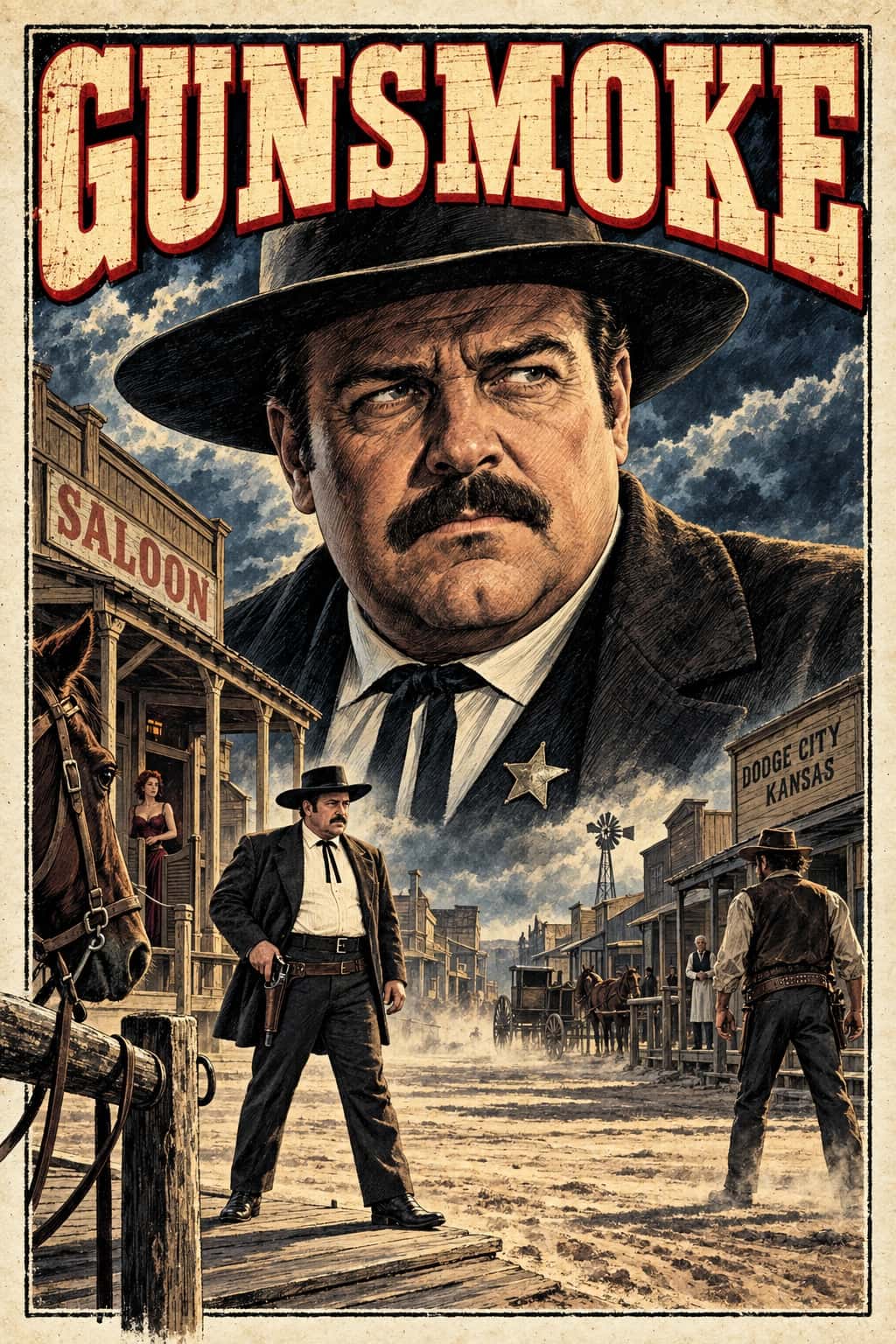
Okay. Getting back to some of the old shows, and one in particular, I think we can agree that the all-time favorite radio drama was... Gunsmoke, starring William Conrad. The story of the violence that moved west with young America. And the story of a man who moved with it. I'm that man. Matt Dillon, United States Marshal. The first man they look for and the last they want to meet. It's a chancy job, and it makes a man watchful. And a little lonely. Bill Conrad and I sound considerably younger on that than we do now, you know. When did you join Gunsmoke? I don't exactly remember the precise time, Chris. It was about the same time that I started work at CBS, which would make it 1952 or 1953. There was a summer replacement program. And I wasn't the first announcer on it. A fellow by the name of Clancy Cassell, who is now in San Francisco, did some. A fellow by the name of Roy Rowan did some. And then it fell my lot.
to do some. And about that time, the program started to become sponsored. It was retained after the summer was over. So it was about, well, in the early 50s sometime. Was there a Matt Dillon before Bill Conrad made the role so famous? As far as I know, the only Matt Dillon that existed prior to Bill making the role famous was in the mind of Norm MacDonald and John Meston. Norm as the producer-director and John as the writer of the program. These men founded gun smoke. These men created gun smoke. They went into a great deal of research. For example, since sound that you mentioned a while ago was so important a part of a radio program, John and Norm went into the detail as to whether or not an average ranch house around Dodge City in the 1800s had a front porch, so that when Marshal Dillon rode out to the ranch house for any reason, should we take his footsteps, from the dirt right into the house, or does he go up some steps, and does he cross a porch, and is there a screen door? And this kind of detail apparently paid off. In listening to John and Norm talk about the creation of Gunsmoke, they felt that they were going to create a character that was, above all else, believable. A U.S. Marshal that knew all the emotions, not only heroism, but one that knew fear, one that probably knew a bit of hate, too. And, uh...
The role was the result, and of course, they gave it to Bill Conrad, who just grabbed the ball and ran. Well, believe me, in all the years I've listened to radio, I've heard a lot of factors. I think Bill played the role perfectly. He is my image and my perfect example of a real U.S. Marshal, typed and cast perfectly for the part. Well, he played many famous roles and did them all equally well. He's a very competent, capable actor, very fine fellow. Did you ever play an acting role on that series or any other? Not on that series. I, as the old saying goes, couldn't really act my way out of a paper bag. I'm an announcer, but I played a couple of them. I was very large on some crowd scenes and various programs, and I just mumbled. I was the best mumbler in the world. I could sound like four men standing off mic trying to say, gee, what happened here, officer?
But I never played a role that got me any cash credit or anything like that. Was Gunsmoke the longest association you had with a radio show? I have to think about that for a minute, Chris. I suspect so, yes. If not the longest, it was probably the most happy. What is a rare behind-the-scenes story of radio that you can share with us now? Well, since you probably will be heard by family groups and some youngsters, I probably have to clean up several of the stories. But one that comes to mind had to do with Gunsmoke, as a matter of fact. And Norm MacDonald was directing one day, and we had a scene in the Long Branch Saloon. And all of a sudden, a fight broke out. And where there had just been a low, moderate level of conversation throughout the Long Branch prior to this fight, as soon as the fight broke out, he wanted a great reaction from all the people that supposedly were in the Long Branch Saloon at the time.
So here we are in Dodge City in the 1870s, and all of a sudden the fight broke out, and one of the actors stood up and ad-libbed a great line right into the microphone. Hold the phone! In those days, it was a live program, and there wasn't much you could do about it. And one of my favorite recollections of the radio business was when I was lucky enough to be doing the spooky voice thing on suspense, and I met some very, very famous people, some very wonderful people as a result of that program. One day I met Herbert Marshall, and about two years went by, and he had a repeat performance on Suspense. And when I walked into the studio and he looked up and in this wonderful British way of his said, oh, hello, George, good to see you again. You know, the little kid from Cleveland, Ohio, just wanted to pass out from sheer excitement because this to me was a wonderful feeling. And to me immediately marked Herbert Marshall as one of my all-time favorites because he was so warm and gracious.
Did you ever show up late for a broadcast and have to huff and puff on the opening? Well, not for a broadcast that required much of an opening. In the old days of radio, you remember, on the West Coast particularly, it's necessary an answer to say at the beginning of many programs by transcription. Well, many times I showed up huffing and puffing at literally the last second. And my last dying gasp, I sounded like the guy on the desert, you know, looking for the drinking call. My last dying gasp said, my transcription. But not for a program that involved a legitimate opening. I was always there on plenty of time for that, usually because it was preceded by a rehearsal and probably a dress rehearsal, and I was there for those, too. Did you ever drop a script and have to ad-lib? I don't recall that I ever had to ad-lib because I dropped a script. I think there were other...
circumstances under which I had to had left one of the most noteworthy comes to mind when I was an announcer on a program that you probably wouldn't recall called romance and the assistant director had many duties one of them was to keep time for the director and he the assistant director was going on vacation one time and his replacement sitting in with him The assistant director said, now here's how I keep time for the director. I have this little pad here, and when we are over five seconds, I just put a five on this side of the pad. When we're under five seconds, I put a five on this side of the pad. Everybody thought this was a wonderful system because it had worked for a long, long time. Well, the assistant director went on vacation the following week, and his replacement came in and took over for him. One thing no one happened to notice was the fact that the replacement was left-handed. And during the program, he is signaling to the director that the director is now five minutes short.
Or five seconds short, rather. The director keeps compensating, but he's compensating the wrong way. And the next thing he'd get would say ten, which means that he was ten seconds over. The director figures he's ten seconds short. The timing was so messed up that I was the last thing on the program, and instead of having to have a minute to go, I had like two minutes to go. They were giving me stretch signs and slow down and everything. Well, you can stretch and slow down only to a certain point. I don't remember what the announcement was. It was not a commercial. It was more like a public service announcement. But I used that as the basis, and I did quite a bit of bad living, and I think I might have lost a little weight that day. George, you brought many happy listening hours to many of us. Let me tell you the saddest words I ever heard from you. Don't move. Produced and directed in Hollywood by Norman McDonald, stars William Conrad as Matt Dillon, U.S. Marshal.
The story was specially written for Gunsmoke by John Meston. Featured in the cast were Vic Perrin, Gene Bates, John Daner, Barney Phillips, and Harry Bartell. Harley Bear is Chester, Howard McNear is Doc, and Georgia Ellis is Kitty. This broadcast concludes the current Gunsmoke series. This is George Walsh speaking. With these words, you signed off the last dramatic show to come from Hollywood. Did you realize the impact at the time? Oh, probably not. At the time, I was a newlywed on cloud nine, my wife and I. We're still on cloud nine, but now we have three daughters up there with us. It's crowded once in a while. And I don't know, Chris, the radio business, as every other business, I guess, is a rather dynamic thing. It doesn't stand still. It moves. And no matter how much you are in love with a program or a show, you know when you start it that it's not going to last for the rest of your life.
look at it realistically and go on to another program or another show. One of the ideas that has been brewing in my mind for a long time is to see a reunion of the radio cast of Gunsmoke, but unfortunately this will be impossible with the untimely passing of Howard McNair, who played Doc Adams on the air. I have here in front of me a CBS press release, which came out about 10 years ago, which typifies the performance that Howard McNeer portrayed as Doc. And I'd like to read it here for you, and perhaps this could be a fitting tribute to a fine actor. Is there a doctor on the show? The answer is yes, if you're referring to CBS Radio's top-notch Gunsmoke series. And Doc is veteran radio actor Howard McNeer, who together with star William Conrad, Georgia Ellis, and Polly Bear, make up the quartet of regulars on the show.
McNair plays his part so realistically that he is constantly receiving letters from listeners asking for his medical advice. Would you care to comment, sir? Well, I can't add to that, Chris. That just about covers it beautifully. And Howard was a fine actor. He was a true craftsman. Displayed his ability, I think, not only in the role of Doc, but his great adaptability to other roles. Indeed, I strongly suspect that you have seen Howard in... motion pictures, on television. And you've seen him in a wide variety of roles, all the way from things as serious as Doc Adams to light comedy. And he did them all equally well. He was a wonderful, wonderful man. As a participant in radio yesterday and radio today, can you speculate on radio tomorrow? If I could give you an accurate assessment of radio tomorrow, Chris, I think that we could be carrying on this interview in the salon of one of my yachts.
because if I had the answer to that question and could give it to you accurately, I think that my financial worries would be over. Radio today or tomorrow, I don't know. I seriously doubt if it will ever revert to the golden days as you so accurately referred to them a while back. I think that the days of the family gathering around a large console in the living room and shushing each other while they all listened to their favorite program. will never return these are days that i remember days that your dad remembers but i don't think that they will ever return radio is a a mobile thing radio is is a means of communication and keeping in touch while you are not only driving but but at the beach anywhere these days i anticipate radio receivers becoming smaller and smaller until they might get to a point where One might wear them as one today wears a wristwatch to know what time it is. You might wear a radio of some sort to determine what's going on in the world. And I think this leads me to the further belief that radio is to be more and more a medium of information, not one of entertainment, but primarily one of informing people as to what is going on. Well, then what do you think of an idea of a museum or some type of place set aside So our children and grandchildren can know what real radio was like. What do you think of an idea like this? Well, I think it's a good idea, and I think the city fathers of Los Angeles thought it was a good idea, too, when they started to build what they referred to as the Hollywood Museum that included a section of radio. But the Hollywood Museum became embroiled in a lot of political wrangling and so forth and constantly never came to fruition. But I think the idea of a museum is fine, good.
And with due respect to your organization, I think it's good only as long as it is considered to be a museum. If I can draw an analogy, I think that it's almost like comparing a fine old car to a fine new car. A fine old car is fine as long as you realize that it's a museum piece and it's pretty to look at, fine to remember the day you went fishing with your Uncle Charlie in it, but it certainly couldn't compete with today's fine cars. And I think the same thing is somewhat true of radio in that It's fun to listen to, as long as we realize what it was. I don't know, as young as you are, you may have had the experience already in looking at a TV show, an old movie, and saying, is it possible that when I saw this X number of years ago in a theater that I was so thrilled or so entertained or so excited? Because now you look at it with a little different eye. I think the audiences are becoming more sophisticated all the time. There's a whole generation of youngsters, indeed, what, 16, 17 years old?
that don't know what it's like to be raised in a world without television. To them, radio might be a novelty, but if you tried to present to them a radio program from the old days, I think their natural question would be, well, that's well and good, but where's the picture? Right. Well, for the last few minutes, I've been asking you all these questions. Two minutes? I'm the gabbiest guy you ever talked to, Chris. Have you got any questions you want to ask me, sir? Yes, I'd like to ask you about the organization that you represent. I'd like to know more about it. How did it come about, and what is its aims and purpose?
I don't know exactly how it got started. I was in the service at the time, and the correspondence, I pen pal to one guy back here, and he sent me a few names, and we got to talking about radio, and the next thing I do, I was offered membership in the Radio Historical Society. Our aims are simple. We're not out to bring back radio in its full glory, because we know it can never happen, unless the American people want it, and we're waiting. Our idea, is to preserve as many of these old shows as possible for posterity. Just like you go to a museum and you see many things which were related to American history at one time. And radio, believe me, falls into it. It was a key medium. At one time it was the biggest medium of entertainment, information, and education. But as the years have gone by and as the ideas of radio have changed, people have grown up with the idea of radio not as it was and not as it could be.
So our group is putting together all the shows that we can through large electrical transcriptions, wire tape, and magnetic recording tape, and through trading and preserving them and sharing ideas, we're keeping alive something that was really wonderful. And this is strictly the aim of our club. Also, we're meeting new friends around the country and sharing ideas and events that happened in our lives that were related to radio. It's fascinating, and I think there's a future in it. We're not known nationwide like the other large clubs, such as the Elks or Kiwanis or Lions Club or even the Boy Scouts of America. But our organization has a purpose and a goal which we think can be obtained. Well, your goals and purposes are very lofty. Aren't they also very expensive? Not really. You'd be surprised. A large number of the shows have been acquired by fans who actually air-checked them, recorded them off the air from a radio in their home.
A lot of the people I've run across had wire recorders available right after the war. And they took the time in the evening to sit down and actually record the programs right off the air. And isn't it wonderful because many of these programs were live and the sound has gone forever. But because of these few people who had the farsight to record them at the time, the sound is preserved forever. I think it's wonderful. It is wonderful, and it's particularly... It's heartening to see a fellow as youthful as you are interested in the olden days. I have an 11-year-old daughter, and she asked me the other day if when I was a young fellow they had covered wagons, and I couldn't convince her that that wasn't the case. Have you ever had the opportunity to play any of the shows that you announced at your home with comments from your children, what they think? Well, I play them occasionally for my own entertainment, but with the comments from the youngsters...
They have a rather jaundiced view of Daddy. They have heard Daddy do many, many things in their young life, and I've done some very interesting things. For example, at Disneyland, on the moon ride, they have an audio-animatronic figure in the spaceport control center, and I recorded the voice for that. This gave them rather shock to see Daddy's voice coming from this other man, is what it looked like. So, uh... I don't really attach too much significance to their evaluation of a program on which I appear. Okay. Going farther in our organization, you have here in front of you a couple of fan magazines. These are radio fan magazines? They sure are, and they're available through the mail only and through subscription or organization. Gosh, wouldn't it be nice if these could be available on the newsstands because from the front to back cover, the information on there is entertaining and clean. Well, at one time, of course, a radio log was...
popular magazine as a TV log is today. Remember Radio Mirror and Radio Adventure magazines? Those were fortunes today in the collector's market. And, of course, they answered one big question that many, many listeners had. I wonder what he looks like, because this was something you didn't know, not like you were the radio performer. Right. Many of these pictures that you're looking at now come from the Radio Dow, Radio Mirror magazines, which were on newsstands in the 1930s, 40s, and early 50s. Wonderful. The other magazine is put out by one man alone, and it's called Stand By On The Air. This is not part of any clubs. We are simply putting this out on his own, and Blimby's put a lot of heart into it. On his own, he has come out bi-monthly with a magazine which covers the full facet of radio entertainment in its prime and glory. It's a lot of fun to read, and Blimby, I think a lot of people would be interested in a magazine like this. It is very interesting, very nostalgic, too.
Superman on radio, remember that? No, you don't remember that. Clayton Buck Collier as a man of steel? You better believe it. A lot of these shows were on the air, the adventure films that you just mentioned, were on the air until the mid-1950s. Being born during the war, I was able to catch the last years on the radio. In fact, I can claim I am the last generation of Americans to be a faithful fan of Captain Midnight and Sky King. Really, this was in the late 40s, early 50s. In fact, we had Juvenile Adventure. until 1955 when Sober Eagle went off the air. He was portrayed by Jim and Reggie, believe it or not. 55? 55, The Last Juvenile, Adventures Built on Radio. That sounds like it may have been transcribed in advance. I think as far as actually producing new live shows every week was concerned, that up until about 55, CBS was the last ones to give up the ghost of old-time radio programs. Well, most of the networks were leaving the...
active entertainment field of radio, CBS did stick on. Believe me, you put out quite a few great dramatic programs. In fact, as late as 1906, I could sit down, literally sit down in an evening, and after the news of Lowell Thomas, I could hear programs like Masters of Melody, Amos and Andy Music Hall, Bob and Ray, and good entertainment discussion programs, weeknights, and then on the weekends came the fun. Johnny Dollar at 5 o'clock, Suspense at 5.30, Have Gun, We'll Travel at 6, and Gunsmoke at 6.30, followed by Mitch Miller at 7. What more could you ask for? This is in the 1960s. If we'd had a fire and burned up all the logs in those days, we should have phoned you. Chris, you want to speculate on something interesting the next time you get some of the members of your organization together. Speculate on this. Although we have kind of decided, at least as far as the two of us are concerned, that radio will never return as far as the golden days are concerned. And I don't think you could find a radio producer who would seriously consider going into the field of comedy.
for the radio show, for example. Throw this one up in the air the next time you want some discussion. What about the commercials that are on radio today? Some of them are the greatest one-minute comedy shows you've ever heard. Radio drama still exists today in commercials. A lot of the old ex-radio actresses and actors do appear in commercials. I see them every now and then. People like Bryna Rayburn, Parker Finley, they're doing their commercials on radio. I guess that's all that's left for acting. I guess so. That's it. Another question you might throw up to your membership next time you have a discussion is that in the event that radio could not be sold to the public or to an advertising agency, how can they account for the fact that so many hundreds of thousands of comedy record albums are sold every month, which is strictly an audio medium? They don't see these people perform. They merely listen to them on this record and enjoy them and pay good money to buy them.
Well, how about dramatic programs on the freeway rush hours? What do you think? Well, I can't speak for CBS, let alone the broadcast industry, but the executives claim that this is not what the listeners want. They claim that it is not what the advertisers will buy. Freeway rush hours, they say, people want to know what is happening, one, on the freeways, two, around the world. People then, as far as you can see, by surveys taken, are really satisfied with radio right now. If we are to believe the surveys, they are satisfied with the direction that radio has taken. They may not be satisfied with it as of this day, but they're more satisfied with it than if they went back to what we can nostalgically refer to as the old invasion of radio. It's amazing why these shows can't come back. You're right. Comedy albums are available in record stores. When you read a book, a paperback, that's got no pictures, and you must create a picture in your mind in every book you read. And I wonder why these shows couldn't be available in records that take it apart.
Well, I think that it would probably be easier to produce a new one than it would be to resurrect an old one. The old one involved so many people. It wasn't uncommon in the old days to have a program that involved 20 or 30 musicians who did nothing more than play the theme songs and the musical bridges for transition between the scenes. They were paid for this performance, but they were not paid from a standpoint of a recording session, which they would have to be if they were going to use the recording on this program on the air. And when you start talking about modern-day musicians and recording sessions and 20 or 30 of them in one group, you're talking about a lot of money. And that's just one of the many obvious stumbling blocks. In the case this possibly happens in the future, does CBS still keep a lot of their old shows in their library right here in the studios? Or have they all been removed, as far as you know? They are someplace. I don't know whether they're right here in the studio. They have a copy of them someplace.
I can find my way from the parking lot to the studio where I work, and that's about it. They did have a large collection of them at one time, and I know this to be a fact because they were moving them during one of the remodeling periods of the buildings. They remodeled this place about every six weeks, I think. Currently, they have just finished, but they'll start six weeks from now to remodel it again. And one of these remodeling periods, they moved a large section of storage. and it involves some old radio programs, so I suspect they have them someplace. They do exist. Scenes stored for a reason. I wonder why. Maybe they're still... Well, I don't know, but I suspect strongly that if she weren't dead, I would say that my old maid aunt, who used to save string, was now an acting vice president of CBS Radio in New York because they never throw anything away. You paint it...
Again and again and again. Modernize it. Now, this is not true of the electronic equipment. They always have the very latest in the way of technical equipment. But as far as anything else is concerned, it seems that no one wants to take the responsibility of throwing anything away. Was Gunsmoke done live, pre-recorded on tape, or on transcription? Over a period of time, it was done live, and then later on, it was on tape. As it started, it was done live on Saturday morning, and, excuse me, recorded at that time. Repeat it on Sunday evening. I remember that. I would hear the program Saturday morning. It was wrapped in Bob Crane. It was about story. One of the two. And then I would hear the same program the next evening. The next Sunday evening. The next Sunday evening. Repeat. Yes. That was the repeat that you heard. That one was taped. Then later, in its final stages, we recorded the show right from the start. It never went on live in the last few years. Our rehearsals...
problem or the actors were really in the mood because they'd been doing it so long that they later got smokes could be uh recorded in the afternoon or at one time no we uh we must give credit to the fact that we're talking here about a bunch of real pros and uh i'm sure that we could get them in the large barn someplace and uh as soon as the director threw the cue they were ready well a lot of the great radio writers It's good to see that they still like him on television. You know, Morton Fine and David Brinkin work on I Spy, and I see Norm MacDonald's name on Gunsmoke, the television version. So it's good to see that they're still in the directing field of the related shows. I don't think you've seen Norm's name on the Gunsmoke television for quite some while now. Okay. You worked here, and you perhaps knew a lot of the other great announcers that were brought here at CBS. I wonder what they're doing today, some of them. People like Bud Sewell, Dick Joy, Michael Roy, Hugh Douglas, John Wald.
Am I bringing back too many people that you know? No, no, no. I remember all of them. Ken Niles and Brother Wendell? John is... John Wall, the last I heard, was a TV city. That's a staff announcer. Hugh Douglas recently has completed a series of commercials for Standard Oil. Dan Cumberley? Dan Cumberley owns and operates a very popular radio station in the northern end of California. I want to say... Wairika. I don't know that part of the world, but it's someplace up there. And Dan is the owner and operator, and I suspect strongly, I hope, he is one of the fine newscasters down there, because he has such a fine voice. Okay. Bud Sewell is the last I heard around town, and if you want to know his whereabouts, just call him and tell him you want him to do a commercial, and he'll be on your doorstep in 20 minutes. I like to get a whole lot of these old announcers and actors and talk to them about the days, because I think they've never been done.
As far as I know, you're right. I don't think it ever has been done. One of the great contacts you might make, if you want to erase this part of the tape, you can do so, but you should contact the American Federation of Radio and Television Artists, which is a craftsman's union. It's the guild for radio and live TV. It does not cover anything on film. But get in touch with them, and I'm sure that they'd be more than happy. to put you in touch, if not with the artist directly, at least with the artist's agent. Okay, I think that answers my question. And it seems that the clock up there doesn't stop. And you're about ready to go on the air, music till dawn, so I think I'd better close out here. That's the same clock we've been using for all these years. The one thing that hasn't changed the radio business, the same merciless clock. And it won't stop. No, it never does. It doesn't stop. You've got to be right on time. Well, again, Mr. Walsh, I want to thank you for your time.
fine recollections we've been discussing about on radio. Really, it's been a pleasure. Thank you. Thank you, Chris. I've enjoyed it thoroughly. This is George Walsh inviting you to join us again next week when CBS Radio presents another story of the Western frontier. When Matt Dillon, Chester Proudfoot, Doc, and Kitty, together with all the other hard-living citizens of Dodge, will be with you once more. It's America growing west in the 1870s. It's Gunsmoke.