
The written record
Read the transcript
Read along with the recording · About 46 min to read
Spotlight on a star. The magic that was radio returns to you once again through a series of informative and interesting interviews with the stars and personalities that made it all possible. The everyday grind. Ever dream of a life of romantic adventure? Want to get away from it all? We offer you Escape. Escape. designed to free you from the four walls of today for a half hour of high adventure. You are kneeling in the church of a Caribbean village, seeking the sanctuary it might offer, while slowly walking down the aisle, carefully studying each bowed head, is the brute of a man who has come to kill you. Listen now as Escape brings you Les Crutchfield's story, Violent Night.
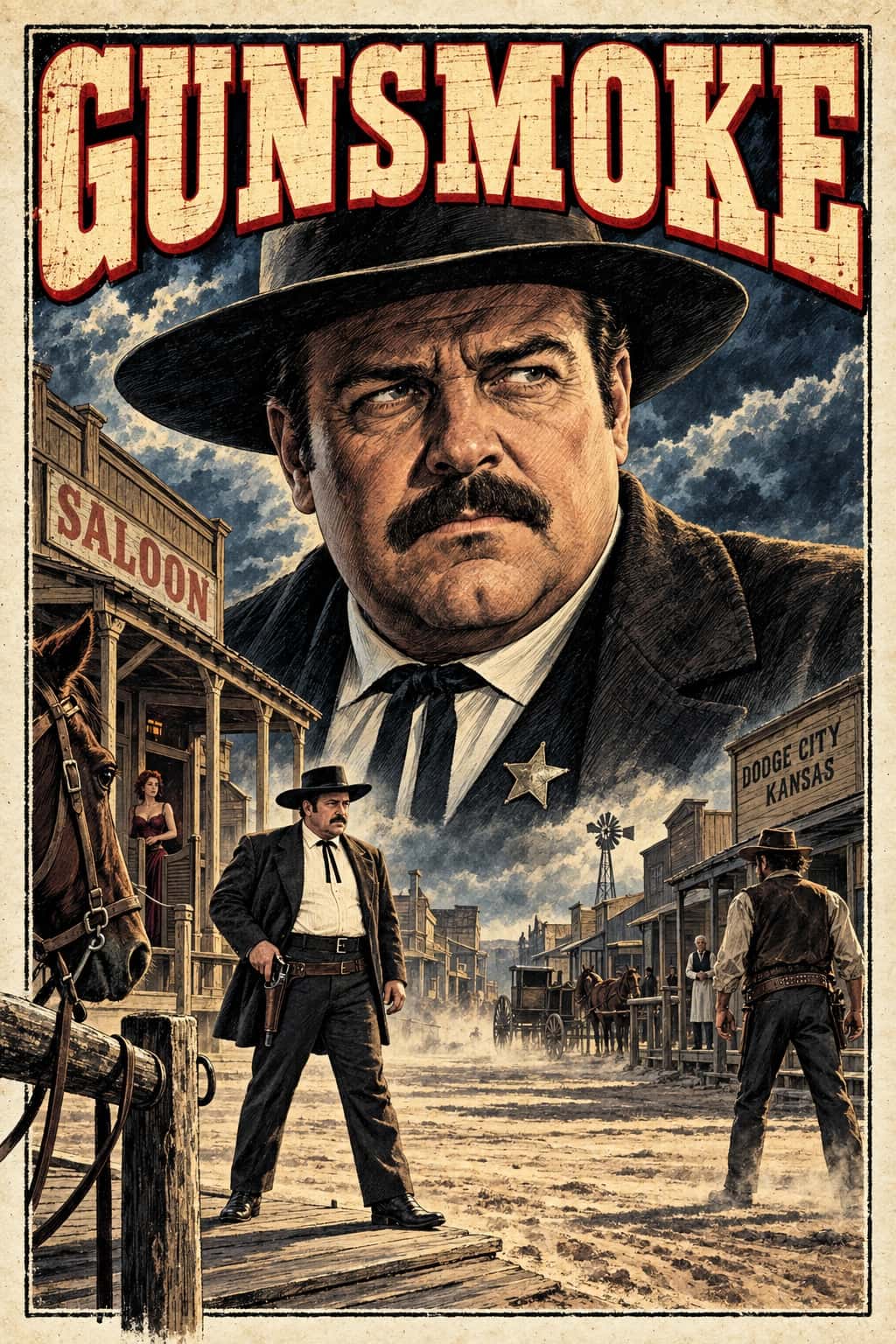
Around Dodge City and in the territory on west, there's just one way to handle the killers and the spoilers, and that's with a U.S. Marshal and the smell of Gunsmoke. Gunsmoke. Starring William Conrad. The story of the violence that moved west with young America. And the story of a man who moved with it. I'm that man. Matt Dillon, United States Marshal. The first man they look for and the last they want to meet. It's a chancy job, but it makes a man watchful. But a little lonely. Welcome once again to Spotlight on a Star. You just heard two famous openings to two of the most popular dramatic programs in late radio. It is my privilege to have with me today a man who was very much a part of those programs and many, many others in the golden days of radio. He needs no introduction because he is a favorite among all of us. And may I say...
He is my all-time favorite radio actor. The date is December 15, 1969, and I am at the Bell Recording Studios here in Hollywood, California. With me at the microphone is a gentleman who has kindly consented to a few minutes of his time in reminiscing with us those wonderful days of radio. Ladies and gentlemen, Mr. William Conrad. Thank you very much, Chris. It's a pleasure to be here. It's certainly a pleasure to be on this tape that you're editing. I just heard the first part of it, and I think it's fascinating. How did you enter radio? Oh, that's a good question. It's been so long, I can hardly remember. I don't know. I was fascinated with radio when I was a kid. I had to go to work very early. My father died when I was, I think, 15.
I had a dear friend who was an announcer on one of the local stations, and I used to hang around with him at night, and he'd let me, this was long before AFRA, or AFRA, he'd let me do a commercial every now and then, and that fascinated me. I went to a radio station called KMPC and started working. I stayed there for a long, long time. I don't know, I was just... It's the only thing I can figure to do at that point in my life. Okay, how did you get started in dramatic network radio? In dramatic network radio? Well, I had never been on a network show, and I was in the Army, and it was about 1945, and somebody said they will allow you for the next two or three months while you're waiting to get out to take a job occasionally, as long as it doesn't interfere with...
Your work, and I was in the Armed Forces Radio Service. So I went up and auditioned for a show called The Whistler on CBS. I hoped to get a small part in it, and much to my amazement, I got a call to come do it that Sunday, and I was doing the lead in it. It scared the hell out of me. But I did it, and I guess they liked it because they asked me back next week to do the lead in it. I think that was the first... I know that was the first network show I ever did. You leave the house, walk slowly down to the cottage near the beach, pleased with the way you've handled Edith. You lied about the work you have to do, didn't you, John? That was just an excuse to get away from the house without arousing her suspicion. Sometime later, a light tap at the cottage door tells you that your expected visitor has arrived. Hello, Frank. Come on in. Party going on up at your place? Some of Edith's friends.
Any chance of them dropping in on us? No. Well, I still don't think, well, we couldn't have met at my place like home. It's too risky. If we're smart, Frank, we'll arrange to meet at a different place each time from now on. Yeah, maybe you're right. Well, this is a nice little spot you've got here, Sheridan. Just a guest house. Eated this idea. What's this stuff? Your wife a sculptress? No. Well, that's some of my work. Just a hobby. Been fooling around with clay modeling since I was a kid. Huh? Sit down, Frank. Get you a drink? No, thanks. Don't have time. You, um... You have the money? Yep. Here you are. Your cut for the library building job. Five thousand. Good. Now, how about that bridge contract? The final bids will be in Friday. I'll go over them all before the board meets. You can tip your contractor off. Who is it this time? Greenwood. Al Greenwood. Okay, the job's his. I'll get the usual cut. As soon as the contract's signed. Good. That'll be in a couple of weeks. How did you become associated with escape? I think I...
I'm not sure whether I started doing the voice on it or not. Perhaps you know. Two men that were announcing the program at first, uh, Paul Freese and Bob Lamond. Tired of the everyday routine? Ever dream of a life of romantic adventure? Want to get away from it all? We offer you... Escape! Escape! designed to free you from the four walls of today for a half hour of high adventure. Tonight, we escape to the island of Pelota in the South Seas and an exciting tale of the strangest bargain ever made as we bring you Letter from Jason, adapted from George F. Wirt's famous story, Sunk. You appeared in a lot of small parts and then larger roles. You have...
Cigarettes for me. Hey, mate, what's the big idea of knowing this lady? I know it. What do you mean? This little... Watch your language. Now, look here. I'm sitting here minding my own business. Well, now you're minding mine, now scram. Well, I got as much right... Are you looking for trouble? Well, no. But it seems to me you are. You little jerk. Okay, boys, carry him out. Nice work, sister. Here's your hundred francs. Thank you, Captain Steve. You want me to make things? Not now. Some other time. I got work to do now. Well, I was doing a lot of work around CBS. My God, in those days, it was unbelievable. We were doing, I guess, maybe 15, averaging maybe 10 to 15 shows a week. And a lot of it was in CBS. I never got involved in the comedy shows, so I did all of the dramatic shows.
And I started doing the opening voice in it. Frankly, I don't remember how it started, but I did an awful lot of them. We all remember you as Marshal Matt Dillon of Dodge City and one of the greatest radio programs of all time, Gunsmoke. In case you're wondering, Mr. Conrad, Gunsmoke started out in 1949 as a CBS audition pilot. In fact, the very first Matt Dillon. with an actor named Howard Culber, who played the part in one episode. It was an audition program that was never aired, and the character was called Mark Dillon. Now that you mention it, I do remember that they had tried to do it five or six months before we started it again, and I do remember that they had auditioned everybody in town for it, practically, and I came in. I think I was the last man to audition for it.
Fortunately, I managed to get it. What year did you become part of the Gunsmoke cast? I haven't the slightest idea. I don't even remember. It's been so long. Perhaps you can tell me. I really don't know. Sometime in the early 1950s. I just wanted to get a definite date for historical purposes. I have no idea. The only thing I can remember was that the show ran for roughly 10 solid years. Well, as the years went by, Gunsmoke became an extremely popular series. Yes, it certainly did. It's still running on television. I guess it's probably the most remarkable series that's ever been on the air in any form. And still being heard overseas by our men in uniform over the Armed Forces radio service. The cast of Gunsmoke was a very special one to me because the actors played their roles perfectly.
You know, Mr. Conrad, I discovered Gunsmoke quite by accident. When I was real little, I was turning it down one night when I discovered a Western-type program that was unlike the Western-type programs that I had heard when I was a child, the juvenile-type programs. It was adult, and I understood it, and I liked it. It was unlike any dramatic show that I had heard because it was real. And I would like to ask you just how much realism, detail, and research went into Gunsmoke? Well, I think quite a bit. Of course, there was no Matt Dillon. That was a figment of the writer's imagination. But you'll get a lot of fights from a lot of people who will tell you that they know that there was. It's pretty funny. I've had several arguments with people about it who say that they know for a fact that their grandfather was related to him or something of the sort. But the writer, John Meston, and the producer, Nolan McDonald, were very meticulous in seeing that everything was as authentic as they could possibly make it. They took complete and deliberate time in setting up the sound effects, which was probably one of the secrets of the show's success. We tried to make everything as honest as we possibly could. That's probably why it had that...
sweet smell of success to it because everybody tried far beyond the call of their normal duty. It's always been an idea of mine to have a reunion of the original Gunsmoke radio cast, but I find this quite impossible with the untimely passing of Howard McNair, who played Doc Adams on the show. I have in front of me a CBS press release from around 1955. entitled, Is There a Doctor on the Show? The answer is yes, if you're referring to CBS Radio's top-notch Gunsmoke series. And Doc is veteran radio actor Howard McNair, who, together with star William Conrad, Georgia Ellis, and Polly Bear, makes up the quartet of regulars on the show. McNair plays his part so realistically that he is constantly receiving letters from listeners asking for his medical advice. Would you care to comment?
on howard looking you're the man that you work with i would be honored to comment on howard i in all the years that i've done in the business i don't think i have ever worked with a more talented man nor have i worked with a nicer human being everybody who met howard no matter under what condition loved him that's all you could do with howard he was a zany wonderful wild, crazy, beautiful human being. It was such a great shock to all of us when he passed away. Of course, it had been a long problem. He had had a stroke about two and a half years before that, and it was most unhappy for him for those two and a half years. He tried to work a little bit, and it was...
so unhappy to see a man who was so bright and sharp, not quite up to it. And, well, I'd like to say one thing. Parley Bear, who played Chester, was asked by Mrs. McNair to give the eulogy at the funeral. And there was no man of the cloth there. Parley did it. The place was filled. It was very, very quiet. I probably got up and started talking. And there were a lot of tears for a moment. And then the most magical thing happened. He started telling about the wild zaniness of Howard. The beautiful times that we'd all had together. And for the next 45 minutes, you won't believe this, everybody laughed.
and loved every minute of it. And it was the strangest, most beautiful, and I think probably the way that all funerals should be, thanks to Parley, who did a wonderful job. Oh, that's just wonderful. And talking about Parley Bear, who played Chester, there was another wonderful actor. I've argued with friends about the character of Chester on radio against the one on TV. I've always had the impression by voice, Mr. Conrad, that... Chester Proudfoot, on the radio version of Gunsmoke, was a middle-aged or older man. What was the character of Chester on the radio series? Could you describe him? Well, just about what you felt. We felt that he was always a middle-aged man who was not too bright, but who was always getting into jams. Matt was always saving him from problems he'd involve himself in.
also felt because of the name Proudfoot that he probably had a little Indian blood in him. It's strange on the TV how it worked out. I think they invented the limp that Chester had because of the word Proudfoot. Now, isn't that strange? Because there's never any indication. Yeah, Chester.
I declare I sure am glad I found you, Mr. Jones. Oh, what's the trouble? Oh, well, sir, I just think you better get on back to office right away. You sound mighty excited. Somebody start an Indian uprising or something? Well, no, sir, it ain't nothing like that. A prisoner escape? No, it ain't that neither. Well, you are going to tell me what it is. Yes, sir. It's that lady. What lady? Well, that lady sitting there waiting for you in the office. Well, who is she, gentlemen? She wouldn't tell me, Mr. Jones. She wouldn't tell me nothing. She's just sitting there fanning herself straight as a ramrod, claiming she wants to see the marshal and where is he at, and why ain't he tend to his office? All right, Chester, I'll see to it. How are we going to handle it? I'll handle it, Chester. Well, yes, I know, but how? Well, the first thing is, you're going to go for the mail. For the... again? That's right. I already got it, Mr. Dillon. I brung it earlier this morning. Don't you remember that? Well, you never know, Chester. They might have forgot to give you some of it.
Go on, Chester. No. Yes, sir. I'll be back. Incidentally, on Doc, there was an interesting reason for calling him, giving him the name. His name was Doc Adams. This came about. His name was only Doc in the script. This came about one day when we were all sitting around laughing. the ghoulish way that Howard played the part. And he was always so happy when somebody got shot down because then he had a little business. And I said, my God, Howard, you know, you're like a Charles Adams character. As a matter of fact, that's what you should be called is Doc Adams. And that's how he got his name. Dave Thorpe took this. Want me to have a look around, Mr. Dillon? Whoever did it ran down the alley into the street. He's just one of the crowd out there by now. Is Dave dead? No, he's breathing.
I saw Doc in the saloon there. What's he doing? He's coming. Oh, go keep that crop back, huh? Yes, sir. Dave. Dave Polop, huh? Somebody shot him, Matt. Yeah. Let me see. Let me see. Oh, yes, he got shot, all right. Who did it, Matt? I don't know if you can bring him, too. Maybe we'll find out. No, no, not this man. He's bleeding to death, Matt. There's nothing I can do to stop it. Can you tell how it happened, Doc? I mean, where the bullet went in? No, you don't need a doctor for that, Matt. His gun's still in his holster. Or maybe somebody outgrew him. I didn't think about that. It couldn't have been much of a fight, Matt. He was shot in the back. And the bullet came out right here. Can you get him to talk, Doctor? He's too far gone. There's nothing anybody can do for him now that makes a man feel pretty helpless. To stand here and watch somebody bleed to death probably doesn't even know who shot him. Maybe not. But he'd know who might want to.
Every time there's a new moon, somebody gets murdered around here. While completing the cast of Regulars was Georgia Ellis as Kitty. Could you comment on her? Well, Georgia was a lovely girl who was very, very good in the part. She had a sultry voice and a great sex symbol in Dodge City. I haven't seen Georgia in a long, long time. I don't know what she's doing, frankly. I see Parley occasionally. But we all get involved in our own devices and caught up in them. You seldom have time to do the things that you should do or want to do. You want some more coffee, Kitty? Yeah, thanks. Well, go on. What did she say then? Well, nothing. She just swept out, proud as you please, as though she'd been in the governor's mansion instead of her saloon. I tell you, Matt, she had me kind of flabbergasted. Yeah, well, you've got a lot of company. Matt, not sure, of course, but...
I think I did see her grandson. Oh? When was this? About a week ago. But did he tell you his name? No, no, he didn't, Matt. And that's why I didn't say anything to the woman about it. Anyway, I don't know where the boy is now. Well, what makes you think it was young Chamberlain? You remember me telling you about Lou Stowe calling me over to a poker game to tell him whether a watch fob was pure gold or not? Yeah. You told him you thought it was. Well, since I saw Mrs. Chamberlain, I haven't been able to get that watch fob out of my mind. Why is that? It had a design on it, Matt. Family crest or something like that. And Mrs. Chamberlain was wearing a pin with the same design on it. I could swear to it. I'm glad you didn't. What? What? Mrs. Chamberlain would probably have had the cavalry out looking for the boy by now. Oh, Matt, the boy means a great deal to his grandmother. I don't think you should joke about it. I'm not joking, Kitty. I don't see anything funny about the whole thing.
For real fans of Gunsmoke who were real attentive listeners, and I was one of them, you had a lot of other regulars in the show that appeared off and on. Now, I might spring a few names on you, and you might care to comment. They were put into the show every now and then when they became an important part of the story. One was a character called Major Honeyman of Fort Dodge. Do you remember that character? Vaguely. He helped you out quite a bit. It probably was John Boehner who played it. We'll be getting to him in just a minute. Okay. Well, thank you, Marshal. I'll be getting along. Major, you said you were sorry that the judge didn't convict him. Why have you changed your mind? Marshal, now he won't even be tried. Not for some months, anyway. What? You mean that the Seventh doesn't want him anymore? No, they want him all right.
My new orders are to send him right up to the Dakotas. Huh? Seems that the 7th Cavalry needs every man available. They're leaving Fort Lincoln soon on an expedition against the Sioux in the northern Cheyenne. The Sioux, huh? I wonder if old Sippenbull is still the chief medicine man with them. Sure he is. But at any rate, the 7th will be heading into Montana territory. Yeah, not if they're after Sippenbull's tribe, they will. He's always had a large camp over on the Little Bighorn. Yes, I know. Um, by the way... Who's in command of the 7th Cavalry now? An officer I served under a couple of years. I never did care for him much. The Colonel George Custer. Another one was Moss Grimmage, who ran the livery. Yeah, that probably would have been Jim Nusser. James Nusser or Sam Edwards or somebody like that. Right. And, of course, where did you, Doc, and Kitty always eat?
The Dodge House, I guess. Wasn't it Delmonico? Delmonico, that's right. And you must forgive me. It's been a long, long time since I've been involved in it. John Daynor is another favorite actor of mine. And when you two got together on any show, whether it be Escape or Gunsmoke, you were a natural pair. You worked very good together, and I enjoyed you both very much. Would you care to comment on John as an actor? We have worked together for so many years. It really, Gunsmoke was like one big family, and I will stress, a happy family. I have never known the joy that we had on that, on any other enterprise that I've been involved with. Everybody, all of the regulars and all of the people who, although they didn't have regular parts, were regularly on the show. John Daner, Larry Dobkin, Harry Bartell, you could go on and on and on, Vic Perron.
We really looked forward to working. It was like all the people who loved each other had an opportunity to see each other once a week or once every two weeks. Oh, there were so many, I really can't pick any one out that would be outstanding. It was just a ball every time we got together, that's all. Taking a wild stab, I'll bet Lawrence Dodkin played the bad man in more gun smokes than the other actor. Probably. He was the one that always just gave you a bad time. What's the matter with you? Start out real friendly and then you freeze up. Come on, get in that train like I say. Let me go. Come on, have a little drink. No, you won't. Let the lady go. You're asking for trouble, ain't you? No. He tried to force me onto the train.
And he wanted me to drink with him. Now, don't you worry, miss. He won't bother you anymore. You wouldn't mind if there was none until you busted him. Ab Laster, huh? How do you know my name? Well, I heard you tell the lady. You're real snoopy, ain't you? Sometimes, yes. Do you know what you're getting into, mister? Now, you tell me. I'll show you. Well, you're carrying a gun. I don't always use it. You hit him. I'll kill you. I swear I'll kill you. You tricked me, you know that? Got a boardwalk, you can still walk. Mister, when we get to Dodge, you're going to wish you never had seen me. I'm wishing that already. Now move. You were active in the late 1950s on another program called the CBS Radio Workshop, which was experimental acting and original drama, which I enjoyed very, very much.
The program originally was done out of New York in the late 1930s by people like Orson Welles and Norman Corwin. It was revived on the West Coast, and you had the privilege of being on the very first one where you announced Brave New World. Oh, Brave New World. Yes, that's right. CBS Radio, a division of the Columbia Broadcasting System and its 217 affiliated stations, present the premiere broadcast of the CBS Radio Workshop. Radio's distinguished series dedicated to man's imagination, The Theater of the Mind. Tonight, part one of two half-hour programs devoted to one of the world's most shocking and famous novels, Aldous Huxley's terrifying forecast of the future, Brave New World. We are proud to have Mr. Huxley as narrator for these broadcasts. Original music is composed and conducted by Bernard Herrmann. Another performance that I...
that I enjoyed, that you did very much, was an anthology called The Ballad of the Iron Horse. It was the story of a locomotive that served its life in the United States from the Civil War to the Wayne of the West, and then nobody wanted it until a few enterprising businessmen bought that locomotive, and it was put out of Travel Town in Griffith Park, California. I remember vaguely the show. I can't remember who wrote it, frankly. Was it Sam Pierce by any chance? Sam Pierce. Was it? Yeah. Bill Robeson probably produced it or directed it. CBS Radio presents the CBS Radio Workshop, dedicated to man's imagination, the theater of the mind.
From Hollywood, the workshop brings you William N. Rogeson's production of an original folk tale, The Ballad of the Iron Horse. He was a locomotive, a 4-4-0. Eight wheels and a diamond stack and a whistle to blow. When he was young, there was no mightier thing. West of the Mississippi, he was the real king. He wasn't streamlined, didn't have much looks, but he wrote his page in a history book.
His father was iron, his father was steel. Forged in a smelter, from his back to his wheel. Rocked the rails in 1862. Time of the strife, our grandpappy's new. There are no plays of Japan, which was, with John Diener and yourself, you narrated a very good story about the Japanese pilgrimage. CBS Radio presents the CBS Radio Workshop, dedicated to man's imagination, the theater of the mind.
Today, the workshop offers an unusual departure in radio drama, a free adaptation of 14th century Japanese theater based on Arthur Whaley's translations of the classic No Flays of Japan, adapted by Harvey Marlowe. Music composed and conducted by the noted Japanese composer, Takshindo. There is a rock which stands at the gates of the shrine on the highest peak of Mount Katsuragi. On this rock is written, Whosoever of all mortal men, whether he be king or slave, if he turn his heart to me, I will send a light to lead him and guide him on his way. I recorded two programs in Europe that I don't know from what series they're from. Maybe you can help me. One was called The Waxworks, where you played all the parts. Was that from a workshop or from a suspense? Do you happen to recall? I think that was suspense. Well, the uniformed attendants...
The mariner's waxworks were ushering the last stragglers through the great glass-paneled double doors. The manager sat in his office interviewing Raymond Hewson. The manager was speaking. Oh, there's nothing new in your request, sir. In fact, we refuse it to different people, mostly young bloods who've tried to make bets about three times a week, I should say. We have nothing to gain and something to lose by letting people spend the night in our murderer's den. If I allowed it and some young idiot lost his senses, what would be my position, huh? But your being a journalist somewhat alters the case. I suppose you mean that journalists have no senses to lose. No, no, of course not. But one imagines them to be responsible people. Besides, we have something to gain here. Publicity and advertisement. And another one.
And the only clue I had to go by, the music was done by Jerry Goldsmith, and it was a thing called 1,489 Words. Oh, yes, I remember that very well. That was a wonderful success. My God, they had more fan mail on that than I think anything that they did. All of their other shows put together. Yes, that was Columbia Workshop. With no prejudice against pictures that are worth 10,000 words, we will bring you, in the next half hour, 1,489 words, which are worth innumerable pictures. Exactly how many only you can tell, for, well, it's the magic of your imagination that will paint them. They say one picture is worth 10,000 words. Do you still believe it? Well, listen then to 398 words from the pen of the late, great Thomas Wolfe, from his book of Time in the River.
A passage known as The Thunder of Imperial Names. The mighty names of the state. Fredericksburg. The Wheatfield. Balls Bluff. The names of Carpens, Brandywine, and Saratoga. Of Death Valley. The Chickamauga. And the Cumberland Gap. The names of the Nantahalas. The Badlands. The Painted Desert. The Yosemite. And the Little Bighorn. the names of Yancey and Cabarrus counties, and the terrible name of... And for the continental thunder of the state, the names of Montana, Texas, Arizona, Colorado, Michigan, Maryland, Virginia, and the two Dakotas, the names of Oregon and Indiana, of Kansas and the rich Ohio.
The powerful name of Pennsylvania. And the name of old Kentucky. The undulance of Alabama. The names of Florida and North Carolina. In the red oak thickets at the break of day, long hunters lay for bear. The rattle of arrows and laurel leaves. The war cries round the painted butte. And the majestical names of the Indian nation. The Pawnees. The Algonquins. The Iroquois. The Comanches. The Blackfeets. The Seminoles. The Cherokees. The Sioux. The Hurons. The Mohawks. The Navajos. The Utes. The Omaha's. The Onondagas. The Chepawas. The Crees. The Chickasaws. The Arapahos. The Catabas. The Dakotas. The Apaches. The Croatans. And the Tuscaroras.
The names of Powhatan and Sitting Bull and the name of the great chief in the face. Westward in the dark. Brother, have you seen starlight on the rails? Have you heard the thunder of the vast express? The names of the mighty rails that bind the nation. The wheeled thunder of the names that net the continent. The Pennsylvania, the Union Pacific, the Tennessee, the Baltimore and Ohio, the Chicago and Northwestern, the Southern. The Louisiana and Northern, the Seaboard Airlines, the Chicago, Milwaukee, and St. Paul, the Langewanas, the New York, New Haven, and Harvard, the Florida East Coast, the Rock Islands, and the Denver and Rio Grande. The names of the great rivers that are flowing in the darkness. The names of the great mouths, the mighty moors, the vast, wet, coiling, never-glutted, and unending snakes that drink the sun.
Where and in what other land will you find others like them? And where you can match the mighty music of their name. The Monongahela. The Colorado. The Rio Grande. The Columbia. The Tennessee. The Hudson. The Kennebec. The Rappahannock. The Delaware. The Penobscot. The Wabash. The Chesapeake. The Tuananoa. The Indian River. The Niagara, the St. Lawrence, the Susquehanna, the Tom Bigby, the Nantahala, the French Broad, the Chattahoochee, and the Potomac. A few of their princely names. These are a few of their great, loud, glittering names. Sit for this immense, lonely land that they inhabit. Did the writers...
Can the producers of Gunsmoke ever get or accept stories written by the listeners? I don't know. It seems to me that at least once somebody wrote in something that was a story outline that they did use, but I'm not really positive of that. I do remember one incident that happened about Gunsmoke that was rather interesting. We had a tremendous listening audience. I think they estimated we had something like 50 million listeners a week. which is pretty fair, even in today's... What happened was that it was released twice a week. That's why we got such a large audience, because it was on Sunday night, which was one audience, and Saturday morning, which was an entirely different audience. But the show had been on something like, oh, seven or eight years. And I was walking down the street one day, and a nice gentleman stopped me and said, I want to say something to you. And I said, yes.
And he said, it's a chancy job and it makes a man a little lonely. And I looked at him like he was insane because I said, I beg your pardon? He said, you know what that is? And I said, no. He said, oh, come on. He said, you're being stuffy. And I said, no, I'm not being stuffy. I don't know what that is. And he said, well, that's ridiculous. plays the part, and then isn't even nice enough to admit that he wants to talk about the show. And I read him annoyed with you, and he turned and walked away. And I couldn't figure out what in God's name was going on. Because you see, that opening was recorded the first week we did the show, which was eight years before. And I had never said those words since then. And I had never listened to the show.
So I had no idea, you know, he was very annoyed at me and rightfully he had a right to be because he thought I was being a big shot or something. But I honestly didn't know what he was talking about. You know, even though you entered radio, like you said, in sort of its latter years, you were on some of the most popular and well-remembered programs in radio history. If I may run through them very quickly, let's reminisce. Do you remember Jason and the Golden Fleece with McDonald Carey? Yeah, he and I co-starred in that. Ah, you could not sleep, huh? No, Louis. I was thinking about our friends, Alan and Donovan. Huh? Do you find this interesting? In a morbid sort of way. Well, at least the sea is giving us no trouble. I have the feeling that if those characters below wanted to, they could rustle up a storm. I imagine that the Gulf of Mexico is a little out of their joy of fiction. Maybe. I'll still be glad when this cruise is over. They are paying us well, you know.
Yeah, and we're earning every penny of it. Hey, you smell something. Only fresh air, which I will admit is somewhat of a novelty after the atmosphere of the French Quarter. I'm serious. Don't you smell it? No. You're right, you're so... Look, it's coming out of the engine room. Nightbeat with Frank Lovejoy. Yes, lovely. It happened in the Pelican's house. He was sitting alone. Tall, gray-haired, rugged, a face full of some 50-odd years, I guess, and full of some other things no one could guess. It was three drinks at the bar before I made out who he was. A man who was once big, you know. Mind if I sit down? Who? Randy Stone, Chicago star, Mr. McMaster. Well, you're the first one. What first one? Who's recognized me. Oh. Well, only from your pictures. It was a long time ago. Time? I know more about time than you or that old guy they always have around on New Year's with the beard and the hay cutter.
I just thought there might be a story somewhere. Sure, sure. Sit down, sit down. I'll tell you a story. Once upon a time, there was a guy who had everything. Money, friends, a future. Then a bunch of old women made a law called the Volstead Act. You remember it? Yeah, yeah, but I wasn't thirsty at the time. Well, a lot of people were, everybody. You see, the law was always supposed to be for the other guy, not for them. But there were no other guys. So this fella I'm telling you about got on the bandwagon. He bottled millions of violations of the Volstead Act with a lot of money and a lot of trouble. Am I boring you? If you are, I asked for it, but you're not. Well, the trouble got him a lot of jail. 19 years of it. Started in 1931, ended just two days ago. I see. Now this guy's out, and he's gonna stay clean.
And they can pass a thousand stupid laws and he's not going to fall for any of them. He's going to do everything the way it says in the books and live happily ever after. How's that for a story? It's a good moral, but no drama. Good, I hope it's real bad because I don't want you to print it. Stone, I'm flattered that you recognize me, but I paid back ten days for every one I took. All I ask is that you just let me alone in the papers. Okay, McMaster, as far as I'm concerned, you made your last copy in 1931. Stole, it's nice to come out of prison and have the first guy you meet turn out like you. Let me buy you a drink. Richard Diamond, private detective. That's with several different people. My God, Dick Powell, Gene Raymond did it. Oh, gee, Diamond, I'm sorry. Did I hurt you? Oh, no, no, no, Seymour. I feel great. Who needs teeth?
Come to think of it, though, I might be more comfy down here if you'd lift this desk off my chest. Oh, yeah, sure. There you go. Oh, well, thanks. Sorry, I didn't mean to knock you over. Sorry, forget it, forget it. I enjoy having my chest crushed as much as the next guy. Okay. Now, the throw I'm going to show you now is called a Japanese shoulder toss. Look, Seymour, you've convinced me. Judo is a wonderful sport. I didn't realize what I've been missing all these years. I love this sport, judo. Now, what'll it be, canasta or old maid? What? How about hopscotch? Oh, come on, come on. Let me show you just one more throw. Not even if it was with a beanbag. And maybe some wrestling holes in it. I know a lot of wrestling stuff. Must be some trick you'd like me to try. No, no, no, Seymour. I really don't believe I... Well, come to think of it, yes, I... There is a wonderful little trick. Huh? You get yourself a nice long rope.
Throw it high up into the air. Yeah. And then real quick, you climb way, way up to the top and just disappear. Ah, that's nuts. Three or four people who did Johnny Dollar. Were you ever on Johnny Dollar? Oh, yes. How about Frontier Gentlemen or Have Gun, Will Travel? Uh, no. In later years, I directed many of the Have Gun, Will Travels, the TV version. Well, another show was Sam Spade, and that was a ditty with Howard Duff. Right. There was one beautiful one that you were in where it was such a bizarre murder that it wasn't solved until the very end, and that was the part where you played the millionaire Albert Martini, who had himself murdered. Do you remember that particular episode? No. I used to play it. You're exactly one minute and 42 seconds late.
Hours are made of minutes. Minutes are made of seconds. In killing this seemingly negligible interval of time, you have wounded an hour. Oh, I have? Well, I'm sorry. The traffic's pretty heavy out here. There's an hour in the morning, you know. You should have started a minute and 22 seconds earlier. I'm sorry. There was a bore on the telephone. Kept talking about how valuable his time was. Well, don't apologize. Only waits more time. Here's your check. $100. My car's just around the corner. I paid that chauffeur a large salary. We mustn't keep him waiting. In the meantime, you may as well start earning your fee. I've been earning it for the past 22 minutes and 22 seconds. Wait.
Uh-huh. I suspected as much. Do you drive a car? Yeah, you mean one man drives all that? Yeah, I see him, that rascally chauffeur of mine. Sleep in the back seat. All right, come out of there, you. Hey, what? I was behind him and a little to the right. The shock of the rapid-fire 30-caliber slug lifted him off his feet and knocked him against me. I went down under his 300 pounds of dead weight. The time I rolled him off of me and got up, the gunman had jumped out of the limousine and into a gray sedan that was double-parked alongside. In the welder of traffic on the boulevard, I didn't dare risk throwing a shot after him, but I did get the first three numbers of the license plate before it buried itself in a heavy stream of AM commuters. Suspense, many roles in suspense, and you had the good fortune to work with a wonderful lady. In fact, I call her the first lady of radio, though many don't, and that's Kathy Lewis. Yes, Kathy was very good. You were with her on two programs that I have in my collection. One is The Search for Isabel with Red Skelton.
He played the part of a gangster named Tony Desimoto. And Kathy Lewis was the voice of Isabel. That isn't Smart Boy. I thought I told you not to pound. Let me in. Smart Boy's got a gun. I might get hurt. Let me in. What else? My hospitality's boundless. Come in and have a cocktail. Yeah. Thirteen-half-year-old scotch cocktail, I suppose. Where's Isabel? Oh, come now. Where is she? I know she's here. Put the rod away before you get hurt, Smart Boy. Oh, hello, Roy. Come on in. Close that door behind you. Now, you two put your hands up. What is this? Now, both of you get over back. Get that wall. Look, Brown, I don't know what you're trying to prove. If you're as smart as you think you are, you'll get out of here fast. Isabel. Isabel, come out. It's okay. Stand back where you are. You got hurt once, nosy. Keep quiet.
Isabel! What are you waving the gun around for? Now, stand back. You nervous? You let Isabel go. Hey, you're shaking so bad you couldn't hit the wallpaper. Now, you stay away from that mantle. I just want to pick up this automatic, that's all. Now, stay away. You're too nervous. You're out of your league, smart boy. Put that gun down. Drop the rod. Drop it. Don't! That's it. Drop the gun. Well, the other one was never steal a butcher's wife. Well, you worked with her. Never steal a butcher's wife. You did a good job as a liquor clerk in the... Supermarket. It's a fascinating title, but I don't remember it. Well, Kirk Douglas did the law of suspense about eight years earlier. No. It started the first day of the job. I was quick in the liquor department of this supermarket. I hadn't been in Los Angeles but about a week. My brother, when I left New York, had given me this letter to a friend of his, a guy who owned a string of these supermarkets, and this guy had this opening, Liquor Clerk, and comes following Monday, and I'm at work. One of those big places with hardly any clerks, you know?
You pushed a little cart around, and you helped yourself. To get out, you passed the cash register, and the girl loaded your stuff and rang up the price. Well, that's where the trouble was, this girl at the check stand. I hadn't noticed her until around noon, and when I happened to look up, there she was, looking at me, just looking at me. She must have been 50 feet away, at least, and with customers between us, but it was like we were all alone, the two of us on a beach somewhere, an empty beach. Do you remember one called A Matter of Timing, where you were a hired killer paid to do a job that never got carried off? Well, I suppose you know what you're supposed to do. Yeah. My partner. How'd you find somebody like me? Well, it isn't hard to find a friend. A friend? Well, you know. Yeah. What's the matter with your partner? Huh? I mean... Personal reasons. And his wife? No. Oh, you've been...
Definite of a two and you got your fingers cut. What's so important about the reason? That's not. Only I get curious why people want to have other people killed. Does there have to be a reason? Oh, not as far as I'm concerned. I get paid to do a job. That's also living. That's my reason. Yours ought to be at least as good. It is for me. Good enough. Let's get on with business. I got an 18-hour alibi. That means I got to be out of here by night. It should be out by 9 o'clock this morning. All planned? Just about. Good. I don't like complications. I won't be. When do I get the rest of my money? Just as soon as the job is done. Do you trust me? I'm sorry. My business, it has to be cash in advance. Nothing personal. It's just that I can't sue you. You could come gunning for me. Well, I could, but I wouldn't. I only do my work for money, not pleasure. Yes. In advance.
Another one I recorded in Europe. You narrated it. It was a very good one called The Man Who Threw Acid. He was a young man serving his second year in the city assembly. And because he believed in honest government, he wanted to enact restraining legislation against the racketeers. At first, the older men, the wheels of the political machine, laughed at him, patted him on the back, gave him a cigar. They liked him because he reminded them of their lost ideals, wasted energy. And then... I began to listen to him, wondering. The young assemblyman said in council, I wasn't elected to this office to see my wife and kids or anybody else's wife and kids dictated to by the racketeers and the hoodlums in this city. That's what's happening. Dope, gambling, mugging. The protection racket started again. If the chief of police won't or can't do anything about it, I say we should. Make laws. Put teeth in them.
Get rid of the big boys who run the rackets and we'll have a clean city. It wasn't a brilliant speech, not in content or in delivery, but it made its point. And the young assemblyman kept on making his point. The older, wiser city fathers began to take notice. So did the press. And so did the big boys, the racketeers. And the man who was considered the boss called a meeting. There was no red tape involved, no orders in triplicate, a simple direct edict from the top. And the organization was such that by 7 o'clock that evening, the Highland had been contacted. 18 shows a week, and you multiply that by 52 weeks a year and multiply that by 15 years. You did appear on First Nighter, Bold Venture. Yes, as a matter of fact, I was Mr. First Nighter for a while. I think I was the last Mr. First Nighter. There were many before me. And when it moved out here, I did the part. And you did a couple of favorite stories of Ronald Coleman. A couple of favorite stories.
God. Sometimes you did more. I did all of them. I think I did leads on probably 95% of them. Well, then, with all that, you might remember one in particular called the Diamond Lens. Oh, I remember that very well. Oh, beautiful story. Yes. You don't have a copy of that, do you? Yes, I do. You do? I'd love to hear that. All right. I'll make sure you do. We're going to have to get together after we get off this interview. My lens sat with such infinite precision within my microscope. And then a muffled cry within my throat. I raised one of the massive andirons before the fire. And with a strength beyond my own, I struck again, again, again. And at last, there on the floor beneath my feet were but shattered remnants of the object of my hatred, my diamond lens. And that, young gentlemen, is my answer to your question. Do creatures exist beyond the realm of human sight? They do. I, of all the world, have seen them. There leave any out.
Well, probably, but who cares at this point? You've certainly hit enough of them. Yes, that's about it. You did appear in a few Johnny Dollars. Yes, Johnny Dollars played by John Lund, Edmund O'Brien, Mandel Kramer, and Bob Bailey. Bob Bailey, right. And which ones were you with? I think nearly all of them. There was a Johnny Dollar that you, and I can't remember his name. Charles Russell? Charles Russell, right. I have one. Have you really? He was the very first Johnny Dollar, I believe. Yes, he was. He had the very first Johnny Dollar program. Yeah, right. Christopher London with Glenn Ford or Rocky Jordan with Jack Moyles? Oh, Rocky Jordan, yes, but never on the other one. I don't even remember the name. How about Drag Nets with Jack Webb? No, I never did any Drag Nets. Good group of actors, Barney Phillips, Herb Ellis. But you did work with Jack on quite a few escapes. Yes. All right, you guys, come on, the party's over. Hey, Miller.
You guys don't look like no bunch of daisies, but we'll make you bloom, won't we, Miller? He was a brute of a man, and he carried a .45 and a holster. He and the driver, Miller, herded us out of the truck like so many cattle. It was some sort of a road gang. I saw a sign blocking the road that read, Under Construction, Pendler Construction Company. Well, I had no idea where we were, how far away from the border. The landscape was dry, dusty, barren. Well, Gonzales, you with us again? Didn't we learn you not to get drunk, huh? Come on, you guys. Stop on it. All right, quit shoving. Come on, come. Hey, what are you doing here? Yeah, that's what I'd like to know. How many times I got to tell you to be careful who you pick up? Now, wait a minute, Jake. Don't get sore before I tell you. Don't you know we can get in plenty of trouble picking up the wrong guys? I didn't pick him up. O'Toole threw him in. O'Toole. Shut up, you. What O'Toole wish him on us for? Little Hensler hears about you. Well, O'Toole has already talked with Hensler. He says this fellow will not give us any trouble. He is an embezzler.
The police are looking for him. Yeah, crazy. He came across the border to sell some money he had stolen from a bank or something. He must be plenty hot. He was willing to drop 15,000 real dough for 4,000 cash. Real dough? What are you talking about? That was counterfeit I sold O'Toole. Listen, buddy, I don't know what your racket is, but nobody fools O'Toole about money. But it can't be real money. It was counterfeit, I tell you. It had to be. Look, I want to see Hensler. You talk to me or you talk to nobody. But I got to see Hensler. I got to get back to Juarez. Huh? You hear that, Miller? He's got to get back to Juarez. All right, look, you can't push me around. I'm an American. Oh, he's an American. Well, send this to your congressman. Okay, American. Get on your feet. Get a pick and start working. Well, I am just about out of questions. Would you care to ask me any? Well, yes, I'm fascinated with what you're doing here. You just showed me a couple of magazines about...
old radio, and I didn't realize that there was anything this advanced in the way of radio buffetry, if you would use that expression. I'm fascinated that there are a lot of people around who believe that radio was a great medium and could be a great medium today. Unfortunately, it does not exist today, but I firmly believe that radio cuts it all over television in many areas, and it's a shame. that a medium that is that beautiful has to disappear. I bet there are many gun smokes that you did that were so well written and you enjoyed doing so much that you would like to do over again. As a matter of fact, I did one of the shows I did. I made a movie out of it later. What was it called? It was called The Ride Back with Anthony Quinn and I starred in it. Talking about movies, I saw the movie The Cowboy that you narrated along with John Daner on document text writer.
A good anthology about the American West. Yes, it was. And it had a touch of Gunsmoke in it. Well, okay, thank you very much. I certainly appreciate talking to you, and good luck on your collection and whatever else you involve yourself in. Thank you. It's been a pleasure to have the opportunity to talk with you today about those wonderful days of radio. Thank you very much. This is George Walsh inviting you to join us again next week when CBS Radio presents another story of the Western frontier. When Matt Dillon, Chester Poundfoot, Doc, and Kitty, together with all the other hard-living citizens of Dodge, will be with you once more. It's America growing west in the 1870s. It's Gunsmoke.