
The written record
Read the transcript
Read along with the recording · About 24 min to read
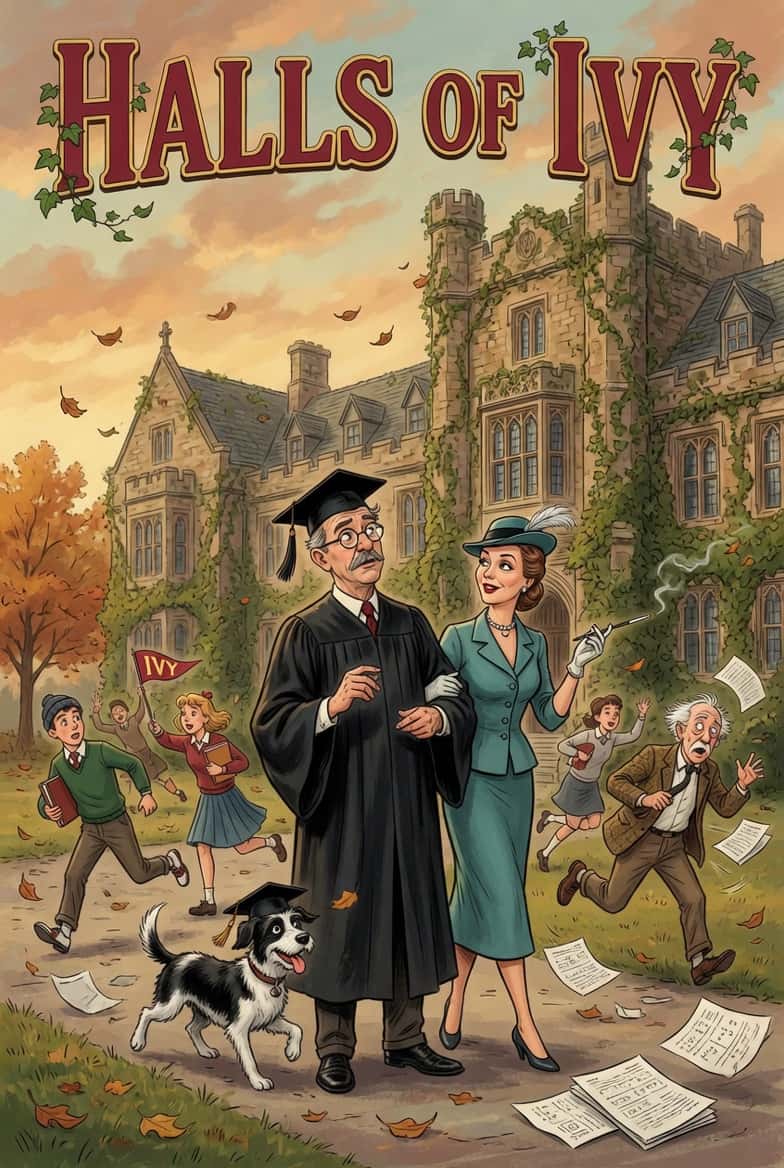
Ladies and gentlemen, it is a great pleasure to have in our studios a man whose name I'm sure many of you know. If you have listened very carefully to one of our most delightful programs, indeed one of the most delightful programs on the air anywhere, and have listened all the way through to the end, you have heard his name many times. Certainly he is a man whose art you are familiar with and whose art you have enjoyed. tremendously, I know, whether or not you know his name. For he is the writer of our delightful program, The Halls of Ivy. And his name is Quinn, Mr. Don Quinn. As I said, Mr. Quinn, it is a great pleasure to have you here. Welcome. Thank you. I think that our listeners will be interested first, although we want to talk about Halls of Ivy, of course. I think they'll be interested first in talking about Don Quinn.
Who are you? Where are you from? Where were you born? And so on. Where were you born, Mr. Quinn? I was born in Grand Rapids, Michigan, although my family traveled quite a bit through the Midwest. My father was a chamber of commerce organizer who would go to a town, organize a chamber, and run it a year, and then move on. So my schooling was rather sketchy. Oh, yes, all over the great Midwest of our country, huh? Yes, through Michigan, Pennsylvania, Illinois. then you were educated here and there and everywhere. If you can call it educated, yes. I always say I'm a self-made illiterate. What do you mean by that? Well, most of my education has been, as I say, was scattered here and there, and most of it has been through reading and observation. One would think that you must be an extremely highly educated man. I mean from the standpoint of formal education, however. Since you write this...
Program Halls of Ivy, which is quite an erudite script sometimes. Well, thank you. I'm glad to have this illusion as being perpetuated. But it's quite fraudulent in the fact that my formal education has been neglected. However, my wife is a journalist from Northwestern. And practically a Phi Beta Kappa, although she denies it. and she is my reference point for most of the college work. Oh, indeed, I'm very much interested in that. I was going to ask you if you had any family. Now, you have told us of your wife, and she is helpful, eh? She's very helpful and a great critic. Good. What is the famous old phrase out of a play of years ago? Best friend and severest critic, eh? Yes. Any other family, Mr. Quinn? Yes, I have two children, a girl, 60, Nancy, and a boy, Johnny, 10.
Nancy is with us. Oh, Nancy is, huh? I hope she and all of you are enjoying your Hawaiian visit. My daughter's practically in tears at the thought of going home Thursday. Well, we're sorry to see her and all of you go. We hope that you'll be inspired to come back. It's been a delightful visit, and we hope to make this an annual tour. How long have you stayed this time? Between boats, ten days. Oh, have you been here before? Yes, we were here in the summer of 1941. Oh. and this is your first opportunity to get back again. Yes, the first time, but it won't be the last. We're going to try to make this more frequent. Fine, I'm delighted to hear that. Do you have any hobbies, Mr. Quinn? I have so many hobbies, I don't have time for my work. I get in my car and drive in the mountains, which is my principal hobby. I paint, I pistol shoot, skeet shooting, chess, reading, theater.
Oh, any number of things. You have a well-rounded and full life, eh? I have a lot of fun. As a matter of fact, they all, I imagine, they all help you in your work, too. They all contribute, if only in the matter of relaxation and rest. Yes. Capable writers should be a versatile fellow of many interests and so on. Well, radio writing is a highly competitive business, and it's a great strain during the broadcasting season. And when vacation time comes along, it's highly welcome. Yes. Anything you can do to relax is all to the good, and there is nothing like a trip to Hawaii in this direction. That's so true. How did you come to get into radio writing, by the way? You know, in this business, very often the question is, from what profession do you come? How did you get into radio? How about with you, Mr. Quinn? I came from the ranks of commercial cartooning. Indeed. Which in 1929 and 30 laid, as Variety says, a big egg.
I had been giving jokes to a radio comedian around Chicago named Jim Jordan. Oh, yes. Who is now Fever McGee. And they asked me if I would write a show for them called Smack Out, which was a rural community country store skit. And I wrote this for four years, a country store rural thing without ever having been off the city streets. So you can see I'm a fraud all the way along here, writing a college show with no education. And it's a city boy writing a country show. Fibber McGee and Molly stemmed from that kind of story skit because we featured tall stories. This is why we called him Fibber McGee. Oh, I see. That's where the name Fibber came from. And that's how you came to start writing that script. I neglected to tell you, ladies and gentlemen, that Mr. Quinn did, of course, also originate Fibber McGee and Molly and wrote it for many, many years. Seventeen, to be exact. Seventeen, really?
We, of course, have carried that show, too, here, Mr. Quinn, and have enjoyed having it very much, Herbert McGee and Molly. Now let's get to Halls of Ivy, shall we? We all love that show so much. It's such a beautiful thing. And that's no Ho'omolimoli. Have you learned what Ho'omolimoli is? As far as I know, it means nonsense, or fun, or... Kid of Mulan. I think the best meaning of it is flattery. Flattery, yes. Probably the truest meaning. And so that's no flattery. That's no ho'omolimoli. Hui is not a contraction of this, is it? No, no. Ho'omolimoli is pure Hawaiian. We do love the show, and so let's talk about that, shall we? Tell me, how was the idea for the program born in the first place? Well, this was a mental conception which, like all reporters, have a play in the trunk which is never finished. It's the ideal book or play or production.
This was my idea of a show in which a thought could be expressed once in a while. A little above the average low comedy. I have very high respect for low comedy. It's entertainment for a lot of people. But during the war, in the government allocation program of war messages on Fibber McGee and Molly, we found that we could... sell an idea embedded in comedy very successfully. We used to take the war themes and build shows around them rather than tie them on the end of the show and brush them off. So with this in mind, I thought I would like to do a fairly literate type of show for me. I didn't think it would ever go on. It was just a dream show. But my agent and very good friend, Mr. Nat Wolfe, who was the husband of Edna Best, the English actress, kept after me to write this show until I finally did it to get rid of him. And the first show went on exactly as written. I don't think a word was changed. And it was quite a successful thing from the beginning, much to my gratification. Yes, of course. That must have been a thrill of satisfaction for a writer, eh?
dreaming about it for a while. Yes, this was a dream come true. It doesn't happen very often. It was purely then from the standpoint of a writer's ideas. He would like to get across a thought, as you say, a serious or a worthwhile thought dressed up in comedy, huh? Yes, in almost every show, no matter how frothy the show itself is, we try to have at least one line or paragraph or idea which you can take home with you. If it's only, don't kick dogs or be good to your mother. Yes. Usually it's some little, a bit of philosophy, maybe borrowed, maybe original. But in every show, we like to have one serious thought. And I think we have done it fairly successfully. Oh, you certainly have. I remember many of them. I remember one. One comes to mind and, in fact, has seldom left my mind, that charming script that you had about the award, the literary award. And Dr. Hall thought at first that, of course, he had won it.
It was for his book, and then it turned out that it was for a student and so on. And you had that beautiful bit of Chinese philosophy at the end about the teacher and so on. Well, innumerable, I would say innumerable, a great many of our shows have been requested, copies have been requested by various state and government agencies. And, for instance, we had one on adoption, in which we expressed to a child why he was adopted. I remember. And this script was requested by a great many state welfare agencies as the proper explanation to a child of adoption. General Hershey asked for copies of a script for indoctrination purposes. We had one on hoodlumism in the colleges of young men who felt that they were going to go in the army anyway and they might as well have fun while they could, and they had rather a destructive attitude.
rather a lack of obligation to their own citizenship. And this was considered quite valuable by General Hershey, and he's using that script now. Now, this has happened so many times with this show that we're all very happy that we're entertaining as well as useful. Yes, exactly. It must be most gratifying. I wondered if perhaps something of the idea had been inspired by the people. You know, sometimes an idea, I think, for a writer is inspired by an actor that he has to work with. Do you find that true? We get material from all directions, particularly the people concerned with the show. We have bought scripts from the violinist in the show, from the musical director, from two of the engineers, from an announcer. A lot of people around the show offer ideas.
hesitate to accept an idea from outside, from people we do not know. As a matter of fact, we return them unread. This is a rather... It's too bad because we probably pass up a great many wonderful ideas, but motion picture studios use this too because the dangers of suit for plagiarism later on are so great from crackpots and opportunists that they don't dare read unsolicited manuscripts. We have to depend on known sources. We use... I have a staff of three or four writers, of which I am one, and I edit all the shows. No show goes on without my having edited every word of it, practically rewriting the told show, mostly. But it's a very small stable, as we say, of writers, and most of our shows stem from those. From your own... Yes, I see. The ideas come from everywhere, and by osmosis... Yes, I suppose you perhaps have an actor play a part, and...
The way he handles a given scene or a given development probably will give you an idea for something that you can use in a later script, is that not so? This happens all the time in radio. Something happens and you realize that you've found a quality or a piece of business which is valuable, and then you use it again. And this is the way a great many radio actors and types have been developed. If they're not good, you drop them, you not use them again. Pieces of business like Fibber's Closet and Certain Professors on Ivy have stemmed from what was intended as a one-time performance. But they've been so good that they've been retained and repeated. So you never know. This is one of the fun things of radio. You never know where your next property is coming from. Yes, how true. How did the charming Coleman's get into the picture? By inadvertence. A lucky inadvertence. Fortuitous.
The show was originally written for Mr. Gail Gordon, who is a very prominent and, to my mind, the most proficient actor in radio, a fine man. It was written for him and Edna Best, the English actress. But Miss Best had to go east to do some Maurice Evans plays in New York, and Mr. Gordon was tied up contractually, and we couldn't have him, so we had to frantically recast. And Mr. and Mrs. Coleman were suggested. And they turn out to be the ideal people. I don't know why we didn't think of them in the first place, but they have just been wonderful ever since they are Dr. Hall. As a matter of fact, he gets mail addressed to Dr. Hall asking him to solve college problems. That's marvelous. Imagine. That certainly must be gratifying to him, eh? Practically all our mail is gratifying. It's a very pleasant, very literate type of fan mail.
Oh, yeah. And I have a great joy in answering it. I have a lot of fun even answering the crackpot letters, of which every show gets a few. Sure, I suppose. For instance, do you recall anything that might be interesting or amusing? Yes, I do. We happened to be on for a beer sponsor. Yes. And one, some fanatic type in California said that we were undermining the youth of the nation and selling them into alcoholic slavery. Another such nonsense. Yeah. And as the privilege of answering a personal letter was mine, I answered this and told her that Christ's first miracle was turning water into wine, and I hoped one of his later ones would be turning bigots into human beings. Oh, marvelous. There's a line for a writer if I ever heard one. It must be a great pleasure for you to work with the Colemans, isn't it? It is pure delight, because they're very charming, literate, gracious people. And we couldn't be fonder of them than we are, and they...
They're very conscientious. They do a wonderful job. And Mr. Coleman is somewhat of a literary authority himself, which saves me a great deal of work. I just refer to him instead of Bartlett's quotation. Oh, indeed. I was going to ask you if they ever made any suggestions, do they? They have both written scripts. Ronnie has written two scripts, and Benita has written one. And they're very sharp critics. They know when a theme or an attitude is fraudulent and correct it. not that it often is in this show because we work too closely together, but they are very sharp in detecting a false note or a lack of quality. Yes, well, that certainly must be most helpful. Two, in listening to the show, they seem to enjoy themselves very much. You can tell, you know. An actor feels the reactions and he feels the script, and I think a knowing listener...
can feel the actor's feeling, if you get what I mean. I have always held to the theory that friendliness is a communicable feeling in the air. And this is probably, and I can say this after 25 or 30 years of radio writing, this is probably the happiest group of people on one show that I've ever seen. Everyone likes everyone else. Everyone is competent. We have experts in every department. And it is, from a writer's standpoint and a production standpoint, it is a pure joy to put this show on the air every week. I imagine. It certainly sounds as though everybody's having a fine time, and certainly sounds as though the visual audience is having a fine time. They all love it. They all want to come back week after week. We like new people in there every week to give them all a chance to see it. Of course, of course. Do the Coleman's ever express themselves as missing the stage? I mean, does Halls of Ivy quite take the place of the stage for them, or what?
Well, I think all actors have a certain nostalgia for the stage, but this is such a pleasant and comparatively easy chore for an actor, and I think the compensation is a little higher, except maybe for a motion picture. Yes. And then you're not under the pressure that you are in either the stage or pictures. So I think they enjoy this as much as they would a stage production. You may, if you wish, say I refuse to answer, you understand. Because I'm going to ask you a question now to which you may want to give that answer. We extend that privilege beforehand. However, I hope you won't. The question is this. Is the idea of the show, or are any of the characters in it, biographical or perhaps autobiographical? No, no. There's no autobiographical basis for any of the characters. Some of them have been borrowed lightly from people we know.
We don't lean heavily on acquaintances. Mostly they're idealizations of people that we have known. Ah, I see. How did Mr. Wellman develop? Of course, quite obviously, or it seems quite obvious, he has become a very popular character. How did he develop? He developed mostly, I think, because we needed a conflict in the show. We needed a menace of some sort and a dissonant note. Yeah. which he fulfills very well. He's a fine man and a good actor, and he's a lot of fun. And I will say that college boards throughout the country have taken this kid in very good part. Have they? No, there is no malice in it. He plays the part beautifully, no question about it. His pacing and his... Well, he's a very competent actor. Who is he? He's an old... Herbert Butterworth. Oh, yes. A stock company of many years, an actor of long standing. Mm-hmm.
To get back to that other thing I was talking about, the theory of the actor inspiring the writer, have any things that he has done, any treatments that he has given the part ever inspired you to, given you an idea for some future? Well, any writer or any producer who ignores an actor's suggestions is an idiot, because they have some very valuable contributions to make. They know what they want to say and how they're going to say it. And the best radio writing is done for certain talents and for certain people, tailored to their delivery. And everyone on our show is free to submit ideas, and they all take advantage of it. They all submit them, and we listen very respectfully to them, including Mr. Wellman. Good, that's fine. And, of course, Mr. Merriweather, he's our friend. Mr. Merriweather is Gail Gordon. Yes, I know. Who was the original...
Dr. Hall. Yeah. Oh, the planned original, yes. Well, of course, when he comes in and takes up the fight in Toddy's behalf, we all love him, of course. How did he develop? Well, he developed from the very first show. Yeah. He was such a likable character that we decided to use him as an offset for Mr. Weldon. You've certainly given him some terrific lines. Some of these comedy things of his are delightful. And the housekeeper, how about her? Did you just insert her for a reason? Well, our production man, Mr. Milton Merlin, who is a very, a book reviewer, a very well-read man, and one of our chief writers practically invented her. And she's played by Elizabeth Patterson, who was an old-time movie actress and whom you would recognize instantly if you saw her. Yes. My wife and I recognized the name right away, of course, and I think the voice, too, yes.
Uh-huh. Which character would you say gets the strongest audience response? I suppose that's Dr. Hall himself, but I mean of the other characters. I think Mr. Wellman, probably. Uh-huh. Mr. Wellman, yes. Overwhelmingly, I would say, after Dr. Hall and Mrs. Hall, because he's probably the most... projecting of the characters. Yes, yes. You usually give him a very flamboyant entrance or exit, and he has some snapper to his exit. That's right. Every once in a while, we give him something nice to do to show that he is a human being after all. Yes, I noticed that toward the end of last season, you had a very nice touch in there. Don, do you work with the...
Production itself, I mean, do you attend the rehearsals yourself and so on? I work very closely with the production. I see the script all the way through, editing every word, inserting a great deal of my own work. Then I attend every rehearsal and every broadcast. This to me is one of the writer's obligations because if anything should happen, if an emergency should arise at the last minute, the writer must be there to make corrections and changes. If an actor has an accident on the way to the studio, this leaves a very embarrassing gap in the script. Oh, yes. So I think it's part of a writer's duty to follow through the actual broadcast. Oh, I see, yes. Then you must know very well my old friend Arthur Bryan. Arthur Bryan's a very dear old friend of mine and a very competent actor. Yes, he is. I've worked with Arthur for 15 years. Oh, really? I had the pleasure of working with him 20 years ago.
He's never done a bad job that I know of. No. Always in there pitching. Nice guy, too. Yes, he is. When do you expect Halls of Ivy to return to the air this season? I think in October. We're still negotiating contracts. Tell me something about your own personal, shall I say... Oh, not problems, because you have a very happy situation here, and quite obviously from our conversation, it goes along smoothly and happily, and you're pleased with the whole thing, as who could blame you? It's the smoothest and most pleasant operation I've ever been connected with in radio. Yeah? Isn't that swell? That's fine. I think it shows it, too. I really do. But to get back to what I was going to say, the problems of radio writers themselves, you know, I mean...
After all, some are lucky and some are not. Some are successful and some are not. As we say in show business, some get the breaks and some do not. What about that? What's your view on that? Are you a member of the Writers Guild, for instance? I am practically a charters member of the Radio Writers Guild, a charter member, and I have been on the council for almost ten years. Oh, really? And if I may... You said that this was a... I didn't have to answer a question? Well, you don't have to listen to this answer either. But there was a recent blast in the newspaper by, I think, Senator McCarran, charging that the Radio Writers Guild was red-dominated. Yes, I was going to ask you about that. Well, I think it is pure hogwash. Senator McCarran is a politician, and all politicians will do almost anything for a vote or a headline or...
to perpetuate themselves in office, and I think this charge is pure nonsense. I've known these writers for many, many years, a great many of them personally, and neither in council meetings or membership meetings has politics ever arisen. One of the two taboo subjects. The other is the quality of radio shows, because other authors, your friends, are present, and we don't discuss each other's shows. Oh, yes. And you do not discuss politics? We do not discuss politics, except where legislation is pending concerning the welfare and status of writers in general. Oh, yes. This is the only thing the Guild is interested in, is the status of writers and their welfare. And the fact that there are probably, in all organizations where you have 600 or 700 members, there are probably a few communists. But they certainly do not dominate the Guild. As a matter of fact, I don't think I know any.
And I know a lot of these men personally. And in the first place, the chances of a subversive attitude or line or script reaching the air are highly remote. In the first place, not many writers are communists because they are independent thinkers and the Communist Party does not welcome independent thinkers. These are individuals. And granted that they're all shades of political opinions. and a great many of them are liberals. This does not make them communists in my mind, because I'm a liberal myself. But to get a subversive line on the air after going through production men, advertising men, mimeograph girls, engineers, network authorities, continuity acceptance, this would require a collusion on the part of all people, which would be utterly fantastic. And I think to get communistic ideas...
either on the screen or on the radio, are very remote. I've never heard one in all my years of radio writing. As a matter of fact, the record of the writers during the war effort was very, very good. I personally have a drawer full of citations, medals, and recommendations from various government agencies, and I'm only one writer. They've all done great work during the war and supported the government in all ways. It annoys me very much to hear this group branded as red-dominated, because I do not think they are. In fact, I'm sure they're not. Well, it's wonderful and certainly most gratifying to hear you say that. It would seem to me, on the face of it, to be a little ridiculous anyhow, because if some subversive line or thought had to be so extremely subtle that it would get by all these people... It would be ineffective anyway. That's the point, exactly. Exactly. Well, thank you very much, Don Quinn. It's been a great pleasure.
to have you in our studio. Ladies and gentlemen, this Don Quinn, whom you have heard talking, is the originator, owner, and writer of the famous program The Halls of Ivy. And it was he who originated and wrote for many years our other popular show that we used to carry, Fibber McGee and Molly. We all look forward to the return of your delightful Halls of Ivy, Don Quinn, and we all look forward to the return of you and Mrs. Quinn and your children to Hawaii. Thank you, Owen. It's been delightful to be here, and I hope you can come back soon. I hope you can. Aloha. Aloha nui. This interview of Mr. Quinn has been transcribed in our studios and presented as another of our broadcasts in the public interest. This is Owen Cunningham speaking. This is NBC in Hawaii.