
The written record
Read the transcript
Read along with the recording · About 15 min to read
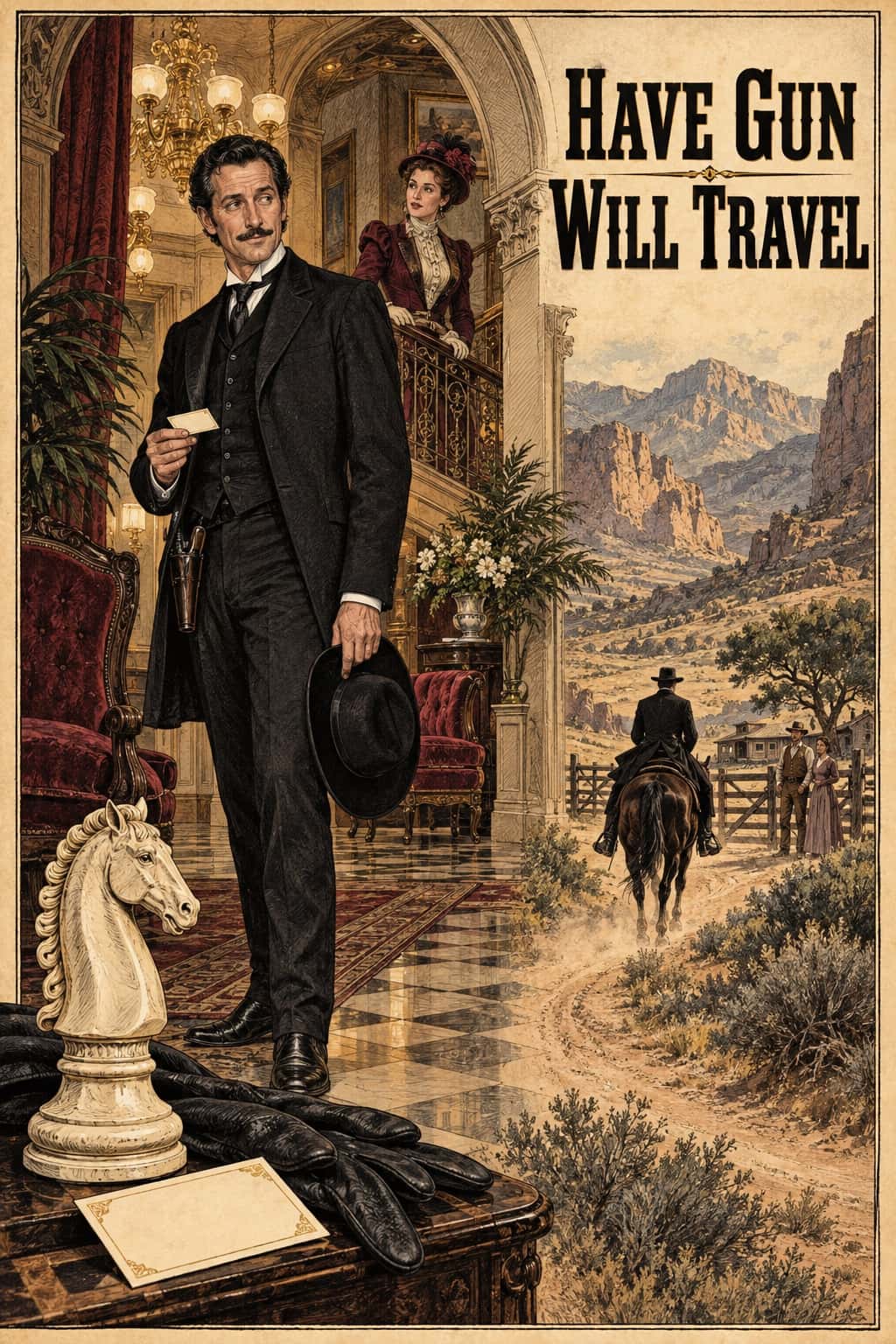
There's something you should remember, mister. Man going into Indian country should never be paid in advance. Have Gun, Will Travel. Starring Mr. John Daner as Paladin. San Francisco, 1875. The Carlton Hotel. Headquarters of a man called Paladin. Socks? Yes. What is it? Oh, Miss Wong. It's for party. You like? Oh, I certainly do. Why the mask, Miss Wong? Going to masquerade party in Chinatown tonight. I take it hay boy. Oh, where is it? Oh, big problem with hay boy. He going as cowboy. Well, that's no problem. Oh, it's a big problem. He wearing cowboy hat, leather pants, big boots, everything. But what is his problem? Spurs. Oh.
Oh, big spurs. Mr. Paladin, please give Hayboy information on how to walk with big spurs. All right, send him in. He got them on now. That can do. Hayboy hardly can walk. Afraid to try stairs. You come down? Yes, of course. I'll come down as soon as I finish packing. Yes, another trip. Oh, you travel so much, Mr. Paladin. Where are you going this time? Up around the little bighorn. Well, that's a river, Miss Wong, in Montana Territory. All right, come on, let's get the hayboy untangled from his spurs. You know, I guess just about the most popular sport in the world, everywhere in the world, is fishing. You hear a lot of discussion among American sportsmen, which is better, the dry fly or the wet fly, still fishing or trolling, lake, stream, or ocean? Everyone has his own ideas about this sport of fishing, and he goes after it in his own way. Well, that's true all over the world.
As our servicemen have observed, there are a lot of different ways of catching fish. In Borneo, for example, the natives crush the berries of a certain shrub, and the juice poisons the fish of a river without spoiling them as food. In Africa, South America, and Alaska, the spear or harpoon is used. In Japan, trained birds called cormorants are sent diving down into the water to bring up fish. In some Pacific islands, nets are used. In others, the bow and arrow is the favorite method of getting fish for supper. Well, what's true about fishing is true about other customs and traditions around the world. The way of doing things may be different, but the ideals are the same. No one way is right or wrong. It's just what suits the individuals best. These customs are important to the people who follow them. And our servicemen are helping to maintain goodwill by observing the customs of other people in other lands. My problem was to find an army deserter named Henry Carver.
and persuade him to go back to his outfit. It seems he'd deserted in order to rescue a girlfriend from a marriage that was being forced on her. He was asking for money from his family to help him escape into Canada. He and the girl would be at the Billings Waterhole. Montana was no place to be at this time. The Sioux were being pressed by the army to go back to the reservations. I saw a lot of Indian sign. Several times there were Indian smoke signals on the far hills. Then I saw the waterhole. But someone saw me first. Hey, don't! Don't shoot! Where are you? Keep riding, mister. You Corporal Carver? Who are you? My name is Paladin. Your mother sent me. Did she send the money? No. Then get out of here. Now, wait. Wait. Let me talk to you. I don't come any closer. We got nothing to talk about. You get back on that horse and ride out of here. Henry, maybe he can help us. Becky, you stay out of this.
Go on, mister. Start moving. Any message for your mother? Yeah. Tell her Becky and me will make Canada on our own. Maybe you won't. The troop of cavalry. Becky, stay here. No, you stay out of sight. They may be looking for you. No. Don't try anything. I got this rifle pointed. All right. Look. Down there. You're right. It is a troop of cavalry. What are we going to do, mister? We? They're not after me. You came to help me? I came because your mother asked me to. Well, then... Now go on. Get back where you were. They're probably just coming in for a water break. Maybe. Don't try to trick us. I'll still have you covered. Go on. Hurry. Up for the landers. When we move out, I want the scouts out. You can push the flank guards farther out, too. Captain. Who are you? John. John Keogh.
Well... Sight to see in the middle of nowhere. John Keel, say. Well, that's right, Captain Keel. How long's it been, Paladin? Six, seven... Oh, I'm not sure. You came through San Francisco. I've still got the hangover. Oh, uh, Dolan. Yeah, Captain. Yeah. Meet my friend, Paladin. Sam Dolan. Paladin. How are you, Dolan? Dolan and his men joined us a couple hours back. Oh, Scouts? Oh, civilian. I'm hunting for a man, but them engines, the way they are, I figured traveling with the cavalry was safer. Yeah, I understand. Well, John Keels. Hey, I see you're still riding that same old horse. Comanche? Sure. We've been together a long time. What are you doing out here, paladin? Business. See any Indians? Just sign. We've been driving most of them north. Well, let's walk to higher ground. Maybe we can see something. Dolan, you better come. Maybe the man you're looking for is around here. On June 15th in the year 1215, King John of England met a group of barons on the meadow of Runnymede. There he placed the royal signature.
upon a charter which means much to us today. The document that King John signed was the Magna Carta. In later years, from its provisions, developed our present-day concepts of trial by jury and the right of habeas corpus, concepts which are a vital part of democratic life. Thus, the Magna Carta, written in England almost 750 years ago, became an important source of American democracy. From the contributions of the past come the principles, of the present. See anything, Kale? No. No sign at all. That's good. Well, let's start back down. Yeah. Hey, you married yet, Paladin? No. I guess I move around too much for that. You ought to see the fine family I got back at Fort Lincoln. Yeah? Well, good for you. It's my last field trip. Next week I go out. I plan to get a piece of land and teach those kids of mine how to live off.
Where are you going now? Rejoin the battalion on Rosebud Creek. How far from here? Oh, about half a day. Who's your command now? George Custer. Remember him? Oh, yeah, I remember him. What about you, Mr. Dolan? It's a dangerous country to be traveling in. I'm here on a personal matter. Oh? Hunting a kid and a girl, a soldier boy. All right. The girl and I are supposed to be married, but this boy made off with her. I traced him to this area. I see. Sure got a score to settle with him. Well, if I run into him, I'll give him your regards. You mind if we still tag along with you, Captain? Suit yourself. Well, good luck to you, Paladin. Say hello to San Francisco for me. I'll do that. I watched Captain Keogh and his men leave. He and I had been in the war together. If it hadn't been for the business of the Carver boy, I'd have ridden on with him. When I was sure they couldn't see me, I edged around the rock toward Carver.
Only the girl was there. Where'd he go? I... I don't know. Gallatin, don't try anything. Give yourself up, Carver. Maybe you ought to, Henry. You're in my way. Get on your horse. All right. Give me that rifle. He'll live. He's not shot. What are you going to do with us? I'm going to save you from yourselves. If I can.
Say, here's a question I'd like to put to you. How much do you appreciate the things that make life just a little easier? For instance, take the way our teenage gals dress for a Saturday night dance. All glamorous like just regular walking fashion plates. And when they get to the dance, there's a super combo waiting to give out with the music. Let's go back a spell, around 1790, and see what the teenage gals were wearing then for a weekend get-together. It's Sunday afternoon and the gals are attending a rare social gathering. Every last one of them is dressed in a plain, homemade, lindsey-woolsey dress dyed with butternut or walnut juice. And there isn't a frill or a bright-colored ribbon to be seen. They don't cotton to such doodads in 1790. Of course, they've all bought their spinning wheels and looms with them. And while they sit and talk, their fingers kept busy. There's stockings to be made for everybody in the family.
mittens and shawls for the winter, maybe a potholder or two to protect mother's hands from the homemade iron pots. What do they talk about? Mostly about the time when they'll get married and have their own families to take care of. Sometimes when the Indians pull a surprise attack on the fort, the gals are called out to take their place at the stockade to keep the muskets loaded or maybe fire one themselves. Yeah, that's what a weekend date meant to the gals in 1790, but to them it was just part of the routine. Because like their folks, they worked and fought so living would be easier in the future. The future that you're now protecting. You might as well have turned me over to that captain this morning. It's not the same as giving yourself up. I'm not giving myself up. Can't you see it's not his fault? He didn't just run away. I begged him to help. He was in the service. It was his duty to stay there. Duty? Beating the scrub for a handful of disorganized Indians?
Becky was being forced into marrying that old Coop Dolan. You saw him, the kind of a man he is. He's still deserted. Mr. Paladin, there's something you should know. Oh, don't bother, Becky. It won't make any difference to him. We're married, Mr. Paladin, the day after we ran away. Oh, my best wishes to you, Miss Carver. However, your husband's right. That doesn't make any difference. Now, wait a minute. Hold up. What now? Looks like there was a camp here not long back. Indians? I don't know. Canteen. Stamped 7th U.S. Cavalry. 7th? Yeah. That's your outfit, Corporal. From the look of it, it was a large group. Larger than Keogh's. Well, let's get out of here. What is it? What are you listening to? Do you hear it? Rumbling in the ground. Like a lot of horses or distant thunder. I don't know. Let's go. Why are you so worried, Mr. Paladin?
What makes you think I am? I've been watching you. Ever since you heard that sound you've changed, like something's bothering you. Paladin, look. What? That horse. On top of that ridge over there. Yeah, I see him. He's got a saddle on him. Let's ride up there. Come on. Maybe his owner's foraging. Maybe. He's just barely moving. Paladin, that's a cavalry saddle. Yeah. Wait a minute. That's Captain Keel's horse. Who? Who now, boy? Here now. Here, boy. Comanche. Easy. Easy, boy. Easy. Good Lord. This horse has been shot. Carver, get down and help me doctor this horse. Then we'll look for Captain Keel. Watch your horses don't slip. What are we going down here for, Paladin? I gotta find out what happened to Keel. Easy. Comanche seems better, Mr. Paladin. Yeah.
Come on, let's head down that draw. Drop your gun, Paladin. We got you from both sides. Dolan. Well, looks like I got my bride back. And our friend, the deserter, too. You can't do anything now, Mr. Dolan. We're married. About that later. Thanks, Paladin, for delivering them up. We saw you coming a long ways back. What happened to the cavalry, Dolan? I left them this morning. There was a lot of Indian signs, so we turned back. It's a lucky thing. We might have missed you. All right, boys, get them off the trail to the clearing, and then get that noose ready. We got a deserter to hang. With our American servicemen in many countries around the world, they have a wonderful opportunity to observe new customs and traditions. What might have seemed strange before is becoming pretty familiar to them. For instance, among the Mohammedans, to drink coffee with anybody is regarded as a sacred rule of hospitality, a token of peace.
The berries are roasted over a charcoal fire, and the coffee's allowed to boil three times. It's thickly sugared and served in very small cups. All this is traditional among the Mohammedans, but as our servicemen have observed, it's, well, it's simply their version of our mid-morning coffee break or our afternoon tea party or our cocktail hour. It's a time for friends to sit down and relax. It's a time for conversation with a cup of whatever beverage suits the individual taste. And this is true of customs and traditions of all countries. The way of doing things may be different, but the ideals are the same. So it is by observing these customs that our servicemen are helping to maintain goodwill with other people in other lands. Dolan and the two men forced us towards a big tree in a clearing nearby. One man threw a rope over a branch while the other put the noose around Henry Carver's neck. Dolan sat his horse watching with a grin on his face.
I waited the chance to get to my derringer. All right. Let's get this job done and get out of here. Swat that horse out from under him. No, please don't do it. I'll do anything you say. Well, you will anyway. Now, go on, boys. Do it. Get away from that horse. Got a gun. Look out. Dolan. You two will get the same thing. We ain't staying. This ain't our business. Come on. Paladin. Is Dolan dead? Yes, he's dead. And I've got his gun, Mr. Paladin. Point it right at you. So drop that derringer. Now, Becky, don't do this. Drop the gun. All right. But you're not going to win anything this way. Henry and I can get to Canada. Oh, can you? There's a cavalry patrol coming this way. Where? Becky, quit talking and get this rope off of me. The patrol just kept coming on as though they hadn't seen any of us. The kids were riding up the hillside. I mounted and started after them. They'd stopped at the top. Carver and the girl sat their horses, staring down the other side as I rode up. Ooh, Carver! What's the matter?
Paladin, look. Down there. What is it? Good Lord. It's the 7th Cavalry. No one's moving, Mr. Paladin. They've been slaughtered. They're all dead. My outfit. Oh, Henry, don't please. What could you have done except die with them? That's what I could have done. Colt! You're there. Yeah? I'm Lieutenant Bradley, Chief of Scouts for Colonel Gibbon. They're looking for General Custer's command. Down there, by the river. You'll find all of them. Thanks, mister. Oh, no. They must have been ambushed or massacred by Indians. No survivors could come out of that. There is a survivor, Lieutenant. There's a horse. There's another survivor, Lieutenant. Oh, Henry, don't do it. Lieutenant, I'm Corporal Henry Carver. I deserted from the 7th Cavalry.
I want to turn myself in. Oh, Henry, please. Becky, try to understand. I couldn't go with you now. Not till I've done what I have to do. All right, couple. Fall in with us. Hold up! Why, Mr. Paladin? Why did he turn himself in? They won't care now. He will. He was a part of the 7th Cavalry, Becky. He was a part of other men. I'll take you home. Have gun! Will Travel, created by Herb Meadow and Sam Rolfe, is produced and directed in Hollywood by Norman MacDonald and stars John Daner as Paladin with Ben Wright as Hayboy. Tonight's story was written by Irving Wallace and adapted for radio by Tom Hanley. Featured in the cast were Sam Edwards, Barbara Eiler, Vic Perrin, and Jack Miles.
Have Gun, Will Travel is brought to you through the worldwide facilities of the Armed Forces Radio and Television Service.