
The written record
Read the transcript
Read along with the recording · About 12 min to read
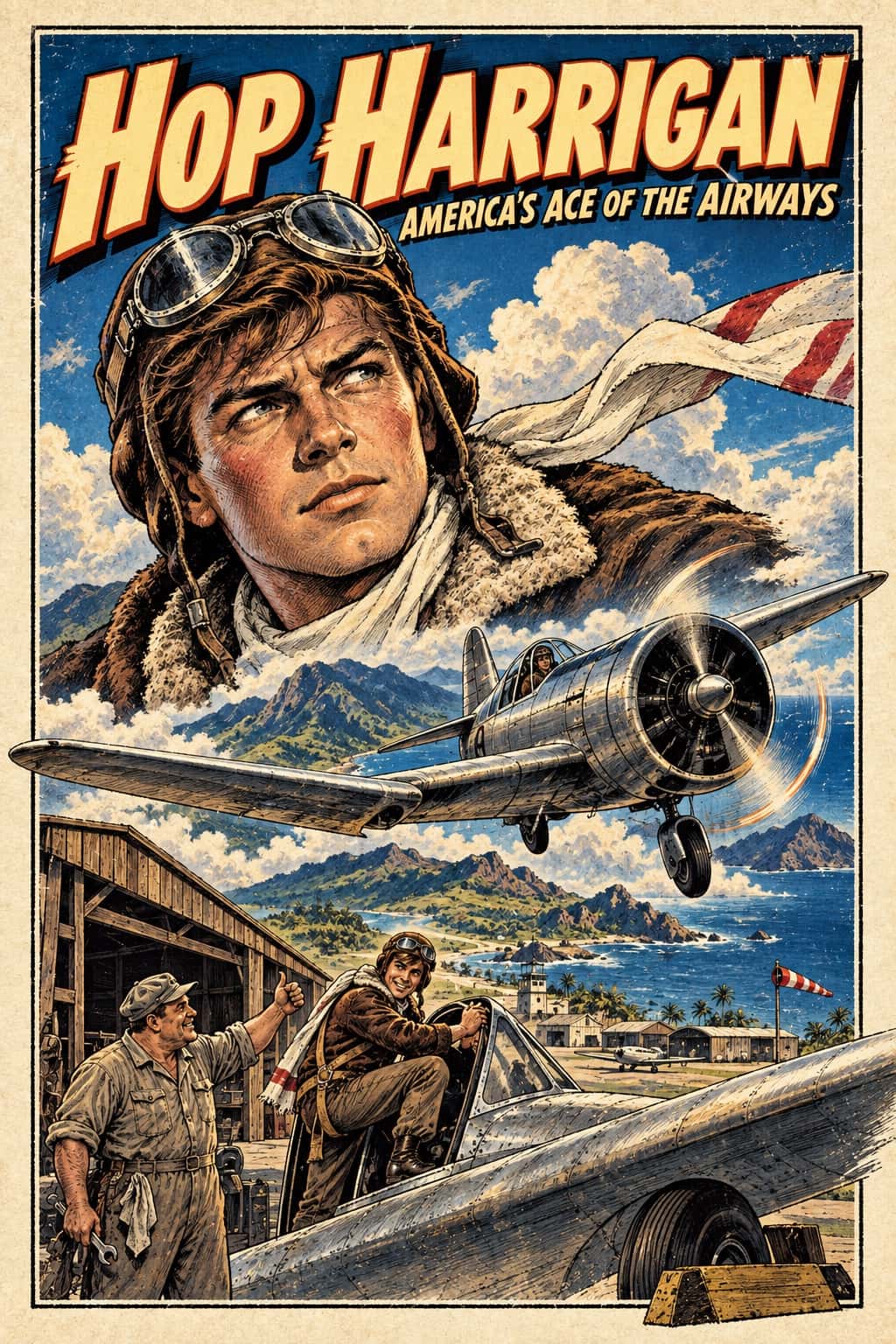
Presenting Hop Harrigan, America's Ace of the Airways. CX-4 calling Control Tower. CX-4 calling Control Tower, standing by. Control Tower, back to CX-4, southeast. Okay, this is Hop Harrigan, coming in. It's America's Ace of the Airways, coming in for another transcribed episode in the adventures of Hop Harrigan.
Say, gang, offhand, you'd think a plane built 13 years ago would be old and out of date by now. And in most cases, you'd be right. In fact, many planes become outdated within a few years of being built. But Adaptable Annie is different. She dates all the way back to 1934, and her logbook shows close to 9,000 hours. With every flight, Annie becomes more modern and carries all the latest navigation aid from electronic automatic pilots to automatic approach equipment. You see, fellas and girls, Annie is a research plane working for the Civil Aeronautics Administration, operating out of the CAA Experimental Station at Indianapolis. Annie has been nicknamed Adaptable because of all the varied work she's done in her lifetime. To go back to the very beginning, back to 1934, Annie came off the production line as an ordinary transport, the eighth Boeing 247B out of the factory. Before she could see any routine service, however, a special assignment came Annie's way.
She was entered in an international air race from London to Melbourne, Australia. So the brand-new plane was fitted with extra fuel tanks, flown to New York, and from there transported to England by boat. Her crew in that race included Colonel Roscoe Turner, Clyde Pangborn, and Reader Nichols. They completed the long flight in 91 hours, bringing Annie in third into Australia behind an English and a Dutch plane. She fought fog and headwinds all the way from Athens to Baghdad, but still reached Melbourne ahead of every other American ship in the race. More about Annie later, gang, so don't forget to listen. And now to our story. Reporting to a hidden aircraft plant in the Black Mesa of Oklahoma to help Major McCall solve the weird mystery of the Wailing Witches, Huff and Tank narrowly escaped suffocation in a smoke-filled underground chamber within one hour of their arrival. The finger of guilt seemed to point directly at Simon Gore.
the designer of the new jet-propelled flying wing and owner of the plant. For after their escape, the boys had seen a figure clad in green coveralls running away, and Gore was the only man in the plant wearing green coveralls. In our last episode, you recall, when the designer showed them the wreckage of one of the test models which had crashed, Pop and Tank were faced with conflicting evidence. A girl, also wearing green coveralls. Unaware of the boys' confusion, Gore stepped forward and introduced them. Harrigan, Tinker, I'd like you to meet Miss Davis. Carla is one of the best spot welders I have. Carla, this is Hop Harrigan. How do you do? And Tank Tinker. Hiya. Hiya, fellas. You've already met Major McCall. Oh, sure. Hiya, Major. Fine, thanks, Miss Davis. Everything all right here, Carla? Kind of slow, especially around this forward section. Oh? Excuse me a minute, will you, gentlemen? Of course. Go right ahead. See Mr. Gould right here. Oh, can you tie that? Another green coverall on a dame's wear. Brother, she looks tough. But there's a big hole in your story, doesn't it? It certainly does, sir.
I ain't so sure. Oh, come now, Tank. Why didn't you tell us green coveralls were standard gear, sir? Well, frankly, they aren't. First time I've seen Miss Davis wearing them, as a matter of fact. Uh-huh, and I bet he put her up to it. Tank, you're being more obstinate than usual. All right, Harrigan, Tinker, suppose you come around this way. You can examine the cockpit closely from this side. Oh, thanks. As I told you before, this is the forward section. We haven't found the other half yet. What happened to it? Squashed lighter than a pancake. Was the pilot caught in that section? Yes, just as he was trying to get out.
He was crushed. Gosh, there must have been terrific pressure on the surface. Yes, apparently there was, on both the upper and the lower wing panels. Well, how fast was it going? Where did the instrument panel show? The camera on this ship was lost, Tank. Yes, it was anchored at the rear section. It's my belief the pilot entered the zone of extreme compressibility. He was actually in the transonic speed zone. Flying faster in sound, you mean? Or at least at the speed of sound. And this is what happened. Well, didn't he report by radio? Yes, we have his report on the wire recorder. But there was no mention of speed or altitude at the time. Obviously, he then opened her up a little too much. But that doesn't make sense, Mr. Gore. You said these planes are designed for supersonic speed. Well, they're designed to meet the conditions which I imagine exist at that speed. There's a very even chance I may be wrong. You tested the model in the wind tunnel, didn't you? Of course. How fair. The limit? Oh, and I see what you're driving at, Tinker. But no matter how much we try to simulate actual flight conditions, there's always something lacking. Something impossible to duplicate.
Apparently, the transonic barrier is one of them. Other designers have the same trouble, Tank. Well, how do you brace the ship to protect yourself against compression? My own invention. A large armored coil winding completely around the cockpit. A coil? Yes. Come inside. I'll show you the model on the wind tunnel stand now. Oh, Carla? Yes, sir? Let that go for a while, will you? I'll send Max in to help you later. I need you in the tunnel now. Okay. Now, right in here, please, gentlemen. Wow. You could hang her a flock of B-29s in here. Yes, it is tremendous, isn't it? Now, there, as you can see, is the model up on the stand. The fans that create the wind are down at that end of the room. The motors are immediately behind. Where are the controls? In that room over there that's built right into the wall. It's completely glass-enclosed, double thickness of protection. Well, shall we have a look at the plane? Oh, yes, please. Now, Tinker, you asked about the coils surrounding the cockpit. Yes. It's really one continuous armor-plated cube.
Hollow at the core, winding around the cockpit for its full length. How come you thought of that? I wanted something that would stand pressure at all points equally. Flat plates tended to belly inward, so I hit on the idea of a coil. Oh, why a hollow coil? Merely a form of insulation at high speed. Oh, here we are now. Care to climb up? Oh, yes. Now stay down here, Hop. Take a look at the outside of the ship. Okay. Go right through that hatch in the belly. It's the only entrance to the cockpit. That's it. Pretty tight squeeze. It is. Just as well Tinker decided against coming in. Oh, I see the pilot flies the ship lying down. Yes, the controls are integrated forward. Oh, do you see the tubing? Uh-huh. Nice clean job. Say, how about running a test on this model now? Well, I... I'd like to see what happens. All right, Harrigan. I don't see why not. Oh, Carla? Yes? Will you go into the control room? Prepare to start the motors? Right.
Hey, what's going on up there? Harrigan wants to run a wind test. With him in the ship? Yes. On our hop. Don't mind him, Mr. Gore. Go on, run it off. Right. Well, there's a headset in front of you, Harrigan. Put it on. Then we can talk while we run the test. Check. And you'd better snap on that harness. Gets a little rough. Okay. I'll close the hatch and talk to you over the intercom. As the hatch slides closed behind him, Hop is left alone in the narrow confines of the cockpit. And after adjusting the headset and easing his lanky frame into a more comfortable position, he waits for the wind test to begin. As the powerful motors controlling the wind fans roar into life, Gore explains to Major McCall and Tang. We'll stay behind this shield near the plane, gentlemen, and talk to Harrigan by phone. I don't like this. I don't like it at all. It's merely a test. I won't open up the wind motors all the way, I assure you. Here, Major, will you take this headset? No, thanks. You can use this one, Tinker. Thanks.
What are them controls for? To regulate the speed of the wind. I thought all that stuff was in the control room. Oh, it is. This is a duplicate set. We work out here at low speeds. The shield is enough protection against high speeds. They test from the control room tank. We won't go any higher than two or three hundred, however. Hello, Connor. Can you hear me? Switch over the master control. I'll handle the test out here. Arrigan? Aye. Are you ready? Uh-huh. Pop, you sure you know what you're doing? Oh, not really. Go ahead, Mr. Gore. Right. Harrigan? Yes? I forgot to tell you. In case anything goes wrong, sing out fast. The stress indicators aren't hooked up out here. Right. What's the speed now? Only 100. I'm building it slowly. You okay, Hop? Yes. Well, let's do somewhere else. 150. Oh, hi. Have you tested it, Gore? 325. I won't go that high. Good. 200. How goes it, Harrigan?
Advancing the master throttle slowly and carefully, the designer increases the speed of the wind now obviously buffeting the plane as Tank and Major McCall clench their fists in mounting anxiety for hop safety. There's danger ahead, though, gang, so stand by. Now, let's get back to Adaptable Annie and take up where we left off. After making the headlines in that air race, the Boeing transport went into United Airlines commercial schedules as the best-known liner in America. For two years, Annie did the job she was designed for, that is, flying the coast-to-coast air lanes. Then in 1937, she got a new job. Annie became an executive plane, carrying officials of the Union Electrical Company around on business trips. For two years, she flew all around the country, and then she got her fourth owner. Annie went to work for the government. She flew for the Air Safety Board for a year, and in 1940 went to work for the Civil Aeronautics Administration with her wings trimmed for research work. She still flies daily.
Quite a feat for a 13-year-old plane, don't you think? And carries her share of the work, along with three newer research ships. Annie has been changed so much, fitted up with so many new aviation developments, that Colonel Roscoe Turner, who flew her in the International Air Race, would never recognize her today. In the seven years since she was transferred to the CAA, Annie has had a hand in a flock of jobs. She's done laboratory work on instrument approach systems, airway markers, airport lighting, navigation lights, warning devices, and many, many others. In all the years she's been on active service, Adaptable Annie has proved to every airman who's ever flown her, age doesn't hold her back. She's shown stability, ruggedness, and reliability on all her jobs. Those characteristics have made her ideal for the testing of the nation's newest aircraft equipment. And say, gang, all these new aviation developments will go into our future planes. They'll be better, faster, and safer all along the line. But to have the world's best aircraft industry, America must have flyers to man her planes. So always remember...
America needs flyers. And now back to our story. Asking for a demonstration of the flying wing's performance in the wind tunnel, Pop stayed in the cockpit as Simon Gore, flanked by Major McCall and Tank, began the test from behind a shield adjoining the plane. Slowly, the designer increased the speed of the giant motors in the wind tunnel. Until now, the plane is in the grip of an air current of 275 miles an hour. Pop reports over the interphone. Oh, thank you. Hey, how much more are you going to open her up? It's at 300 now. I think we'll hold her there. Yes, Carla? No, I guess not, Carla. Just go ahead. Who's going to shut off the motors? I can handle it out here, Tinker. Everything all right, Harrigan? No, I'd rather not. Hey, look at that indicator. What's the matter? It's climbing up to 350 already. Oh, that's impossible. The throttle is locked. Well, look at it. Look at it.
Rides as easily at 375 as she does at 100. There, you hear? Stop her back. Hurry, man. Yeah, that's right. Oh, you jerked back. She's passed 400. You're going to close her down all the way. You cut the motor. I can't. I can't. Better ease off now. Stop worrying. She's starting to buck a little. You're hitting 450. Don't tell him anything's wrong. The master switch won't work. Here, let me at it. 500, you'd better close her down. Yes. Yes, Harrigan. Take it easy, Hop. Hey, what's wrong down there? The needle's still climbing. It's nothing, Harrigan. We'll have you out in a second. Tigger, can you cut that wind? No. Cora, this shield can't take the wind pressure. It'll blow away. Hey, cut that wind. That's astonishing to give. I've been crushed. Even as Hop shouts frantically, the pounding low of the motors increases. Gang, there's action and spine-tingling adventure ahead.
Don't miss episode number six of The Mystery of the Wailing Witches. Tune in and fly with Hop Paragon, America's ace of the airwaves. So long, Hop. We'll be seeing you same time, same mutual station. Hop Paragon is a transcribed copyrighted feature appearing in all American comics magazines.