
The written record
Read the transcript
Read along with the recording · About 13 min to read
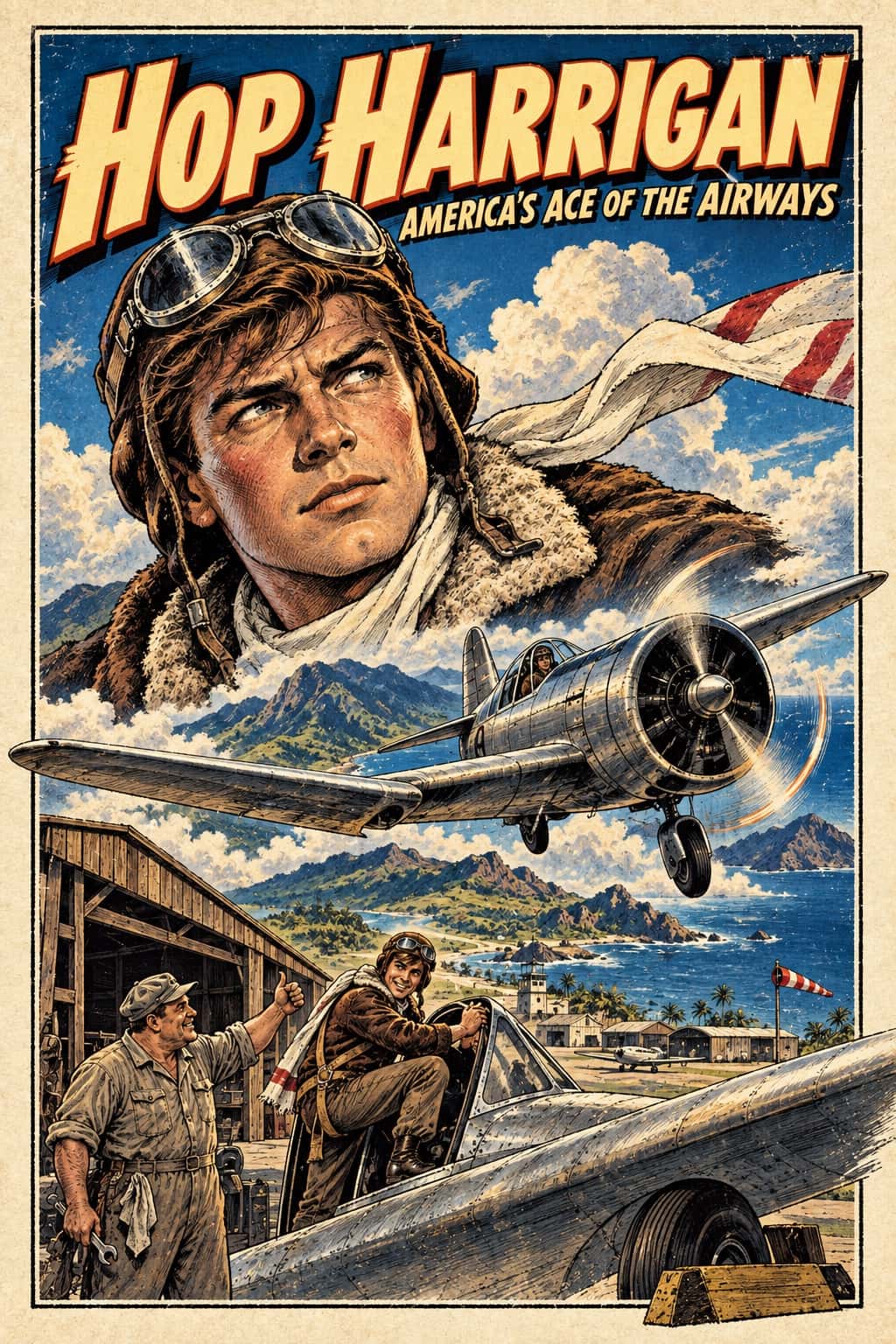
Presenting Hop Harrigan, America's ace of the airwaves. CX-4 calling control tower. CX-4 calling control tower. Standing by. Control tower back to CX-4. Wind 1,200. Okay, this is Hop Harrigan. Coming in. Yes, it's America's ace of the airwaves. Coming in for another transcribed episode in the adventures of Ralph Paragon. Fellas and girls, have you ever wondered why our airline companies operate so smoothly? Well, the answer is an amazing amount of attention is paid to every detail, no matter how small or unimportant it may seem. It took many years for the major scheduled airliners to get to their present efficiency. Years of trial and error. Well, now the airlines don't have to depend on trial and error. They have time now to check, recheck, revise, and improve every operating item.
from gasoline down to food. This matter of food on airline trips is getting quite a lot of attention from the major companies. For instance, take United Airlines. In order to have the best possible food service on the giant planes, they're using a group of employees in Chicago as guinea pigs. They're given free meals, but the rule is that they must eat no slower, no faster than would the ordinary passenger. The company has built a complete mock-up of a plane's food galley. At mealtime, the galley goes into operation. with stewardesses serving a complete dinner to anywhere from 5 to 50 persons seated at individual tables close to the mock-up. While the eaters go from course to course, motion picture cameras grind away, and observers with stopwatches move about, jotting down notes and timing certain procedures. From their pictures and notes, they revise and improve their food service methods. When you ride in one of the new mainliners next summer, you'll see why your dinner is served with smoothness and efficiency.
In just a few minutes, I'll be back with more aviation news, so don't forget to listen. And now to our story. With the knowledge that Carlos Mendes, the pilot of a Blanca monoplane, was closely connected with the mystery of the suddenly discordant tones in the bells of the carillon of Piranhas, yet lacking proof, and more important, the motive, Hawk Tank and John Temple, the FBI agent, tried to track him down. Returning to Lakeville, they received word from FBI headquarters in Washington that the Blanca had been found at the New City airport, only 200 miles away. So, in our last episode, they quickly flew over to New City, but found no trace of either Mendez or his mechanic. Early in the evening, they returned to Lakeville, and suspecting Mendez's presence in the area, Temple suggested reexamining the bell in the town hall steeple. They drove into town in the Jeep immediately after landing, and the FBI agent's fears proved correct.
A block away from the town hall, they saw the belfry was empty. The bell was gone. Jeff and Jenny, you sure we ain't seeing things now, Tank? The bell's not there. Faster, Hop. What could have happened to it? Ten-ton bells don't get up and walk away. I hope old man Miller is there. Miller? Oh, the caretaker. If he blames this on Chris, I'll... Take it easy. Wait till we find out what's what. Okay. Come on. All right. Can we go right in, Hop? I think so. Doors usually open. Yes, it is. See, Miller, the place is empty. Well, it's half to seven. Hey, Mr. Miller! Mr. Miller! Mr. Miller! I thought you said he lived here. He does, up on the second floor. Hey, you don't think... Mr. Miller! We'd better go up. Right. Gosh, after all I said about the poor guy. Tank, don't jump to conclusions. After what happened in Bay City, what else can you expect? Come on, up the stairs. Who's there? Hey, who's there, I say? Answer me. It's Miller. Where is he? Mr. Miller, are you okay?
What kind of tomfoolery is this? Oh, there he is in the back. What are you... Oh, it's you again. What are you doing here? Are you all right, Mr. Miller? Of course I'm all right. What's the matter with you? Oh, gosh. We thought... We thought... Well, we called and you didn't answer. We were worried. I didn't hear you. I was down in the basement taking care of the furnace. Now, what do you mean by busting in here and raising an old neck? Listen, Mr. Miller. What's happened to the bell? The bell? Yeah, yeah, the bell. Well, nothing's happened to it. It ain't there. Ain't where? Up in the steeple. Of course it ain't. What? You know. Well, sure I know.
What's the matter with you, anyway? Look, let's calm down and get this thing straight. Calm down? You're the one who's... All right, Mr. Miller. Now, suppose you tell us exactly what happened. What happened to what? The bell, you old... Don't you shout at me now. Of course. Go away, kid. Hey, take it easy. Take it easy, both of you. Fine thing, coming in here, raising a record. I'm sorry, Mr. Miller. Now, let's start all over. What happened to the bell? It was taken out. Why? When? Who did it? I can't answer all of you at once. All right, then. Why was it taken out? That was no good. Why do you think?
Well, who did it? Well, who's going to fix it? Huh? What's his name? I don't recollect exactly. Well, who ordered the bell repair? I don't know. Folks in town, I guess. Did he show you an order? Well, he had a piece of paper, kind of official looking. Didn't you read it? It's order. What do you mean, sort of? What did it say? I don't recollect. I got too many other things to do. Did you get a receipt, at least? No. What do I need with a receipt? That's the trouble with this job. Too much paperwork. Oh, my gosh. Of all that dope. Tank. Well, all right, Mr. Miller. Then suppose you tell us when the bell was removed. It's afternoon, about 2.30, 3 o'clock. How'd they do it? How do you think they did it? That's what I'm asking you. Well, you don't suppose someone went up there and carried it down, do you? Now, help me. I'll wring that skinny neck of yours if you don't cut out the double talk. No, you will, will you? Tank, Mr. Miller, please. I ain't taking no guff from this young squirt. Then you start talking. Tank, shut up. All right. Let John handle this. All right. Quiet. Now, Mr. Miller, tell me.
Exactly how the bell was removed. Well, this fella had one of them big cranes set up on a truck. Did the job quick and easy. Lifted the bell out, put it on the truck, and off they went. How many men on the crew? Oh, three or four, near as I can recollect. I see. And what was the name of the trucking company? Don't tell me you can't recollect. I don't. There must have been a name on the crane or on the body of the truck somewhere. As to me, there was. Now, let's see. Come on, come on. If you don't close your face... I got it. Atlas. That's it. Atlas. Atlas, eh? Ah, okay. Now, is there anything else you can tell us? About the bell? Yes. You're sure you don't remember the name of the man who gave you the order? No, I don't. Well, what did he look like? Oh, kind of tall. Looked like he'd been out in the sun a lot. Uh-oh. Did he speak with an accent? No, but he didn't come from around here no place. Talked too good. That's him, all right. Meant this. Okay, Mr. Miller, thank you. Now, do you have a phone here? Yeah, near the door.
It's a pay phone. Oh, thank you. Let's go, boys. Don't forget to close the door when you go out. Not a tank. Boy, he makes me so mad. Forget it. What now, John? We'll call the Atlas people. Good. Here's the phone book. Let's see. That guy Mendes sure has nerve. Coming in and taking a bell away right out in the open. Couldn't have done a better job. Let's see. Atlas, Atlas, Atlas. Now, here. Atlas movers and truckers. Lakeville 590. Here's a nickel. Thank you. Miller said they were here about 2.30 or 3. That gives them a big lead on us. But it shouldn't be too hard to track down a crane and a 10-ton belt. Where the dickens do they expect to go with it? What are they going to do with it? Hello? Hello? Wait, let's listen, Tank. Is this the Atlas Trucking Company? This is John Temple. Temple of the Federal Bureau of Investigation.
You sent a truck and crane out on a job this afternoon. Yes. Yes, that's right. The bell in the Lakeville Town Hall. What? What's that? Uh-oh, something's up. Hold on a minute. Hop. Yes, John. They called the police an hour ago. The truck and crane are missing. Holding his hand over the mouthpiece of the phone, Temple turns to Hop and Tank and reveals a startling new development. What is Mendez doing with the bell? Why has he gone to such great lengths to get it? We'll know more in just a moment, gang, so stand by. Gang, the Air Force recently awarded a $22 million contract to the Fairchild Engine and Airplane Company for 37 Fairchild packets. The present order is for a new and improved version of the packet, with the principal change being an increase in engine power. The plane, whose fuselage looks more like a boxcar, is designed to carry a load of nine tons for a range of 2,000 miles.
The packet can carry 42 fully equipped combat troops, as well as 22 parachute cans of supplies suspended from an overhead monorail. If used as an ambulance plane, the packet could transport 36 litter patients, plus their attendants. Another difference in the new plane from its predecessor is that windows have been placed in the floor. That's right, in the floor below the pilot and co-pilot. This provides the crew with necessary visibility when parachute troops are being dropped. Oh, and while on the subject of carrying troops, Lieutenant Colonel Eugene Salet of the General Staff College at Fort Leavenworth, Kansas, said a while ago that the Army Ground Force's goal is to produce field forces that are completely transportable by air. He said that real attempts are being made to attack the problem. Such giants of the air as the C-99, which can carry 400 soldiers, and the C-97 are being tested. Several types of new and larger gliders are being tried out.
Experiments were being carried out with a caterpillar-tracked landing gear. In the end, the colonel said, the goal is to eliminate gliders and parachutes of World War II. Instead, troops will be brought into combat areas in fuselages which are detachable. Aviation is moving ahead on all fronts, gang, so plan a career in the air, for always remember, America needs flyers! And now, back to our story. With the discovery that the mysterious Carlos Mendez had cleverly stolen the Lakeville Bell, Hop, Tank, and John Temple attempted to track him down through the trucking company he used. Now, as the boys head back to the airport in the Jeep, Temple tells them of his conversation with the company. The job should have been finished by five, according to the schedule. And they had another job for six, but the truck and crane never appeared. And the crew didn't report, as they usually do when they're going to be late. So Mendez is up to dirty work again. Yes, that's what I'm afraid of.
Well, did they tell you anything else? Yes, sir. Said a man named Miklos contracted for the job. Miklos? Oh, it was Mendes, all right. They described him. He said he was a representative sent from Czechoslovakia to repair the bell. His papers seemed in order, so they agreed to do the job. Well, where was the bell to be delivered? The Lakeville freight depot. It never got there, huh? No, of course not. They checked with the station master, but he didn't know anything about it. Oh, boy, Mendes sure is a smart operator. He's played his cards perfectly. Now, what do we do now? We'll have to wait until we get a report from the state police on the truck and train. It's a cinch. They can't hide him. They can't hide a 10-ton bell, either. Hey, there's the field. You want to go to the office or the house? Now, wait. There's a police car parked next to the office. Gosh, maybe they found Mendez. Hang on. There's a trooper waiting on the steps. I wonder if he has any news or if he's just reporting that they're still searching. We'll find out quickly enough. Okay. Oh, good evening, officer. Good evening.
One of you John Temple? Yes, I am. We found that truck and crane outfit. Good. Oh, boy, where? Right here. Here? Yes, down the other end of the field. The whole outfit was turned over, lying in the woods. Almost missed it. What the dickens is it doing here? What about the crew? Dead. Oh, my gosh. Then that means he must have carried the bell away by plane. Looks that way. But I should think somebody would have seen the plane land. Mendes must have landed sometime this afternoon. Well, yes, of course. Gail would have... Gail, good Lord. Oh, for Janice, no. That's why she wasn't here to meet us before. Mendes has her... or else... Hop suddenly stops, remembering what happened to the trucking company crew and an FBI agent in Bay City, Nebraska. His face whitens in sudden, overwhelming horror. Now, Mendes' deadly activities have struck close to home.
Gang, the action gets fast and furious in our next episode, so don't fail to listen. Tune in and fly with Pop Harrigan, America's ace of the airwaves. We'll be seeing you same time in Mutual Station. Pop Harrigan is a transcribed, copyrighted feature appearing in All-American Comics Magazine.