
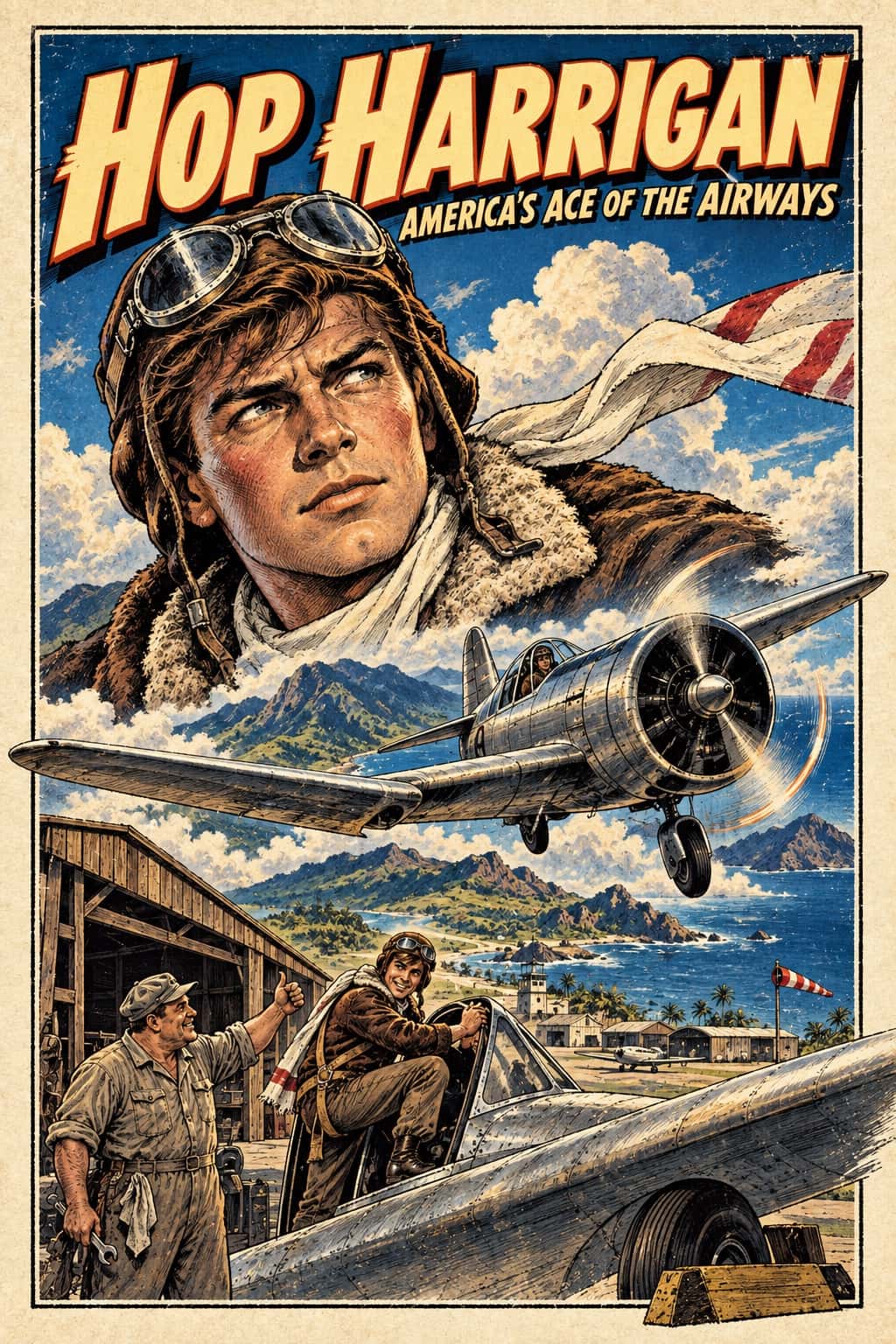
The written record
Read the transcript
Read along with the recording · About 11 min to read
Presenting Huff Paragon, America's ace of the airwaves. CX-4 calling control tower. CX-4 calling control tower. Standing by. Control tower back to CX-4. Okay, this is Huff Paragon coming in. Yes, it's America's ace of the airwaves. Coming in for another transcribed episode in the adventures of Huff Paragon.
Say, gang, you often hear that pilots like their jobs so much they wouldn't change with anyone. And if you like flying, well, you can easily see why. Of all the pilots, there's one down in Washington, D.C. who's extra happy with his job and has a good reason for not wishing to swap with anyone. This flyer doesn't bat an eyelash when his boss says, OK, Hank, wind her up and let's go to Paris. Or the destination may be Florida, Brazil, or almost any place in the world where President Harry Truman wants to go. The pilot, as you may have guessed, is Lieutenant Colonel Henry Myers, personal pilot to the president and other high government officials. With Lieutenant Colonel Myers, it's a case of always being available to go anywhere at a moment's notice. Myers was assigned to his present job as presidential pilot back in wartime days when he was chosen to fly the sacred cow for the late President Roosevelt. During the war years, he logged thousands and thousands of miles flying the president, military men, and top advisors to international conferences. All in all, Myers logged close to half a million miles at the controls of the Sacred Cow. Now, however, that ship is a second stringer, with President Truman's new flying White House, the Independence, taking over the principal flying chores. It's a different plane, gang, but Lieutenant Colonel Myers keeps rolling along as air chauffeur to the top man in America. In just a few minutes, fellas and girls, I'll be back with more news about aviation, which I think you'll find interesting. So don't forget to listen.
And now to our story. After a nerve-wracking wait of more than three hours in which John Temple marshaled all possible aid in the search for Carlos Mendez, the mysterious South American who stole the Lakeville Bell, Pop Tank and the FBI agent have finally been given a slender lead. Naval radar, operating from a destroyer in the Gulf of Mexico, picked up an unidentified plane heading south. And after a thorough check of all scheduled airline flights in the area, the information was forwarded to Lakeville. As a result, the boys and Temple are now roaring southward through the night in the Beechcraft, heading for New Orleans. Temple is explaining the combined operations on the search. The Coast Guard's working on this with us. They sent a couple of long-range patrol bombers out. And they've alerted all shipping in the Gulf. Wow, that's what you call cooperation. Not only that, I've arranged for another ship. An Army B-26. Oh, swell. It's faster and it's got a longer range. We'll pick it up in New Orleans.
We only had some idea where Mendez was going, what his eventual destination will be. We might get a lead on that, too, Huff. I'm waiting for a report from the State Department. For free take, what can they tell you? Where Mendez lives. Enough? Plenty, but how'll they find out? Through our embassy in Argentina. Well, I guess we've done everything we can. Now it's up to us to catch them. Yeah, well, that's 1,500 miles behind them. That's gonna be some sweet job. As though in answer to Tank's pessimistic outlook, Hop opens the throttle to the last notch, sending the beach roaring ahead at top speed. Meanwhile, far to the south, flying high over the turbulent, shark-infested waters of the Caribbean, the Fairchild Packet carrying the Lakeville Belle and Gail Nolan drones steadily on course under the expert hand of Carlos Mendez. But while Mendez is calm and supremely confident, his so-called mechanic, Otto Vogel, is protesting violently. I tell you, we are taking too much of a chance. We do not need the woman. Get rid of her. Vogel, do not raise your voice. I hear you quite plainly. Yes, you hear me, but you sit there and do nothing. What is it you wish again? Get rid of that girl. She means trouble. I do not see how. After all, what can she do? She is absolutely helpless. Now, perhaps. But later it may be different.
We have too much at stake to take such unnecessary risks. Vogel, I assure you, I know perhaps even better than you do how much we have at stake. Then why do you persist in such obstinate behavior? Because it pleases me, Vogel. And I will thank you to remember that I have the final word in whatever we do. When I decide to get rid of Miss Nolan, then it will be done. But only then. You are a fool, man. Mind your manners, my friend. End your tongue. Now, if you will take over the controls. You are going back to Ceja again? If you do not mind. Hold this course in this altitude. Then we'll be reached the coast of Andorra in a few moments. Call me when you see it. Well, Miss Nolan. Well? I thought perhaps you might have changed your mind. About what? Oh, something to eat, to drink. The trip has been long. No, thank you. Do not be so foolish, Miss Nolan. I said no, thank you. Miss Nolan.
Perhaps you do not realize it as yet, but we are far from the United States. Your friends cannot possibly hope to catch me now, even if they knew where I am, which I assure you they do not. Your resistance is quite ridiculous. Perhaps. But I'd like to keep my self-respect under any circumstances, Senor Mendez. Miss Nolan, you are proud. I like that. And what do you expect to do with me? That will depend on you and your behavior. Mendez? Yes, Vogel? We are flying over the coast. Very well, I will be there. We will be landing shortly, Miss Nolan. Perhaps if you feel in a more, shall we say, cooperative mood, we will free you. That is for the moment. Allow you to walk around. You must be very cramped. I'm quite comfortable, thank you. Very well, as you wish. When you change your mind, please do not fail to let me know. The hatch leading into the flight compartment slammed shut, leaving Gail alone in the semi-darkness of the cargo compartment again.
She sags back against her ropes, fighting the tears of helplessness that well up in her eyes. Then, suddenly, she is conscious of a strange sound. She listens intently, hears it again, and traces it to the giant bell not two feet away from her. Puzzled, she stares at it, and as the strange sound is repeated once again, she sees a slip of paper on the floor, protruding from under the edge of the bell, and even as she looks at it, The paper moves. In the world. Inch by inch, the paper slides out from under the bell. Gail watches another bewilderment. Then, bending over as far as the ropes will allow her, she tries to read the message scrawled in pencil with an obviously wavering hand. Worry, Miss Nolan. Be brave. Good heavens! Chris, here? Thunderstruck, Gail stares at the bell. Chris, inside. It seems impossible.
but the scrawling handwriting is ample proof. How did the boy get there? And now, how can he possibly survive a long flight trapped under a 10-ton shell without food or water? Gang, you won't want to miss the action-packed climax of today's episode, so stand by. Now, fellas and girls, let's take a look at what's going on in aviation today. Ordinarily, the ceiling, or in other words, the height of clouds over an airport, can be measured pretty accurately by a visible check in the daytime. But at night, it's a different story. A few months ago, there was no really reliable check on ceilings after the sun had set. Then the General Electric Company came up with a new gadget to accurately measure the height of clouds. The new device, called a sealometer, gives constant readings and provides a permanent record for weathermen. The big advantage in the sealometer, besides its accuracy, is the fact that it works equally well in the daytime or at night. The machine projects a vibrating beam of light straight up to the base of the clouds.
Then a receiver located about 1,000 feet from the transmitter picks up the reflected light after it hits the cloud and converts the light waves into feet of height. The figures are immediately recorded on a chart in the Weather Bureau office to form a permanent record. We've been hearing a lot about helicopters lately, and the small ships seem to be gaining in popularity. For instance, in one phase of newspaper work, the field of sports, helicopters seem to have a definite place. In Syracuse, New York... The Herald Journal had a picture of the kickoff of the Syracuse-Coldgate game before the first period was over. The photographer chartered a helicopter and circled the stadium several times, snapping his shutter right on the kickoff. Then he headed back to the newspaper office and walked up to the city desk with the picture before the first 15 minutes of play was over. You can bet helicopters will be used more often for jobs of this kind in the future.
And say, fellas and girls, aviation is moving ahead faster than ever these days, so always remember, America needs flyers. And now back to our story. Reaching New Orleans at dawn, Pop Tank and John Temple receive another message from the Coast Guard, locating Mendez north of Cape Honduras. So, picking up their new ship, they took off again, heading south for Trujillo. Two hours later, as the sun gleams dully through a high overcast, Temple receives another message by shortwave radio. Slamming a fat child pack after 700 hours. Takeoff, Zuni to refuel. That is all. Yo-wee, we're on the right track. Come on, hop, hit that throttle. One hour and 300 miles later, there's a second return. Located large in central Argentina, named by Carlos Mendez. Any information obtainable at this time. That is all.
Boy, now we're really on the beam. And you're the Verdi, eh? Spot that on our map stack. Right. Pop, how much longer before we arrive at Trujillo? Oh, two hours, maybe less. Depends on this tailwind we have. There it is. And you're the Verdi. Well, let's see. There. Uh-huh. Now let's have a look at the overall map showing the Caribbean and South America. Ah. There. I wonder if we could cut corners. What do you mean? If we landed at Managua, here on the west coast of Nicaragua, we'd be holding a straighter course to Argentina. From there, we could fly southwest over the Pacific to Guayaquil, here in Ecuador. How do we know Mendez ain't following that course himself? He might be, but we'll have to wait until we get another report on him. But in any case, we'll land at Managua. Banking slightly, Hopp alters course to the southwest and takes a new heading for the capital city of Nicaragua, arriving in the heat of high noon. There, they find another search report waiting for them. Listen to this, Hopp.
Pan American Clipper reports sighting Fairchild Packet on southeasterly course this morning at 9 o'clock. Positioned 50 miles east of Bocas del Toro on the Caribbean coast of Panama. He's taken a long way. Look at this war map. With all his supposed skill as a pilot, he apparently doesn't trust himself over water. He's sticking close to land. So if we cut straight down over the Pacific, we might lop some distance off. We'd lop off plenty, Tank. Okay, we'll take the shortcut. Hurriedly refueling the plane and rechecking the engines, Hop, Tank, and John Temple take off on the second lap of the chase, a thousand miles all over water. Their weather information is incomplete, but Hop roars away from the coast with confidence. However, not 400 miles distant, on a direct line, a small tramp steamer lurches and plunges through towering seas and roaring winds of hurricane force. In a small radio shack, the operator sends out a frantic call.
50-foot seas. Wind velocity ranging from 50 to 70 miles per hour. Storm sprang up without warning. Alert all shipping and aircraft. Clear the area. Passage through storm impossible. Repeat. Clear the area. Passage through storm impossible. Completely unaware of threatening danger. Roars ahead. Gang, you won't want to miss the next pill-packed episode of this exciting case. Tune in and fly with Tom Halligan. America's ace of the airwaves. Hold on, Hop. We'll be seeing you same time, same mutual station. Hop Harrigan is a transcribed copyrighted feature appearing in all American comics magazines.