
The written record
Read the transcript
Read along with the recording · About 13 min to read
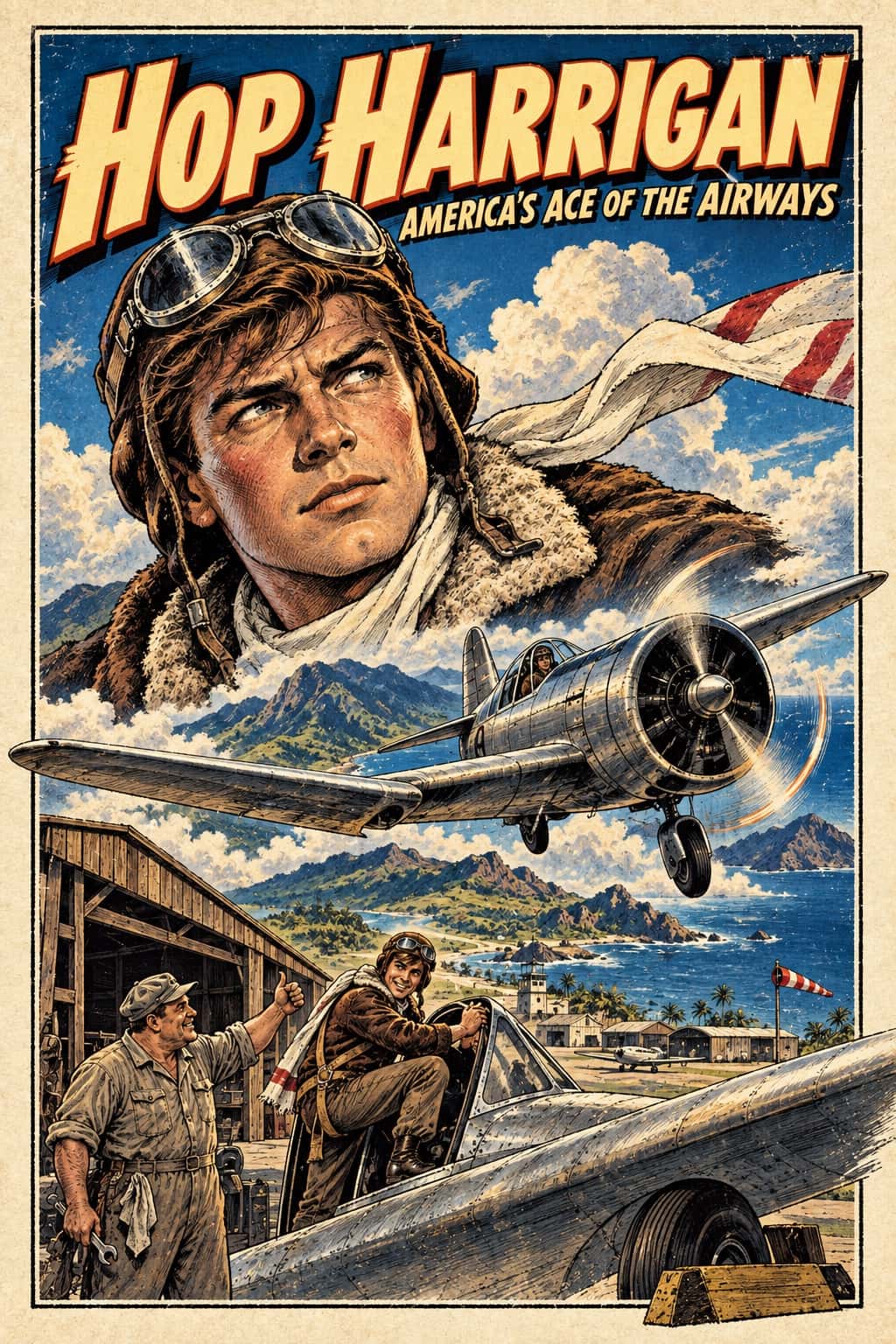
Presenting Bob Harrigan, America's Ace of the Airways. X-4 calling Control Tower. The X-4 calling Control Tower. Standing by. Control Tower, back to sea. Okay, this is Bob Harrigan, coming in. Coming in for another transcribed episode in the adventures of Bob Harrigan.
Gang, you've all read and heard a lot about those mysterious flying saucers which have been sighted all over the country. Well, don't be surprised if someday you see one yourself, because the Navy has a plane that is a dead ringer for the reported saucers. It's the XS-5U, a flying wing nicknamed the Flying Pancake, and it's very easy to see how the ship got its name on what takes as one look. During the war, it was a mystery ship. All of its flight details were kept top secret. But a lot of people got a look at the pancake while it was being tested on the East Coast. Its strange design and gigantic propellers started a great deal of comment. Well, now the lid's off and we have all the lowdown on it. The most amazing thing about the flying wing is its ability to go backwards without any trouble at all or stand still in the air, if the pilot so wishes. It can even land while going at zero miles an hour. In other words, all it has to do to land is go straight down. Sounds exactly like a helicopter, doesn't it?
And that's right, the principles are the same. The plane can go forward as well as backward. Its cruising speed is somewhere around 400 miles an hour, though the Navy is still working on it, trying to improve it in every way possible. The firm which built the ship for the government is doing the testing now, as they did during the war. Biggest news on this flying wing is that it may soon be turned out for private owners. At the start, the inventor wanted it to be a light private ship, and when the war came, all that changed, the Navy took over. Well, now that it's peacetime again, inventor Zimmerman has an eye on the civilian market. We'll be back to tell you more, so don't forget to listen. And now to our story. Under suspicion of murder, Hoff and Tank fought to solve the riddle of the ghostly Avengers to clear themselves, as well as help their friend, Paul Conroy. But when two of Paul's pilots lost their lives as a result of a collision in midair...
Hopp still wasn't convinced the crash was caused by a German fighter plane reported by the pilot just before the fatal collision. Concluding their investigation at the scene of the wreck, they climbed back into the Beechcraft for the return flight to New Orleans. The field was short, and after gaining a bare minimum of speed, Hopp pulled back the stick sharply to clear a high-wire fence for the plane to don't respond. Throttle wide open, it hugged the ground, heading straight for the fence. Come on, get her up, or we'll plow into that fence. She doesn't answer the controls. It's too late. Hey, give me full flaps. Flaps, roger. Now, tray, fellas. Tray. Keep lifting. Still have to clear the fence. Stay up in the air and just get flaps. I know. We're going in again. Where? Straight ahead. That feels pretty level. Hold tight. Closing the throttle. She does it, baby. Don't drop out from under me. Tight down. Tighten still. We're safe. Nice going, boy. A little rough, but at least we're in one piece. Now, let's...
Find out what happened. Go on, Tank. Pile up. Right. I don't understand why the ship wouldn't answer the controls. Neither do I. That's what we're going to find out. Tank. Yeah. Give me a check. Ailerons operating? Yeah, fine. Rudder? Uh-huh. Force is sick back and forth. Well? The elevators ain't moving an inch. Looks to me like something's wrong with the cable. I'm going to sleep. Come on, folks. Right. How could it be the cable? Didn't you test the controls before we took off? Of course I did. How about a tank? Find anything? I'll say I did. Get a load of this. What? What? The cable's broken. Broken? My hind foot. Look again. Ah. I get it. What is it, Hop? Let me see. The cable was cut. All but two or three strands. And they snapped when I pulled up sharp to clear the fence. Great. God, what in the world could have happened?
The table was all right when we landed here, wasn't it? Sure it was. I bet my eyeteeth on it. Well, then who'd want to do it? Certainly not the state trooper or the people standing around the wreck. Hey, hey, wait a minute. What's the matter, Sam? I remember. Now I remember who the guy was I saw and do the pizza's fit. Who was it? Martin. Martin? Who's he? The pilot who quit on Paul the first night we got into New Orleans. The guy who wouldn't take the DC-3 up to Richmond. Thank you, sir. I'm positive. What would he be doing here? The wreckage of the transport's here, isn't it? You mean he's mixed up in this? Well, if he ain't, I'm a monkey's uncle. And a hundred to one, he knows about the busted strap and the DC-3 we took up. A cut strap and a cut cable. It's trademarked. Now, come on. Let's go get him. No, no. He must have seen us come down safely and beat it. Tank, can you fix the cable? Sure. I can splice in a new section in no time. Okay. Get to work. Now, finally, we have a definite lead. And we're not going to waste any time following it.
Working swiftly and skillfully, the lumbering mechanic completes the repair work in short order, and 20 minutes later, the boys are successfully airborne. Flying frontal wide open, they reach Shreveport within an hour, and land to refuel. Then, holding a steady course southwest, they reach New Orleans late in the afternoon, where Bert Craig, one of Paul's partners, meets them in front of the Ace Flying Service hangar. Well, did you find out anything? Buddy, do we have Martin's home address in our file? Martin? What do you want with him? We got an idea. He's the rat who's behind everything. Oh, but why? Tank spotted him at the wreckage of the transport. And he got a little fancy with our elevator cable. Same kind of a job he did on the cargo strut. Oh, I can't believe it. Why would he do anything like that? That's exactly what we want to find out. He left a forwarding address, didn't he? I'm not sure. He must have. We're supposed to send him a check for his last week's pay. Oh, maybe it's on the desk somewhere. Come on, we'll have a look.
Jump in, Jenny. Hey, what's the matter? Look who's standing in front of the office. Oh, fly it, Inspector Fry. Oh, sorry. I meant to tell you right away. He's been waiting for you two boys. What's he want now? Take it easy, fella. Don't get riled up. Don't get riled up when he's trying so hard to pin a murder rap on you. No, don't talk nonsense, fella. He's only trying to do his job. Well, why don't he leave it alone? Take it easy. He'll hear you. Afternoon, Inspector. Oh, good afternoon, Mr. Conroy. Hello, Inspector. You looking for us? Yes, Mr. Harrigan. I got a little worried that you might have decided not to come back. Listen, wise guy, we ain't got no reason to run away. I'm glad of that, Mr. Tinker. Uh, shall we go inside? Uh, sure. Go right ahead. Thank you. Would you rather we waited outside? Perhaps we should. Oh, no, no, no, no. Not at all. Mind if I sit down? Doing a little running around today. Kind of tired. Oh, welcome.
Take that chair. It's the most comfortable one. Oh, thank you. Well, uh, your, uh, your trip proves satisfactory? Yes, we got a couple of leads. Mr. Harrigan, a word of warning. Playing detective is that to get you into trouble? We ain't playing, chum. We got a job to do. You got something to say to us? Spill it and stop wasting our time. Hey, easy, Tank. Mr. Tinker, I happen to have a job to do, too, and my time is just as valuable as yours. Okay, then. Let's get down to brass tacks. Gladly. I checked the fingerprints we found in Moran's room. You know, he was a murder mechanic. Yeah, we know. With those, we took a view last night. So what? Must have found a lot of them. Yes, we did.
On the chest of drawers, the closet doorknob, everywhere. I told you we were looking around, sir. I, uh, even found your prints on Moran's wallet, Mr. Harrigan. That's right. Rather odd, don't you think? Most people finding a dead body wouldn't touch it. I told you we were looking for clues. Oh, yes, yes, of course. But there was something you didn't tell me. What? Ever seen this before? Well, it's the busted cargo strap. Oh, you recognize it? Yes, sir. Moran was going to tell us who cut it. If you get it anyhow. I found it in the apartment. Oh, must have dropped out of my pocket. Really? Could it have dropped around Moran's throat? What do you mean? Mr. Harrigan, this is how the murder was committed. Moran was strangled with his strap. Dangling the broad webbed strap before the startled eyes, Inspector Frye watched his hop and tank coldly.
Impassively. The boys are completely bewildered. With this damaging piece of evidence, they're again in very serious trouble. We'll bring you the climax of today's episode in just a moment. We'll tell you about the Navy's flying wings and how they soon may be on the civilian market. Just imagine them speeding through the air or else just standing still as if held up by an invisible giant. Then you see the pancakes settle softly to the earth, landing almost on a dime. With a ship like that, you don't need an airport, just a smooth little piece of land. If and when the pancake comes out on the market, it won't be such a strange sight to see one of them landing in your own backyard. All this sounds pretty easy when we talk about it, but believe me, the inventor, Charles Zimmerman, worked on his model for a long time before he got a break. He started out 14 years ago, in 1933. That time, he designed the flying wing, but it was turned down because it was too far ahead of the time.
But Zimmerman wasn't going to give up so easily. He worked all of his spare time with two friends, and by 1935, he had a working model of his wing. But it wouldn't fly. The engine was no good. But he was still determined to prove that his ship could fly. So in the fall of 1936, he built a rubber-powered model, and sure enough, it did fly. Then he took his plans to a research council. They encouraged him, told him to try his luck with an air manufacturer. Finally, in 1937, he joined the Volk Company. and went to work on his now famous ship. He says the pancake will do better than the helicopter, and at the same time will cost less to run. Zimmerman says the cost can be brought down to five cents a mile at the economical cruising speed of 200 miles per hour. And that's not far away from what it costs to run an automobile. Charles Zimmerman kept trying again and again after each failure, and he finally won out. Remember, gang, you won't win if you don't try. And also remember, America needs...
Liars! And now, back to our story. Returning to New Orleans, Hop and Tanker met at the airport by Inspector Fry, the police detective in charge of the Moran case. Showing them a broken cargo strap, which they readily identified, he then informed them, This is how the murder was committed. Moran was strangled with this strap. I couldn't have been. You're nuts. Inspector, you're making a big mistake. My laboratory doesn't make mistakes, Mr. Cornelius. Well, then you think Harrigan and Tinker really murdered Moran. Hey, Bert, wait a minute. I'm sorry. I didn't mean it that way. We didn't murder nobody. I don't know how that strap got there, but we didn't use it on Moran. Your fingerprints are all over it, Mr. Tinker. Sure they are. I must have lost it before we went to his room. Inspector, be reasonable, will you? We came down here to help Paul find out what was wrong with his airline. Why should we murder a mechanic, a man we didn't even know? That's the only thing that bothers me, Mr. Harrigan.
Frankly, if I could find a suitable motive, I'd take you down to headquarters now. Yeah, I bet you would. How come you're being so good to us all of a sudden? Why don't you take us anyhow? That's what you could use, ain't it? A couple of poor guys. All right. Can't control yourself, will you? Inspector Fry's only trying to do his job. Then why don't he do it right? Mr. Tinker, you have quite a temper, haven't you? So what? I was thinking. Suppose you had discovered that Moran himself had cut the strap in your plane. Your reaction would have been quite violent, wouldn't it? Wait a minute, Inspector. Yes, with a strap in your hand, who knows? Yes, a temper like yours might easily lead to murder. Inspector, he didn't do it, I tell you. And you, of course, being his best friend, would cover up for him. What an interesting theory, don't you think? Sure, but it ain't the truth. Well, we'll see about that. Mr. Tinker, if I were you, I'd watch my step. Yes, I'd watch my step very carefully.
At the police detective's calm, measured words, Hop's blood runs cold. Suddenly he feels hemmed in, trapped by a chain of circumstantial evidence, evidence which threatens to engulf them completely in a charge of murder. Gang, the riddle of the ghostly avengers takes a new and fantastic turn in our next episode, so be sure to listen. Tune in and fly with Hop Harrigan, America's ace of the airwaves. So long, Hop. We'll be seeing you same time, same mutual station. Paul Paragon is a transcribed copyrighted feature appearing in all American comics magazines.