
The written record
Read the transcript
Read along with the recording · About 13 min to read
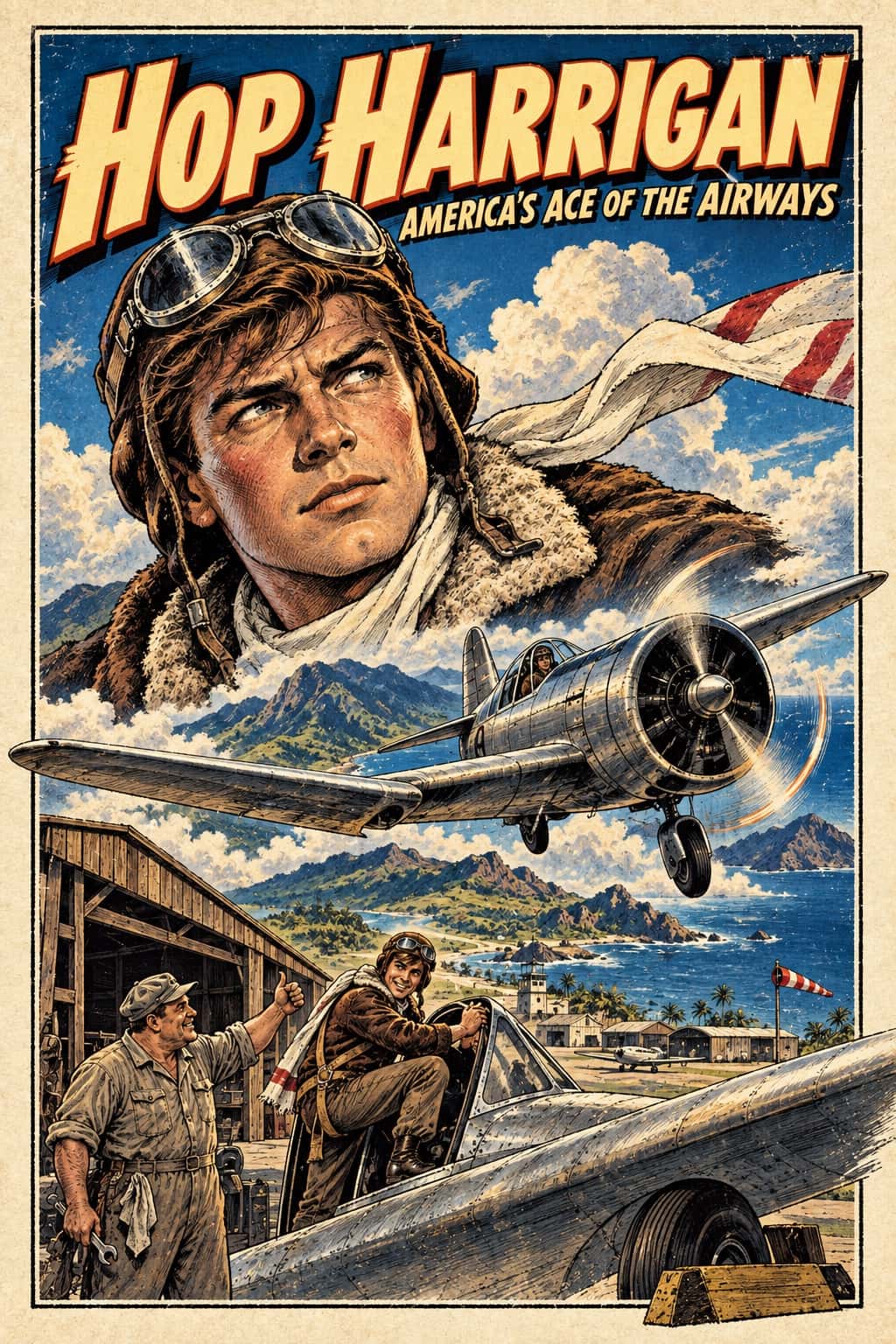
Presenting Hop Harrigan, America's ace of the airwaves. CX-4 calling control tower, CX-4 calling control tower, standing by. This is Hop Harrigan, coming in for another transcribed episode in the adventures of Hop Harrigan. Fellas and girls, did you know that one of the greatest hazards to flyers colliding with mountains can now be eliminated almost completely by a shoebox-sized radar device invented by that great aviator and plane designer Howard Hughes? Well, according to Mr. Hughes, his new anti-crash warning system can prevent at least 96% of these accidents. Not only is this invention an important advance in making our planes safer, but it's so simple that anybody can understand how it works. An amber light flashes and a bell rings when the plane comes within 2,000 feet of an obstacle, such as a mountain or building, directly ahead or below it. So as soon as the pilot hears and sees these warning signals, he goes into a climb and within a few minutes is out of danger.
The device also can be set to work at 500 feet to help the plane land, and it works in any kind of weather. Radar has been the white hope of aviation engineers, pilots, and the public ever since it was first installed in planes during the war. But wartime radar was a very complicated mechanism. To use wartime radar, our airline pilots had to be specially trained to read the radar scope. Since the war, in order to determine obstacles in their course, pilots have been comparing readings of their barometric and flight maps. Then they figure out their average speed and wind drift and compare the whole business with what they can see. But you can well imagine all this takes time, sometimes too much time. In just a few minutes, I'll be back to tell you more about Howard Hughes' new anti-crash radar device. So don't forget to listen. And now to our story. If Paul Conroy and his two partners were to keep their charter airline in operation, they needed help.
So Hop and Tank took on the job of discovering, if possible, what was behind the mysterious attacks by ghost-like wartime enemy fighter planes. But before they could make any progress, Vinnie Stevens, one of the partners, reported by radio that he was being attacked by a Jap Mitsubishi while en route to New Orleans in a DC-4 transport. For nearly an hour and a half, nothing further was heard from him. And then the control tower reported the ship near the field apparently trying to come in for a landing. As we continue now, Hop and Tank are running across the field following Paul Conroy while the transport circles overhead. Tank, he can't make it. He'll never be able to bring the ship in by himself. Why not? Craig didn't tell Conroy, but there's been an accident. I thought the nose looked kind of funny. It's almost all smashed in and the cockpit windows are all broken. That won't keep a good pilot from landing. All right, here we are, fellas. We'll go right up to the transmitter and we'll talk to Vinnie ourselves. Paul, wait. We can't wait. Something's wrong or Vinnie wouldn't keep circling. I'd better talk to him. Paul, listen to me. I know what's wrong. What?
There's been an accident. The co-pilot's unconscious and Vinnie's blind. Blind? Well, how do you know? Craig got it from the tower operator. Why didn't he tell me? He didn't want you to blow your top. So when you talk to Vinnie, take it easy, will you? Take it easy? Hop, we've got to help him. Come on. What? What about Vinnie? Is there any way we can get him down? We'll have to wait until we hear from him and find out exactly what the score is. Hey, Sparks. Oh, hello, Mr. Conroy. Are you in contact with Stevens? Yeah, tough break, ain't it? I got the crash truck standing by. All right, let me talk to him. Sure thing. Hello, Stevens and Ace 2-9.
This is the tower. Come in. Over. Haven's here. Am I still near the field? Over. Yeah, you're over the north boundary. Keep circling. Here's Mr. Conroy. He wants to talk to you. Stand by. Okay, Mr. Conroy. Hello, Vinnie. This is Paul. Hi. Saved the ship, but don't know it. Hang the ship. What about you? You hurt badly? Got smacked up around the face. Can't see. Makes it tough. Can't you see anything at all? Nope. Listen, we've got a couple of chutes in the locker. Bail out. I can't. Something happened to Pete. I can never get a chute on him, and I won't. leave him. How much gas is left? I don't know, but it can't be more than a teacup full of that. Oh, Lord. Paul, let me talk to him, will you? Hop, is there anything we can do? Well, it depends on how good he is at following orders. Hello, Vinnie. Go ahead. I'm putting on a friend of mine, Hop Harrigan. Here he is. Hello, Stephen. This is Harrigan. Hi. Paul has told me a lot about you. I won't get a chance to meet you in person. Maybe you will. Listen, did you ever make any landings on a ground control approach? Yeah, a couple in service. There's no GCA unit down there. We don't need one. We can see or find. I wish I could say the same. I'm going to try and talk you in. Do you think you can follow my orders without question? Well...
Try? You've got to do more than try, fella. Okay, Harrigan. It's a pinch I haven't anything to lose. Take over. All right, keep circling. I'll get a car and a portable transmitter and talk to you in from the runway. Stand by now. Hey, Sparks. I'm way ahead of you, sir. There's a jeep with a short wave set in it parked in back of the administration building. You can use that. Fine. Come on, Tank. I'll stay here, Hop, and keep in touch with Vinnie. Good idea. Don't let him drift away from the field. On the double now, Tank. We've got to move fast. Taking the tower stairs two at a time, Hop and Tank rush out on the field, quickly locate the jeep, and with Tank at the wheel, race madly out to the head of the runway.
In the back seat, Hopp makes contact with a still-circling transporter. Hello, Stevens. Hello, Stevens. How do you hear me? How do you hear me? Come in. Over. Okay, Harrigan. I think you're fine. Over. Now, stand by. Hello, Tower. Are you listening? Come in. Over. This is Paul, Hopp. Go ahead. Give me exact wind velocity and direction. Hold it. Right in the middle. Okay. Hello, Hopp. This is Paul. Go ahead. Wind velocity 12 to 14 miles from due south. Thanks. Is it okay here? Fine. Cut the engine. Right. Now, Tank, keep your fingers crossed. I got my eyes crossed, too. Hello, Vinnie. Are you ready? Anytime you are, pal. Okay, let's get to work. You're now west of the field, about a half mile, flying parallel with the row of hangars. Got that? Perfectly. Roughly about 3,000. You'll have to come down. You're telling me. Chop back your throttles and lower your nose now. Roger. Easy now, not too much. Okay. You're now southwest of the field. Give me a 90-degree turn to the left. 90 to the left. You stab in the dark, but here goes.
We ain't giving her enough rudder. Hello, Vinnie. Get your foot down on that left pedal. Your turn's too shallow. Roger. That's better. Okay, far enough. Level out. And keep your nose down. Trying to. I can't help feeling that I'm going to plow up the ground any second. You've still got a good 1,500 feet. Trust me, Vinnie. Okay, pal. Now, stand by for another 90 to the left. You're almost over the water tower at the southeast corner of the field. Check. All right, hit it. Get that wheel over. Coming around. Get it smoother this time. Hold it, Vinnie. Hold it. Now, break it. Level out. Nice going. Now listen, you're in your downwind leg. Lower your gear and give a flaps. Gear and flaps. Check. On your right, Vinnie, both of them. Okay, got him. Check on the wheels. Good. And the flaps. He's really on the ball, that guy. Okay, Vinnie, you're doing fine. Now chop back the throttles a little more. Throttles back. What about the altitude? Vinnie, level out. You're down far enough. I feel like I'm right on top of the tree. No, you've got enough room. Now, is everything under control? As near as I can get it. Then stand by for another turn.
It'll put you on your base leg. Arrogant. I'm getting scared. Relax. You'll be okay. Lean on that wheel now and cut around. Roger. If I were in his shoes, I'd be ready for a straight jacket. Okay, Vinnie. Level out. You're in the base leg. Check. Hello, Tower. Come in. Right. Standing by. I'm going to try to bring him in. Have everything ready. Do you understand? Stop trying to play cagey and get those crash wagons out fast. Relax, Vinnie. You're doing fine. Cut the chatter. Stand by for your last turn, Vinnie. Last is right. Go ahead now. Hit it. Roger. So tight. Ease off, Vinnie. Not so sharp. Roger. Now, straighten level again. Straighten level. You're about a mile and a half away. Drop your nose, but not too much. Nose down. Check. Look out. He's dragging the left wing. Vinnie, get the stick over. Left wing's low. Check. How close am I? A mile now, and you're lined up perfectly. Hold her that way. I can't do it. Yes, you can. Hold her steady. He's drifting to the right. A little left rudder now, Vinnie, and easy does it, boy. Where am I now? Less than half a mile from the runway. Keep coming. Thanks. Roger.
Pull over to the glass when I tell you. Harrigan. Harrigan, come in. Where am I? You're all set for the touchdown, pal. When I count five, close down your throttles all the way. Understand? Count five. Cut the engines. Right. Okay, Tank, get off the runway. You bet. Now, Vinnie, this is it. One, two, three. His eyes glued to the steadily approaching transport, Hop counts off slowly, sweating the massive plane in. One mistake, the slightest miscalculation now, will mean a fatal crash. Gang, in a minute you'll hear the gripping climax of today's episode, so stand by. Howard Hughes recently took a plane load of the nation's leading aviation writers up in a constellation to demonstrate his new anti-crash radar device. To show what it could do, he flew until he was opposite the steep mountains beyond Santa Monica, California, mountains which have crushed in their stony fingers many a fog-bound plane. Hughes flew the plane directly toward the highest peak. His passengers held their breath.
Suddenly a bell rang, a light flashed when the radar cat's whisker brushed the rising ground ahead and below. Pilot Hughes immediately adjusted the controls. The ship roared up into a steep climb and cleared the rocks in plenty of time. The passengers aboard were profoundly impressed, to say the least. Well, that day, newspaper wires buzzed with stories of the spectacularly successful demonstration. This new airline radar system, which weighs only 15 pounds and costs only $130, sends out brief bursts of high-frequency pulses or waves both ahead of the plane and below it. When these pulses echo back from the ground or from the sea or buildings, a receiving apparatus measures the time the waves take to make the round trip. All this is as quick as a wink. If any waves return fast enough to indicate that an obstacle is within 2,000 feet of the plane, the light and bell go into action and the pilot immediately pulls his plane into a climb. In many parts of the country where mountains aren't so steep, he would be warned of an approaching peak as much as 30 miles in advance.
The Air Safety Board, appointed by President Truman, was recently shown this invention in action. And ten days later, they recommended that all airlines be required to install anti-crash radar. Yes, fellas and girls, the pilot's life is just as exciting as it ever was, only it's being made easier and safer all the time. And gang, always remember, America needs flyers. And now, back to our story. Huff and Tank are seated at the head of the runway in a Jeep, using a shortwave radio. to talk Vinnie Stephens, D.C. 4, into a safe landing. Now, Hop measures off the time to a touchdown as he watches the huge transport coming closer. Cut the throttles, Vinnie. You're right over the concrete. Here goes nothing. Stay with him. No sound, Vinnie. No sound. His wheels are touching. He's in, Hop. He's in. Okay, Vinnie, you're down. Hold it steady. Ball, come in. Go ahead, Ball. Is he all right? Of course he is. He did a beautiful job. Now go on out there and meet him. Right. Talk to you later. There, he stopped. Everything's okay now, Hop. You were swell. Thanks.
Now, Tank, get this crate rolling before I pass out. His knees suddenly turning to water, Hop slumps in the back seat as Tank starts the jeep. And after the two injured flyers are taken to the local hospital, Hop and Tank give the damaged plane a careful examination. Boy, she sure took an awful while up in the snoot. No wonder the nose wheel came down at all. No wonder the whole control cabin didn't fold up. What did Vinnie say happened? Did the jet plane crash into him head on? Yes, it burned. They were awful lucky to come out alive. It was more than luck, Tank. What do you mean? Something's wrong somewhere. I believe Vinnie's story. I'm sure he wasn't lying. But I'll bet my bottom dollar this ship was never hit by a Jap fighter. It was never hit by a plane at all. Hop has made an astonishing statement. But if the DC-4 wasn't hit by a plane, what did happen to it? Gang, there are plenty of surprises ahead, so don't miss the next episode of The Riddle of the Ghostly Avengers.
Tune in and fly with Pop Harrigan, America's ace of the airwaves. We'll be seeing you same time, same mutual station. Pop Harrigan is a transcribed copyrighted feature appearing in all American comics magazines.