
The written record
Read the transcript
Read along with the recording · About 12 min to read
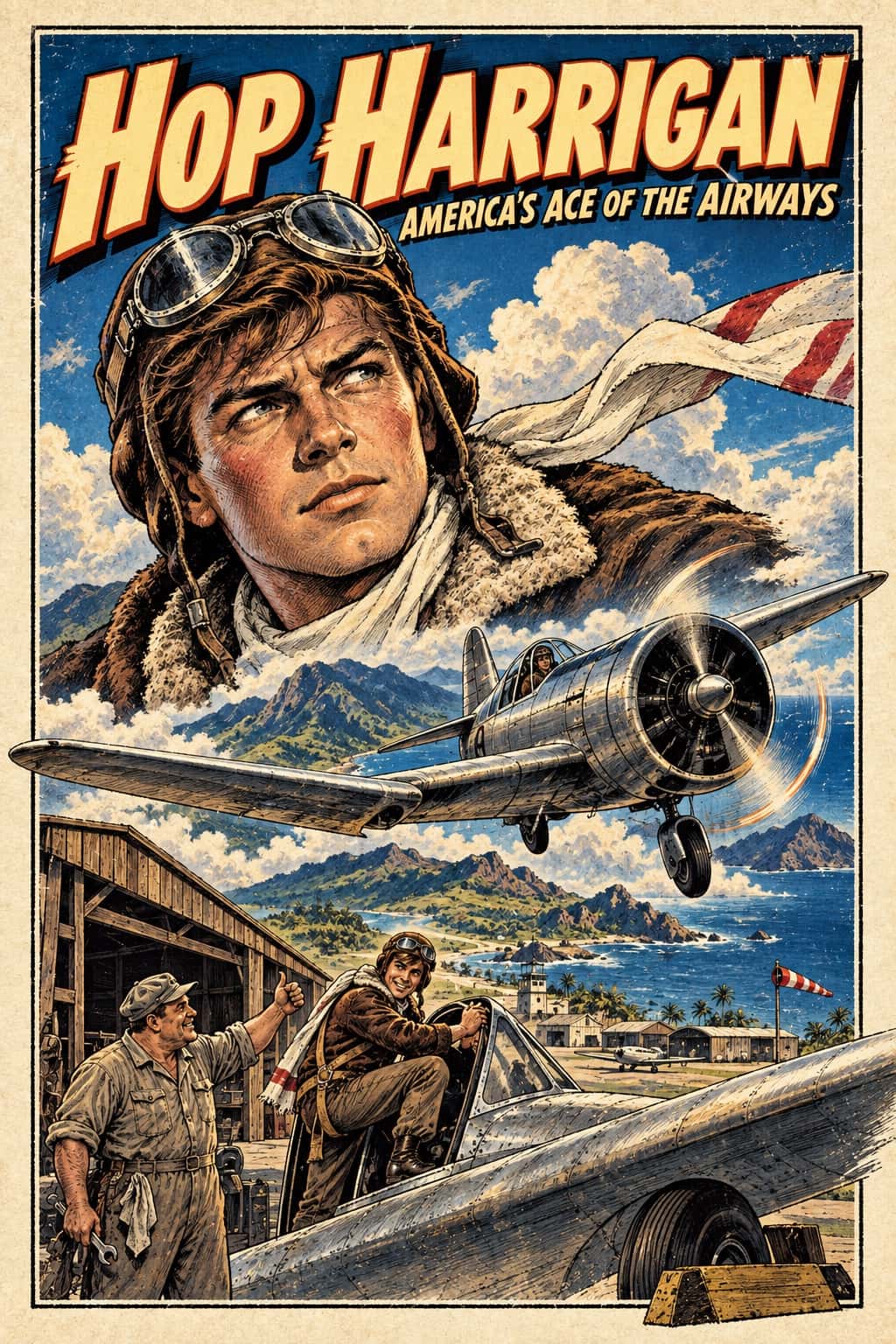
Presenting Pop Harrigan, America's ace of the airwaves. The X-4 calling control tower. The X-4 calling control tower. Standing by. Okay, this is Pop Harrigan coming in. Yes, it's America's ace of the airwaves. Coming in for another transcribed episode in the adventures of Pop Harrigan.
Every aircraft company in the United States has been doing its share of planning and building new and better planes. During the war, when new type ships were badly needed, all these plants got right on the job and turned them out fast as lightning. And many of these planes, like the Flying Fortress and the Super Fortress, played a big role in winning the war. Well, now the pieces here, the plane builders, are at it again. They're rolling new models off the production line all the time, better passenger and freight planes and better planes for our Army and Navy. One of these post-war models is Lockheed's land-based patrol ship, the Neptune, also called the P-2V. This is a two-engine job that rates along with the larger four-engine ships used during war. The Navy especially asked for this kind of plane, and Lockheed went right ahead and built it for them. For six months, technicians worked over blueprints, using everything they'd learned from many years of air research. And after all the tests were completed, the Navy found that Lockheed had done a great job on the Neptune.
It stood up under long, tough endurance tests, flying well over 5,000 miles nonstop. That is, from New York to Pearl Harbor, or from Washington to Moscow, for example. And without once refueling. It can stay in the air as long as 36 hours in an emergency. Its speed is in the 300 mile an hour class. But when it has to, the P-2V can go faster. Last spring, it set an official east-west transcontinental speed record, shooting from New York to Burbank, California, in 9 hours and 23 minutes. More later... So don't forget to listen. And now to our story. Death, sudden and violent, has become part of the strange riddle of the ghostly adventures. First, the murder in which Hop and Tank were held on suspicion by the New Orleans police. Then, the disastrous crash of an ace flying service transport, which cost the lives of two pilots. Now, Hop and Tank, released on bail supplied by Paul Conroy, are flying to the scene of the crash in their Beechcraft.
They listened quietly to Paul as he told them what happened. It was the same as before. But then he saw an enemy fighter. Only this time, it was a German ship. A Fokker Wolf, 190. The pilot reported it was attacking, and then the radio went dead. A mid-continent airline ship reported seeing the wreckage during the morning. And when the state police got there, the crew was dead. To hold us in, we would have been in their place. I suppose the German fighter was spotted in the same area as all the others. Yeah, 200 miles west of Little Rock. We are. Hey, Paul, is anyone guarding the wreckage? Yes, a couple of state troopers. The CAA examiner will be up sometime this afternoon. Due to warning, he ain't going to swallow the story. I can't ignore it. The pilot reported seeing the purple wolf to the rain station. All messages are recorded. Thank goodness for that. We'd be in fine shape if the CAA grounded us for all the operations. We ain't in such good shape now. Don't remind me. I didn't dare go back to the office this morning. I know Bert's got his hands full trying to hold on to what little business is left. Heads up. We're getting close.
Watch for the wreckage tank. Small private field about 10 miles north of here. We could sit down there and hire a car. Let's find the plane first. I'll drop to 1,000 feet. That's pretty level. Well, there. There it is. Where? Left, about 10 o'clock. Half mile away. Check. Hang on. Thank you. That isn't pretty. Looks like he came straight down. You notice, Tom? No skid marks on the ground at all. Uh-huh. That's nose first and then burn. Boy, look at the wings. I bet they're 100 feet away from the fuselage.
Paul, I don't think we'll meet at the airport. We'll land right here. Sure. I can slip her in, all right. Give me wheels and flaps and hang on. As the landing gear is lowered and the flaps extended, Hop turns beachcraft into the wind and, closing down the throttle, settles Richard in a long, slanting glide. Junking the plane skillfully, carefully, he heads for a wire fence at the downwind end of the field and, losing speed in a sharp forward slip, flattens out not ten feet over the ground to come in for a safe landing. Two minutes later, they're walking slowly around the wreckage of the DC-4, accompanied by a state trooper. A small knot of curious bystanders watches them from a distance. Yes, you're right, Hop. Let's come straight down. Used to look just folded up like an accordion. Yeah, what's left of it, you mean? Nothing but a mess of splinters now. I don't see how the CAA examiner will find anything out of this. You'd be surprised what they can do, thanks. Well, Hop, what do you think? Is it like Benny's accident? A head-on crash?
Certainly seems like it. Where's the wreckage of the enemy fighter? Must be in there someplace. Where's the engine, for instance? Let's see. The left outboard is still on the wing. Same with the right outboard. Which makes two. And there's another one on the right. And there's number four. See any others? I don't know. Me neither. Maybe it's all clear. Let's check. Officer. Yes, sir? Was any other wreckage found in the area? No, sir. The inspector from the CAA told us to look around in a radius of about five miles, and we've had patrols out all morning, but they haven't turned up anything. Well, that's bad. No fighter engine anywhere around. The DC-4 exploded when she hit the ground, I guess. I beg your pardon, sir. The plane was burning before it hit. How do you know? There was an eyewitness. A farmer who lives in that house across the road heard what sounded like a crash and looked out the window. Then he saw the plane come down.
It was in flames before it hit the ground. Did he see any other planes? No. He didn't happen to see the transport before he heard the crash, did he? No, he said he was getting into bed. He wasn't even sure he heard the engine. Just the noise and then the plane coming down in flames. Hey, here's something. What? Looks like one of the instruments was thrown clear. Better not touch it, sir. The examiner left strict orders. Don't worry. I just want to look at it. At what? The altimeter. Huh. Like I said. Please, sir. That's all right, officer. I'm not touching it. What is it? A piece of wood. driven right through the back of the altimeter. What about it? Must be a chunk of the instrument panel that went through when the ship crashed. Oddly. The hands of the altimeter registered 2,500 feet. That's when it went out of commission. Holy cow, then the wood's a part of the enemy fighter. Yeah, so it seems, but have you ever heard of using soft white pine in plane construction? White pine? The piece in the altimeter is white pine? Right. Are you sure? As positive as I can be without digging into it. It's got green paint on it. Green paint? Is that registered for?
Of course. Vinnie and the other boys said the enemy fighters all glowed with a strange greenish light. Right. Now, we've got a couple of facts to add up. To what? Something which looked like a Focal Wolf 190, but was at least partially made of soft white pine, crashed into the DC-4 and burst into flames. You can't be sure of that. Maybe the crash ruptured the wings. No, no, no. Don't you remember Vinnie's ship was all black with smoke? Vinnie said it started to burn. He was a lot luckier. He made it back. Well, I think we're through here. We might as well go back to New Orleans. Yeah, Inspector Fry from the detective bureau might come snooping around. If he finds out we ain't there, he'll think we jumped out bail. Don't worry, Tank. I told Bert to explain everything if he showed up. All right, officer. Thank you for letting us look around. You're welcome, sir. Now, listen, you better keep those sightseers back or they'll start picking up the pieces of souvenirs. Yeah, I've been keeping my eye on them, sir. There were a few of them hanging around your plane, too. Oh, yeah? No, they didn't do anything, sir. I was watching. Fine. Now, let's go, Hop. All right.
I'll tell the CAA examiner you were here, sir. Right. And if he has any questions, tell him to contact me in New Orleans, will you? Right. Come on, folks. Climbing tank. Go ahead, Hop. I'll kick the stones out the window of the wheel. All right. Hop. Yes? You think we'll be able to get off all right? Oh, sure. We've got a pretty stiff headwind. We'll get plenty of lift. When do you think we'll be back in New Orleans? Hmm, about two and a half hours. I want to stop at Shreveport to get. Hey, Tank, hurry up, will you? What's the matter with him? He's just standing there. Tank! Huh? Oh, sorry, I'm coming. What were you dreaming about? I was dreaming that I saw somebody I knew in the crowd over there. Huh? Oh, that's good. I can't tag him. I swear I've seen him someplace and I can't remember. Ah, well, forget it. Stand by now. Starting up. I only saw the guy a couple of days ago. How could you think? You've never been around here before? No, it's just that you sure look familiar.
It's not going to make me mad when I can't remember things. Shaking his head, Tank continues to puzzle about the matter as Hop opens the throttle and taxes to the end of the short field. And Tank is right. There is someone in the crowd whom he knows. Someone who watches the beach craft narrowly, a mocking sneer curling his lips. Gang, you won't want to miss the startling climax of today's episode, so stand by.
Now let's get back to the Neptune, our Navy's long-range patrol ship. One of the details that the Navy insisted on having in this plane was the ability to operate equally well at high as well as low altitude. And the P-2V meets this requirement to a T. It can skim the ocean on search and rescue trips, as well as climbing more than five miles up in the atmosphere on photographing and mapping missions. Furthermore, the plane had to have comfortable quarters for the crew, for very often a ship such as the Neptune has to spend hours and hours in the air on long missions, so it's important that the men in the crew be rested and wide awake. Real soft upholstered bunks and comfortable reclining chairs are scattered behind the cockpit so that the crew can relax when they're off watch. And also, they've got the pilot and co-pilot riding ahead of the propellers. This arrangement lowers the noise and helps keep them from getting nervous and jumping.
Food requirements are well taken care of, too. The Lockheed Neptune is equipped with a galley, a refrigerator, and electric cooking devices. All this to add to the comfort of crew members on long, monotonous patrol missions. Besides all these features, the Navy has had the Neptune built so that it can be converted to a battle plane in a hurry. There are other important features built into the P-2V Neptune also. A plastic shell that protects the self-stealing fuel tank. Loran, a new type of radar that tells the operator just where the plane is. Improved fowler flaps that make it easy for inexperienced pilots to handle the ship. These and many others are built in to make the Lockheed Neptune one of the best and most comfortable patrol ships in the sky. Boys and girls, get set to take your place in the sky with these new ships. For always remember, America needs flyers. And now, back to our story.
Examining the wreckage of the DC-4 and learning that it had crashed as a result of another collision in midair with an enemy fighter, Hop, Tank, and Paul Conroy prepared to return to New Orleans. Taxiing to the end of the small level field, Hop turned the Beechcraft into the wind and made his final engine check prior to takeoff. Stand by for magneto check next. Okay, go ahead. Number one. One okay. Two okay. All right. All right, you slept in? Uh-huh. Well, okay.
with a seat of a fence. The fence down there looks awfully close to me. Ah, we can manage it. Here goes now. Hold tight. I hope those people over there don't come wandering across our path. All right. I'm going to listen now. Hold still. I've got the thick beverages with me. Some cold sweat suddenly break out on Hop's forehead as he pulls back frantically on the control and the plane does not respond. At full throttle, it charges toward the heavy wire fence. A fatal crash seems inevitable. There's action and a thrill a minute in our next episode, gang, so don't fail to listen. Tune in and fly with Pop Harrigan, America's ace of the airwaves. We'll be seeing you same time, same mutual station. Pop Harrigan is a transcribed copyrighted feature appearing in All-American Comics magazine.