
The written record
Read the transcript
Read along with the recording · About 23 min to read
Radio's own show, Behind the Mic. Radio, with a switch of a dial, radio brings you tragedy, comedy, entertainment, information, education, a whole world at your command. But there are stories behind radio. Stories behind your favorite programs and favorite personalities and radio people you never hear of. Stories as amusing, dramatic, and as interesting as any make-believe stories you hear on the air. And that's what we give you. The human interest, the glamour, the tragedy, the comedy, and information that are Behind the Mic. And now, presenting a man who is pinch-hitting for Graham McNamee this week, one of radio's most gifted announcers, George Hicks. Thank you, Gilbert Martin, and good afternoon, ladies and gentlemen. This afternoon, Behind the Mic brings you the story behind orchestra leader Enoch Light's disappearance from the airwaves.
amusing mistakes made by your favorite announcers, how an advertising agency builds a program for a prospective sponsor. We give you the sound effect of the week. We salute a program you love, the Don Amazo program that featured violinist Godfrey Ludlow. We answer letters from listeners, and finally, in celebration of his 10th anniversary on the air, we bring you from Hollywood the one and only Jack Benny being interviewed by Don Wilson. Last year, one of the fastest-rising orchestra leaders in radio was a young man named Enoch Light. He was on the air four or five times a week from the Taft Hotel and had numerous commercial programs. Then suddenly he dropped completely out of sight for months. As a matter of fact, from June of last year to January of this. But here's Inet Light to tell you all about it. Inet, suppose you tell us what happened to you. Well, George, last year I went on a road tour with my band. We played at the University of Michigan prom, the Carnegie Tech dance.
a couple of dates in Boston, and then we went up to Old Orchard, Maine to open up the pier. It was a very successful opening, I might say. After the job, I was driving back to Boston with a couple of my musicians. It was 4 a.m. on the morning of June 2nd, a Sunday morning. We were traveling along the Newberryport Turnpike. We topped the crest of a hill. I remember we were talking about Old Orchard. That was a great opening, Enoch. Yes, it was. They seemed to like us all right. I hope we do as well on our next date. As a matter of fact... Hey, what's this guy trying to do? He's on the wrong side of the road. Pull over to the other side. I am. Look out, he's going to hit us. I had tried to pull over to the side of the road, George, but they caught us head on. The driver of the other car was killed immediately, and the man with him was badly injured. One of the boys with me had a broken leg and nose, and the other musician was thrown out of the car and had his jaw broken. How about you, Enix? Well, the motor was pushed right into my lap. I had a hip...
One arm, six ribs, my jaw and nose all broken, and my head was cracked open. My face was also badly cut. When I was hit, I was knocked out. I regained consciousness about 4.30 a.m., shortly after the accident. This fellow looks to be in a pretty bad way. Say, uh, what happened? You were in an accident, buddy. Yeah? I remember. How are the other fellas? Well, they've been taken to the hospital in private cars. We're waiting for an ambulance to take you there. Oh. Oh, just take it easy, buzzy. Just lie still. I felt that I was going to die. I wasn't afraid, just kind of curious. They took me to the Anna Jakes Hospital in Newburyport. I was given an antitetanus injection, and they removed 36 pieces of glass from my face and body. I was semi-conscious for about two weeks. The doctors didn't think I was going to live.
but I fooled them. I was in the hospital for months. Eventually, they moved me to my home in Danbury, Connecticut. It took me to January of this year to completely recover. How about your band? Well, of course, it broke up. They were all good men, and they all found jobs within two weeks after my accident. When I felt okay, I started putting a band together again. Six of the old boys, including Art Lombardi and Fowler Hayes, who'd been in the accident with me, came back and formed a nuclear. I added five others. We've been playing various college dances and weekend dates. And now I'm just waiting till I get the right spot with a radio wire. You feel you can get right back there all over again, huh? Yes, I do, George. I think that three or four more weeks on the road and then a spot with a radio wire will put me over further than I was before. That accident was a terrible experience, Phoenix. Yes, George. It was pretty bad. But it's a funny thing. That experience has helped me. How? Well...
I always worried a lot. Too much, I guess. But when I was in that hospital, I saw so many people who really had things to worry about. Injuries and all kinds of sickness. And I myself was so near death that by comparison, all the worries I have about work and success seem so small and unimportant. Besides, I feel that if I could come through such an experience as I did and be all right today, that everything's going to be all right from now on. I'm not trying to be a Pollyanna, George. I really mean it. Well, Enoch, you're making a grand comeback, and to prove it, Song Hits Magazine has just awarded your band a plaque as the Orchestra of the Month. Here's wishing you the best of luck. You deserve it. Thank you, George. Oddities in radio, offering odd little true behind-the-mic stories that help make radio sometimes amusing, sometimes exasperating, but always interesting to the people in it.
This week's oddity. Every once in a while we present fluff, beards as they're sometimes called, or amusing mistakes that favorite radio personalities make on the air. Announcer Ben Brower was on his very first appearance on radio and was quite proud of himself because he was doing very well. He was announcing a program which featured a talk by Mrs. Carrie Chapman Catt, well-known suffragette. The new announcer was supposed to say at the finish, Thank you, Mrs. Catt. We are deeply grateful. What he said was, Thank you, Mrs. Katt. We are dolefully grateful. George Putnam, well-known NBC announcer, made a very rare boner only recently when he said, This is the National Breadcasting Company. Katt, you're a broadcasting company on the waters, and it'll come back to you as a fluff. An announcer at the World's Fair introducing Grover Whelan said, You will next hear the voice of Grover Cleveland. But this week's prize is taken by Dick Dudley, master of ceremonies who conducts NBC's program Who's Blue.
and who finished his program by saying, listen next week for another dripping grandma. For examples of some of the best of the plus we've featured, see the article on Behind the Mic in this week's Liberty Magazine. A few weeks ago, Behind the Mic showed how a program was originated and prepared for sale to a network for use as a sustaining feature. Well, this afternoon, we're going to show you how an advertising agency originates and prepares a program for sale to a prospective sponsor. Here's a man who can tell you all about that. a member of the radio department of one of the biggest advertising agencies, J. Sterling Getchell. Our guest is Stuart Ludlow. Well, Stu, how does an advertising agency go about preparing a program for a prospective client? Suppose we take an actual experience of an agency preparing such a program. Last summer, it was for a bread account. Let's call it White Flower Bread. That wasn't the name, but it'll do. We'll change the name of the program, too, but the actual details are accurate. Well, what's the first thing you do to prepare a program?
This was a campaign to extend from July through September, when bread sales are at their height. You see, strangely enough, it has been found best by advertisers to plug their products most when their sales are highest, so that people will buy their products instead of someone else's. After all, every sponsored radio program has a prime purpose, and that's to sell the product advertised. Now, the first thing to do in figuring out a radio program is to find out from the client what are the problems to be met in selling his product. We discovered that since this was a bread, the program couldn't cover the entire country. We had to concentrate our efforts where the client had his bakeries and distributed his bread. That's right. Why advertise in places where people can't buy your product? So we decided to buy time on individual stations, mostly stations connected with the large network. Various executives and myself got together to discuss where we'd go from there. Well, fellas, the problem now is what sort of audience are we going to try to appeal to? Well, how about a kid show?
Kids eat a lot of bread, and they're very loyal to the programs they like. You must remember, Pete, this is a summer program. And the time for a kid's program is generally between 5 and 7. We'll have daylight saving time, and the kids will be out playing. So you're not going to reach your audience. If you have a kid's program after 7 o'clock, when the whole family's home, they'll probably want to listen to something else. Well, how about a program for the whole family? The cities in which we have to advertise white flour bread are so scattered, we can't buy a network show. We'll have to put it on by record. You know, transcription. Yeah, sure. If we do a show for the whole family, we'll have too much heavy competition from the big network shows, which are also built for the whole family. We're competing with shows like Benny's. Well, I think the person to appeal to is the one who buys the bread. Yes, the woman of the house. You mean we should present a daytime cereal? Maybe you're right. Well, was that what you offered the client? No, we didn't, George. You see, one of the men in the advertising agency traveled from city to city. Actually rode the bakery delivery trucks.
and called on the groceries. When he came back from his trip, he had additional information that changed our plans. You know, one of the most important things I found out on my trip was how important it is to get bread placed on the top of the bread rack in grocery stores. Why? Well, I watched the women buy, and they almost invariably reach for the bread on the top of the rack. They feel it, and if it's fresh, then they buy it. I think that it's important that we try to get the grocers to put our bread on the top of the bread rack. How could a program help to do that? Yes, yes, it could, if we'll try to have a program that reaches not only the women, but the grocers as well. How can we do that, Stu? The one thing, I don't think we can use the daytime cereal as we planned, because they primarily appeal to women. Do most grocers have radios in their stores, Joe? Yes, practically every one of them has, and they're generally tuned into news or music programs.
Well, then I think we should present a musical program that will appeal to both the women and the grocers. And the best time to put it on the air would be either in the morning or in the early afternoon, when the women listen. We'll go on every day, and we'll tell the truck drivers to tune the grocer's radio to our station when he makes his daily deliveries. You know, if we din the name of White Flower Bread into the grocer's ear long enough, he might put our bread on top of the rack and might even recommend it. Well, Stuart, have you any musical program in mind? I've been investigating as many possible programs as I could. I think I've got something here that'll fit the picture, especially since we haven't too much money to spend, and this will be inexpensive. What is it? There's a fellow who has a program of dance records. He's on a small station. He introduces the recordings and comments on them. Although he's on a small station, he's so popular and such a good salesman that he generally draws more listeners to his station than the big ones with whom he's in competition.
Now, if he can do that, I think he's the right program for us. Sounds like a good idea. Let's get busy on it right away. And then, George, we, and by we, I mean the head of the agency, the account executive, and the whole radio department, presented this program to our prospective clients. We gave them the reasons why we thought it would be good for them, and we sold them the program for presentation on the air. It did a darn good job, too, as we believed it would. Thank you, Stuart Ludlam, for that interesting information and for giving what is undoubtedly, for the first time on the air, A legitimate picture of how an advertising agency goes about presenting a program to a prospective sponsor. The sound effects of the week. From time to time, behind the mic presents some unusual sound effects. Every once in a while on various programs, there's a sequence involving an air raid. We're going to show you the difference between how an air raid actually sounds and how it's done for radio. This is how an air raid sounds when made for a radio program.
This is done by playing three records on three different turntables. One record is a recording of a flight of bombers in formation. Another record presents the sound of airplanes zooming and diving. The third record is a series of explosions. Not actual bombing during a raid, but sounds made at Army proving grounds and consisting mostly of artillery fire. Once again, the sound of an air raid as done on radio programs. Now, the following record was made during an actual air raid. Well, some difference. But here's one case where the genuine doesn't seem half as real as the synthetic. I believe that radio has a tradition of which it can well be proud. A tradition of good programs that linger fondly in your memory. And so each week we bring you a star or a part of a program you're used to hear. A program you love. Among the programs you loved in the 1920s was Don Amazo. Don Amazo was a Spanish violinist, the part created by Godfrey Ludlow.
Don Amazo's interpreter was played by the late Colonel C.T. Davis, also well known to listeners of those days as Old Man Donaldson. Don Amazo's stories were written by Colonel Davis and Malcolm LaCroix. The interpreter related incidents from the life of Don Amazo, who would illustrate these stories with melodies played on his beloved Stradivarius. And now, let's turn back to the year 1926, a long time ago in radio, for a brief memory of a program you loved, Don Amazo. I have often told you of Don Amazo's boyhood days in the old city of Granada and how he used to slip away from home to visit the gypsies of the Albertine Hill. The gypsies liked young Don Amazo and taught him to play many of their old tribal melodies.
Don Nemezo has suggested that I tell you of his first experience in buying a donkey from the gypsies. Just in case there happens to be a gypsy camp in your own neighborhood. Now, this particular donkey belonged to the king of the gypsies. And his majesty assured Don Nemezo that the animal was unique in all the world. It could read. Well, Don Nemezo saved his money for months. And at last the bargain was concluded. He hurried home with his donkey and placed a book instead of a bunch of carrots before the astonished animal. Not a brain. Not even a snort. Don Demeso hurried back to the Gypsy King. See here, you've lied to me. This donkey can't read a word. I held a book before his eyes and he said nothing. Of course not. Of course not, said the Gypsy King.
But you told me he could read. Oh, that he can, said the gypsy. But I forgot to tell you, the donkey cannot talk. After all, it didn't matter, says Darnamezo. I had to have some good excuse for going to the Gypsy King's hut and buying a donkey, so very well. The real reason Darnamezo went so often to the Albacene Hill, well... I think a pair of flashing black eyes and lips like rosebuds. And that's another story. Perhaps Donna Maisel will permit me to tell it to you someday. Ask me to say, Buenas noches, amigo. Good night, my friend. Thank you, Godfrey Ludlow. It's a real pleasure to hear Escalita played again as only you can play it. That Donna Maisel was the program.
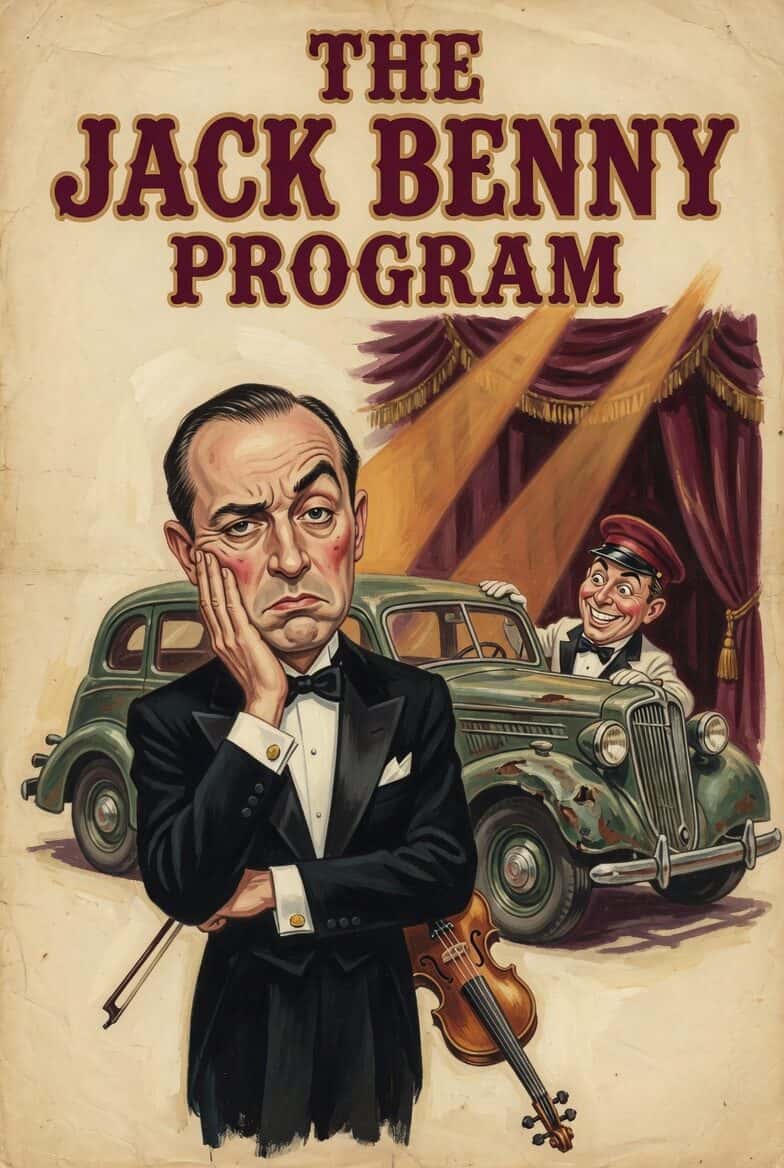
Many thanks to Malcolm LaPrade, co-author of Donna Mazo, who supplied us with the material you heard. And now, ladies and gentlemen, for a really big moment. May 9th marks the 10th year of regular appearances on the air for a comedian who is unique in the history of radio, Jack Bennett. As a matter of fact, Jack will be honored on this anniversary at a gala banquet this Friday night. I had the honor and pleasure of being the announcer on Jack's first commercially sponsored program. And our orchestra leader, Ernie Watson, was saxophonist in George Olsen's orchestra, which appeared with Jack on that show. That's why we think it's particularly fitting that Behind the Mic helped Jack celebrate his anniversary. Now, after a 15-second interval to make the switch, we take you to Hollywood, California, where Don Wilson will interview the one and only Jack Benny. Thank you, George Hicks, and good afternoon, ladies and gentlemen.
As George has already told you, Jack Benny will be honored on his 10th anniversary in radio at the Gala Banquet this coming Friday night, May 9th, at the Biltmore Bowl at the Biltmore Hotel here in Los Angeles. Gee, I'm nervous already. Since Jack is one of the very few radio stars who can point to such a record of achievement, it is only fitting that he should appear on today's broadcast of Behind the Mic. Both Jack and I have just left rehearsal for today's jello program, and while the cast continues across the hall, we've come over here to this little studio to take part in Behind the Mic for a few moments.
so that Jack can answer some questions about his career in radio, and I'll try to put myself in the role of a typical Jack Benny fan. First, Jack, here's a question that especially fits the occasion. Suppose we can go back ten years and have you tell us about your very first appearance on radio. What was it like, and was it a sponsored show or on the cuff like this one? Well, Stu, they're done. I went on the radio for the first time early in 1932 when Ed Sullivan, a Broadway columnist, invited me to make a guest appearance on his program in New York. Do you remember what you said? No. Oh, yes, yes, yes. I'll never forget it. Look what it got me into. Well, let's hear about it. All right, I'll give it to you. Now, just to illustrate how times change, particularly in radio...
It was a little monologue up there where I walked to the microphone and said, Ladies and gentlemen, this is Jack Benny talking. There will be a slight pause while you say, Who cares? Now, that was funny then, Don. It may not sound funny now, but they screamed at it then. Anyway, I went on. I said, I am here tonight as a scenario writer. There's quite a lot of money in writing scenarios for pictures. Well, there would be if I could sell one. Even that. Even left that then. Anyway, I'm going back to pictures in about ten weeks. I'm going to be in a new film with Greta Garbo. They sent me the story last week, and it's a very novel idea. When the picture opens, I'm found dead in the bathroom. I hear. Now, would you... They screamed at that, Don. Imagine ten years ago. Anyway, I was found dead in the bathroom. I say, it's a sort of a mystery show. I'm found in a bathtub on a Wednesday night. I should have been in Miss Garbo's last picture, but they gave the part to Robert Montgomery. You know, politics. The funny part of it is, I'm really younger than Montgomery. That is, I'm younger than Montgomery and Ward.
You'd really like Garbo. She and I were great friends in Hollywood. She used to let me drive her car around town. Of course, she paid me for it. Well, that was it, Don. That's what I said when I first went on the air. That was my first crack at radio. Well, Jack, if you don't mind my saying so, it sounds a bit like a boat bill routine. That's true, Don. Don't forget that radio was unknown to me then. I didn't know whether it was good material or not. I could judge only by stage standards, particularly vaudeville, where I had gained most of my experience. What was the reaction to your first broadcast, Jack? Nobody liked it but me. However, on the strength of it, I landed my first radio commercial just two weeks later. I don't blame you for saving the script as a souvenir. But tell me, Jack, when did Mary Livingston start her heckling career on the air with you? Oh, she's been in my hair since June of 1932. But she did all right by herself before that in Portable. When was that?
Well, about 12 years ago in New York. And it all happened because the girl who ordinarily worked with me became ill just before the show one night. Mary volunteered to substitute, and she's been working at it ever since. I think that our listeners would like to hear something about the other members of the cast. Jack, take Rochester, for instance. How long has he been with you? Well, Rochester started with the program back in 1937 when he won an audition over 50 other contenders for the role of a Pullman porter. Just a bit part that we had written in for one broadcast only. But it didn't work out that way. That's right. He was so good that we kept him on for another week, then another, until he finally became a regular member of the cast. Well, Jack, I'm often asked about the preparation of your program. How long does it take, on the average? Well, we never stop working. The schedule is something like this. After a Sunday night broadcast, I get together with Bill Morrow and Ed Boulogne, my writers, and we hand over different ideas for next week.
Then we meet early Monday morning and start working. That goes on throughout the week until our first rehearsal, generally held either Friday or Saturday, then rewriting Saturday night and Sunday morning for the actual broadcast. You know, Jack, when Mort Lewis asked me to interview you today, he made a specific request that I inquire about your fan mail. He'd like to know about some of the odd and unusual letters that you receive each week. Well, they are odd and unusual. Honest, Don, you should have my tinfoil troubles. Tinfoil troubles? Now, what does that mean? Well, you remember the program early this season when I talked about my collection of tinfoil? Yes. Well, ever since that time, Don, I've received letters by the hundreds containing bits of tinfoil to be added to my collection. Believe me, I must have gotten at least 30 pounds of it. And that doesn't count the letters asking me to give the tinfoil to various charities. Well, Jack, no interview with you would be complete without a few words about your classic feud with Fred Allen.
Now, did Alan make the first crack at you or vice versa? Well, naturally, Don. He started it. I wouldn't say anything nasty. Well, here's what happened, Don. A few years ago, when Alan had amateurs on his program, a little nine-year-old kid named Stuart Kennan played the B on his violin. And when he got through, Alan made a crack that Jack Benny couldn't do that. He ought to be ashamed of himself. Naturally, I was wounded. So I let my nails grow and clawed back. And as many times I've given him a good scratching, I have yet to strike blood. Anyway, Don, that's how it started. That has been going on ever since. Yes, sir. Well, Jack, we're just about through now. And as it's your anniversary, of course, you get the last word. All right, Don. I just want to thank Mort Lewis for the invitation to appear on today's broadcast for Behind the Mic. That goes for me, too, Jack. We now take you back to New York. Thank you, Jack Benny and Don Wilson. May you both have many more radio anniversaries.
Last week on Behind the Mic, you'll hear the story of how the National Broadcasting Company gets its foreign news by shortwave, as told by the head of NBC's listening post, Jules Van Item. We salute another program you love, and we bring you more of the comedy and the tragedy and the glamour that are behind the mic. This is George Hicks saying good afternoon.
Behind the Mic is composed, or rather written by Mort Lewis. The original music is composed and conducted by Ernie Watson. This is the Blue Network of the National Broadcasting Company.