
The written record
Read the transcript
Read along with the recording · About 35 min to read
Ladies and gentlemen, you are about to hear the United States Treasury Hour, Millions for Defense. The network time for this hour has been donated by the Texas Company to our government as a Texaco contribution to national defense. Millions for Defense. The United States Treasury presents an hour of entertainment starring Don Amici, Jack Benny, Claudette Colbert, Betty Davis, Jane Froman, Mary Livingston, Taron Powers, Master of Ceremonies, Barry Wood. Ray Block's choir and Al Goodman's orchestra. Scrape up the most you can. Here comes the freedom man asking you to buy a share of freedom today. And he stands today. We'll be blessed if we all invest in the USA. Here comes the freedom man. Can't make tomorrow's plan. Not unless you buy a share of freedom today.
Came the Czechs, and then came the Poles, and then the Norwegians with three million souls. Then came the Dutch, the Belgians, and France, then all of the Balkans with hardly a chance. It's all in the book, if only you look. It's there if you read the text. They fell, everyone, at the point of a gun. America mustn't be next. Hello, everybody. That was our theme song, Irving Berlin's Any Bonds Today. And this is your man about bonds, Barry Wood. Right now, it's my pleasure to introduce our master of ceremonies for the evening. Here he is, the favorite of millions, looking handsomer than he even does in technicolor, Jerome Tarr. Thank you. Thank you very much.
Barry, lay off that handsome stuff. You know, you're no Boris Karloff yourself. Well, in this company, I am. Say, by the way, Tyrone, how's it they let your magnificent fizz out of Hollywood? I thought you were working in a picture about the RAF. Oh, we just finished yanking the RAF, Barry. I've come east just long enough to see the shows and to do Lilium with Annabella at a summer theater. A summer theater? Say, I didn't know you were one for the legitimate stage. Why, and my father and his father, Barry. I played here in New York in 1936. with Catherine Cornell in Romeo and Juliet. Oh, sure, Romeo and Juliet. I saw that show. What did you play, Romeo? No, no, I played Benvolio. Uh, Benvolio. Oh, sure, Benvolio. I remember you very well, Cornell. Yeah, you should live so long. Well, it, uh, well, it was a long time ago. Oh, no hard feelings, Barry. It was a pretty small part, but I was mighty glad to get it. When the theater's in your blood, the important thing is to act, not to be a star.
Well, you're one actor who's managed to do both, Jerome. I've been lucky, Barry. But there are a lot of stars on our show tonight, and I'm taking up more than my share of the microphone. Let's get on with our program. Okay, that's a swell idea. Our first guest tonight, ladies and gentlemen, is that lovely singer of popular favorite, Miss Jane Froman, doing a number that is already a jazz classic, Cole Porter's Begin the Beguine. Miss Froman. Begin the beguine, the beguine. It brings back the sun. Music's so tender. It brings back a night of tropical splendor. It brings back a memory ever green. I'm with you once more under the stars and down by the shore. And even the pines, they'll be doing when they begin.
To live it once more is past all endeavor. And that tune clutches my heart. And there we are, unpromising never. Moments devoured, what rapture to clouds came along to disperse the joys we had tasted. And now when I hear people cursing, it was way and no but way.
Thank you, Jane Froman. They can begin to begin any time for my part, as long as you're singing it. And now, ladies and gentlemen, we are to have the pleasure of hearing a dramatic play starring Betty Davis. If Academy Awards, popular favor, and critical acclaim mean anything, Then surely Betty Davis comes as close as anybody to deserving the mythical title First Lady of the Screen. Tonight, this truly great dramatic actress appears in a story of a woman who learned the hard way what it means to be an American. And here is the author and producer of the playlet to introduce it, Arch Obler speaking from Hollywood. The scene, the federal court of the Southern District of New York. The judge was about to administer the oath of allegiance to a group of people who had passed their examinations for American citizenship.
I say the judge was about to administer the oath, but at the moment he's not speaking. He's staring with amazement at one of those before him, a girl. His mouth opens and closes wordlessly, and then at last he speaks. I... I beg your pardon. What did you say? I... I don't think I should be a citizen of the United States. But you came here. The reason was to... Young woman, do you realize what you're saying? I shouldn't be a citizen of the United States. All right. I heard you. What's the explanation? Well, I... Well? I only say what I have to say. Maybe in times like this, the government's got more important things to think about. But please, Your Honor, if it is all right with you, I'll tell you why I said what I said, and then I'll go away. I'm listening. My mother was an American.
And when she met my father, she went back to his country. And when I was born, my father's land became my land. My mother would sometimes talk to me of America when I was small. America was this wonderful thing. America was that wonderful thing. But it was just talk to me. I was happy where I was. It was a good land, so warm and bright, so much news. Everyone laughing so happily. The man you passed working in the field. The worker in the street. And the children. A country full of laughter. It was good to live there. And then, almost in a day, there was no more laughter. There was only... No, why should I...
faith, you know. A voice telling us our only happiness could come not through our work and our dreams and our love, but through him. Not through what we believed in our minds and our hearts, but through him. And there was no more laughter. Tears. A land of tears. The tears in a night that grew darker and darker until the darkest day when they took my father away. His crimes, all that day they have been cursed for shooting people. That night my father stood up in his church in his head. Let not kindness and truth forsake thee. Bind them about thy neck. Raise them upon the table of thy heart. So shalt thou find grace and good favor in the sight To God and man. Kindness and truth. But those were forbidden words from a forbidden book in the land of my father. So they took him away. And then there was no place for me in the land of my father. So I came here, my mother's land. All the way across, I'm afraid. At night when the water's so dark you can't even see the stars. I think there's nothing behind me.
And maybe there's nothing ahead of me. I think maybe there's no more world but the dark world of tears and inhumanity. And then at last I am here. I hear laughter. Just the moment I am off the boat, I hear laughter. Good laughter. Strong laughter. A people that still knew how to laugh. A country where each man could walk in kindness and in justice and in truth. This is what I had wanted. This is what I must have always, always. Citizen of the United States? Yes, I say to myself, I must be part of it. No, Judge, Your Honor. I tell you, I can be no part of it. And if you will listen just another moment, I will tell you why. I went from the city to the country. A farm, it had been my mother's farm. At first it was good. Everything was good.
The soil was poor. It didn't matter. One could laugh. The weeds grew faster than the wheat. It didn't matter. One could laugh. Hard work? What did hard work matter in a land where there could be kindness and truth and justice? But a year went by. Two, three, four, five. Hard the work. If I could only have money, be it... What is the word everyone uses? Successful. I made friends. One day, one of them came to me from the city. He said, can I remember his words? I know a way you can make some money, Anna. Money? Yes, yes, all right. A summer camp for some patriots. A camp for patriots. Oh, yes, a place for them to stay during the summer on my farm. Five hundred dollars for the season, Anna. They'll pay you five hundred dollars.
Five hundred dollars. Good, good. So they came to my farm and made their camp. Men and women. Yes, and children. Camp America! Yes, Camp America. Oh, I was so proud. And five hundred dollars. No one there denies the right to speak. Democracy is foolishness. Democracy is abhorrence. Beats. They began to make beats. Democracy is an illusion. It spits on freedom. The masses are cattle and meat. Oh, no, they shouldn't pay them, no. Oh, I said nothing. And they kept on speaking. I said to myself, what has it to do with me? Not important, just a business deal. Mind my own business. Collect the money. Mind my own business. Soon I would be a citizen of the United States. That's all that meant anything to me. These people meant nothing to me. I took their money. All right. That was the American way. Take the money and be a success. With money, one was a success. Everyone in America said so. The summer went by.
They gave me their money and went away. They went away, and all the people that used to come and listen to them, the way others used to listen in my father's land. I told myself, oh, well, it was over. It didn't matter. I had the money. Now, all I had to think about was my studying to become a citizen of the United States. The book. Study the book. The Declaration of Independence. Beautiful words. The Constitution, beautiful words. All I had to do was learn the words and I would be a citizen. Yes, and the history of America. I would read it all and find out how all this had happened. This bright world of motor cars and laughing people and success. I found out. And so now I say it again. I don't think I should be a citizen of the United States. Because as I studied, Judge, Your Honor, I found out I had done a terrible thing. I let people on my land come there to speak against the United States of America. It didn't matter that they called themselves Camp America, for the things they said were not American. And every word they said, I had said, yes, because I had taken their money. And to take money for what is wrong is a terrible thing to do.
anywhere in the world, but most of all in the democracy. I know this now because I have studied and learned of America, Mr. Lincoln and Mr. Jefferson and Mr. Washington, and I know that what made this America was not success and money, but the want in the heart of a few men for the thing my father had died for. Let not kindness and truth and justice forsake thee. Bind them about thy neck. Write them upon the table of thy heart. So shalt thou find grace and good favor in the sight of God and me. And I know now that no one can be made a citizen or even be born a citizen. No one just is an American. He has to become an American. And it is what he thinks and does for America that makes him a citizen. Yes, the things that he does day by day, even for himself, have to be right, have to be with kindness and truth and justice, and above all, with honor. For it is not the Constitution written on paper that holds America together. It is the honor that each citizen has in his heart because he knows that in all things he has done what is right for all the people of America. All right. Wait, Anna Holmes. Wait. Wait. We've got a great deal to talk about, you and I. But first, I'll fill out this form. Anna Holmes, citizen of the United States of America.
Thank you, Betty Davis. Now, ladies and gentlemen, we bring you another of the Treasury Hour's musical productions, The Song of America, which is based on the music of the many and diverse nationalities who have made this great nation strong. Tonight, The Song of America dramatizes the music of the Irish-Americans, written by D.N. Johnson. It is sung and played for you by Jane Froman, Barry Wood, Harrison Knox, Ray Block's choir, and Al Goodman's orchestra.
The song of America is not a single melody or a single strain. It is blended of the folk music of many peoples. It rises in the united voices of those who come from all other lands to the land of the free. Just ask an Irishman like myself about the Irish in America, and you'll get a list of names as long and grand as the St. Patrick's Day parade. Curran had said that the first of Columbus's sailors to set foot on the New World was an Irishman from Galway. And only a year after the Pilgrims, there was an Irish colony at Newport News. And you'll find Irish names all through our history. John Lewis from Donegal led the first settlers into the Shenandoah Valley. An Irish trader by the name of Dorothy was the first white man in Kentucky. And there was another Irishman, James McBride, who told Daniel Boone of the territory to the west. And if you'll go over the recruiting roles of George Washington's armies, you'll find that one out of three of his soldiers had Irish names. Yes, this is a great land for the Irish. You'll even hear them in our songs if you listen. Ah, yes, I could call off hundreds of Irish words that work magic in carving this land from the wilderness. All the Irish Americans who pushed our railroads across the plains and strung our first telegraph wires to the Pacific and put up our great buildings.
A host of two-fisted men. And you mustn't forget the women. The gentle Irish mothers who raised their children to enjoy and cherish the rights of freedom in this land so far from the old sod. I love the dear silver that shines in your hair. And the brow that solves the road. And wrinkles I kiss. It's like that with the Irish. With all an Irishman's humor and quick wit, there's often a strain of sadness down deep in the soul of him, like the shadow of a cloud on the green of an Irish hill. Still, he's always ready for a laugh, as in this rollicking song by the Irish-American George M. Coan. Yes, whatever our origin, we love the Irish lilt of those songs. The hidden beauty that's like the love of the Emerald Isle every Irishman keeps in his heart. But though an Irishman still looks upon Ireland as one of the fairest spots under heaven, the Irish have fought and died for America in all our wars.
And nestled on the ocean. And when the angels found it. It looked so sweet and fair. So cool there. Wrinkled it with stardust. Make the shamrock through. Is the only place you'll find there. Then they dotted it with silver. To make its lake so grand. And when they had infinite.
Yes, an Irishman always carries in his heart a dream of the land of the shamrock. But names and words can't tell you half the story of the Irish-American contribution to this country. Irishmen have come here for the sake of the freedom which America possesses and will forever fight to defend. But the song of the old star does never cease to echo in their hearts. They have made the song of America their song. Here's music that tells it much better than I can. From the pen of the immortal Irish-American Victor Herbert, Thine Alone. Ladies and gentlemen, you have heard in the song of America the music of only one of the countless national groups who have made this country great. The people of every one of these countries, in a sense, invested in this country. They invested their hopes and their toil. Sometimes they invested their lives. As a dividend, America received the freedom that you and I enjoy. Now to maintain that freedom, America is asking us to invest again. Not hopes or toil, something much simpler. A source and a secure and profitable investment in defense savings stamps and bonds. An investment of money to keep the freedom That all these peoples have worked and died to win. Let's keep America the kind of country we want our children to enjoy. Let's keep it free forever from dictatorship and invasion. Let's make it so strong that no one can take away our freedom. Every penny you can invest is needed. Now. Tomorrow, invest as much as you can in defense bonds or stamps. And make America safe while you save.
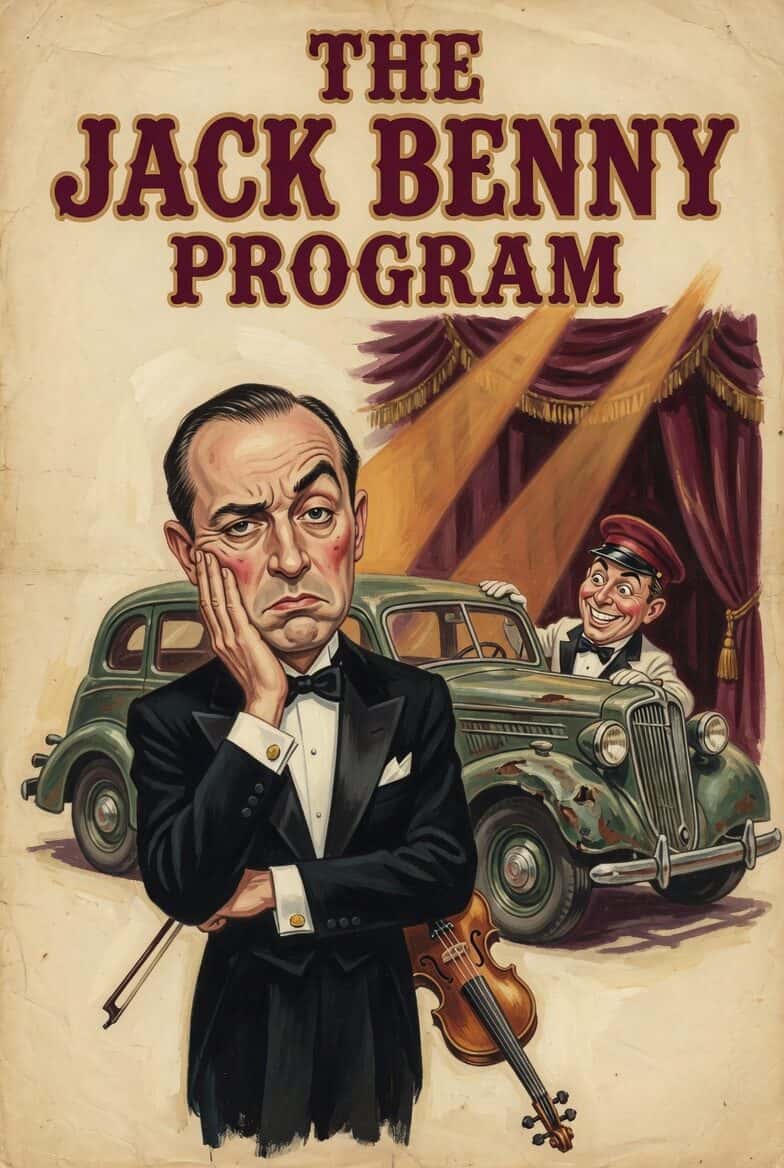
The Treasury Hour, millions forty-fence, will continue immediately after a short pause for your station identification. This is the Columbia Broadcasting System. KNX, Columbia Square, Los Angeles. And now, ladies and gentlemen, out in Hollywood, Jack Benny, Don Amici, Claudette Colbert, and Mary Livingston are now grouped around the microphone. As to what will happen, your guess is as good as mine. Take it away, Don Amici, in Hollywood. Thank you, Ty Power. Good evening, ladies and gentlemen. This is Don Amici, your master of ceremonies from Hollywood. Thank you, thank you very much. And now, first of all, it is my pleasant duty and distinct honor to present a man whom you all know and love. Well... A man who, for many years, has brought joy and happiness into millions of American homes. Oh, Don, can I help it? A man who is always ready to give his services when duty calls. I'm never too busy to say hello.
And the man who thoroughly believes everything I've just said, Jack Benny. Thank you. Jalaw again, this is Jack Benny talking. And Mr. Amici, I gather from your introduction that you think I'm a bit hammy, but that's not the case at all. I'm as modest as a fan dancer in long underwear. I really am. Oh, Jack, I was only kidding. The reason I gave you such a nice introduction is because I'm sure everybody appreciates you coming up here tonight. Oh, I was glad to do it, Don, although I... Don't quite understand why the Treasury Department was so insistent that I appear on this program for defense bonds. Well, Jack, I guess they figured if you'd loosen up and buy a bond, everybody in the country would. Now, wait a minute, Don. I'm very happy to buy these bonds. That's the least I can do for national defense. After all, I can't join the Army. You know, they've exempted men over 28. Yeah, that's right. You are over 28. Over 28?
Don, I'll never see 34 again. No kidding. Oh, now, hold on, Jack. You don't mean to say that you're only 35 years old. I didn't say I was 35. I merely said I'll never see 34 again. I could be 36 or 37. See what I mean? I'm way ahead of you. Wait a minute, Don. Don't let my one gray hair fool you. What makes you think I'm so old anyway? I've got just as much pep as you have any time. I don't know about that, Jack. I walked into Ciro's at 1 o'clock this morning, and you were sound asleep at a table. Well, that was the waiter's fault. I left a call for midnight. I always take a nap after dinner. Anyway, Don, I don't see why you should be ribbing me tonight. After all, I did break up my vacation to appear on this program. Yes, I know that, Jack, and I've already told you how much we all appreciate it. You know, I don't get a chance to go to the islands every summer. It's a long ocean trip, and then to have to dash right back. Well, it certainly was nice of you to make such a sacrifice. You said it.
Of course, it's for a good cause, but gee, I sure miss riding the surf all day, and then at night when those girls would dance the hula and eat the tropical moon. Oh, boy. Well, that's tough luck, Jack, but maybe you'll be able to go back there again sometime. Yes, I guess so, but I sure hated to leave. Gosh, when the band played Aloha and the natives sang, I cried like a baby. Gee. Oh, hello, Mary. Hello, Jack. When did you get back from Catalina? Oh, fine.
Mary, what are you doing here, anyway? Well, I heard you were going to broadcast tonight, so I thought I'd come up and get in your new hair. Now, look, Mary, I don't want any cracks tonight, because I've got a personal letter from Secretary of the Treasury, Henry Morgenthau, inviting me to appear on this program. Oh. And for your information, young lady, he also asked me for my autograph. Why not? You've got a mattress full of his. It shouldn't have fluffed over that line, huh? Don't keep it in my mattress anymore. And besides, it's a fine thing to say after that beautiful bracelet and earrings I gave you for your birthday.
How come you're not wearing them? I gave them to the aluminum drive. Well, believe me, we'll have the only bomber with a star sapphire. There's Don. Aren't you going to say hello to him? Oh, yes. Hello, Don. Hello, Mary. Gee, you've lost a lot of weight. That's Don Amiti, not Wilson. Wilson could lose Amiti and still be fat. The only similarity is that they both laugh at anything. Listen to him, will you? Don laughs a little louder, though Wilson does, I think. Gee whiz, is that Don Amici, the movie star? Well, Mary, I'm in pictures. I don't know whether you'd call me a star or not. Now, Don, don't be so modest. You're just as much of a star as I am. See, I didn't expect a laugh on that one. It's later. After all, we both have stars on our dressing room doors. Yes, but mine hasn't got a crescent moon under it.
Oh, well, that's the sign I was born under. And let's change the subject, huh? Say, Mary, did I hear you say that Jack was in Catalina? Yes, he was there on his vacation. Mary, will you please... Why, Jack Benny, you just got through telling me that you were in Honolulu. What are you talking about? I never even mentioned Honolulu. Oh, no? What was that you said about hating to leave the hula girls dancing in the moonlight? They've got hula girls in Catalina. Human, snappy Hawaiians. They wiggle like anything. I didn't say a word about Honolulu. Oh, yes, you did. You said when the boat sailed away, the band played Aloha, and they only do that in Honolulu. Listen, Don, they do the same things in Catalina they do in Hawaii. Why, even the kids dive in the water when we throw coins off the boat. When who throws coins off the boat? Everybody. I joined in, too. Now, let's get this straight. Were you throwing or diving? I was throwing. I was throwing nickels and dimes. Go on. You wouldn't throw away a banana peel if Fred Allen was walking behind you.
Oh, I wouldn't, eh? Jack, I can't understand why you're such a four-flusher. You spend a vacation in Catalina and try to make everybody think you were in Honolulu. Oh. Jack's always that way. The other night he called me from a Chinese restaurant on Vine Street and told me he was in Shanghai. Listen, Miss Livingston. While I was in that Chinese restaurant, I opened a fortune cookie and there was a little piece of paper in it that said, a certain comedian, whose first name is Mary, may soon be leaning on that hosiery counter again and not buying.
So if you believe in that stuff, watch out. I can't understand why everybody misconstrues everything I say, and especially on this broadcast, after I break up my vacation and take a long ocean voyage to get back. Long ocean voyage? You heard me. You call that an ocean voyage? Now, wait a minute, you two. What do you think that stuff is between Catalina and Wilmington? Spit? I was as sick as a dog. Anyway, what's the difference if I was in Catalina or Honolulu? Oh, I guess you're right, Jack. Catalina's a wonderful place to spend a vacation. You said it, and the bathing there is swell. I tell you, Don, I was a regular beachcomber. I was out on that sand morning, noon, and night. Anything to keep from renting a room. Larry, will you please go away? Now, Don, let's get on with the show. After all, that's what we're here for. Well, Jack, I'm waiting for Claudette Colbert. You know, she and I are going to do a play together. Oh, you and Claudette. Well, what do I do in it? Nothing. You just introduce us. Oh, you mean I introduce you and Claudette, and then I can go home. Is that it?
No, you don't have to go home. You can go to a movie or back to Catalina. Well, Don, are you sure there hasn't been some mistake? Although I thought I was supposed to do a play with Claudette. After all, I'm a little on the romantic side myself, you know. Yeah, I know, Jack, but you're more of a radio personality while Claudette and I are associated with motion pictures. But I'm in pictures too, Don. If you want to know something, I just finished playing the title part of Charlie's Aunt. Well, for heaven's sakes, were you that cute little lady I used to see walking into the commissary every day? Yes, you masher. You winked and don't deny it. Even you hooed at me. Remember? Well, your slip was showing, you little vixen. Anyway, Jack, you certainly fooled me. He fooled everybody. You know, Don, I saw the sneak preview of Charlie's aunt, and Jack was the cutest woman you ever saw in your life. With those curls and long eyelashes, she was a doll.
Well, I was convincing. Honest, Don, he's much better looking as a woman than he is a man. Yes, sir. Well, I'm glad it turned out so well. By the way, Jack, what's your next picture? Rebecca of Sunnybrook Farms. It is not. I'm going to be a skywriter. Now, go away. Don, getting back to our little... I got to tell the listening audience about that skywriter joke sometimes on our own program. Don, getting back to our little problem here, don't you think it would be better if you'd let me work with Claudette? You ought to go home and rest. After all, you're starting on your own program tomorrow. Oh, that's all right, Jack. Being with you tonight is good training for me. Oh, good training. Well, thanks, Don. That's quite a compliment. What program are you going to be with, Don? Craft cheese. Well, I hope you get sunburned from Crosby's shirt. Anyway, Don, I wish you a lot of luck, and if you're ever in the market for a guest star who's a comedian and a violinist as well...
Just give me a buzz. You know how to reach me, don't you? I should. I invented the telephone. And you made more than Alexander Graham Bell on the deal. Anyway, Don, I'm at the St. Catherine Hotel in Catalina, and if you can't reach me there... Throw a dime in the water. Mary, I wasn't kidding about that fortune cookie. Now go and sit down. Hello, everybody. I'm sorry I'm late. Oh, Miss Colbert. Hello, Colbert. Thank you. You should have been here sooner, Claudette. We were just kidding about Jack playing the part of Charlie's aunt. Oh, yes. I saw his picture on the cover of a magazine. Oh, really? Which one? Vogue. Oh. All right, so I wore a woman's clothes. What could I do? It was my part. I'm an actor. I had to cooperate. Go on. They had all they could do to keep you from wearing a sweater. Is that so? Oh, by the way, Miss Colbert, this is Mary Livingston. Hello, Mary. I know exactly what that dress cost.
Mary, please. Oh, that's all right, Jack. You can probably even tell me the wholesale price. That's very good. Now, Mary, will you go away? I have something very important I want to talk to Miss Colbert about. Okay, okay. Don, do you mind? No, not at all. Come on, Mary, let's leave so Claudette can be alone. She's not alone. I'm with her. So long, Jack. So long. Well, Miss Colbert, here we are. Here we are alone. Yes. They both left. Didn't they? Yes, they did. And here we are. You and I. Just the two of us. Get to the point, Pappy. Well, what I'm trying to say is I'm awfully glad you're here tonight because it gives us a chance to be together and really get acquainted. You know, I've always been a great admirer of yours. Oh, well, thanks, Jack. You don't mind my calling you Jack, do you? No, no, I'm thrilled to death. I called you Jack because, well, I feel I almost know you. You do? Mm-hmm.
I've heard Fred Allen speak of you so often. Oh, you have? Well, Claudette, Allen has said a lot of mean things about me, but please don't believe them. Oh, now, wait a minute, Jack. I hate to take sides, but, you know, I listen to your program nearly every Sunday, and I've heard you say some pretty awful things. About Allen? No, just some pretty awful things. Well, it's nice to know you listen, anyway. By the way, Claudette, I have a question to ask you. I... No, this is hardly the time or the place to bring it up, but it's been bothering me. What is it, Jack? Now, come on, get it off your mind. Well, frankly, you and I have been here in Hollywood so many years, and yet I've never appeared as your leading man in a picture. That is, I've never had the opportunity to do a love scene with you. I mean, why is that? Well, Jack, in the first place, you're a comedian. You're a funny man. Not when I'm necking.
Claudette, what I can't understand is this. I mean, why can't I be a leading man on the screen, a lover? Now, in your latest picture, Skylark, you have Ray Milan playing opposite you. I mean, why didn't I get that part? Well, for one thing, he doesn't fall asleep at zero. My goodness, did everybody see me? Now, look, Claudette, what I'm driving at is this. What is it that prevents me from being another Robert Taylor or a Clark Gable? I mean, what is it? Oh, well, Jack, I... I could tell you what I think might be the reason, but I hate to say it in front of all these people. Oh, come on, Claudette. I can take it. Really. Are you sure you won't be offended? No, I promise you. Go ahead. Well, all right, then. Here goes. Now, Jack, you see, I think you're very clever and you're very talented, but you lack the most essential thing that's necessary for the stream. I do? What is it? Sex appeal. Yikes!
Well, I think you must be mistaken, Claudette. I'm very romantic. At least I wasn't Catalina. I was thrown out of the casino five times for dancing too close. Yes, sir. Well, back up, brother. There's no music here. I'm not kidding. Really, Claudette, if I was ever your leading man, you'd never want anybody else. Now, Jack, you misunderstand me. I never said I didn't want you in a picture with me. You didn't? No. In fact, your name was never suggested. Oh, then you mean if my name were suggested, I'd have a chance. I didn't say that. Oh, then you mean if my name were suggested, I might have a chance. I didn't say that either. Oh, then what you mean is if my name were suggested, I wouldn't have a chance. Now, do you want to try for the $32 question? No, but I'm serious, Claudette. Don't you think if I was given the opportunity on the screen, I could be as romantic as Robert Taylor or Clark Gable?
Don't you? Oh, Jack, let me try to explain something to you. Now, suppose you weren't Jack Benny. Suppose you were Robert Taylor or Clark Gable. If you were Gable, do you think I could stand here so coldly, so calmly, just talking to you? Well... Well, listen, if you were Gable, I couldn't stay away from you. I'd want to get closer to you like this, see? And caress your cheek like this. Why, I'd even want to kiss you like this. You see? I didn't feel a thing. That's funny. I'm a rat. I, um, I see what you're driving at, Claudette. But when you mention Gable, don't forget you only see him on the screen when he's acting, giving a performance. I tell you, Claudette, it's all atmosphere, environment. I can prove it to you. How? Now look, I want you to close your eyes and forget I'm Jack Benny. Close your eyes and think of me as Gable. Now remember, I'm not Jack Benny. I'm Gable. Gable.
Clark Gable? No, Max Gable. Who do you think I'm talking about? Now, Claudette, we'll play a love scene together. A real emotional love scene. And I'll show you that my kiss and Gable, it's the same thing. Are you ready? I'm ready. All right, now close your eyes and we'll start. A little soft music, please. Claudette. Oh, Claudette. Oh, Clark, it's really you. And I thought you were leaving without saying goodbye. Oh, my poor darling. I should have told you sooner. But I'll be back. I'll be back even though thousands of miles will separate us. Oh, cruel fate. To meet and part with nothing left to cherish but the ecstasy of love's first kiss. Love's first kiss. Kiss me, my sweet. My darling. Kiss me. To think that we may never meet again. Kiss me. To think that life could treat me thus. Kiss me. That you and I may part forever.
Kiss me. Kiss me for heaven's sake. Kiss me. Dad, wake up. Help, she's fainted. Hey, fellas, carry Miss Colbert off, will you please? No sex appeal, eh? So long, folks. See you in October. Thank you very much, Jack Benny, Don Amici, Claudette Colbert, and Mary Livingston. And thanks also to Hal Block and Bill Morrow. It's cried. Now, ladies and gentlemen, I should like to read for you, if I may. a poem written especially for the Treasury Hour by Herman Wolk to commemorate the landing of the United States Marine Corps in Iceland on the 8th of July. It's called The Ballad of the Leatherneck Corps. Each branch of America's fighting forces has its peculiar glory. Our army has never lost a war. Our Navy, second to none on Earth, has kept foreign invaders from our shores for more than 125 years. And with the Navy goes the Marine Corps.
Uncle Sam's troubleshooter, tackling jobs anywhere and everywhere on the face of the world. On July 8, 1941, President Franklin D. Roosevelt sent a special message to the United States Congress containing these words. Forces of the United States Navy have today arrived in Iceland in order to ensure the adequate defense of that country. Immediately upon the termination of the present international emergency, all American forces will at once be withdrawn. leaving the people of Iceland and their government in full and sovereign control of their own country. The Ballad of the Leatherneck Corps is dedicated to the American Marines, who, backed by the might of the United States Navy, are now standing guard in Iceland, outpost of our national defense.
Oh, the wind blows cold in Iceland, but the wind's blown cold before. And it's not so hard in your own backyard to be set for peace or war. But to strike a blow at a distant foe is a job for the Leatherneck Corps. Where are you heading, Leatherneck? I'm off to Tripoli, son. It's someplace in Africa. I don't know where, but an ornery pirate gang is there. And we're under orders to sweep at bear of each pirate's son of a gun. So off they went. It was 18-5. And they piled in there with a mighty drive till hardly a pirate was left alive. And Jefferson said, well done. Now, the shore is strange in Iceland. But the shore has been strange before. And the folks at home don't have to roam to be set for peace or war. But to challenge fear when it's far from here is a job for the Leatherneck Corps.
Where are you heading, Leatherneck? I'm off to Sumatra, son. The natives there are a savage lot. Our ships have been sunk and our sailors shot. And that place which they tell me is burning hot will be hotter before we're done. So off they went back in 32, and vengeance was had for each murdered crew. And over the isle, old glory flew. And Jackson said, well done. Well, the sea is rough off Iceland. But the sea has been rough before. There are no rough seas where you sit at ease all set for peace or war. But to face a fray half a world away is a job for the Leatherneck Corps. Where are you heading, Leatherneck? I'm off to China, son. A bunch called boxers are raising hob. They're killing Christians, this crazy mob. So the U.S. Marines have got a job, and this one looks like fun. So in 1900 they sailed away and fought the boxers in Old Cathay.
Bagotas crashed and they won the day. And McKinley wired, well done. The gale roars high in Iceland, but the gales roared high before. And it's cozy here by the hearthside cheer to be set for peace or war. But to make a stand in a far-off land is a job for the Leatherneck Corps. Where are you heading, Leatherneck? I'm off to Iceland, son. There's trouble brewing across the map, and it may or may not be our scrap. But we ain't gonna wait till it's in our lap. We'll head it off on the run. So off they march at a soldier's pace, and we pray that they have no fight to face. But they've gone there anyway, just in case. And America says, well done. Oh, the night may be long in Iceland, but the night's been long before. And it's not so hard in your own backyard to be set for peace.
or war. But to beat the worst by arriving first is a job for the Leatherneck Corps.
The network time for the Treasury Hour, Millions for Defense, has been donated by the Texas Company and is a Texaco contribution to national defense. Next week at this time, the sixth Treasury Hour, Millions for Defense, starring Fanny Bryce, Deanna Durbin, Miriam Hopkins, Bob, believe it or not, Ripley, John Charles Thomas, Barry Wood, Ray Block's choir, and Al Goodman's orchestra. Treasury Hour, Millions for Defense has been prepared by a committee headed by Holla Dietz and directed by Earl McGill. This is Larry Elliott saying good night. This is the Columbia Broadcasting System. KNX, Los Angeles, the voice of Hollywood.