
The written record
Read the transcript
Read along with the recording · About 42 min to read
We take you now to Grauman's Chinese Theater. Good evening, everyone. We're speaking to you from the forecourt of Grauman's Chinese Theater in Hollywood, the film capital of the world. Tonight, the motion picture industry has on its best Bib and Tucker for its Academy Award. In years past, this has been the signal for the notables of Movieland to gather around the festive board, but tonight the routine has been radically changed. Everyone dined at home using their own ration points and are now gathering here at the Chinese Theater for the big news. Who and what wins the 1943 Oscars of the Academy of Motion Picture Arts and Sciences? Later this evening at 10.15, Warner Brothers KFWB will bring you a broadcast direct from the stage of the Chinese Theater, which will feature the presentations of the major awards. While everything in Hollywood is usually termed super, tonight we can truthfully call this a super premiere. No one motion picture studio is putting on the show. It is the industry.
or more correctly, the Academy of Motion Picture Arts and Sciences, is putting on this show. That means it includes the entire industry. For days now, not a seat has been available for this occasion, which of course means that the nation's screen favorites will be on hand. All of the industry's producers, directors, musical directors, everyone who has helped to make motion picture history are on hand tonight. And here now to act as your master of ceremonies is a man who knows show business backwards and forwards. Ladies and gentlemen, Georgie Jessel. Thank you and good evening, ladies and gentlemen. It's the idea of KFWB for me to stand here and sort of give you an idea of what this is about. And this is the biggest semis I ever saw. Let me give you a little idea of the Academy and what it does. On the night of May 11th, 1927, in one of the banquet rooms of the Roosevelt Hotel in Los Angeles, the late and lamented Douglas Fairbanks, Sr. was addressing distinguished representatives of the motion figure industry.
And our purpose is positive, not negative, he said. We are formed to do, not undo, he concluded. The applause that followed acclaimed the founding of the Academy of Motion Picture Arts and Sciences. The first award was made on the industry's 1927-28 product. It might be interesting to refresh our memory and delve into a little bit of history. The awards that were made that year for outstanding productions were Paramount's production Wings and Fox's Sunrise headed the list. The Academy's first awards for performances went to Janet Gaynor for her work in Seventh Heaven, and to Emil Jannings for his work in The Way of Old Flesh. This was an important year in motion picture history. It marked the first year of the Academy, and it also marked the startling innovation in films, talking pictures. In the first award year of the Academy, Warner Brothers were given recognition for marking an epic in motion picture history by producing The Jazz Singer, the first feature-length talking picture.
If our memory serves us correctly, and it does, because it broke my heart. Anyway, Al Jolson sang six songs in this picture, which was given its first showing in New York in October in 1927. It should be noted to save arguments that the jazz singer was not completely a talking picture. There were silent sequences with written titles. The Academy, with its various departments, played an important part in furthering developments with the coming of color photography, improved sound, cartoon films, and all that make up today's best entertainment each year ladies and gentlemen awards are made by the academy for the outstanding achievements in all the various branches of the industry these awards include not only recognition for actors and actresses and pictures but recognition for writing direction art camera work editing musical scoring special effects and all the other things that go toward making a good picture each year the number of classifications eligible for awards has grown In the first year, the Academy listed ten fields in which awards would be made. Tonight, 26 regular awards will be made. Last year, the MGM picture Mrs. Miniver was placed on top of the list as the best production, with Greer Garson getting all sorts of kudos and superlatives thrown at her for her work in that production. James Cagney was given the not-as-a-year's-best act of his performance in Warner Brothers' Yankee Doodle Dandy.
Van Heflin was named the Best Supporting Actor of 1941 and 2 for his work in MGM's Johnny Eager, while Teresa Wright drew the plaudits as Best Supporting Actress for her performance in Mrs. Miniver. At 10.15 tonight, KFWB will present to you a broadcast of the presentation of the major awards direct from the stage here at Grauman's Chinese. I understand that this 10.15 time we have through courtesy of Eastside Beer. I have no association with this beer. But if they're listening in, I'm sure they'll be very happy to send me something. 702 Maple Drive. I interrupt the broadcast for a moment to say that one of the great producers of Motion Picture Them, Jack L. Warner, has just come in. He tells me I'm coming through good. I get sent to him. I'd like to have you meet him for a moment. This is J.L. Warner, the big chief of Warner Brothers Productions. Make up your mind, Jake. Say something, Jake. Hello, George. Well, I'm glad to be here, and I know everybody else is, and let's hope that you win.
Next year. Whatever, I may be in Newark. Thank you, Jack. Now, from among the following will come the outstanding pictures of the year. These are from the various companies. Paramount is eligible to win the prize for whom the bell tolls. 20th Century Fox has a bundle of them. Heaven Can Wait, The Oxbow Incident, The Song of Bernadette, if you please. Warner Brothers has Casablanca and Watch on the Rhine. Columbia has The More the Merrier. United Artists has In Which We Serve and Two Cities. MGM has Madame Curie and The Human Comedy. Actresses nominated are eligible to win the Oscar for having given the year's best performance, including Miss Jean Arthur in Columbia's More the Merrier, Miss Ingrid Bergman in Paramount's Whom the Bells Toll, Joan Fontaine in Waters' The Constant Nymph, Greer Garston in Metro's Madame Curie, and Jennifer Jones in 20th Century Fox's The Song of Bernadette. As for nominations for the outstanding performances by actors, the list includes Humphrey Bogart in Warner's Casablanca, Gary Cooper and Paramount's For Whom the Bell Tolls, Paul Lucas and Warner's Watch on the Rhine, Walter Pigeon and MGM's Madame Curie, Mickey Rooney and Metro's The Human Comedy. Now, of course, the public is always interested in music, so naturally they are interested in which song will be selected as the top motion picture tune of the year. Ten songs have been nominated, and one will be named as the best tonight.
The list include A Change of Heart, written by Jules Stein and Harold Adamson and Fischer and Republic's hit parade of 1943. The Johnny Mercer Harold Arlen hit Black Magic from Paramount's Star-Spangled Rhythm. The title melody from Walt Disney's Saludos Amigos, written by Charles Wolcott and Ned Washington. The Harold Arlen hip-hop composition Happiness is a Thing Called Joe from Metro's Cabin in the Sky. Say a Prayer for the Boys Over There, written by Jimmy McHugh and Herb Magusin for Universal's Hearst to Hold. And from RKO's The Sky's the Limit, the Harold Allen, John and Marissa song, My Shining Hour. Then comes They're Either Too Young or Too Old by Arthur Schwartz and Frank Lesser from Warner Brothers' picture Thank You, Lucky Stars. From United House Stage Door Canteen, we have We Must Say Goodbye by Jimmy Monaco and Al Dubin. You'll Never Know, written by Harry Warden and Matt Gordon from the 20th Century production Hello, Frisco, Hello. From the Columbia picture Something to Shout About, the Cole Porter composition You'd Be So Nice took a home to.
It's quite a list of tunes, and before the evening is over, one of them will have an Oscar hung on its title. And now, speaking of music, we have the Warner Brothers Orchestra standing by in the studio. Let's call on Leo Leonati to give us a medley of the best songs of the last three years. White Christmas, 1942, The Last Time I Saw Paris, 1941, and When You Wish Upon a Star, the selection of 1940. We take it to the studio, and I'll be right back with a smash and a flash and a chance to take it.
This is Georgie Jessel again, talking to you from Grumman's Chinese Theater, where we have the Academy Award great showing tonight. Some of the stars are coming in. I see through the door the very great character actor, Mr. Charles Coburn. Mr. Coburn is just having his picture taken. Can we get him here? Say, I wonder if you can get Charlie Coburn to say a word for us. He's on the other side of the fence there. Is he? Oh, he's gone in the theater, has he? Mr. Coburn, of course, played in the more the merrier as one of the great character actors of the country. Stars are coming in on all sides now. And it's wonderful to see people who, even though they're working in the same studios, never meet until they come to a function just like this. You know, there are certain cliques in the motion picture business. Some people never meet each other until there's a big shindig of some kind given. I know I've been invited to Holmes lately that I've never been before, and I've been out here on and off for any number of years. There are a great many stars coming in on all sides. It's almost impossible for me, from my little booth here, to find them all.
I see. Get Charlie. Charlie. Hold on a minute. Charlie. I'll get Charlie Coburn to come here. Charlie. No, no. No? He's gone in. He's too nervous. Well, he's in a picture that might... Here comes the very, very famous fine character actor, Mr. Donald Crisp. Donald is coming in. I remember seeing him in pictures. Oh, my goodness. Well, there's Leo Forbes, the very famous musical director of Warner Brothers. Stars are coming from all sides. And here's Charlie now. Come on. Charles Corbin, ladies and gentlemen. Say a couple of words on the radio, Charlie. Good evening, ladies and gentlemen. That's a couple of words. Thank you. Well, he doesn't have to say any more because his performance is on the screen. Do the rest. Let me see here. That's Geraldine Jessel, my daughter. No, no, no. That's May Dame Whitty. I made a mistake. But the stars are coming in on all sides. Let me see who's coming in right now. Well, well, as I live, here comes lovely Linda Donnell, the 20th century Fox star. My goodness, she's a pretty girl.
Linda's with a hubby, an oddity at times, out here. Here comes the very famous actor and star of Watch on the Rhine, Mr. Paul Lucas. Mr. Paul Lucas, as you heard me tell you before, has quite a chance of winning the best performance of the year tonight. I'd like to bet that he won't come in third and might be second, he might win it. Let's see who we have on the other side. Here comes Mr. Gene Herschel, who is so beloved by everybody.
We're going to have Waldo Wenger, the president of the Academy of Arts and Sciences, with us in a moment to tell you something about his functions. Harry, is Wenger around? He's backstage. Backstage, all right. Well, we'll have Waldo Wenger for you and several other stars. Now, let's see who's coming in on this side. Well, there we have one of the most famous of all motion picturedom, Colonel Darrell Francis Zanuck, chief of production at 20th Century Fox. Not only chief of production, but famous author as well, and the guiding spirit of that concern. I say this with reverence because they pay me every week. And I'd say it anyway. Now, let's see who we have here on this side. Who's that coming? I see that crowd all in the huddle over there. That's William Pearlberg. William Pearlberg is the producer of The Song of Bernadette, truly one of the great, great pictures of the year. Has a possible chance of winning this award? Mr. Pearlberg is surrounded by a number of friends who are tapping him on the back, and very rightly so.
Very, very rightly so. Now we have coming through the door that very, very charming Miss Carol Landis. Miss Carol Landis. Miss Landis is to be seen very shortly in a picture called Four Jills in a Jeep and has written a book, by the way. Four Jills in a Jeep. Her experiences when she toured Africa to entertain the boys. She and Monterey, Kay Francis, Mitzi Mayfair went right into the front line trenches almost to sing songs. Alan Hale just came in. Mr. Charles Skouras. Mr. Charles Skouras has just entered. Mr. Skouras was given a dinner the other day for his wonderful work and the bond sales that he arranged throughout the country for the industry. Mr. Skouras is being photographed now, and right behind him we have Maria Montes. Maria Montes. Geez, she's pretty. Everybody's pretty here tonight. Just entered is the famous young stage director, Elia Kazan, who will direct a picture of 20th Century Fox called A Tree Grows in Brooklyn. Young fellow.
Very talented. Too young. I hate fellas who are so young. Let's see who's coming in on that side. There he is. I've just been talking about him. I said he can't. I said so aptly the other day. When Greek meets Greek, they don't open a restaurant. They make everybody open their pocketbooks and buy bun. He did, too. Famous columnist Jimmy Starr just came in. He's very famous. I repeat that. He shouldn't knock me anymore. Who do we have on this side? Well, well, well. Meredith Wilson, the famous conductor. who's been in uniform for the last two or three years. In a moment or two, I'll bring you Walla Wenger, the president of the Academy of Arts and Sciences, who will tell you more about its actual functions. Meantime, I'm trying to spy a lot of personalities coming in on all sides. Never saw so many people, Rush. You'd think this was all for nothing. Like a restaurant that I used to go... Good evening. They're cheering somebody. I can't quite see who it is. Can't be my uncle. Oh, that's Joey Brown and Mrs. Brown. Joey Brown!
Loud speaker on. Joey Brown, who has just returned from all over the world. He's probably done more entertaining to the boys in service than any other person who ever done the grease paint. Joey Brown. Where's Joe? I'll get him. I'm sure he's having his picture taken. They have three cameras to get his mouth in focus. We'll get Joe Brown right away. Now, let's see who's coming in on that side. That's Harry Brand, director of publicity at 20th Century Fox. Where's Joe? Joe? I want you to meet a great fellow and a great comic, Joey Brown. Joe, say a few words over the radio, will you? Just a few, because I want to get most of the time to myself. It's a great pleasure to be here with George. You're a grand guy. Kiss me. This is the first time that I've ever been at one of these awards, and I'm looking forward to a great thrill. Well, it is a great thrill, Joe, because, I mean, it's practically the only thing. I mean, there's no influence or anything can do anything here. They just got to like, you know what I mean? I appreciate that. And that's good. I'll probably see you later, Joe.
Oh, you deal the cards. I'll be home very shortly. Let's see who's coming in on that side. General Fagan has just come in, my pal General Fagan, with the Congressional Medal of Honor. I was fortunate enough to have lunch with him today. Here comes the very genial, the very genial and very swell guy that everybody loves at MGM, Mr. Eddie Mannix, who I'm sure has a cigar for me. And we've got to watch on all sides to see who's coming in. There's an awful lot of straining of necks outside, so evidently there's some personality that's in the public ear and eye just getting out of a car. I'll have to look and see who it is. They're cheering. I'll tell you in a minute. Who can that? Oh, that's Miss Hedda Hopper has just come in, the famous lady columnist of the Times. Very attractive lady, Miss Hopper, and writes very well. I'm not going to knock any columnists. What am I, a chameleon? They're coming in on all sides. It's so hard to find out which is a star and which is...
An uncle, which is a relation. They're cheering again. I'll tell you who that is. That was Mickey Rooney. Mickey Rooney just walked in. Well, see, he's got a chance to win it, too. And if he doesn't win it this year, he's got an awful lot of years that he'll probably win it from now on. Now, let's see who we have on that side coming in there. Well, well, well. The famous songbird of the AM is Kate Smith. And Ted Collins, her impresario, right behind her. Where's Major General Parker? Oh, look at him. Major General Parker has just come in. Fine-looking man. Major General Parker, they're taking Kate Smith's picture at the moment now, and the bulb almost hit me right in the kisser. Now, let's see who we have coming in on that side. Let me see who we have. Oh, yeah. My landlord just came in. I gave him a big smile. Hiya, Kate. Teddy. How are you? Hello, Kate. Fine, thank you.
All those who are holding tickets outside will get in as fast as they can. I'm speaking out to you, ladies and gentlemen. I'm speaking to the crowd on the outside who seem to be standing rather reluctant to come in. And we're going to start this very soon. Hello, Heather. Some cheering again. I'll tell you what that is in a minute. That's Humphrey Bogart. Humphrey Bogart just came in. Humphrey Bogart may win this for his performance in Casablanca. Humphrey Bogart, in my personal opinion, has made one of the great hits of all time. In motion pictured him. Fine-looking guy, recruited from the stage in New York. I first saw him a long time ago in a play called Cradle Snatchers. They're taking his picture right now. I guess he's used to it. He didn't blink his eye. Who's coming now? Yeah, well, I'll get him if he comes. They're taking his picture now. Where's Waker? They're photographing Bogart. Now, let's see who I can get on this side till I get Bogart to the screen. To the microphone, rather. I'm getting mixed up myself. Let's see.
See, one of you fellas see if you can get Bogart to come up here to this microphone. Here comes Rufus LeMay, my young son. LeMay is associated with me at 20th Century Fox, and I'm associated with him. There's somebody came in very pretty, but I don't know her name. Nope. So I don't know her name. Who's coming out? Who's that crowd following on the outside? Where's Wanger? Tied up backstage. Tied up backstage. You look like he gonna be tied up. Look like he ain't gonna be on time for to tell the people about the Kermit. Well, I told him. And now, ladies and gentlemen, that's Roddy McDowell, a famous young actor. Stand by for just a second. Here comes Lamar Trotty, the famous writer of motion pictures, now at the moment writing the story of Woodrow Wilson. Now, let me see if somebody don't pass my eye here, so as I don't go wrong. Look, there's a little blonde, and she'll call me that soon. What's her name? Dorothy Mann.
They're nothing to do with me. I'm doing a broadcast. There's a man looking for a little blonde. If she comes, will you give her that? Her name's Mann. I'll be very pleased. Her name is Mann, and I must tell my assistant. Levine, if a little blonde comes, give her. Now, let's see who's coming in now. It looks like that most of these stars must have... Miss Joan Leslie. Miss Joan Leslie. Listen, and there's one of the great young actors of the screen, Eddie Bracken. Wait till you see Eddie Bracken in The Miracle of Morgan's Creek.
Who's coming in on that side? Odetsky, don't be sure and give that girl a... What's the name of the little blonde? And now, looks like H.M. Warner, the boss of Warner Brothers, just came in. Now I don't see... William Ive, famous young 20th century star, soon to be seen in a picture called The Eve of St. Mark. William Ive just came in. There's such a bulging of people that it's almost hard to tell anybody. Let me see who's coming in now. I see a great crowd assembling to meet somebody on the street. This is the first time, you know, this Academy Award has been held in the theater. As a rule, it's been made sort of a thing in a, like at the Biltmore Hotel or one of the hotels where it's a dinner and sort of, shall I say, secluded or isolated. But here, the entire town seems to be out on the street watching everybody. Well, let's see what happens now. I'm going to call my assistant. Mr. Charles Kernard, the head of RKO, is coming in.
Had a remarkable year with RKO. A lot of fine pictures. A very high-class guy. You notice I'm saying something about all the heads of all the studios because I figure you must leave the door open. Can't tell. Might want to go with another company sometime. Well, let's see who we have here. Good evening, Charles. That's Mr. Kerner. Spoke to me. Harry? Mr. Lorraine Day. The very lovely Lorraine Day has just entered. By the way, what time is it, boys? We got about four minutes. We got about four minutes. Well, in that four minutes, you suppose Wayne G. will get it? Well, I've told you folks all about the Academy, and I don't think Wayne G. could say any better than I could. I doubt whether he could, because he's not an actor, and he's a producer, and I'm a producer, but I'm mostly an actor. And so, ladies and gentlemen, this is Georgie Jessel coming to you from KFWB and turning you back again to the head guy here. Okay, thank you, Georgie Jessel.
Ladies and gentlemen, this has been the first of two broadcasts to originate from Grauman's Chinese Theater this evening. The Chinese Theater is the scene of the 1943 Academy of Motion Picture Arts and Science Award Ceremonies. At 10.15 this evening, direct from the stage of the Chinese, we'll bring you a broadcast of the presentation of the major awards and the acceptance by the winners. Remember, that is 10.15 this evening over Warner Brothers KFWB. Now, before we say goodnight for this first broadcast... I want to just, uh, no, Georgie, you come in and do this. I want you to do the honors. Come here. And now, ladies and gentlemen, we bring you a young lady, Miss Eileen Tyler, the Red Cross club director, who two short weeks ago was on the front lines in Italy doing recreational work among the soldiers there, passing out hot coffee and good American donuts to the boys at gun replacements in remote, active sectors. She's home in Hollywood, visiting her parents for the first time in two years. She's been overseas for the past 20 months in England, North Africa, Sicily, and Italy.
Miss Tyler, for the American Red Cross is typical of our Red Cross personnel, serving our men on 52 fronts throughout the world. A real GI girl. GI meaning gorgeous individual. Say a word or two, Miss Tyler. Thank you, Mr. Jessel. All I want to do now is to bring a message from the boys over there who've asked me to say thanks to the American public for what they're doing in making it possible for the Red Cross to serve with our armed forces. Thank you so much, Miss Tyler. And thank you, Mr. Jessel and Miss Eileen Tyler of the Red Cross. Georgie Jessel has been your master of ceremonies here this evening. We might tell you that one of the reasons that we didn't get the stars on the broadcast is that the entire ceremonies inside the theater are to be short-wave. And rather than to cause any traffic jam around the microphone, we just let them go right on by, Georgie Jessel telling you who was coming in, but we let them go right on by so that everyone could be in their seats.
by promptly 8 o'clock so that the curtains could go up at 8 o'clock and the men overseas could get their shortwave broadcast on time without any delay. That is the reason that we were unable to bring you many of the stars who came in this evening and you perhaps heard in the background expressing a word of greeting to Georgie Jessel as they went by. Walter Ranger, the president this year of the Academy of Motion Picture Arts and Sciences, was to have appeared. uh with uh just a brief history of what the work of the academy is but he was tied up unavoidably backstage with some of the ramifications because when you get ready to shortwave an affair of this kind it is quite a task and there are a lot of things that come up at the last minute as far as timing and one thing another is concerned so we regret that mr wanger couldn't be with us for a few brief moments to tell you about this uh uh work or the work rather of the academy of motion picture arts and sciences just a brief word here now about the picture that presents itself outside of grumman's chinese as mr jessel told you this is the first time in the history of the academy that the award ceremonies have taken place uh in a theater uh heretofore they have been banquets this year it was decided that because of the rationing in one thing another it would be better to hold it at the theater We see over here in the sort of a roped off space that they have where the photographers have it well lighted so that they can take pictures for the papers and trade publications Well lighted the photographers over there now have Ginger Rogers Mickey Rooney and Cedric Gibbons over there taking their pictures now the stars Do not pause they keep right on going but they the People go right on by, but they pass through that bright light, and the photographers, all experts in their line, manage to get a crack or two at them with the camera. I've been asked for the folks out in front here who are holding tickets, that they are urgently requested to come in and take their seats, as this performance must start exactly at 8 o'clock. The crowd on both sides of the Four Court of Grammar's Chinese and across the street is a huge one.
with, of course, the bright Klieg lights playing across the front of the theater and on the people as they arrive here. Georgie Jethel was your master of ceremonies for this broadcast until 10.15 this evening. This is Neil Reagan returning you to our studios. Stand by for dispatch from Reuters, which follows in just a moment. You are tuned to KFWB, Warner Brothers Studios, Hollywood, California. Greetings around the world from Hollywood. Again this year, Columbia's Western Division of News and Special Events brings you the exclusive coverage of the annual awards meeting of the Academy of Motion Picture Arts and Sciences. This is Ken Carpenter speaking from the stage of Grauman's Chinese Theater in the heart of the world's motion picture capital. This is the big night of the year in Hollywood, the awarding of the Oscars, the gold statuettes for the best picture and best performances of the past year. This broadcast of the Academy of Motion Picture Arts and Sciences Awards has been especially arranged to reach American soldiers and sailors, Marines and Coast Guardsmen in every part of the world. It's being short-waved by the Armed Forces Radio Service. All of Hollywood's greats are here tonight. The winners themselves are seated in the audience, but no one knows yet who those winners are until the sealed envelopes are broken. All the members of the motion picture industry have cast their ballots weeks ago, and the results will be announced tonight. So stand by New Delhi and Naples.
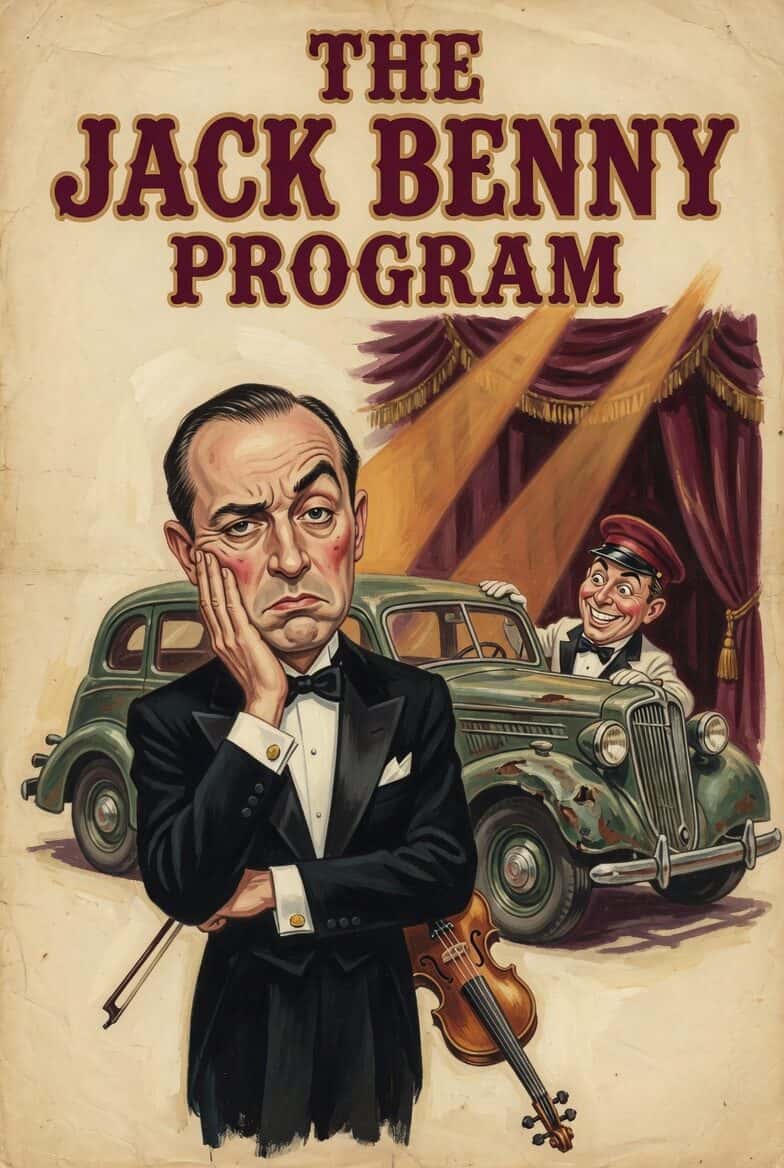
Cairo and Kiska, Sydney and Sicily. Here to act as top kick for this round the world broadcast, your serviceman is Jack Benny. Thank you, thank you. Hello again, this is Jack, ain't got a chance Benny talking. And I want to say right off the reel that any enthusiasm I show on this program tonight is due to vitamin B only. Anyway, it is really a thrill to be talking to all you boys and girls wherever you may be listening in. But Ken... Getting back to these awards, I'm really burned out. Why, Jack? Well, look, Ken, what's the use of kidding? I've been making pictures for years, and I found out one thing. When it comes to these awards, acting isn't everything. I mean, a lot of it depends on your physical appearance, you know? What do you mean? Well, here's what I mean. I mean, a couple of years ago, Jimmy Stewart won the award for the best actor. Why did he win it? He's taller than I am. Two years ago, Gary Cooper won it. He's way taller than I am.
It's all a question of height. What chance have I got? Now, wait a minute, Jack. What about Jimmy Cagney? He won it last year. Well, he's shorter than I am. I mean, it just seems that a nice, talented, in-between, lovable fellow like me is sunk. Oh, I don't think that's true, Jack. I can name a fellow who's exactly your size. He won the Academy Award for the best actor. Who's that? Spencer Tracy. He won it twice. I'm talking about winning it once. That's all I want, once. Believe me. But thanks very much for mentioning the fact that Spencer Tracy and I are built alike. Oh, not at all, Jack. It's all right. By the way, Ken, did you happen to see a picture I made called Charlie's Aunt? Oh, yes, yes. I thought it was great. You played a double role in that, didn't you? Yes. Now, Ken, I can understand my not winning the award for that. I mean, because, see, I was so good in both parts that they didn't know whether to give me an Oscar for the best actor or the best actress.
I wore a very revealing gown, if you remember. I remember that distinctly. Tell you the truth, Ken, I just missed the award that year by a hair. The year after, I just missed it by a hair, too. Jack, you'll have to miss it by something else pretty soon. What are you talking? If worse comes to worse, I can miss it at Westmore's, you know. But getting back to Spencer Tracy. Now, he was voted the best actor one year because he had a great part in Captain's Courageous. Well, I'd have had a good chance, too. I mean, a story of the sea gives you a great opportunity for dramatic acting. Well, if you were so confident, Jack, why didn't you try for the part? I did. I walked up and down in front of MGM for a month wearing a sailor suit. If they can't take a hint, what can I do? You must have looked silly parading up and down in a sailor suit. Silly? It was embarrassing. The restaurant next door thought I was picketing their navy bean soup.
Oh, well. You know, Ken, there's one thing I did tonight, though, that'll make up for everything. What's that, Jack? You know, I'm not sore at all now. Now, sir, when I came into the Chinese theater, I filled my pockets full of rocks and stones to weigh me down. I'm gonna get my feet in that cement some way. Up to now, the only place they let me put my footprints was downstairs in the tile. Well, Ken... Ken, I think you and I have talked long enough. Yeah, I think so, too. But, Jack, before we go, which picture do you really think will win the award tonight? Picture? I don't know, Ken, but when I was out in the lobby, I heard several people mention lifeboat. But then I found out they were just discussing the weather this week. Well, shall we get on with our introductions? Yeah, Jack, and by the way, I don't care how you feel personally. I do want you to congratulate each star who wins an award. Oh, I will. I will, Ken. Only I hope that somebody who won it last year will win it again this year. I haven't got time to hate new people, you know. Well, let's get going and find out who the winners are going to be. Ladies and gentlemen.
fellas and girls overseas, it gives me great pleasure now to bring to the microphone one of Hollywood's greatest producers, a man who last year was given the award for the outstanding production, Mrs. Miniver. He will open the envelope and disclose the winner for the best production of 1943. Here he is, Mr. Sidney Franklin. Don't be nervous or anything. Did you see George Washington slept here? No, I haven't. You didn't see it. I see most all pictures. Well, I didn't see Mrs. Miniver either, so you don't have to collect it. It is my rare privilege to present the award for the most outstanding picture of the year. Award for the most outstanding motion picture of the year, 1943, Casablanca won. Casablanca won the award, fellas and girls. Who's going to accept it? Casablanca is not limited to this single achievement.
For another of their pictures, Watching the Rhine was also nominated for this award. Yes. Who's going to accept the award? Oh. Oh, Jack Warner, certainly. Jack Warner, my boss, Mike. Say a few words? Yeah, I would if I were you, Jack. You know, like you always talk, like you ad-lib. Go ahead, kid. No, no, give it up. First, I want to thank all those who participated in the making of this picture. To Mr. Wallace, the producer, to Mike Curtiz, the director, to Humphrey Bogart, Miss Ingrid Bergman, I'm not nervous, kid, take your hand off my wallet. Where was I? Oh, yes, I'm Miss Bergman. To Sidney Greenstreet, Peter Laurie, and in fact, everyone in the cast. I just can't think of them all because I didn't know we were going to win. I'd have rehearsed more. It was a great...
Really a great pleasure, a tribute to our industry, and we feel very proud at Warner Brothers for this honor. Let's hope we meet again next year, and you really are on top. Thank you, Jack. Did you see George Washington's slept hair? Don't tell me you didn't see it, for heaven's sake. I'm off, brother. The soldiers and sailors really want to get off. Thank you, Jack Warner. Thank you very, very much. And now, the Irving G. Fulberg Memorial Award to the individual who has contributed. to the highest quality production of 1943. This award will be presented by Colonel Darryl F. Zanuck. Colonel Darryl Zanuck, please. It is a great honor to present the Irving G. Thalberg Memorial Award. No eulogy of Irving is necessary. His genius and fame is undiminished. As a matter of fact, it shines brighter than ever today. Irving stood for quality.
and perfection in motion pictures he was ahead of the times and today when even our most severe critics must admit that the quality of motion pictures has advanced we are just beginning to glimpse those things that irving saw so clearly years ago he was a true pioneer in the field of perfection and if motion pictures have grown at all irving g thalberg planted the first seeds. He was ahead of the industry then. He was ahead of the public then. He is still ahead of the industry. He is still ahead of the public. Thank you, Dale. To carry on the ideals represented by Irving G. Thalberg is the privilege of the Academy in sponsoring this award. It is given each year for the most consistent high quality of production achieved by an individual producer.
based on pictures he has personally produced during the preceding year. The Academy Board of Governors has conferred this award upon Hal Wallace. I believe that this is the second time that Mr. Hal Wallace has won the Irving G. Fahlberg Memorial Award. This is a special award given by the Board of Governors of the Motion Picture Academy of Arts and Sciences. It was not voted on by the industry as a whole. Here's Mr. Hal Wallace. Al? Say a few words, Al. Do you mind if I just hold this for a second? Just a second. I will if you'll loan me that paper. I can use one of those. I'm very grateful. Thank you, ladies and gentlemen. I'd like to accept this as a trustee for the many people who had a part in helping me to make my program. Thank you. Thank you, Al. Thank you, Darryl. I know that...
Oh, really? Okay. I know Zanuck didn't see George Washington slept here. Amici wasn't in it, you know. And now, now the award for the best supporting actor. This was won last year by Van Heflin, now Lieutenant Van Heflin, for his splendid performance in Johnny Eager. In the absence of Lieutenant Heflin, this award will be presented by Mr. Donald Crisp. Mr. Donald Crisp.
This is for the supporting actor, isn't it? Yes, just the supporting actor. I mean, not the star. This isn't for the star. No, sir. I mean, I have nothing to get nervous about or anything like that. I see. Go right ahead. Thank you. Ladies and gentlemen, the artist you have chosen. By your votes, this award goes to Mr. Charles Coburn. Good morning, Mr. Charles Coburn, the outstanding supporting actor for 1943. The Academy is honoring a man who's been unswerving in his efforts to elevate the artistic standards of his profession. In the theater and now in motion pictures, Mr. Charles Coburn, now coming to the microphone. Jack, I was in George Washington's sleep here. You don't have to ask. But Charles, I mean, just the name Washington should have gotten something, I mean, out of it, you know.
I mean, I couldn't have hurt him that bad, you know. I don't know. I don't blame you. I was in it. This is an honor devoutly to be wished. And I would like to thank all of my brothers and sisters of the Pear Tree Garden who have done me the honor of casting their vote in my favor. After 50 years of service in the theater from program boy... to this. I want to thank Donald Criss for being the instigator of giving us a man's size instead of the little boy's size. I hope that at the end of another 50 years of service in the theater and pictures that your children and your children's children will have the courage to vote for me again. Thank you. Thank you, Charles Coburn and Donald Criss. Both.
stellar actress, finest that we have in our moving picture industry. And now, ladies and gentlemen, boys and girls, the best supporting actress. I'm sure you all remember Teresa Wright's wonderful performance last year in The Life of Lou Gehrig. Teresa is here tonight and will present the award for the best supporting actress in 1943, Miss Teresa Wright. There she comes, Miss Teresa Wright. How do you do, Miss Wright? It's a great pleasure for me to be able to present this award for the best performance by an actress in a supporting role. The award goes to Miss Katina Paxinou in For Whom the Bell Tolls. Thank you. Katina Paxinou's performance in For Whom the Bell Tolls, for which she's been named the Outstanding Supporting Actress for 1943, is one that will long be remembered, I'm sure, by all those who saw her. And here she is, Miss Katina Paxinou. Ladies and gentlemen. Ladies and gentlemen.
Allow me to share this great honor, which is bestowed on me tonight, with my colleagues of the Royal Theatre of Athens, whom, whether they are now dead or alive, fate has ordained me to represent here. I am deeply moved, and I wish to thank Paramount, who offered me the chance to play Pilar. Mr. Buddy De Silva. my director, Sam Wood, and all those who are responsible for this happy moment. I would like to thank also the voters and the committee of the Academy Award for giving me, besides this honor, the opportunity to send through the air my deep love and admiration to the heroic boys. to the heroic soldiers of your great nation, the American boys who are fighting with their allies all over the world for liberty, justice, and human dignity. Thank you again. Congratulations, Ms. Paxman. That was really a wonderful performance. And now, we're still applauding Ms. Paxman, for they all remember her performance. And now, ladies and gentlemen, comes the award.
that has caused these bags under my eyes. The best actor last year, Jimmy Cagney, won it for the role of George M. Cohan in Yankee Doodle Dandy. Jimmy is somewhere overseas tonight entertaining our troupe. And in his absence, the vice president of the Screen Actors Guild and a fine actor in his own right will stand in for him. Mr. George Murphy. Mr. George Murphy. A tense moment. Now, coach? Yeah, go ahead, kid. Oh, I'm out of it altogether. Can you stand this, Jack? Oh, sure. The Academy of Motion Picture Arts and Sciences award for the best performance by an actor, Paul Lucas. And watch on the rise. For 15 years, American TV audiences have been acclaiming Paul Lucas for his stunning performances on stage and screen. Congratulations, Paul. Don't be nervous. Here he is at the microphone accepting the award, Mr. Paul Lucas. Thank you.
Oscar is called a symbol of achievement. Every actor, it's something that every actor in Hollywood always hopes to win. I, in accepting it tonight, I'm trying vainly, I'm quite sure, to express my thanks. I feel that I must share my happiness and this honor you gave me with Miss Hellman. who made it possible for me the whole thing, and Mr. Herman Shumlin and Mr. Warner and his associates who made it possible for me. Thank you very much. Thank you, Paul. Congratulations again. Thank you, George. Thank you, George. It's really a thrilling evening, ladies and gentlemen. And Lucas showed how thrilled he was.
And now, fellas and girls, one of the greatest, one of the greatest performances ever seen on the screen was given by Miss Greer Garson as Mrs. Miniver. Miss Garson is also here tonight, and we will ask her to come up on the stage and make the presentation to this year's winner, Miss Greer Garson. Here she comes, looking as lovely as ever. Good evening, Miss Garson. Want to say a word first? Thank you, ladies and gentlemen in the audience, ladies and gentlemen of the services. here with us on the platform on the air. I'm very happy indeed to have the honor of presenting the award for the best performance given by an actress in the last year. Suspense. The Academy of Motion Picture Arts and Sciences award for the best performance by an actress is given to Jennifer Jones. She's almost impossible. She just won the award as 1943's Outstanding Actress.
for her performance in her very first motion picture, The Song of Bernadette. The audience is applauding, waiting for Miss Jennifer Jones. She's coming down the aisle, I believe. Yes, here she is, coming to stairway. Jack Benny is coming down to help her up the steps, and she'll be presented the award by Miss Garson. Jones is here at the microphone now. Thank you. I'm really thrilled, and I'm really grateful to you Academy members for voting for me. And if I have a minute, Mr. Benny, may I thank Mr. Selznick? for giving me this opportunity and mr king the most wonderful director in the world and mr pearlberg and mr werfel who created this wonderful part which is really something and to the crew and everyone who worked with me and made this possible thank you thank you congratulations remember ladies and gentlemen remember what a wonderful picture that was And that it was Miss Jennifer Jones' first performance on the screen. And needless to say, it was a grand one. Well, that's about it. It's been a most exciting evening. On behalf of the motion picture industry, I'd like to say to all you men and women in the armed forces, that it's been a thrill and a pleasure to be with you by radio tonight. And from every one of us here in Hollywood to every one of you, good luck, God bless you, and Oscars to you for your great performances.
Thank you, Barry Burns. Thank you, Jack Benny. Well, ladies and gentlemen, that just about brings to a close tonight's doings of the Academy of Motion Picture Arts and Sciences, a very thrilling occasion, I can assure you, here in Hollywood, California. Grauman's Chinese Theater was packed, of course, to the brim tonight with the notables of the stage and screen. All of Hollywood's top names have turned out to watch for these awards because... As a matter of fact, as most of you know, they are completely secret until the actual moment of the presentation of the award. The awarding actor or actress comes out of the center of the stage upon being introduced by Mr. Benny, then turns to the accountant from the Pricewaterhouse account company and receives the award in a sealed envelope. They are not seen by anybody outside of the accounting company who accounts for the 10,000 votes which are cast for the various actors and actresses before this evening itself.
So it is a great thrilling occasion, and everybody in Hollywood waits anxiously for it every year. Just before we close, we have a little time. I might recapitulate for you some of the awards for other efforts in the motion picture industry, which were given earlier in the evening. For the best written screenplay, Casablanca, the Warner Brothers picture, which also received the award as the winning best picture of the year, received the award for the best written screenplay. The screenplay for Casablanca was written by Mr. Julius Epstein. Philip Epstein and Howard Cook. For the best original screenplay, the award for Princess O'Rourke, the screenplay written by Norman Krasner. For the best original motion picture story, the Metro-Golden-Mare picture, The Human Comedy, written by William Soroyan. The best achievement in art direction in black and white films was given for The Song of Bernadette, which also won the award for the best actress of the year. 20th Century Fox picture.
and the gentleman receiving that award for Art Direction, James Basavia and William Darling. For the Best Achievement in Art Direction in Color Films, The Phantom of the Opera, the Universal Picture, and the Art Direction in that Technicolor film was by Alexander Golitsyn. The Best Achievement in Cinematography in Black and White Films, also for The Song of Bernadette, the Best Achievement in Color Cinematography, the same as the award in Art Direction, Phantom of the Opera, Universal Picture. And to Mr. Hal Moore and Mr. W. Howard Green, go the credit for the cinematography for Phantom of the Opera. The best achievement in film editing, the Warner Brothers Picture Air Force. And Mr. George Amy wins the award for that. The best achievement in sound recording, This Land is Mine, an RKO radio picture, Stephen Dunn winning the award. The best song, the best original song of the year, you'll never know from hello frisco hello a 20th century fox picture the music was written by harry warren and lyrics by mac gordon in the uh the short subjects the cartoons yankee doodle mouse a metro golden mare short subject won the cartoon award in the one reelers amphibious fighters a paramount picture produced by grantland rice in the two reels heavenly music a metro golden mare picture produced by jerry bressler and Sam Koslow. Well, that just about winds up the proceedings here. You've been listening to a special round-the-world broadcast of the annual awards of the Academy of Motion Picture Arts and Sciences. This is KFWB Warner Brothers Studios, Hollywood, California.