
The written record
Read the transcript
Read along with the recording · About 11 min to read
This is Glenn Riggs again in the Blue Network Studios in New York. For the next hour, you will hear music from the nation's two greatest musical centers, music from New York and Los Angeles, played and sung by the artists who have been elected by Esquire's board of 22 swing music experts as the world's greatest in the present-day jazz scene. And now, Esquire's second annual All-American Jazz Concert presents the man who has made swing history... and has played a great part in making jazz one of the liveliest of the seven lively arts. Benny Goodman and the great new Benny Goodman Quintet. The Benny Goodman Quintet is joined by a star selected by the swing critics in the feminine vocal department of this year's voting, the incomparable Mildred Bailey.
I was crazy about a man. He mistreated me all. But the next man I get has got the crime. He drove me his door. He drove me from his door. Footbook says, what does it say? You'll reap what you sow. Trouble my day, my day. But just to... Pardon me, may I say a few words? Well, this seems to be one of those occasions when music speaks louder than words. However, if there's something important, please introduce yourself. Well, you see, I happen to be a Benny Goodman fan, and I'm working in the same show with him. So I thought this might be a good time to tell him something important. Oh, Beatrice Lilly is the name. Well, Benny, as you know, there are four people on this broadcast who are gold award winners this year. And I'm very happy to be able to make the awards. On behalf of the Squire, I'd like to present this gold Esky statuette.
and a $500 war bond to everyone's favorite, Mildred Bailey. Thank you very, very much, Bea Lilly. And thanks, too, to the jury who awarded me that wonderful verdict. Thank you. And here's the same award for a member of the Benny Goodman Quintet, who came out top in the Miscellaneous Instruments Division. And there's nothing miscellaneous about the way he plays that vibrahop, Red Norval. Thanks, Bea, and thanks, everyone. It's really a great thrill. Now for another winner. an old sidekick of Benny's, and one of my very favorite pianists, Ted Wilson. Thanks, Bea, and I'm very happy to have been selected. Finally, here's one for the king himself, the man who ran away with the number one spot in the clarinet department, Benny Goodman. Thank you, Bea. This is a wonderful souvenir of a wonderful occasion. Congratulations. Now, while I feel the committee is pretty fair in their judgment and awards, there's a gentleman who slightly disagrees with me.
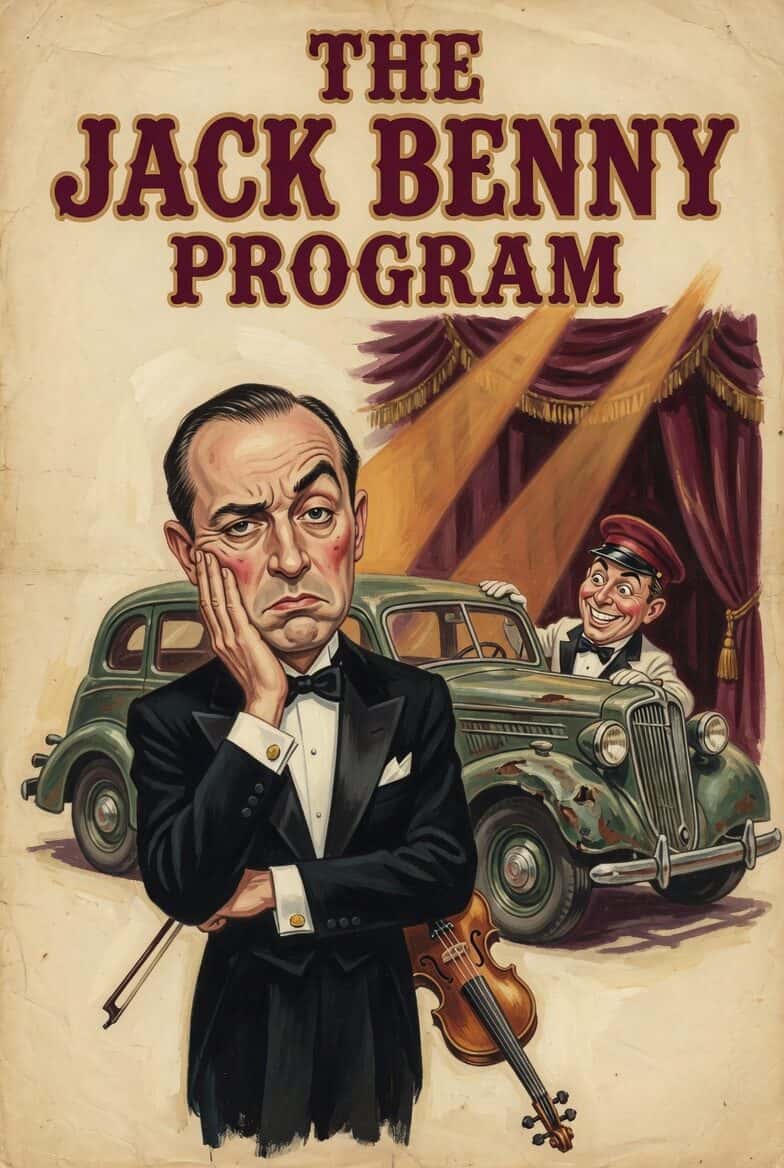
He feels he's not being given proper consideration in this contest. And he's here tonight to prove his point. Benny. Yasha. Yes, B? Now, look here, Jack. You're not included in this contest because you are not classified as a musician. I'm not, eh? Then why was I invited to come up here? Yes, well, you were invited. You crawled up the fire escape, came on your knees, and told them you were Mayor LaGuardia. I did not. When the usher tried to stop me, I handed him my card. Well, let's see that card. Here. Hmm. Jack Benny, star of stage, screen, and radio, and if I can't play the violin better than Heifetz, I'll eat my rosin. So there. Jack, isn't rosin habit-forming? I gave you all the laughter. Not particularly. You see, I've been eating it for 25 years. Anyway, Bea, I'm really a great virtuoso. You see, there are different types of violinists. Some are known for their tone quality, some for their technique, and others just for their, or just, rather, I've been hanging around Phil Harris so long. Others just for their interpolation. But, of course, you wouldn't understand that. Oh, but I do, Jack. It's the same with radio comedians. Some are known for their subtle wits, others for their sophisticated humor, and others use a quaint old English expression, just stink. Thank you. Anyway, Jack, as long as you are here, I'm going to give you an award.
Here you are, and congratulations. Oh, you shouldn't have done it. Oh, isn't this wonderful? Just what I needed. A blue point oyster. Anyway, ladies and gentlemen, I do want to congratulate Benny Goodman and all of the other winners, including me. Thanks, B. Good night, folks. Want to hear just a little jazz? Thank you very much, B. Lilly, and thank you, Jack Benny. And now we get together with those two other fine musicians in the quintet, Moe Feld on drums and Sid Weiss on bass, for a few choruses on an old favorite, The World is Waiting for the Sunrise. To the Benny Goodman Quintet and Mildred Bailey, taking part in Esquire's second annual All-American Jazz Celebration, broadcasting from the Blue Network Studios in New York. Benny Goodman will return later in the program for a jam session with Louis Armstrong in New Orleans and Duke Ellington in Los Angeles.
We take you now to Danny Kaye in Los Angeles. Good evening, everyone. This is Danny Kaye talking to you from the Philharmonic Auditorium in Los Angeles. The Esquire Jazz Concert here is presented by the Volunteer Army Canteen Service. This is a civilian organization which was organized shortly after Pearl Harbor to open and maintain canteens at army outposts and hospitals in Southern California. The proceeds of this concert will enable the VACs to make possible thousands of long-distance phone calls. by wounded veterans to their loved ones all over the country. The very day they arrive here from overseas. Now let's get the program started with Esquire's choice for America's number one band, playing an arrangement written by the man who has voted the best new arranger of the past year. Duke Ellington and his famous orchestra playing Johnny Thompson's arrangement of Leonard Feather's Esquire Jump. The young man who wrote that arrangement is the arranger with Harry James Band.
And another young man who is taking the solo on the next number is also with Harry James. The fellow talking to you is with Harry James, too, on Saturday afternoons on CBS. Now, this boy's name is Willie Smith, and he was... He was selected by Esquire's Board of Experts for the Silver Award as the best musician in the armed forces. Since the voting took place, he has been honorably discharged from the United States Navy. and is now the featured saxophonist with Harry's band. So on behalf of Esquire, I am very happy to give him his Esky statuette and a $500 war bond. Ladies and gentlemen, Willie Smith. Here we are. Here's a nice, fresh $500 war bond. Thanks, Danny, and thanks, everybody. I'd like to play for my number, T for two. This lady's standing offstage here with a bond in her hand and a gleam in her eye, and I think she's about ready to make a presentation.
Ladies and gentlemen, from Metro-Goldwyn-Mayer, one of America's great, great stars, Miss Judy Garland. Thank you very much, ladies and gentlemen. I'm very glad to be able to present this award of wonderful $500 bond to a very talented singer who won the award for Girl Vocalist in Esquire's Team of New Stars. She's featured with Stan Kenton's Orchestra, and she's here to do her number next, Miss Anita O'Day.
Each one busy with his own thoughts. Yet I think I'm lost. Looking at every face that you see. Somebody is lucky. With you were waiting for me. Walking back and. Who's that someone can be. Somebody is lucky. You were waiting for me. Comes around me. I fell to your side never. let you go free. Somebody is lucky with you waiting for me. We pause now for station identification. Maybe you remember there was a famous Ellington tune once called Boy Meets Horn. Well, we are due for a spot of dialogue now which another boy meets another horn. The boy is Billy Strayhorn and the girl is Lena Horn. This is a very happy moment for me.
Because one of my favorite friends and favorite musicians is a winner in this year's voting. And I've been allowed to present his statuette and his war bonds. He is a silver water ranger, a young boy we all love and admire. But he's better known to the public as Billy Strayhorn. Leah, this is a great honor. And I can't think of any nicer way to receive it than from the gracious hands. of the most favorite of my favorite people. And good evening, ladies and gentlemen. This is Duke Ellington. I have taken it on myself to introduce the next artist, because to me, he is one of the greatest things that has ever happened in jazz. So here is the Esky statuette and the $500 war bond for the one and only Art Tatum. This is Danny Kaye again, and I want to turn you over to someone who is best known as a great actor.
but who is also an outstanding composer and is going to honor one of his distinguished contemporaries. Ladies and gentlemen, the Lionel Barrymore. I'd like a double presentation for an artist who won two prizes as a Gold Award arranger and also as leader of the Gold Award Orchestra, Mr. Hugh Kelly. I'd also like you to accept those other bonds and awards for the men in your band who are individually winning. Johnny Hodges, alto saxophone, Lawrence Brown, trombone, Harry Carney, baritone saxophone, and Ray Nance Violet. Now, Mr. Barrymore, ladies and gentlemen, the officer and myself truly appreciate this marvelous gesture. We'd like to play now a number featuring Johnny Hodges on the alto saxophone. Good to be wooed. The next item on our program...
Features one of America's greatest song stylists. And the award will be made to her by one of America's immortal song creators. Our own Jerome Kern. Thank you. Not at all. I'm having a grand time listening to music that I don't want to hold up. I'd just like to hand over the etchy in the war barn to the young lady who's a vocalist on the pole this year. Miss Billie Holiday. From the city that hurts in my... I think it's about time I did a little more awarding myself. I just managed to sneak away with two of these statuettes and war bonds. I want to turn them over to the gold award winners on guitar and drums. Al Casey and Sidney Catlett. And by the way, by the way, Sidney has a double celebration tonight. This is his birthday. Want me? Says here, thanks, Danny. Casey and I are going to join Duke for a few choruses on Honeysuckle Rose. Oh, yeah. You can read it now. Me? Oh, thanks, Danny. No, this isn't me.
Where am I? Thank you, Danny. Casey and I are going to join for a few courses on Honeysuckle Road. That's my boy. And also, incidentally, it's your birthday tomorrow, and I'd like to thank you. Well, thank you very much. I wish you a happy birthday. Thank you, Sidney. Thank you. I'll pause a minute to tell you that this is being recorded by Armed Forces Radio for distribution overseas to the boys. And now I would like to introduce to you the chairman of Esquire's Board of Experts and musical director of tonight's performance, Mr. Leonard Feather.
Thank you, Danny Kaye. Well, for our last number, we're going to do something very special, a three-way jam session. Duke Ellington is going to play Things Ain't What They Used to Be, and he'll be joined by Louis Armstrong from the Municipal Auditorium in New Orleans and by Benny Goodman from the Blue Network Studios in New York. So take it away, Duke, for the first three-way jam session in history. New York. A concert was held for the benefit of the volunteer Army canteen service. Listen. It's the Blue Network.