
The written record
Read the transcript
Read along with the recording · About 14 min to read
More than ever before, news today must be accurate, must be timely, must be authoritative. That is the service given listeners by reliable NBC News. NBC programs will be interrupted at any time for important news. Right now, relax and enjoy the Fred Waring Show over WEAF, NBC in New York. All programs will be interrupted for important news bulletins. Stay tuned to your NBC station for latest development.
Good morning, everybody, and welcome to the Fred Waring Show. We're broadcasting this morning from beautiful Shawnee on Delaware. And we want to help make this day a little more joyous for you, if it is possible. And here's the man who will do his best to make you smile. Come in, Mr. Waring. Oh, come on, Bill. Come on, little peppy. Wasn't I opening peppy enough? No, no, just introduce me. Here he is. That was Bill Bivens, ladies and gentlemen. Good morning, friends. Unofficially, did you get that? Unofficially, we feel great this morning. Unofficially, there's a great roar going up in the streets of most of our cities. Unofficially, it seems everyone is celebrating, and nobody seems to feel much like work this morning. Well, if you're alone in the house just now, why not let those chores go for a few minutes and join us in a little unofficial jubilation? Because unofficially again, this seems to be a great day for our side. We're going to start just as all or any other day.
But it does happen to be Tuesday, doesn't it, Bill? That is right. Fine. Tuesday is ironing day, is it not? That's right. All right. Tuesday's the day you iron your clothes. Search your sheets with these and those. This is the day you iron your clothes. Early Tuesday morning. Bob Evans, any poetry? Yes, sir. I'm too tired to iron today. I'm just about dead, in fact. Too much golf and tennis and sun. Oh, my aching back. Bob, a scamp, anything from you? I can't stand the gas, but Fred Waring's golf iron gave me a laugh. He swung with his all, but he missed the ball and just caught a cold from the draft. A very funny phrase. This is the day you wind your clothes early Thursday morning. Well, the time is now. The time is now. The time is now. It's time to beat the writing on the wall.
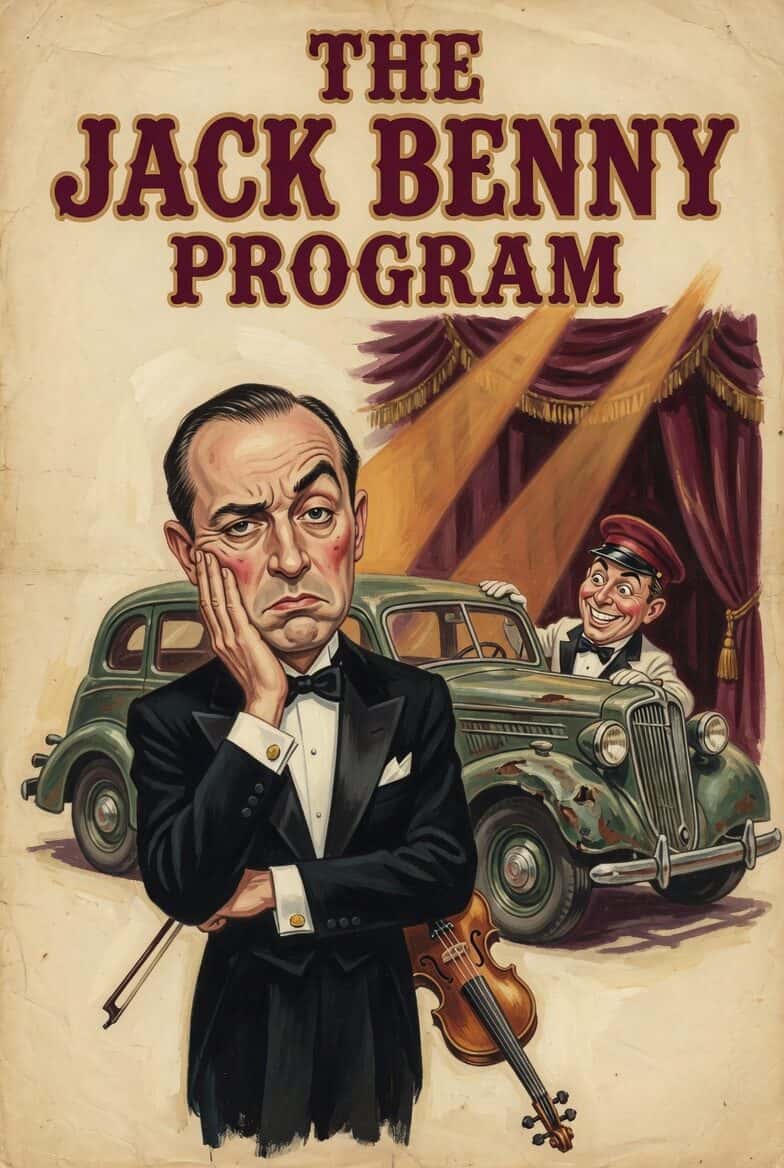
For the world won't wait to face yesterday and the time. The time is now. Oh, the Yankees do or die is on the go again. And they'll see a mighty show again. The curtain's going up. Can you hear that call? Oh, and the time. Pennsylvania to Shawnee. Span the ocean now. And we have a guest. Well, we're going to call him a guest in our program because I think we ought to be very proud to have him anyway. He's over there with Ingrid Bergman and Larry Adler ready to give you his idea of the reactions of the Parisians and the Americans in Paris. Jack Benny. We switch you now to NBC in Paris. This is Roy Porter in Paris. Today, Paris is celebrating with 12-inch headlines in the newspapers saying one word, peace. Today, whether the news is really official or not, Paris wants you people back home to know that we Americans over here are as happy as you are.
that the end of a long, savage, cruel war is in sight. And here's a man who has just finished an eight-week USO tour of Germany, Jack Benny. Ladies and gentlemen, this is Jack Benny coming to you from Paris, France. And we are now on our way back home. When I say we, I mean Miss Ingrid Bergman, Larry Adler, Martha Tilton, David Lewinter, and myself. On this tour, we've had a personal opportunity to see what war can really mean. We've seen their devastated cities. We've watched the long lines of people ejected from their own countries, plodding pathetically down the highways. In fact, what we have seen has convinced us that this must be the last war. We came over here to entertain your boys. We have been visiting boys who have been here for months and months and whose greatest desire is first to end war forever and then to get back home to Oil City or Dallas or even Waukegan.
We've met a lot of them, and we know that your boys helped win this war over here just as they have done in the Pacific. Jack, let me ask you, what is the primary impression that you got over here about the real objective of the American soldier? Well, I think the American soldier has had three definite objectives. First, he wanted to do his best to help win the war, and he did just that. Then he wants to be sure that we've not only won the war, but we've won the peace as well. And finally, after the job has been done and thoroughly done, he wants to get back to the USA. And one thing nobody ever wants to hear again is that old expression, don't you know there's a war on? And now it gives me great pleasure to introduce the young man with whom I have made three overseas trips, the world's greatest harmonica player, Larry Adler. Thank you, Jack. We've seen a city the size of New York, 80% destroyed, and that city is Berlin, Germany. If that sight taught me any kind of a lesson, it's this. The war is over, but the peace has not yet begun.
The winning of that piece will be your job, my job, the lifetime job of every one of us. Ladies and gentlemen, here is a person who to you is one of America's greatest actresses and who to us is one of America's finest troopers, Miss Ingrid Bergman. I came overseas because I wanted to say a personal thank you to these boys, our boys and our allies, for the job they have done. I hope you too at home. We'll also get your chance to say thank you very soon. You're right, Ingrid. And I hope the next time we travel around the world, any of us, it will be at civilian sightseers. This is Jack Benny again saying so long, and we'll be seeing you in a couple of days. And this is Roy Porter in Paris, returning you to the Fred Waring Show.
Greetings and thank you. It was nice to hear from Jack Benny. You made the grade today. This is Fred Waring again at Shawnee on Delaware. What was that, Bill? I said you made the grade today. After all these years, you had a big star on your show. Oh, thank you. Thank you. You've really done it today. How do you feel? Feel pretty good? I feel very, very jubilant, as I mentioned before. Why shouldn't I be very proud to have Mr. Benny? You're going to be funny now? No, I suppose you think that I'm going to enter in one of those feuds. Like Fred Allen. Why don't you say something about Benny? Oh, no, I wouldn't dare. No, not take it easy. I've got enough trouble with you. What's on your mind? Well, Fred, I want to get serious here for a moment, if you don't mind. You know, all morning long, since this unofficial news, it's still unofficial, I presume, has broken, we've been switching all over the country, getting the reactions of the people.
Chicago, New York, Washington, Denver, Cleveland, Hollywood. Hollywood, yeah. But they're the people in the big cities. How about the folks here in the rural community like Shawnee? I think it'd be nice to get their reaction. Well, Fred, I've gone out before our show this morning and rounded up several of your neighbors. You know them. They're farm people, and they're sort of the backbone of our great country. Let's get some views on what they think of this war coming to an end. That'll be fine. You don't know them? Well, I do. John, will you stand right there? This is Mr. John Dimmock, who's a dairyman, and he is also in charge of our golf course, probably knows more about grasses and hay and poison ivy than anybody I've ever met. John, what's your reaction to this war news? I'm certainly glad that it's over with. It's certainly been a struggle for all of us, both on the farm and also here at the golf course, and we certainly will be glad to see it.
the boys home again so we can get some real help. Real help, huh? And I certainly am mighty glad to have this very welcome news this morning. John Dimmick is one of our local people here at Shawnee Village. He works harder than any man I've ever known except Bob Heller, who also is a local man. We've tried to get Bob up here, but he's very busy now. They've all been working 20 and 24 hours a day, and that's not any kidding. These gentlemen are the backbone of America, and what they need now is a little rest and help from the boys who are coming back. Thank you very much, John Demick. Here's another one now. Mr. Lloyd Lee, who was in the last war. He's Mr., we call him Mr. American Legion, Ryan, around here. He's a bald-headed gentleman. He's the owner and proprietor of the local village general store. Mr. Lloyd Lee, what do you have to say about it? Well, it certainly is.
A great satisfaction the way the soldiers of this war dispatched our enemies. Of course, we think in the former war we did it a little quicker, but we had to allow for the robot bomb and so on. You think you did it quicker, huh? Yes, of course. We went in slugging. We may have been Jack Dempsey, and they may have gone down for a count of nine, but we came up on top and, praise the Lord, our young men this time proved beyond a doubt the good old American stock both were. industrious work, and darn good fighting. Darn good fighting, huh? Lloyd Lee, we appreciate your coming up here. How are you going to make use of this official, if it's official, this declaration of, you know what I mean, peace? I'm going to try especially hard to get a larger number of those number two tin cans instead of those large number ten cans. They're too heavy to handle.
That's fine. Thank you very much, Lloyd Lee. Now, I wouldn't try to claim that we had any clam days here at Shawnee, but as the song goes, our hearts are warm and our bellies are full, and we're feeling primed, so there's no trouble at all to get right into the mood of the carousel song hit, This Was a Real Nice Clam Day. This morning, being able to do our broadcasting right on the shore of the good old Delaware River. The best we can do about passing a little of that breeze on to you is to play this arrangement of Summer Breeze. Summer Breeze is a song written... A few years ago, it was used momentarily as a theme by us. We like it. We like the feel of it and the way it sounds. It was sung by the Glee Club and the soloist, Arthur Hestwood. Arthur acted as golf pro here last year. He played a nice game yesterday, shot a fine 74 on the most difficult golf course. My score? Our local pro, Charlie Shepard, shot a 66 on this golf course on Sunday, a 30 on the home nine.
Come on, Arthur. Oh, this is such a wonderful place. There's so many things to enjoy. What would you suggest that we sell this morning? The golf course. How was your game, Bill? It was wonderful. It was? I really got a big score. I saw you out there in the 12th hole for about a half hour yesterday. What was wrong? Oh, the sand trap there? Oh, that's a wonderful trap. Were you making little mud pies for yourself? Well, no, I was making little anthills. Oh, I see. Tell us about your score. How did you arrive at it? Well, it was a great big score, Fred. I saw on the card there it said large numbers, so I strived to get the large numbers. I wound up with, I think, I beat my opponent there. He had, I think, for the...
18 holes, 85, and I had 185. That's fine. You used a Monroe calculator probably to add yours up. No, the more swings you take... Well, did you have any outstanding shots? Anything that... Well, when they took my picture on the first tee, I drove around 300 yards. That's fine. And then when some of the boys ganged up on me and said, let's see old Big Mouth hit one now, Billy Boy stepped up and knocked it within a foot or two of the pin. You used your putter, didn't you, off the tee? The putter, yes. That's fine. That's fine. Well, Annie, did you have any remarkable score? Birdies? Yes, I got a hole-in-one out there. What? I got a hole-in-one. Really? Mm-hmm. That's wonderful. But I had another pair, so I went ahead and changed my socks. Yes, we won't be needing Jack Benny. I'm available for five years and picnics. All right, Bill Bivens, that's enough. Now we're all set for the story hour, Chillin'. All right? This story is called These Bones Grind to Rise Again, and the whole gang...
Lee Club, Don Craig, Herman Henning, Joanne. Joanne, what's her name? She's been here such a short time. Wheatley. W-E-H, what is it? Come on, Don, get in. I wanted to hear you. Joanne Wheatley. W-H-E-A-T-L-E-Y, right? That's right. That was Don Craig, spelling for Mr. Waring. Now, let's see. Joanne Wheatley, bees and honey. Honey's not here, though. And she's meeting Murray. And the orchestra. And we're going to tell you all about it from the beginning to the end, the story of These Bones Grind to Rise Again. Livingston Gerhart made the arrangement. It's a Negro spiritual. You ready? Time was exactly 8 o'clock a.m. on Tuesday morning. The year was 4004 B.C. The place was somewhere in Asia Minor, P.Q. And what happened was this.
He thought he'd make a man. Make him out of mud and a little bit of sand. I know it. I know it. He thought he'd make a woman, too. He didn't know exactly what to do. Took a rib from Adam's side. Made me see for a big bride.
Ladies and gentlemen, one moment, please. The program coming to you from Shawnee on the Delaware of Fred Waring and his music has been temporarily interrupted. We hope to return you to Fred Waring in just one moment. Out of my garden, you and me has got to quit. Out of my garden, you and me has got to quit. Out of my garden, you and me has got to quit.
This arrangement of the Glee Club was done from Roy Ringwald, What Makes the Sunset. We did it last week at this time, and you liked it so well, you've asked for it, so here it is again. Gordon Goodman is the soloist. What makes the sunset? From the picture, Anchors Away. Tony on Delaware and Pennsylvania. Thanks again for coming. Hope you'll be with us tomorrow, again at the same time. All programs will be interrupted for important news bulletins. Stay tuned to your NBC station for latest developments. This is the National Broadcasting Company.