
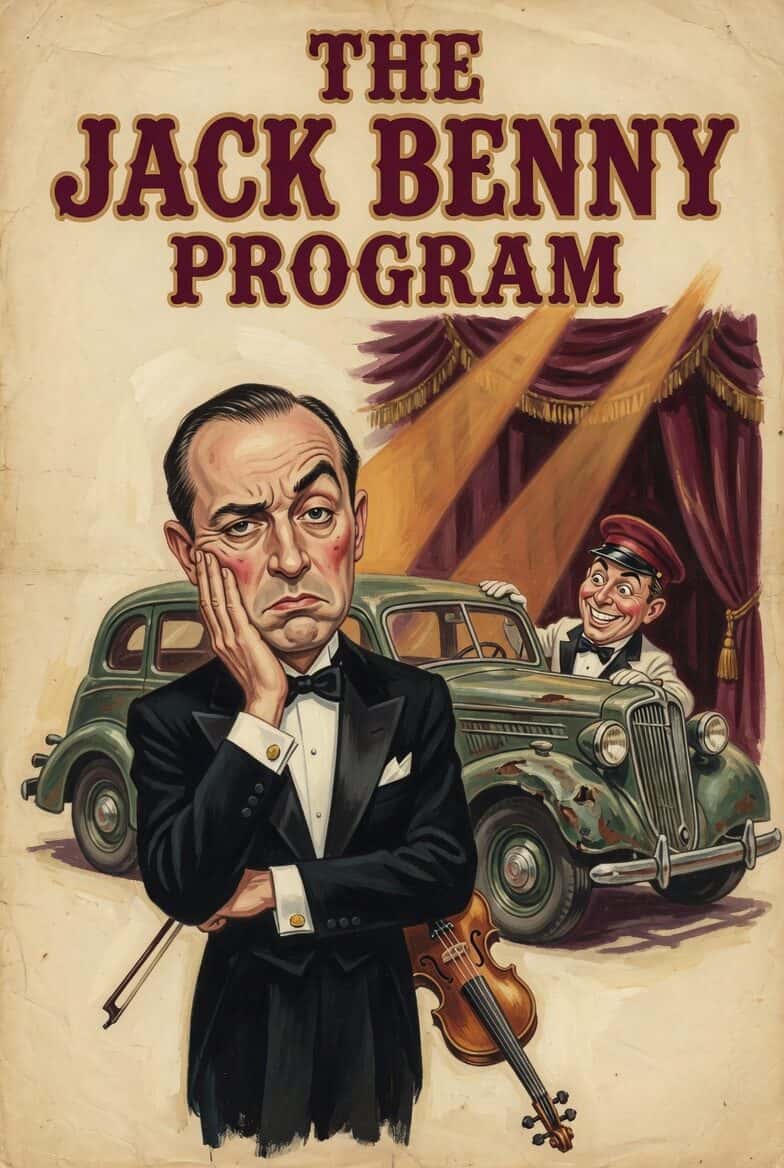
The written record
Read the transcript
Read along with the recording · About 20 min to read
The Jack Benny Program, presented by Lucky Strike. L-S-M-F-T, L-S-M-F-T. Lucky Strike means fine tobacco. Yes, at auction after auction, market after market, the makers of Lucky Strike consistently select and buy that fine, that light, that naturally mild tobacco. Listen to the words of Mr. Tom Jones, 18 years, an independent auctioneer of Mount Airy, North Carolina. He recently said... In my 18 years of auctioneering at market after market, I've seen the makers of Lucky Strike buy fine tobacco, fine, ripe cigarette tobacco that makes a smooth, mild smoke. I've smoked Luckys myself for 15 years. For your own real, deep-down smoking enjoyment, take a tip from the experts. Light up a Lucky. Light up a really finer cigarette. And puff by puff, you'll see... L-S-M-F-T, L-S-M-F-T. Lucky Strike means fine tobacco.
That's why there's no question. Lucky Strike is a finer, smoother, milder smoke. So smoke the smoke of fine tobacco. Lucky Strike. So round, so firm, so fully packed, so free and easy on the draw. No doubt about it. In all the world, there's no finer cigarette than Lucky Strike. The Lucky Strike program starring Jack Benny with Mary Livingston, Phil Harris, Rochester, Dennis Day, and yours truly, Don Wilson.
Ladies and gentlemen, this is our final broadcast of the season. And as you know, farewells are always sad. And doing the final program is always sad. So without further ado, we bring you radio's saddest comedian, Jack Benny. Thank you, thank you. Hello again, this is Jack Benny talking. And Don, that was a rather puzzling introduction. Puzzling? Yes, only last Sunday, in honor of National Pickle Week, you said I was a barrel of fun. Now, now, how in one short week could I deteriorate from a barrel of fun to radio's saddest comedian? How could that be? Well, it's really very simple, Jack. A pickle is something sour. Now, according to Webster's Dictionary, sour means morose. Morose means gloomy. Gloomy means sad. So it's very logical for you to go from National Pickle Week to radio's saddest comedian. See? Well, Don, I've looked in Webster's Dictionary myself.
And I found out that when you pickle a thing, it's submerged in brine. When it's submerged in brine, it's preserved. When it's preserved, it's canned. And that's exactly what you are. Goodbye. And now, ladies and gentlemen, having said farewell to beautiful Don Wilson, we continue. Now, wait a minute. Wait a minute, Jack. You wouldn't fire me on the last show of the season. You're not that cheap. You want to bet, Don? Speaking of things pickled, here's Phil Harris. You can stop with that, too, Jackson. I ain't had a drink in two weeks since Remley had his accident. Remley had an accident? What happened to him? Oh, it was horrible, Jackson. Ghastly. He was carrying a bowl full of goldfish when somebody yelled, bottoms up. You mean... Yep, drained it, sand and all. Gee, Phil, I'm sorry to hear that about Frankie. It must have been awful. Well, he didn't mind the fish in the sand, but that water nearly killed him. Look, Phil, why don't you... Oh, Jack, Jack, I hate to interrupt, but, uh...
I'm really worried about your firing me. Oh, for goodness sake, Don. I was only kidding. I wouldn't fire you. You've been with me for 15 years. Cut your salary, maybe, but not fire. So forget it. Oh, well, I guess I was silly to let it bother me. After all, you couldn't be that cheap. Want a bet? Oh. Oh, hello, Mary. Hello, Mary. Hello, Don. How you live? Hello, Curly, you Ollycon of Encino. Oh, cut it out, Libby. You're embarrassing me. Oh, fine. Look who's trying to act modest. Yeah, on the bumper of his car, he has a rubber stamp that says, You lucky pedestrian. You've just been hit by Phil Harris. That's right. Oh, Mary, you're kidding. No, I'm not. Jack, take off your shirt and show him. Mary, Phil hit me while I was bending over, and let's forget it. By the way, Don, since this is our final show of the season, where are you going on your vacation? Well, I'm going to spend two glorious weeks at the Brown Derby.
That's nice. What are you going to do, Mary? Well, my sister, Babe, is coming to visit me, and we're going hunting. Hunting? Isn't that more of a sport for a man? That's what Babe's hunting for. Well, it's a shame nature gave her such bad ammunition. I'm still a barrel of fun. What about your vacation, Phil? Can't take any, Jackson. I'm making a picture for 20th Century Fox. A picture? What's the name of it? Take me out to the brewery. Good, good. That's a nice title there. Say, Jack, before we went on the air, you said you were going to do something special on the program today. What is it? Well, Mary, I thought it would be nice on this last show to introduce all the people connected with the program. I'd like to start off by presenting Bill Days, Marty Sperzel, Gurney Bell, and Bob Stevens, better known as the Sportsman Quartet. Hiya, fellas. And a happy hmm to you, too.
Don, have the boys prepared a number? Oh, yes, yes, Jack. They're going to offer their version of Frank Lesser's new song hit, Baby, It's Cold Outside. But, Don, that number needs a girl singer, too. Well, I know, and we're fortunate to have with us the girl who made the popular recording of that song with Johnny Mercer, none other than Margaret Whiting. Margaret Whiting, is she here? Yes, Jack. Hi, everybody. Hello, Margaret. Well, now I see where nature sent all the good ammunition. But, Margaret, it's swell having you here with us. This is really a surprise. Some surprise. You've been arguing salary with her for three weeks. Mary, stop. I really am surprised to see Margaret. Oh, well, then what is she doing here? I lost the argument. Yes, yes, my agent is a regular bulldog. Well, look, Margaret, before you sing, I'd like you to meet my orchestra leader. Oh, Phil, this is Margaret Whiting. Hello, Phil. Well, praise the Lord and pass the ammunition. Say, Margaret, Margaret, I, um, what a delivery.
I understand, Margaret. I understand this record you made with Johnny Mercer is a sensational hit. They're selling like hotcakes. Oh, yes, Jack, and I'm very happy about it. Oh, by the way, did you buy one of the records? No, no, I didn't. I figured that as long as you're a guest on my program, you'd bring me one. But, Jack, they're only 75 cents. I know, but... Well, I'll tell you what. I'll give you the 75 cents on one condition. What's that? You let me go in the store with you and watch you spend it. Well... You can't get too close to him, Margaret. The newsreels won't let you. Newsreels, newsreels. One little camera when I bought my new suit and she makes a big thing out of it. Now, Margaret, are you ready to do your song with the quartet? Yes, Jack. Who's going to accompany us? My orchestra, honey. Well, praise the Lord and pass the bromo seltzer. Well, look, Margaret, if you don't want Phil's music, perhaps I can accompany you on my violin. Well... Well, what?
That puts me between the devil and the deep blue eye. Thank you. And now, ladies and gentlemen, Margaret Whiting and the Sportsman Quartet present their version of Frank Lester's new song hit, Baby, It's Cold Outside. Start to worry. Beautiful, watch your hurry. And father will be pacing the floor. Listen to the fireplace roar. So really I'd better scurry. Beautiful, please don't hurry. Well maybe just a cigarette more. Light a lucky, that's what they're for. I've got to go home. Let's light up a lucky strike. Lend me a cigarette you will buy. They really are great. From now on, your favorite brand. But don't you see? Just one more L-S-M-F-E. But darling, I must be going. Look at the smoke rings we're blowing. At least I'm gonna say that I tried. You can smoke a lucky with pride. I really can't stay. Oh, baby, don't hold out. Baby, it's cold outside.
I'll leave with regret. A wonderful cigarette. And that's a fact. So round and firm and fully packed. Darling, if you get lonesome. That's why we will always own some. Remember all those luckies by your side. What's the sense of hurting our pride? You know what I like. It must be a lucky.
Let's smoke a lot. Margaret Whiting and the Sportsman Quartet singing Baby, It's Cold Outside. Thank you, Miss Whiting. And now, ladies and gentlemen, I'd like you to meet the man who is responsible for all the musical commercials that we do with the quartet. My arranger, Mr. Malin Merrick. Thank you, Jack. Malin, how long have you studied music? Oh, I've never studied music, Jack. Never studied music? Well, then how come you're qualified to make arrangements for Phil Harris' orchestra? Well, I used to work in a boiler factory. Oh. Every summer I go back there just for a rest. Well, I don't blame you. And now to get on with the introductions, I'd like to present Artie Auerbach, who plays the part of Mr. Kitzel. Mr. Kitzel, are you here? Mr. Kitzel, I haven't seen you for a few days. Where have you been? Well, I went to the Rita Hayworth Helicon wedding. Back this soon? Well, Mr. Kitzel, that must have been thrilling. Thrilling!
When Rita said, I do, I got so excited I fell in the swimming pool. Oh, you're kidding. You didn't fall in their swimming pool? Smell me. Oh, oh, oh. Well, Mr. Kitzel, I want to thank you for all the laughs you've brought to the show, and I'm glad you're going to be with us again next fall. Oh, thank you, Mr. Benny. And while you're on your vacation, would you drop me a postal card now and then? Oh, sure. What's your address, Mr. Kitzel? 4270 Riverton Avenue, BH. B-A. Oh, Beverly Hills. No, Boyle High. Well, goodbye, Mr. Benny Boyle. Goodbye, Mr. Kitchener. Now, ladies and gentlemen, I'd like to introduce another talented actor named Joe Kearns. You know him as Ed, the man who guards my underground vault. He's been there for years, and whenever I go down to get money, he always says... Oh, who goes there, friend or foe? Friend. What's the password? A penny saved is a... Oh, it's you, Mr. Benny. Yes, Ed, I...
Well, I had to get some money out of the vault for my summer vacation. I'm going to drive to New York. Where? New York. Where? New Amsterdam. Oh. Well, Ed, take care of everything while I'm gone. I'll see you again. Goodbye, Ed. Goodbye, Mr. Benny. And now, folks, another actor whose appearance on this program, whose appearances, rather, on this program are always greeted with laughter. Because he's won. Bud. Bud. Who, me? Yeah. Come here a minute. What do you want? What actor are you going to introduce now? Frank Nelson. Uh-uh. What? Introduce Sheldon Leonard. Why should I introduce Sheldon Leonard now? Because that's me, and I just laid six to five. I'd come in ahead of Nelson. All right, ladies and gentlemen, the man who plays the part of our tout, Sheldon Leonard. And now, Mr. Leonard, will it be all right if I introduce Frank Nelson? Okay, it's your show. Good, good. At this moment, folks, I'd like to present Frank Nelson. Let's see. Where is he? Oh, mister. Mister. Yes? Are you Frank Nelson, the actor? What do you think I'm doing with this script in my hand? Swatting flies? All right. I just want people to meet you. But you know, Frank, it's funny. Whenever I run into you on the program, you're always so antagonistic toward me. Yes. Well, look, Frank. Well, look, Frank. Of course, that's...
I can't wait for this next one. Look, Frank, that's just on the program. But in real life, do you really hate me? Ooh, do I? You, Frank Nelson. Ladies and gentlemen, a radio program is only as funny as the writers make it. And I happen to be fortunate enough to have four of the greatest, most talented, most original, most versatile writers in the entire industry. Mary, introduce my writers. Why don't you introduce them? Every time I look at them, I get sick. All right, I'll do it. My writers are Sam Perrin, Milt Josephsburg, George Balzer, and John Tackerberry. Sam, I understand you're going to spend your vacation at the Flamingo Hotel in Las Vegas. Yes, and thanks for mentioning it. Now I won't have to pay. And George, you're going to spend your vacation at the Del Mar Hotel in Del Mar. Thanks for mentioning it, Jack. Now I won't have to pay. And Tack, you're going to spend your vacation at the Shamrock Hotel in Houston. Thanks for mentioning it, Jack. Now I won't have to pay.
And, Milt, you're going to spend your vacation at your brother's house in Brooklyn. In fact, mention it, Jack, but he's still going to charge me. Hey, Milt, he has to. I own the house. Ours, too. And working in close cooperation with me and the writers is our little script girl, Jeanette Iman. Hello, blue eyes. I'm going to miss you this summer. She can't type, but she's a good secretary. You know, folks... All the people I introduced here tonight will be with us again next season, as well as my regular cast. Me too, Mr. Benny. Yes, you too, Dennis. And don't do anything silly right now, because I was just going to talk about you. You were? Yeah. I was going to say, Dennis, that you're talented, clever, versatile, and you're looked up to as one of the most promising personalities in radio. And you know what that means, coming from me. Yeah, when you're all washed up, you'll want me to give you a job. Hmm. Dennis, Jack really meant what he said, and I feel the same way.
You're not only a fine entertainer, but you're modest, considerate, kind, and one of the nicest boys I've ever met. Oh, I can understand it coming from you. Why? You're nuts about me. All right. Look, Dennis, it's time for your song. What's it going to be? Well, I'm going to sing Three Wishes, which is my latest recording. Good. On sale at all music stores. Go ahead, Dennis. 75 cents. Dennis, sing! Okay. If I only had three wishes. Here is just what I would do. First I'd wait for days of gladness. With a someone we can prove. Five seconds for two. Last of my desires.
stage singing his latest recording, Three Wishes. On the other side is a kiss in the dark. I know, I know. Ladies and gentlemen, there are two telephone operators on my program whom you've enjoyed many times. Bea Benederat, who plays the part of Gertrude, and Sarah Byrne, who plays the part of Mabel. Jack, I don't see the girls around. You don't? Well, then maybe they're still at the switchboard. I'll pick up the phone and find out. Oh, Mabel, what is it? Thank you. Benny's line is... Yeah, I wonder what Judy Splinters wants now. Shall I answer it and find out? Eh, let him wait. I had a date with him last week to go to the movies, and he kept me waiting for two hours. I'd have gotten awfully tired if I wasn't sitting down. Sitting down? Yeah. When Mr. Benny takes you to the movies, he meets you inside. I know what you mean. He's a slick one.
Once he took me up on Mulholland Drive, shut off the motor, and then he said, You know, honey, my back itches. Would you mind rubbing it for me? So, then he said, I want to take my shirt off. Would you mind closing your eyes? All right, so you closed your eyes and rubbed his back. Rubbed his back nothing. When I got through, I found out I Simonized his car. Well, of all the nurses... Operator, operator. Gertrude. Mabel. Well, folks, I really did want you to meet them, but I guess the switchboard is busy. And now, ladies and gentlemen, I'm going to introduce one of the most versatile actors in radio, Mel Blanc. As you may or may not know, Mel plays several parts on my program. For instance, when I come downstairs in the morning and walk into my den, Mel looks at me and says, Oh, hello, Polly. And many times, the Polly had to listen to me take my violin lesson. But Polly never complained because she knew my French violin teacher.
was also Mel Blanc. No, no, no, Mr. Benny. How many times must I tell you it is not? Oh, what's the use? Mr. Benny, my money, please. Then every once in a while on my travels, I have to take a train. And at the railroad station, again you hear Mel Blanc. Train leaving on track five for Anaheim, Azusa, and Coupe. Then sometimes I decide... Among God. Then sometimes I decide not to take the train and go by automobile. And when I get in my car and step on the starter, does the motor start? No. Again, it's Mel Blanc. Thank you, Mel Blanc, and good luck with that wonderful novelty song you wrote, Big Bear Lake. And that's a wonderful recording you made of it with the Sportsman Quartet. Well, folks, the program is almost over. It looks as though we've brought on everybody except...
There he is now. Hello? Hello, Mr. Benny. This is Rochester. Hello, Rochester. Have you got my car ready for my trip? Almost, boss. I'm looking for a piece of cheesecloth so I can strain the oil into the crankcase. But, Rochester, the last time you poured the oil right out of the can, you didn't bother to strain it. I know, and when you drove away, the exhaust pipe kept spitting sardines. Oh, yes, I remember. Well, anyway, it'll be a long automobile trip to New York, so be sure and put my Charlie's Ant costume in the back seat. Your Charlie's Ant costume? Yes, the skirt, the blouse, and my sheerest nylon. Oh, boss, why go through all that? If you get a flat, fix it yourself. I know what I'm doing. Anyway, I'll be home right after the broadcast. We'll have everything ready. Okay, goodbye. Goodbye. Oh, say, boss. What is it?
I happened to glance at the road map and I noticed that you're driving east the same way you always do. That's right. I'm going straight to the Mississippi River. Then I turn north, go up to Canada, through Toronto, across to Quebec, and then down the East Coast. You don't have to do that this year, boss. When you get to the Mississippi River, you can go right across now. I can? Yeah, they took the toll off that bridge. Good, good. Well, so long, Rochester. Good, good. Well, I guess that just about winds up... Oh, Jack. Jack. Yes, Don? While you were talking to Rochester, a gentleman dropped in to see you. He's from Washington. Oh, from Washington? Yes, my name is Vernon Clark, and I'm from the United States Treasury Department. The, uh, Treasury Department? Jack, get up off your knees. He's here to give you something. Oh, oh, I'm sorry. I mean, I mean, I'm happy. I mean, what is it, Mr. Clark? Well, Jack, I'm here to thank you on behalf of the Treasury Department for the motion picture short.
you made to spur on the opportunity drive. Well, thank you very much. And I think the title of this picture, The Spirit of 49, is very appropriate. And when it is released in all the theaters in the country, I'm sure it'll be very successful in stimulating the sale of savings funds. Well, I hope so, too. And by the way, Mr. Clark, I can appreciate the responsibility you have in the Treasury Department because I happen to be the treasurer of the Beverly Hills Beavers Club. That's fine, Jack, because... I'm going to present you with something that you can keep in your beaver's clubhouse. What's that, Mr. Clark? Well, it's a citation and Sidney Williams' replica of the covered wagon, which is symbolic of the spirit of 49 and is a symbol of this year's Opportunity Drive. Thank you very much, Mr. Clark. It's a great honor to receive you. But first... In a cigarette, it's the tobacco that counts.
Yes, it takes fine tobacco to make a fine smoke, and Lucky Strike means fine tobacco. At auction after auction, independent tobacco experts can see the makers of Lucky Strike consistently select and buy that fine, that light, that naturally mild tobacco. No wonder a recent survey shows more of these experts, auctioneers, buyers, and warehousemen, smoke Lucky Strike regularly than the next two leading brands combined. Yes, at each and every Lucky Strike, in every pack, in every carton. There's fine, light, naturally mild tobacco. Tobacco that makes Lucky Strike a truly finer cigarette. L-S-M-F-T, L-S-M-F-T. Lucky Strike means fine tobacco. Tobacco that gives you all the real, deep-down smoking enjoyment you expect in your cigarette. So for a finer, smoother smoke, light up a Lucky. Light up a really finer cigarette. Lucky Strike. So round, so firm, so fully packed.
So free and easy on the draw. So next time you're at the cigarette counter, ask for a carton of Lucky's. In all the world, there's no finer cigarette than Lucky Strike. Ladies and gentlemen, starting next week at the same time, our summer replacement will be a great Lucky Strike program called Your Hit Parade on Parade. Be sure to listen in as I'll be playing second violin. On today's broadcast, you met nearly everyone associated with my program. Before we leave the air, I'd like to also thank my two sound men, Jim Murphy and Gene Twombly. My engineer, George Foster. My CBS contact man, Lucian Davis. Bert Scott. Oh, Jack, Jack, you better speed it up. We're running late. Oh, yes, that's my producer. I was just going to do some Hillard Mark. Thank you for mentioning it, Jack, but you'll still have to pay me. I know, I know. And now my entire cast joins me in wishing each and every one of you a very pleasant summer. Good night.
Ladies and gentlemen, the United States Treasury Department is conducting an intensified drive, the opportunity drive, to sell more United States savings bonds. It's a terrific opportunity for you to create financial security and independence. If you haven't been buying savings bonds regularly, start now. Put more opportunity in your future. Invest in United States savings bonds. And be sure to hear the new Lucky Strike summer replacement, your hit parade on parade, starting next Sunday in the Jack Benny time slot. This is CBS, the Columbia Broadcasting System.