
The written record
Read the transcript
Read along with the recording · About 30 min to read
The next full hour has been set aside for a special broadcast featuring entertainment's greatest stars and bringing you the story of a miracle, the most important miracle of your life. Miracle of America. In the interest of a better informed nation, the Columbia Broadcasting System, in cooperation with the Advertising Council of America. brings you a special full-hour broadcast produced and transcribed in Hollywood and starring Bob Crosby, Joe Stafford, Jack Benny, Mary Livingston, Mr. and Mrs. Ronald Coleman, Frank Sinatra, Jack Smith, Dinah Shore, Dick Haynes, Lucille Norman, Bing Crosby and Gary Crosby, and Charles Lawton. This program has been made possible through the cooperation of the American Federation of Musicians, the Radio Writers Guild, the American Federation of Radio Artists, and the Radio and Television Directors Guild.
Ladies and gentlemen, Mr. Robert Young. Thank you and good evening, everyone. It may seem strange to you that we should present a program to sell you something you already own. But that's exactly the case. Because tonight our only purpose is to sell you America. To remind you of the advantages you enjoy living in this land of ours. To ask you if perhaps you have taken the miracle of America for granted. We intend to do this in two ways. First, by entertaining you. Second, by asking you to write to your radio station for a free booklet titled The Miracle of America. You'll hear more about that later. Right now, let's bring up the curtain. And here's just the man to do it, ladies and gentlemen, Bob Crosby. Hello, everyone. This is Bob Crosby, opening with Joe Stafford and the Modern Airs, who join me now in a polka of the Hoop-dee-doo variety. Let's Hoop-dee-doo it, huh, Jerry? Hoop-dee-doo, I hear a polka and my troubles are through.
Hoot-de-doo, hoot-de-doo. This kind of music is like heaven to me. Hoot-de-doo, hoot-de-doo. It's got me higher than a car. Hand me down my soup and fish. I'm gonna get my wish. Hoot-de-doo and it's a night. When there's a trombone playing. I get a thrill. I always will. When there's a concertina stretching out a mile.
Rain or fall and snow may come, nothing's gonna stop me from whoop-dee-doo-a-dip-a-bop. Wonderful, Bob, and thanks to Joe Stafford, the Modern Airs, and Jerry Gray. Well, Bob, Bob, before I go... Yes, Robert? Say, who all have we got on deck for this miracle of America extravaganza anyhow? Well, Bob, all I can say is we've got some pretty wonderful people. Oh? We've got Democrats and Republicans. You mean both on the same program? Bob, not only have we got Republicans and Democrats, we've even got... no. In person. The only living survivor of the Greenback Party. Who else? Jack Benny. Yeah, he's that guy who lives next door to Ronald Colton. I remember him now. It's funny, I didn't see him when I came in. Well, you see, Jack's very busy these days. He's trying to make a fortune. Bigger. I get it. Enterprise, industry, hard work. Yeah, he's at the races. You mean Benny thinks he can make a killing on the horses? Maybe I ought to introduce him to Brother Bing, huh?
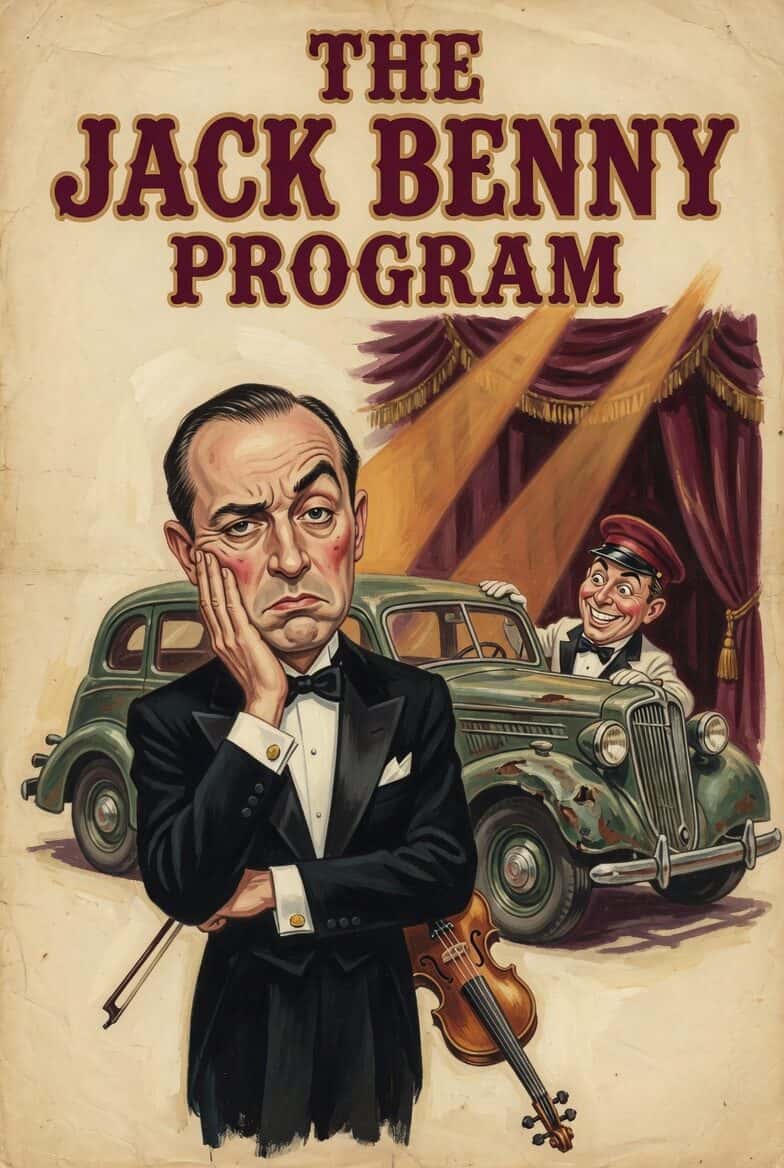
I don't think even Benny could afford that. As a matter of fact, Bob, Jack's even now looking over the entries. There's Mary Livingston next to him. Let's listen. Say, Mary, have you decided yet what horse you're going to... Ladies and gentlemen, as you all know, the last race was a photo finish, but you won't know the results till tomorrow. That's strange. The picture turned out so good that we've decided to show it at your neighborhood theater. Hmm. Now, come on, Mary. We'll walk around. There are probably a lot of people around here we know. Benita, may I have your pencil? Here you are, Ronnie. I'm so glad you brought me to the races today. This is my first time, you know. Yes, yes, I know. Now, let's see, in this next race... And, darling, did you notice the women? Most of them are wearing lovely things. Benita, please, please. I'm trying to pick a horse for the next race. But, Ronnie, you don't have to do all that figuring. Why not just bet on the winner? Just bet on the winner? Well, I said...
Isn't horse racing like wrestling? Don't they know ahead of time? I'm afraid not, darling. You see, horse racing is a sport. Wrestling is just something they use to sell television sets. I just can't decide on a horse for this next race. Well, Ronnie, why don't you bet on the horse that Mervyn LeRoy told you about? Oh, yes, yes. He gave me early bird. And he knows horses. And look, it's a long shot, too. Well, that settles it. That's the horse I'm going to bet on early bird. for you. Oh, my. What a big crowd here today. Seems as though every one we... Oh, Ronnie. What is it, Benita? Look to your left six miles over. Who is it? Jack Benny. What? Will we do if he sees us? I don't know about you, Benita, but I'm going down to the starting gate and run around the track. Make hands with your jockey.
No, look, Benita, are you sure that's Benny? Let's have a look through those field glasses. Is Jack all right? You're looking through the wrong end. I know what I'm doing, darling. It puts him farther away from me. Is Mary with him? I don't know. I've just lost him in the crowd. Say, Jack, the next race will be on in a few minutes. Aren't you going to make your bet? Yes, Mary. Five bucks on audacious man. Come on, let's go over to the $5 window, Mary, and... Hey. Hey, Mary, look down there. Where? Down that aisle. Isn't that Ronnie and Benita Coleman? Oh, yes. Well, come on. Let's go over and talk to them. Jack, they came to the track to enjoy themselves, and I'll leave them alone. But, Mary, if they knew I was here and didn't stop to say hello, they'd be heartbroken. Come on, right down this aisle. Gee, Ronnie is handsome. I wonder how I'd look in a mustache. Well, they don't look good on everybody. Now, take my sister, Babe. Oh, be quiet. Your sister, Babe.
Hello, Benita. Hello, Mary. Hello, Jack. Hi, Ronnie. Look who's here. Hello, Ronnie. Aren't you surprised at meeting me here? Ooh, am I? You know, you know, Ronnie, there must be a hundred people here that I know, and yet I just had to come over and say hello to you. Well, thank you, Jack. Now, don't keep the other 99 waiting. Oh, I can see them later. Say, Ronnie, what horse are you going to bet on?
on the track are the horses for the sixth race. Ronnie, have you picked your horse yet for the next race? Yes, Jack. Come here a minute. Hmm? Oh, you better, man. Early bird. Uh-uh. What? Early bird hasn't got a... Jack! Mary, I'm only going to tell him to bet on my horse. Look, Ronnie, forget about Early Bird and put your money on Audacious Man. He'll win by eight lengths. Now, Jack, my mind is made up. I'm going to play Early Bird. But look, Ronnie, I've been studying these horses all season. I know what I'm talking about. Audacious Man can't lose. I'm sorry, Jack, but I'm betting on Early Bird. Well, okay, Ronnie, it's your dough. But don't say I didn't tell you. The horses are nearing the starting gate. Well, I'm going up the window to make my bet. Five dollars on the nose. Now, if you girls will excuse me, I'll go up and place my bet, too. Ronnie? Yes, Benita?
Jack Benny is betting $5 on Audacious Man. I know. Well, Ronnie, if Jack bets $5 on a horse, he must know something. Well, no, I don't care. I'm going to stick with Early Bird. But, darling, think of it. Jack Benny betting $5. Benita, maybe you're right. I'll take his advice and play Audacious Man. I'll be back. Benita, it's fun coming to the races once in a while, isn't it? Yes, I've enjoyed it tremendously. The horses are in the starting gate. Well, I did it, Benita. I bet on Jack's horse. $100 on Audacious Man. Good. Now they're all lined up. Say, this is exciting. And there they go. First turn is Hitchwood in front. Naturalist, second. Straddle is third. Early bird is fourth. And Audacious Man. Come on. Come on, Audacious Man. I wonder what happened to Jack. Coming around the far turn. It's still Hitchwood in front. Naturalist, second. Straddle is third. Audacious Man is now fourth by half a length. And Hemet Square. Come on, Audacious Man.
Audacious Man! Driving down the home stretch, it's Straddle in front. Here I am, kids. Hedgewood is second, Audacious Man is third, and here comes Triplicate and Early Bird. Come on! And now, coming into the finish stretch, it's Straddle, Triplicate, and Hedgewood. And coming up fast on the outside, it's Early Bird. It's Straddle and Early Bird. It's Straddle and Early Bird. Now, Early Bird is pounding hard. They cross the finish line. Ronnie! Ronnie, we won! We won! What do you mean, we won? I bet on your horse, Early Bird. What? Jack, you mean that when you left here, you didn't bet on audacious men? No, you talked me out of it. Ronnie, what are you so unhappy about? Jack Benny, I bet on the horse you gave me. You did? Ronnie, how could you be so silly? Ooh. Benita, you shouldn't have done that. He's wearing glasses. Ladies and gentlemen, continuing this great miracle of America Hour, here speaking to you from Washington, D.C.,
is the Honorable Maurice J. Tobin, Secretary of Labor. The Columbia Broadcasting System and the Advertising Council have given me this opportunity to speak to you briefly. I am happy to take advantage of it, for one of the most notable things about the American labor movement is the emphasis it has always placed upon the spread of economic knowledge among its members. In fact, representatives of both the American Federation of Labor and the Congress of Industrial Organizations serve on the public policy committee of the council which reviewed this program. America has one resource which is priceless above all others. It's manpower. And now more than ever, that manpower must be used wisely and must be used well. We know that what we used to call the Cold War is now over.
We know that we already face one very hot and very furious in Korea. I can say without hesitation that labor will not fail to carry its fair share of any load our country must bear. It has never yet shirked a patriotic duty. It will not do so now. But we must remember, there will be no relaxing, no letting down behind the Iron Curtain. So let us thank God. that we are free, and resolve that we shall stay that way. Let us rededicate ourselves to this priceless miracle that we have twice in a generation fought to defend, and that we must again guard vigilantly the miracle of America. You have just heard the Honorable Maurice J. Tobin, Secretary of Labor. One way you can help guard our American principles is to send for the free booklet, The Miracle of America.
Send a postcard or letter giving your name and address to your local CBS station. And do it now. Simply say, I want the miracle of America. Now back to Robert Young. The lights of freedom burn brightly in our land. On every street, on vast highways, and in the public meeting places. Frank Sinatra knows of one of those lights. With the help of Axel Stordahl, he'll tell us about it in song. Frank? The light that's burning most brightly is the one that burns warmly and hopefully for all mankind in the window of the house I live in. What is America to me? A name, a map, or a flag I see. A certain word, democracy. What is America to me? The house.
I live in a plot of earth, a street. The grocer and the butcher and the people that I meet. The children in the playground, the faces that I see. All races and religions, that's America, the place. I work in the worker by my side The little town or city Where my people lived and died The howdy and the handshake The air of feeling free And the right to speak my mind out That's America to me The things I see about me, the big things and the small. The little corner newsstand and the house a mile tall. The wedding and the churchyard, the laughter and the tears. The dream that's been a-growing for a hundred and sixty years. The house, the face.
Most of you listening to this Miracle of America broadcast are citizens of the United States by virtue of the happy circumstance of having been born here. But at regular intervals, in cities throughout the country, men and women of foreign birth stand in United States district courts to become citizens by choice. The naturalization ceremony is simple, but deeply meaningful. Not long ago, a man well known to you all experienced that ceremony here in Los Angeles. And tonight, we are proud to present him to you, ladies and gentlemen, a new citizen of the United States, Mr. Charles Lawton. Thank you.
Three months ago, it was my privilege to be in the chambers of the United States District Court when my wife and I were sworn in as citizens. And I should like to describe to you something of that scene. Now, upon motion by the examiner of the United States Immigration and Naturalization Service, the presiding judge orders that the prospective citizens rise to be sworn as witnesses in their own petition for naturalization. Now, that was a truly solemn scene. There were old people, there were middle-aged people, and some young people. And I remember wondering, my wife and I talked about it afterwards, what all the stories were behind their becoming American citizens. Now there are questions by the examiner and the oath of allegiance to the Constitution and laws of the United States of America. And I will never forget the rustle of the murmured I wills. It seemed to come from...
people's hearts. Now on this occasion, it is the practice that the presiding judge addresses a few words to the new citizens. I was very moved by this address. I got a transcript of his speech and I would like to read some of it to you. Today, said the judge, I have the honor of congratulating you upon becoming citizens of the United States of America. I have often felt that those who have come to us from foreign lands have a deeper appreciation of the privilege of citizenship than those who have acquired it through birth. You have come to us voluntarily. You have sampled the freedom and opportunities of America. In our country, people, generally speaking, obey the laws under which we live. Ours is not a police state.
The success of this nation lies in the fact that our people freely and voluntarily comply with the rules of the game of life as played in the United States. American citizenship carries responsibilities. Well, responsibility to live and let live, and the responsibility to do unto others as you would have them do unto you. These are indeed responsibilities. May you find in this nation peace and security. May the opportunities for good living for you and yours be greater than your expectations and hopes. Above all, may the United States of America be a better and greater country by reason of the fact that you have become a part and parcel of this great nation.
which is constantly striving to increase the individual freedom of its citizens, and in these trying days to make lasting peace and security. May the United States of America always be the land of the free and the home of the brave. So much for the judge's speech. My fellow citizens, to his words, may I, Charles Locke, and solemn. Amen. In thousands of different ways, the miracle of this America of ours has made itself felt in your life and in mine. The radio receiver that brings my voice into your living room right now is a product of our free economic system, a system that has made it possible for Americans to own almost half of the radios in the entire world. And in a very real way, the music we listen to is a part of the miracle, too.
But here to tell you more about that is the fellow with a smile in his voice. Ladies and gentlemen, Jack Smith. Thanks, Bob, and hello, everyone. Well, it's true, all right. The songs we sing really are a part of the miracle of America. I'm thinking particularly of a young fellow who started thumping a piano on the east side of New York City and went on to invade the sanctum sanctorum of long-hair music, Aeolian Hall. Yes, popular music really came into its own that afternoon. And so did George Gershwin, who saw an American miracle come true. So here are some of the Gershwin's finest. To help play them, Frank Duvall. And to help sing them, here's Nashville's finest, Dinah Shore. Hiya, Jack. Hiya, Dinah. Well, what do you think of this miracle of America? Jack, George Gershwin summed up the way I feel about it perfectly when he wrote this song. Wonderful. Marvelous. That you should care.
for me. Well, it's awful nice. It's awful nice. Paradise. It's paradise. What I love to see makes my life so glamorous. Oh, it's nothing really. You can't blame me for feeling slightly amorous. It's wonderful. And it's marvelous that you should care and be willing to share. Wild, keen, super duper. That you should care for me. Now here's Uncle Jack with a beautiful George Gershwin ballad from 1930s big Manhattan music comedy, Girl Crazy. They're writing songs of love, but not for me. Of lucky stars above, but not for me. I know that love... the game. I'm puzzled just the same. Was I the moth or flame my mullet sing? So well, what an end. This is the time a fella needs to bring when every happy moth Well, George Gershman's tunes worked their way westward from New York to Hollywood and became the musical heart of many a celluloid extravaganza. Every one of us who has fond memories of those terrific Fred Astaire, Ginger Rogers flickers has fond memories of this one, believe me. I say either, and you say either. I say neither, and you say neither. Either. Either. Neither. Neither. Let's call the whole thing off. I like...
Potato, and you like potato. I like tomato, and you like tomato. Potato. Potato. Tomato. Tomato. Let's call the whole thing off. But oh, if we call the whole thing off, then we must part. And oh, if we ever part, then that might break my heart. So if you like pajamas and I like pajamas, I'll wear pajamas and give up pajamas. For we know we need each other, so we better call the calling off off. Let's call the whole thing off. You know, folks, during the war, the fellows who ran the big army radio show Command Performance had a special boxcar where they kept those thousands of G.I. letters commanding Dinah Shore to sing that time-defying tune by George Gertrude. Embrace me, my sweet embraceable you. One look at you.
Jack? Yes, Dinah? You know, Gershwin, in a way, does sum up the miracle of America. His songs had the feeling of our country. I know what you mean, Dinah. The vitality, the energy, the real knowledge of what makes America great. George Gershwin knew what made America. I wonder how many folks listening right now know. Well, Dinah, I guess we all take America pretty much for granted. Freedom isn't something you can just draw a picture of. Oh, but it is something you can read about, Jack. Something you can learn. Something you can actively support. That's why I want to urge everyone to read the free booklet, The Miracle of America. I've read it, and believe me, it'll help you learn about our country. It's a responsibility, Dinah.
the responsibility of every single person living in the United States to read this booklet, to read it and reread it and learn about their country. Folks, won't you take a minute now and write to the radio station to which you're listening? Simply say, I want the miracle of America. That's all. It's free. Ask for yourself, and you're asking for your country. You're so right. But now it's time to say so long, Dinah. So long, Jack. And thanks, everybody. This is your Master of Ceremonies, Robert Young. You are listening to The Miracle of America, produced and transcribed from Hollywood. This full hour special broadcast is pleading no cause except the cause of democracy and has nothing to tell except freedom. Still to be heard from on this special broadcast are Lucille Norman, United States Secretary of Commerce, Mr. Charles Sawyer, Bing Crosby and Gary Crosby, Governor Earl Warren, and Dick Hayes. We pause now for station identification.
This is CBS, the Columbia Broadcasting System. Yes, the miracle of America is a wonder to behold. And to continue this great full-hour Miracle of America broadcast, once again your host, Mr. Robert Young. It may seem strange to you that we should present a program to sell you something you already own. But that's exactly the case. Because tonight, our only purpose is to sell you America. to remind you of the advantages you enjoy living in this land of ours. Now it's music again to continue the story of the miracle of America. This is Lucille Norman. Stephen Foster is a part of our American musical heritage, too. And Lud Bluskin joins me now in a medley of Stephen Foster songs. All Stephen Foster favorites, perhaps none is more fondly remembered than this lazily romantic ballad.
Well, a part of that miracle is the fact that a song typifying the South can become a favorite in North, South, East, and West. Yes, all of America claims this as its own song. Down upon the Swanee Where my heart is turning Where the old Fluffin' down the whole creek I roll along and store the old For the old folks at home My heart from the old
Now speaking to you from Washington, D.C., the Honorable Charles Sawyer, Secretary of Commerce. Good evening. I'm sorry I cannot be with you in person on the Pacific Coast this evening. But no member of the cabinet can stray far from his post during these critical days. I'm happy to take part in this refocusing of attention upon our American economic system. All of us enjoy the benefits of our system, yet too many of us have but a vague idea as to how it works. Never before in our history has it been as important as now to realize that we Americans live better because we produce more efficiently. Our ability to produce what the economists call productivity is our horn of plenty in peacetime, in war, It is the key to victory. Now we have before us the double task of fighting an overseas war and continuing an adequate flow of civilian goods. To do this, all Americans must team up to produce more efficiently than ever. This task is not beyond us. Our productive capacity has increased incredibly since the years before the Second World War. Businessmen have spent, within the last five years, over $115 billion in new plants and equipment. In every line, production is at practically an all-time high, and output per man-hour has greatly improved. At the moment, this is more than a matter to be proud of. It may be a matter of life and death. Let us all rededicate ourselves to this miracle that is America.
You have just heard the Honorable Charles Sawyer, Secretary of Commerce. For your copy of the booklet, Miracle of America, send your name and address to your local CBS station. Again, your host, Mr. Robert Young. We Americans are people who find a great deal of our strength, our happiness, at home in the family circle. And in many ways, all our families are pretty much alike. Sharing the same problems, finding laughter and a little fun in the everyday happenings around the house. For example... You know how it is with your teenage son about to go out on his first date. Well, in this case, the son's name is Gary. And the father who makes with all kind of advice is Bing Crosby. Thank you very much. You know, in the Crosby household, there are four boys. That's if you don't count me. The youngest is Lindsey, who's 11. Then there are the twins, Dennis and Phil, who are 15. The oldest is Gary, who is... Yeah, you all ready?
Step out, son. Do your pop proud, huh? Thanks, Dad. Say, uh, isn't that the new ensemble you're wearing, the new suit there? Gary, you look pretty sharp. Yes, sir. That's Mom's idea. She even made me put on this necktie. Oh, well, certainly. I would hope so. You're appearing before the public tonight. You are, too, Dad. Where's your necktie? You're wearing it. Gee, Dad, you're doing pretty good. You ought to have more than just one necktie. I don't see why. I've only got one neck. Yeah, but you got four sons. Yeah, that's why. on this afternoon? I don't have to practice, Dad. I want to sound like my favorite singer. Well, I see. But, son, what you don't realize is that I do practice. Oh, I know you do, Dad. Maybe I'm taking too much for granted here. Just who is your favorite singer? Elroy McDougal. I've never heard of him. Where's this McDougal ever sung? He sings in our glee club at school. All the fellas think he's gonna be another Morton Downey. He sings that high? Yeah.
but Elroy wonders how he's gonna sound when his voice changes. He worries about it. So does Downey. Hey, uh, Dad, I was wondering if it would be possible for me to get an advance on my allowance tonight. Gary, I don't like to be the stern parent, but if you want extra money, you can do what I did when I was a kid. Aw, Dad, I don't want to stand on the street corners and sing. I didn't sing on street corners until after I joined Paul Whiteman's band. Whiteman had me sing on the street to drive people into the theater. Who drove him out? Nobody drove him out. Henry Buzzy blew him out. To get back to your case, now, I don't see why you need any money anyway. As long as you're going right home to bed, there's no need of it. I hadn't planned on going right home to bed tonight. Oh, you hadn't? Uh, no. I thought I might go out for a bite to eat later and maybe take in a movie. That might be an idea. We might do that. We? Yeah. Well, uh, Dad, uh, would it be all right if you didn't go? Going out to eat with one of your school chums? Well, yeah. Kinda. What do you mean, kinda? Well...
What I had in mind is more like a girl than a chum. What are you talking about? Well, it's a chum, but you couldn't exactly say she's a fella. You? You asked a girl for a date? It was inevitable, Dad. Now, this comes as something of a shock to me, Gary. You're an athlete. You're a football player. You shouldn't be thinking about girls. Well, girls are more fun than football. And they're not so seasonal. That's right, but you amazed me tonight. I always thought you were bashful, bashful type. I always thought he was being timid around girls. Yeah, that's good. What do you mean? A shy guy does a lot better than a wise guy. Let's not get into techniques. I realize that you should be going out on dates, but really not so soon. After all, Gary, you're only 14. I'm 16. Oh, yes. Even at 16, son, you've got plenty of time for girls. That's what I say. From now on, I've got plenty of time for girls.
Boy, now I'm beginning to realize how Louis Stone felt every time Mickey Rooney walked into his study for a heart-to-heart chat. Well, Dad, how about it? Can I go out on the date or not? Well, I guess as long as you've gone ahead and made this date, we'll have to take her out to dinner. We? Sure. Then I'll be the laughingstock of the whole world. It's not that I'm ashamed of you, Dad. It's just that you might get in the way. Get in the way of what? How do I know? This is my first date. Now, don't get excited. Gee whiz, you treat me like an infant. I think I was 15 instead of 16. This'll work out. Now, don't get the idea that I'm old-fashioned. Please don't do that. I don't want you thinking I'm a wet blanket. I'm a very modern parent. I'm a wet electric blanket. And the three of us, I think, I think the three of us can certainly have a good time tonight. But gee whiz, Barbara asked me for the date, not you. What? Barbara had to ask you for this date? What's the matter with you? You're supposed to take the initiative.
Dad, I wish you'd make up your mind. One minute I can't have the date, and the next minute you're telling me how. All I can say, things have certainly changed since I was a boy. Maybe I am being a little old-fashioned. I'll tell you what. You can go out and have dinner and dance. You don't have to take me with you. Thanks a lot, Dad. Nothing personal, you understand. You're a lot of fun on a fishing trip. You're a great comfort, son, a great comfort. Then right after the show, you kids can go out. I want you to behave yourselves and have a good time. Gary? Yes, sir? Make sure that you're home by 11 p.m.
Oh, Dad, 11 o'clock. Things don't really start jumping until after 11. That's right. At 11.05, you'll be jumping into your pajamas. Hey, how about doing a little song with me? You mean play some simple melody? That's the one. Let's do that for the folks right now. We'll get by, all right. Grab the ukulele now. Let's go. Won't you play some simple melody like my mother sang to me?
With a good old-fashioned harmony Play some simple melody Musical demon, set your honey a dream And won't you play me some rag Just change that classical nag To some sweet, beautiful drag If you will play from a copy Of a tune that is choppy You'll get all my applause And that is simply because I want to listen to rap. Musical demons that you lay some simple melody. Just change that classical night to some sweet beautiful drag. We'll play from a copy of a tune that you get on my floor. And that is simply because I want to listen to rap.
Now speaking from Sacramento, His Excellency, the Governor of the State of California, Earl Warren. Our nation today faces a crisis, the effect of which is felt particularly by all of us who live here on the West Coast. It is essential that we do everything possible to strengthen ourselves for the present conflict of ideologies. It is vitally important for each of us to find out what the American system under which we live really is. Without that knowledge we cannot know how this world crisis affects us as individuals. Without this knowledge we leave ourselves open to infiltration of disrupting forces that can spell the destruction of our American way. Our free system is the very foundation of our way of life, a way that provides the highest standard of living ever enjoyed by any people in the history of the world. I urge each one of you to find out what our American system really is. One way you can do this is to send for the booklet The Miracle of America. I have read this booklet, and I have found it a worthwhile analysis of our system. The Miracle of America booklet is warmly endorsed by leaders of both labor and management. Send for this booklet now by mailing a postcard or letter with your name and address to your local CBS station. Now it's music again to continue the story of the Miracle of America.
And the man to tell you all about it is Dick Hames. Thank you, and thank you very much. Millions of people embracing all the faiths of Christianity express that faith in their own way, in their own churches. Common to all is the Lord's Prayer. I would very much like to repeat it. The Lord's Prayer as set to music. It's a special broadcast urging you to stand for a booklet titled The Miracle of America. This booklet was prepared by the Advertising Council, Incorporated. And here speaking to you from Minneapolis is the chairman of the board of that organization, Mr. Sam Gale. Speaking for the Advertising Council of America, I wish to thank the various citizens' committees from management, labor, educational, and other groups who have helped make this broadcast possible. Also to the many stars, technicians, to the Radio Writers Guild, the Television and Radio Directors Guild, the American Federation of Radio Artists, the American Federation of Musicians.
to everyone whose cooperation has created the miracle of America. I wish to thank the Columbia Broadcasting System for making available the time for this special broadcast. This program has one purpose only, to acquaint you with a booklet that reflects the faith we all have in America. We urge you to write for a copy of this booklet for your home. Complete knowledge of the freedom we Americans have is the only way to ensure the continuation of this freedom. The booklet that explains this freedom is called The Miracle of America, and hundreds of thousands of copies are being made available. To receive your copy, merely write the station to which you are now listening. Write now and say, I want The Miracle of America. Thank you. And this is Robert Young adding my word of thanks and saying good night to all of you. The Miracle of America is a wonder!
This special broadcast was produced and transcribed in Hollywood by Sterling Tracy with special music by Leith Stevens. This is CBS, the Columbia Broadcasting System.