
The written record
Read the transcript
Read along with the recording · About 42 min to read
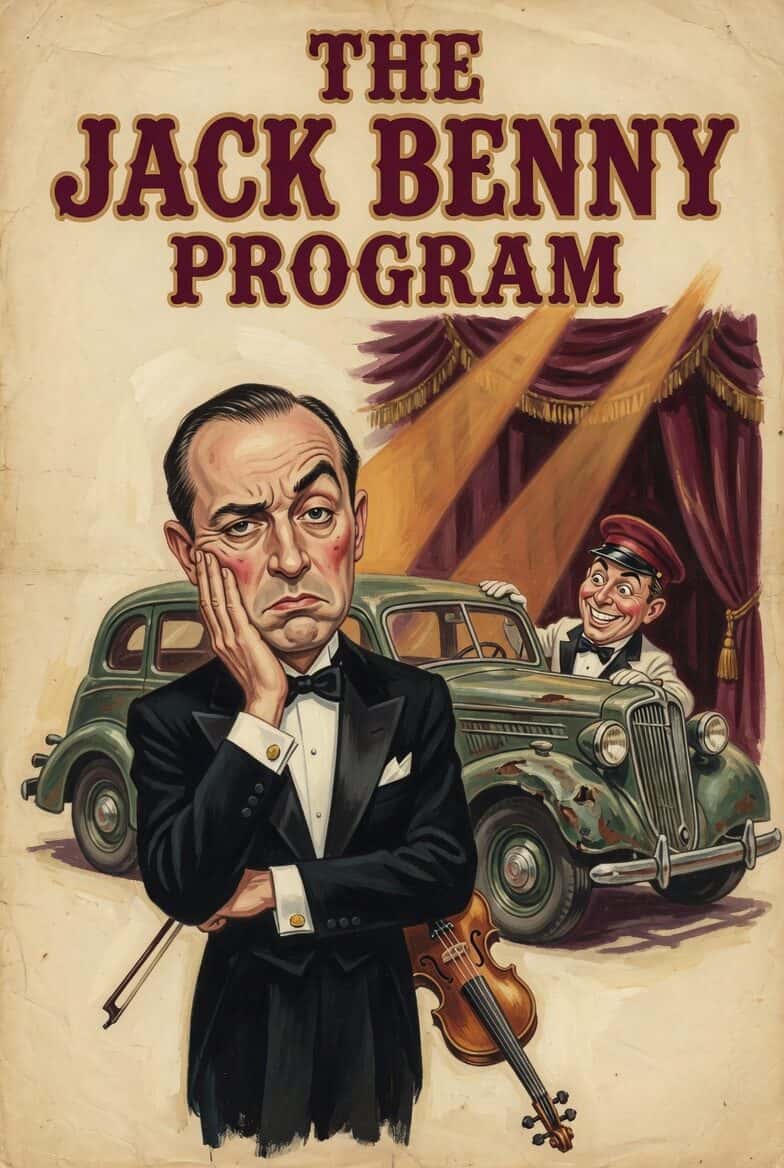
And the Jack Benny Program. And guests Ronald Coleman and Dorothy Kirsten of the Metropolitan Opera. April 25, 1948. Classic stuff. And we remind you again, as we always do when we play these shows with original tobacco ads, those commercials are no longer allowed on radio. But we play them as documentary evidence that they once were and remind you that the Surgeon General has determined that smoking is hazardous to your health. sometimes. And it is now eight minutes until four o'clock on KNUS in Denver. Are we going to take a break? Your choice. Okay, we're going to take a very brief break, and then we're going to come back with George Balzer, one of the longtime Jack Benny writers. We'll be right back.
Today on Bob and Ray's Hobby Time, we have Ralston McGregor and his dental floss sculpture. What's this, Ralston? That's a swan, Bob. Composed entirely of dental floss. That's right. Amazing. Do you work with floss right out of the box or after it's been used? Used? You know, to clean your teeth. Teeth? To scrape off the plaque that leads to tooth decay and gum disease. You mean this stuff is good for teeth? Are you sure? I got that straight from the American Dental Association, Chicago. 60611. I'll be darned. The Old Time Radio Show continues now on Talk Radio 71. Here's John Dunning. There we go. Seven minutes until four on KNUS in Denver. And boy, Bob and Ray fit right in there, didn't they? We're going to go out to the West Coast on our long lines and talk to George Balzer for a leisurely chat about the Jack Benny Show. And we're going to hear some more excerpts as we go along. Are you there? Is he there?
Let's see. No. Let's try him again. There he is. Oh, you got me? I got you. Well, fine, John. I had a rapid heartbeat there for about 30 seconds. Well, that's true. You didn't bother me at all. I wonder why. Did you hear the end of that? I did, and by a strange coincidence, you played a show to which I will refer to a little bit later on. Oh, okay. You know, you're very familiar with the show, then. Oh, yes. The minute I heard Dorothy Kirsten, I knew what show that was. That was great stuff. Well, thank you. We've got so much here to talk about in the next 50 or 60 minutes. Well, why don't I just come up and spend a week? That's a great idea. Are you ever in Denver? I haven't been in Denver for, well, let's see. I guess I went through very quickly with our camping equipment, but we didn't stop.
But during the war, during the years of the radio show, why, we used to get into Denver maybe once a year. We always had a great time in Denver. The writing, I don't know, technique, when there are, what, five or six of you, how many of you were there at a given time? Yeah, why don't I clear that up right now, as long as you brought up the number. Okay. Basically, four writers on the show.
When we got into the transition years from radio to television, we added called the Junior Writers. Now, before we added, my partner, Sam Perrin, and myself, and Milt Josephsburg, and John Takaberry, we worked together until, I believe, the other two. And then when we really settled into television, why, then we dropped back, and at that time, and myself were retained, along with the two younger writers. And then Milton Tack went their way to other 12 years, and my partner and myself, five, and probably more than that, if you want to count the period of the first television specials and so forth. You talk about Sam Perrin as your partner. Did you actually break up into those two different groups? Well, more or less, because I met Sam originally.
On the Burns and Allen show, when I was just starting out. From that time, then Sam and I worked together. We were considered a team. And did the two different pair of you trade off? One of you would do the cast portion one week, and the other would do the story portion? Is that the way it was written? No, it wasn't. We had no set pattern. What we would do on Sunday evening, we would go off the air.
And at that point, we hadn't the slightest idea what we were going to do the next Sunday. And we would spend Monday supposedly just taking the day off, but you really don't. It's always on your mind. And somehow about Monday evening or during the day Tuesday, we'd come up with an idea or two. Then the four writers would convert by telephone. When we had formed what we thought would be a good idea, why we would get to Jack. and probably just by phone and say, Jack, this is what we think we ought to do, so forth. He would say, yeah, let's do it. And then on Wednesday and Thursday, why we would, the two teams would, Milton Tack would work on one half of the show, Sam and I would work on, he would say, yeah, let's do it. And then on Wednesday and Thursday, why we would, the two teams would, Milton Tack would work, work on the other, and it never mattered which part.
Usually our conversations would end with, which half do you want to take? And if they had no preference, maybe we would have. So we would indicate which part we'd want to take, so we'd take it. And we'd work on that Wednesday and Thursday. In the rough, Jack, home in Beverly Hills, clean up the script. And it would be sent to Mimeo, and Saturday we would go to sea and rehearse it. Sunday we'd go back to the stand on the air. Sunday evening we were back. We didn't have a show for the next week. You literally had one rehearsal then. Yes. We would have a rehearsal on Saturday. Then we would have, we called that a reading on Saturday. It wasn't really a rehearsal. That was just to get a feel of the script, for the cast to get a feel of the script, and time it out, see how, then we would polish it up a little more, and then Sunday morning we'd come in and have a reading, go on the microphone just for, and break until airtime. That was the, lovable part about radio. Yeah. One of the pieces of tape I brought today, Jack has a line in there where he says, I only ask for one rehearsal a week and you still get it wrong. Something like that. That's why I asked that question. You literally did have one rehearsal. Oh, yes. Let me put it this way. We not only worked for a beautiful man, we had a wonderful job.
Do you remember how... Somebody asked me a question about a week or two ago, and I couldn't answer it. The question came up from someone who was not that familiar with the format of the show. Why was Dennis Day always listening, or always somebody, anybody in the cast, always listening to a rehearsal of the show or listening to the show on the radio? And in so many of the shows, we go back and relive a show. Do you remember how that format got started? You know, I don't even recall the format, and I recall the show quite in very fine detail. Just exactly what... Say that again. Let me try that again. I don't know whether format is the right word, but so many of the Benny shows, he is either late for the show and listening to it and feeling that he can't get there, or he is reliving the show.
going back to a show that was done last week. They're always at his house talking about the show that they're going to do next week. And I guess the question the listener had for me was, was there ever any shows where they actually were supposed to be doing the show as it went along? What he thinks was a format really happened on very rare occasions. Very rare. I can't really... If I had to pick out a show that... went that way, really have to search. And the only reason we would do that would be if it made sense with our storyline, what little storyline we had. But rarely, we were most all, or if not on stage, we would start in Jack's home. And from there, things would happen. Or we would start in the corner drugstore, maybe between rehearsals. The corner drugstore.
It's two minutes after four in Denver at KNUS, and I'm talking to George Balzer about the Jack Benny Show, one of the writers from the Jack Benny Show. The drugstore really existed, didn't it? Not actually. There was a play we would, between the last rehearsal and airtime on Sunday, but it wasn't the drugstore. No, making it a drugstore came out of our own imagination for the simple reason that when we did a scene, where it was before showtime and the cast was gathered in the drugstore having a bite. It gave us more laughing in the drugstore than in a car. And that's about it. I always swore I would never ask a writer where a guy got his ideas, but writing comedy and writing for a comedian like Jack Benny, it seems that over a period of 25 years you must have done everything at least once.
How did you get those ideas, and how did you avoid repetition and stay fresh? Well, you know, actually enough, we didn't really avoid repetition. If you'll analyze the Benny shows, many of them are, and people have told us, they seem to be the same. Well, there seemed to be a sameness, let's put it that way, about them. And the reason for that is because that's what the listeners wanted. When we didn't do them... Now, if you have a moment, I'll give you an example of what I'm talking about. As you may remember, we established completely that whenever we traveled, if you'll recall, we usually had a show with Rochester. Either Mary would drop in or he would call her, maybe talk to her, and so on. We'd fill up half the show. Then we would go to the railroads, and then we would walk through. The train announcer, which was played by Mel Blanc, would just start.
to drive Jack crazy, if you're glad. Okay, sure. Then when he would go to the ticket booth with Frank Nelson, he got into more trouble. Then he had people coming up to him, the magazine girl, whatever, and they drove Jack crazy. Now, you remember how we built that year after year. We did that every time we traveled. Now, here's what we did. We had an idea. So one day, thinking of what we might be doing the next week, week, and I said, Jack, I think I've got an idea that might work. We're going to be going to New York. That means we're going to be doing a show of packing, going to the station, and then do the station. He says, yeah, naturally. I said, I know they want it, so here's what we're going to do. We're going to do the packing, we're going to get in the cab, we're going to go to the station. Front doors of the Union Station, you stop, and Mary's going to say, Jack, what are you doing? You say, Mary, I can't go in. I couldn't go through that in one more time. Drive me nuts.
And she said, but Jack, you've got to. You have to get on the train. We have to go to New York. He says, yeah, I guess so. And he opened the doors, and you heard the sound of people in the station. And then you heard a train, a beautiful voice, giving a legitimate train announcement. And Jack says, you see, Mary? You see, I told you. Wait a minute. He says, the fella announcing the trains. He's a nice fella. The crazy guy is not here anymore. Now, she says, validate your ticket. Goes up to the validating counter, and there's the nicest man you'd ever want to meet. Yes, sir, what can I do for you? Why, certainly. There you are. Jack says, I don't understand it. Where's that other guy that used to be here? And this we did at every booth, every place he stopped to do something pertaining to getting on the train. Other train announcements were made along the way.
I can't get over it. Now they get on the train in Union Station, Los Angeles, which is about six, seven miles away. And we're riding along in Jackson. I just can't get over it. That's the first time I came to that station. They treated me like a human being. Now, as we're going along, Mary says, oh, darn it. Now, incidentally, the point I wanted to bring out was that when we hit this very nice station, you could hear the studio audience go, they were disappointed. So we're riding along on the train now, and Mary says, oh, darn it, I forgot to buy a magazine. Jack says, look, Mary, we're going to stop in Pasadena. I'll jump off the train, run into the station, buy the magazine, be right back on. She says, Jack, don't bother. He says, no, no, I'll get it for you. The train comes to a stop. He runs along the track into the station, and the first thing that hits him is train leaving on track five for Anaheim, Azusa, and Cucamonga.
From that minute on, for about four minutes, we had Frank Nelson, we had Benny Rubin, we had everybody there who just drove him nuts. And he finally ran out of the station screaming and jumped on the train, and we went to New York. Now, the only reason that pulled firmly in our listeners' minds, that they couldn't wait for the railroad station, and we didn't give it to them, we delayed it. That is one reason, getting back to your first question. We did a lot of things that had a sameness to them, but it's because it was expected. And I guess that takes care of that. Yeah. In terms of where you get your ideas, you really didn't do the kind of topical stuff that Fred Allen did. You must not have gotten too much of them from the newspapers, right? We used to do, yeah, if it was, we used to play off topical, not necessarily comedy about the city, about the news but we would use the news as background for things for things that we would do uh that isn't very clear i'm trying to think well one with with phil has since during during the war in in the coal mines now at that time whenever you whenever you closed you had to there's an agreement between labor and management a skeleton crew would stay on and the furnaces would kept kept lit because if you ever let them cool so on then they all had to be rebuilt So they kept going even during the strike. So one day, playing off of that situation, Jackson, I got good news for you. I stopped drinking. Are you sure you really stopped drinking? He says, that's right, Jackson. I only have one martini a day. Stop drinking. Why do you have one martini? You can shut it down, but don't let the fire go out. Now that's playing off a current news item for humor. And it played big.
There must have been an enormous camaraderie on that show. Well, only hesitating because I want to make this so clear. All the members, very strong. And I've had Jack to me, and I've heard him several times say it in interviews. And this was his attitude. Always say with a twinkle eye that I, meaning Jack Benny, came. Then he would say very seriously, after me, come my forearm. Then you can put my sir. parking lot attendant, janitor, or anybody you want. But don't you ever put anybody between me and my... Stop and think about that. Great tribute, Dan. Just what it means. Not only a tribute to those of us who did the writing, but a tribute really to himself in that he was smart enough to know that a performer that wants innate ability to stand in front of an audience and perform when he has that, Then he must support that good material. And Jack never denied that. And he said, this is my unit, myself. The classic line that Fred Allen...
said to Jack Benny, and I guess paid you all an additional compliment, was you wouldn't talk to me that way if your writers were here. That's right. Jack Benny said to Fred Allen, I got it backwards. That's right, yes. Did you all write for him on other shows when he was on, like, Fred Allen's show? Did you write his part of it? No, we didn't, because we, and I say we, including Jack, had so much respect and had the pleasure of knowing Fred quite well, had so much respect for him. Mm-hmm. Sure. I'm going to be on so-and-so's show next week, and I just got a copy of the script. Right or not, would you tell me? And we'd take a look at it. And I will say, in most cases, it was pretty good. And we'd make a few suggestions for it, and then he'd feel better, and he'd go do the show. Yeah. So we were actually in television at times. We attended every rehearsal, whether it was radio, television. Many times we'd have a guest star.
a big name. During the rehearsal, during a break, the guest star might say to Jack, Jack, don't you think it would be funnier if here you said so-and-so to me, I am, and he'd give a new line. He would say, yeah, maybe that is something. And then he would immediately turn to us and say, hey, fellas, come here a minute. He'd say, he's got a funny idea, maybe. And usually, usually, we'd say, Jack, we think we ought to
Oh, sure. And I have to admit, once in a while, not very often, but we'd say, yeah, I'll bet, and we'd do it. But Jack relied. He relied on his writers to answer his requests. I asked this question of Frank Nelson, and he took exception to it. I mean, not exception. He said that this was not true. I'd been reading for years that Jack Benny, You know, you read the old cliche, I think Fred Allen coined it, couldn't ad lib a belch at a Hungarian restaurant? It actually wasn't Fred Allen. Who was that? I believe that was Harry Kahn. Was it true, though? I mean, was he... Oh, do you mean, was it true about Jack? Yeah. No. Let me tell you now. On the air, they were few and far between. It had nothing to do with his ability to ad lib.
It came from his respect, written word. And he believed, and he finished with a script, that that was the script. He rarely stepped out of that script. A lot of times here on this page, when he said to me, so-and-so, I was all, it might hurt what, and he wouldn't do it. Amazing. So, you know, Jack was perhaps one of the most knowledgeable men about comedy, the delicacy of comedy, the difference between, Between success and failure, very fine line. If I may, I'll tell you a story which backs this up. Okay. One night after we heard Jack, and he said, Benny, I just heard the rehearsal, and I think you ought to, you should cut those two jokes on page six. And Jack turned to page, he says, this one here and that one. But I cut them because they aren't funny. He says, wait a minute. Ever say that a joke, isn't funny you think it isn't funny i think they aren't funny jack says now that i'll buy you said you think they aren't funny but unfortunately for you me and my four writers think they think they are funny and they're going to stay in and the jokes stay both got big laughs now the only point i tried to make is that jack always he says remove comedy there's no no one can say for a hundred percent that You can only think it's wrong. And when you think it's right, then we do it. And we hope that we're right. And I will say, and I think for so many years, we're right. You bet. You know, well, let me just say again, it's 20 after 4 in Denver. I'm talking to George Balzer, one of Jack Benny's four major writers throughout the years. I guess you came on in 43? I did, yes.
You know, I wanted to ask you something, but I think I'll save this until a little later. I wanted to talk a little bit about how radio really seemed to kind of grow up around 1941 or 2 as I listened back to the shows. I'll ask you right now. I wonder if it's just me or if it really is a fact, but as I go back and I listen to hundreds and hundreds of radio shows, it seemed to me that... in radio comedy particularly, all of the comedic shows seemed to really start putting on long pants around 1941. Fibber McGee and Molly was suddenly doing timeless stuff. Jack Benny was, Fred Allen was. They had gotten out of that stand-up vaudeville stuff that you hear when you go back into the 30s shows. Do you agree with that? I do to a certain extent because even on the Benny show, I recall,
When we first joined the show, when we first show, we went to New York. Now Jack had been on seven before that. And he had two other, I think Bill went in the army and Ed went to the. So we came on the four. One of the reviews, I think, I'm not sure. Reviewed our opening show and it was a great review. A fine show and so forth. Commented on the fact that comedy wise it was stronger than in the past. The jokes.
By that I mean, and I think you're right, about that point is where things began to... I'm very happy to say that for me it was a privilege. I wonder why it happened right around then. It seemed to happen almost across the board. All the shows that you remember as great. All right, let me make a guess. Because I haven't discussed this with anybody before. I think it was wartime. I think the war had much to do with it. That's easy to explain or not. But I think it was the general atmosphere seeking strain and so forth. And I think they just did better than they did before. And then you sort of... You rose to the inspiration of it. That's my guess. I could be all wrong. I don't know. I'm just guessing at it. But that's what I think it would be. I wanted to talk about the integrated commercials a little bit.
Jack Benny, I think, did those better than anybody. I know Fibber McGee had them. They did wonderfully with Johnson's Wax. I have a little piece of tape here, which is one of the, to me, one of the classic moments of integrating commercials into the show. We talked about it on the phone, the famous Shaboom bit. Yes. I'd like to play that for the audience, then we come back and talk about it a minute. Fine. Okay, hold on. We're going to... We're going to hear a little piece of tape, Jack and Don go into the drugstore. This is from the show of October 31st, 1954. Hmm. All the tables seem to be taken. Let's get those two stools at the end of the counter. But there are two right here, Jack. Oh, yes. I'll see if we can have them. Oh, waitress. Waitress. What do you want, Mac? Are these two stools available? No, they're reserved for the Duke and Duchess of Windsor.
Come on, Don. Let's sit down. What do you want to eat? Well, I haven't made up my mind yet. Better take my friend's order first. What do you have, Don? I can't make up my mind either. Maybe we better look at a menu. Have you got a menu? Here. Now, let me see. Don't bend it. It's the only one we've got. Look, I'm not... And stop drooling. There's nothing on it that good. Look, miss, all I want is a chicken sandwich. I'll have the same. Okay, I'll be back with a grub in a minute. You know, Jack, I just can't understand how a girl like her can hold a job here. Now, wait a minute, Don. Don't be too hard on her. You know, she's had a tough time of it. Do you know that she used to be a big star on Broadway? Really? Yep. For three years, she played the title role in The Voice of the Turtle. That's the way her head keeps coming in and out.
What'll you have, Mac? Say, Don... Oh, excuse me a minute, Jack. Excuse me. The sportsmen are sitting over there. The quartet? Where? Yeah, over there in the corner. I want to talk to them a minute. Well, remember, Don, will you give them a warning about what I said? I'll talk to them about it. You do. You drive me nuts. Shine on, shine on, harvest moon up in the sky. Hey, Mac. You want milk to drink with your sandwich, don't you? Yeah, how'd you know? Our coffee would knock you right off that... All right, all right. Just bring the milk. Now, fellas, please, do yourselves a favor. Take my advice. Don't sing that song for Jack. This is neither the time nor the place. Oh, here he comes with that quartet. Now, look, fellas, I'm telling you for your own good. What's the matter now, Don? They want to sing a new number for you. Here in the drugstore? I should say not or it'd be embarrassing. I told you, fellas. You see, Don, they won't listen to anybody. That's why I want to fire them.
But, Jack, they claim that this is a very beautiful song. I don't care how beautiful it is. Boys, he's mad at you anyway. Now, you better not do a thing. Don, Don, will you keep him? Boys, hold it, hold it. Don, will you keep him? I'm singing. This is why I want to fire. Life could be a dream, Shaboom. Shaboom? If I could take you up in paradise above. Shaboom. Shaboom. If you would tell me I'm the only one that you love, life could be a dream, sweetheart. What happened to Shaboom? Oh, life could be a dream, Shaboom. If only all my precious plans could come true. Shaboom. If you would let me spend my whole life loving you, life...
Could be a dream. Shaboom. Sweetheart. Sweetheart! You gotta do something about these guys. Something is on my mind. If you do what I want you to do. Baby! I could be a dream. If I could take you up to paradise up above. If you would tell me I'm the only one you love. Could be a dream, sweetheart, sweetheart. Shaboom, da-boom, da-boom, da-boom, shaboom, sweetheart. The only thing I understand is sweetheart, now. Now look out. Fellas, we're in the drugstore. Pop on a lucky and you will agree. Shaboom, boom, boom, shaboom, Mr. B. Lucky strikes are made of light and fine tobacco. You'll get better taste and lucky strikes are back. Yeah, lucky strikes are posted. Fellas, please. Fellas, everybody's looking at us in the drug store. Fellas, we're in the drug store. Don, I told you. Fellas, we're in the drug store. People are not eating. Wait a minute. Boys, wait a minute. Wait a minute. That, to me, is inspired.
You know, I'm glad you highly, but I think we had several that really surpassed. But then we did so many integrated commercials. And with the quartet, the story behind the quartet might be interesting. Sure. It came out of a meeting when actually Sam Perrin, what if we had a quartet while he's doing the integrated commercial? And basically that was a good idea. So we kicked it. around a bit. And what we decided was that Don would hire the quartet and think he had done a marvelous thing for $2,000. He hired the quartet. And he came out on the show and he said, Jack, I just picked up a quartet, just sensational. They only cost you $2,000 or $1,000, whatever it was. And Jack says, wait a minute, $1,000 for a piece? He says, Jack, you'll love them. Now, Don did the integrated commercial in which he did about, oh, 15, 20 minutes, 15 or 20 seconds straight cell. Then the quartet would just go, he did another bit, and they'd go, hmm. And Jack's standing there, he says, $1,000 for that. That's attitude. Now, we only wanted to use the quartet on that one show. They played so well that Don brought them back, supposedly, in our story. The next week enforced them on Jack. Well, the next week they had a little, they were going to do the cell and so forth, with Jack throwing.
off the stage. And then the next week, they're back again, and it reached a point where I don't know how long they were on, but five, six years or more. But that's the way most of our not only within the show, but from week to week. We never knew what was going to become a party, and I happened to have the idea for the railroad station. When we did that the first time, in January of before we were going to New York, At that time, we figured that was the end of that. But for the next 20 years or more, every time we went to the railroad station, to the airport, was in keeping with the times. We just did it over and over and over. New people, new people, but new ideas. And so just never let go, but the audience wouldn't let us. Boy, Mel Blanc sure played a variety of parts on that show, didn't he? Mel played Jack's parents, played the motor to his Maxwell. Sort of wise guys.
I remember him playing the sniffing gymnasium... Oh, yes, the boxer. Yeah, the boxer, the pugnacious, and the violin teacher, Professor LeBlanc. Professor LeBlanc, the violin teacher, which was, again, it was an idea that that show... And then about three weeks later, in putting a show together, trying to get an idea for a show, we said, why don't we have Jack take another violin lesson? And it just continued on and on, and no end to it. The same thing, Mel was the little Mexican in the seaside routine. Yeah, we just got a question on that. Somebody just called in and wanted to know whose idea that was. Well, I'm happy to say, because it had such long life, that was my idea. Now, Sam, he's very nice.
doing show which is the start and john houston and in our sketch the setting was in mexico old in mexico sure and in our sketch jack played and don wilson at a point i said sam like i think i got a funny idea when we run into sick and bandits ask him another question him another question then jack your name you'll say sigh say sigh to see i'm said yeah that sounds kind of funny why don't we do that
Now, again, this is something that we felt would be in one show, and that's the end of it. We found another reason for running into the little Mexican routine again. Then we began to do, and I have a collection of routines, taking different shows and show. When I go around different places, I show them how it changed, but we just got a little crazier and crazier with them. How did you get the job? How did you get started with Benny?
I never forget that I was very, very fortunate in that, briefly, my history is that, as a young man, my health wasn't a chance to do an awful lot or listen to radio. And I began to say to myself, I think I can write that kind of material. My version, even though I listened to them, there'd be scripts for them. Fate, Andy Devine, who was on that time as Benny Sears. Do you remember that or have any of those recordings? I have some of them, yeah. Yeah. Well, Andy's brother, Tom, out in the west end of the San Fernando Valley, where we were living, happened to be in right behind us. Now, here I am, a young fellow wanting to make a Benny connection, and Andy Devine. So I made it a point to be over there, and I asked Andy, Woody, what do you think a writer has? And he says, George, they use up material you think you can do. Andy, he was there again, and then one day, Harrington at Young and Ruby Camp, advertising agency. So Tom went in.
And he said he just wanted to talk to me because you never knew when something might happen and so forth. And he said, by the way, how would you like to go to the Jack Benny show next Sunday? Tom was then producing. And for me, a young kid, practically, this was half because I had never up to this. Well, thank you so much. And he reached over and buddy. And then there's a long pause. And he says, oh, phone. He turned to me and he said, no, I was terribly disappointed. But he said, if you will come to the artist entrance. and asked for me, they will bring you back to the, so I went down to NBC Hollywood, or over on Melrose at that, went to the artist's entrance, Mountain got me and went in, and I saw my first room at the Jack Benny show. Now that's kind of an unbelievable, then of course nothing happened, because at that time Jack had his writers, Bill and Eddie, and with a writer who, or Bob Burns, you remember Bob Burns? Oh sure, the bazooka. Right.
who was on the Bing Crosby Craft Music Hall. Sure. And I worked for this fellow for a while up in the attic, sliding jokes under the door, almost no money. Why, I got a call from the advertising agency, and they wanted to talk to me about going on the Burns and Allen show. And that was when George and Gracie became man and wife on the air. Up to that time, they were just a bottle team. Right. They did that swan. And then, when the summer came along, the summer replacement, Tommy Riggs and Betty Lou, you probably never heard of them. Oh, sure, Tommy Riggs. All right. Yeah. They then took the time on Tuesday night, myself, assignment. About the ninth week, we were told sponsors, the Tommy Riggs and Betty Lou show, come back to Tuesday. We would then go to Friday, which we did, and we ran a 13-week assignment into 65 weeks. On about the 62nd week, I came from Jack Benny, and I had to go to New York.
Hadn't been on a train for... I came out from the East. And next thing I know, I find myself in New York, and I'm meeting Jack, working for him, or at this point. Very... It sounds like, you know, when you say you just thought you could write that kind of material. Now, to me, comedic writing is the most difficult kind of thing because, you know, something is either funny or it isn't, and often the author is the last one to know that. Well, I'll tell you what it is. It's a gift. It's something you're born with. Now, I don't mean that you can't improve and do it. You can. But if you don't have it to start with, say, gee, I think I'll be a comedy writer and become one. They better have fundamental... It's a certain way of looking at the world, isn't it? Well, yeah. Then people say to me, well, were there any indications as a young...
that this might happen to you. And I said, I didn't know it at the time, but as I reflect, there were certain things that I now know that someday I would be involved with comically writing. I can remember in high school, I had just finished the peers over, the bell rang, and as the bell rang, everybody got up to leave. And the teacher looked at me and she says, George Balzer, don't you leave this room. You stay right there. And when the room was empty, she says, come up here. He says, what's wrong with me? I said, well, I don't know. What are you talking about? She says, I stand up here trying to teach this class, and you're sitting back there with a face. She says, is my showing? Have I got a run in my stocking? Am I exposed somewhere or what? I start out in front of the desk, then I get behind the desk, and then I slide down, and you're still smiling. So I said, well, no, I don't. There's nothing. I don't see anything. She says, well, you're driving me crazy.
as I analyze it, while everybody else was thinking about history or economics or what, apparently something funny is going on in my mind. And I'm kind of smiling to myself, and she thinks that I'm getting a kick out of it. So anyway, those little things, they all kind of build and tend that, yeah, somehow you see something funny in everything. Are you in the advice business? If a young comedy writer came to you today and said, what would you advise me to do? Do you do that? Or would you tell them it's just something you have to feel? Well, I would tell them mostly what I just told you. If they feel, they think funny, and have a good sense of humor, then I say, this was the advice I got. Sit down and write. And eventually, it'll come. Now, if you don't have it, it's not going to come.
How about reading? Are there great writers of comedy that you have read? No. You don't do that? No, I was never much of a reader. And I never followed anybody's advice as how you have to together, because a sense of... And I watch today and see a lot of comedy where... sorry for them to this point where I say, oh my gosh, they had such a great joke underway and then they missed it. They didn't develop it. You know, the punchline was wrong. There's a certain rhythm to comedy, as you know. And if the rhythm isn't right, you kill the laugh. There's such a way in constructing a joke. Don't use up...
That takes a little bit of explaining toward a joke and finding that when you give the punchline, it's no longer fresh because you've used up key words already in the buildup. Use a synonym in the buildup and then words. Someday I'll write a book explaining that because I'm not sure I understand it, but that's the way I work. They don't have to play for laughs today because they push buttons and get laughs. This is a terrible thing. When I started out, and everyone from my time, you wrote, you gave your material to a performer, he went out on that stage and he did it, and you either died right in front of that audience or in front of millions of people who might be tuned in. That gets your adrenaline flowing, doesn't it? But today, yes. But, you know, today they write four lines and the attitude is, I don't know if that joke is right or not, but they'll laugh in there.
This is why now they think it's funny to go over and turn a doorknob. You know, open a door, it's a laugh. Hello is a laugh. Goodbye is a laugh. Sure. Well, it isn't a laugh. Anything. They're just not fooling anybody but themselves. Any little tiny bit of sarcasm is a laugh. And I look back at Jack Benny's show and Phil Harris' show as masterpieces of sarcastic humor, Mary especially. In fact, we've got... We've got about five minutes to talk here, and I haven't even begun to ask you questions. We didn't play the second piece of tape we've got. I wanted to ask you about various members of the cast. I'll have to get you back some one of these days. All right. But Mary is portrayed in Joseph Spurge's book.
as being kind of a naturally sarcastic comedian who really brought a lot of this stuff out herself. And it was kind of in her personality. And some of it, according to his book, was really biting and sent Jack Benny off into a funk. Yeah, well, let me get... Now, since you played that Dorothy Kirsten show, that's where she sang, was it in the commercial? Right, right. All right. Now, very quickly... The biggest laugh, supposedly, people think, was the your money or your life joke. By Jack's own admission, that was not his biggest laugh. There was publicized laughter because it got a lot of publicity and a lot of print. But Jack himself says there were at least ten other jokes that got bigger laughs. And then he says, he was writing a guest column one day, and he went over this topic of the biggest laugh.
He said the biggest laugh he ever got was on a show with Dorothy Kirsten. Now, this goes back to Mary. When Dorothy was on, as you recall today, she and Don got into a discussion. The operetta Dorothy had just sung that evening or whatever. The very high class conversation went back and forth. Dorothy and Don using beautiful musical phrases, whatever they were, just descriptive phrases for music. Recall that? Oh, yes, I sure do. All right, and then Jack stands there like a jerk, and he would love to get into this conversation. So when he says, well, I thought, Mary just looked at him and says, oh, shut up. And that, Jack, the biggest laugh he has on stage, and even though that is not a joke, I had the bill going, and I needed something to really show what kind of a guy Jack was, could handle him.
And it was a simple thing, just old up. Because you knew Jack wanted to get in there. And he didn't belong in there, and Mary knew it. You know, it's funny you mention that, because a couple of us were sitting here talking about it. And I think I mentioned that's, I believe, as big a laugh as your money or your life. It's bigger. See, I have the comparisons here on tape. I have this because I use it to show people. Money or your life is about a... second laugh. And you can get it out and time it if you want. Time the laugh on Oh Shut Up. It runs about 27 seconds. That's the difference. I'll take your word for it. It is an enormous laugh. Jack just stands there and the audience is so sorry for him and yet they laugh at him because he asked for it himself. He should never have tried to get into that conversation. So take care of that point. I guess you're almost out of time, but I'm not.
I can go on talking after you're... You know, I'll just hang up the phone. We're really rolling now, and we've got about three minutes left. Well... You would agree with Joseph Spurge's book that Mary had that natural biting... I don't mean that in a negative way, but she had that ability and that personality. No question about it. Mary rode herd on Jack. By that, I mean she always kept him in his place. Her character was... You know, she was not Jack's girlfriend. She was not, of course, on the air was not Jack's wife, even though in real life she was. She was just a girl that Jack liked very much. We were going to do a scene where Jack had to be with a girl. He would be with Mary. But if he had to be with a good love interest and romance, he's with somebody else. One of those sarcastic dames like the gal in the drugstore. Or, or, or, hmm? Yeah, that was done by Iris Adrian.
Telephone operators. The telephone operators, Bea Benederat and Sarah Berner. Marvelous, marvelous performers. They played as the telephone accent. And so I always said that their characters were two girls who could step out of a swimming pool smelling of perspiration. That's a great line. It's just the kind of character they played, you know? Oh, gee, I hate to say this, but that's going to have to end it for us today. I appreciate you being on enormously. It was a lot of fun. Well, I've got pages all over my desk here I haven't even flipped yet. I hope I can lure you back to these microphones one of these days, not too long from now, because I have a whole list of questions about the cast that I haven't even asked you yet. I've got them all lined up here to tell you something about each one of them. Well, can we do that?
Can we come back sometime? Well, let me put it this way. I've enjoyed doing it. Okay. And if you want to do it again sometime, let me know. I sure will. All right. I appreciate it. Thank you. Thanks much. You bet. Bye-bye. Oh, boy. George Balzer, one of the great four writers of The Jack Benny Show. And we're at five minutes until five on KNUS on old-time radio. We'll be right back after these words. All right. We're back. I want to... George Balzer is gone, but I want to thank him again for a fantastic hour on Old Time Radio. High priorities to get him back here because that was super. We got some other super things on KNUS in Denver. I want to remind you that we have a whole menagerie of talk shows during the week. Gary Tesler will have John Dean on on Monday. So tune in for that, all you Watergate freaks.
and see what a real-life Watergate man has to say two years later. And come back next Sunday for Old Time Radio. We'll hear Studio One, a full-hour show called The Angelic Avengers with Ann Blythe. That's a pretty good show. May of 1948 is the date on that. And we will get back to the Halls of Ivy. We'll do the show that we were going to do today, which is called The Lost Dog. That actually is a pretty good show. That's a collector's title. That's another actual title. Ronald Coleman and his great wife, Anita Hume. And Saturday night, we will do some more old-time radio, and if I have my things together, I will be able to tell you what it is. The Black Angel on suspense, and Mysterious Traveler, great show, behind the locked door. So we'll see you then.
I want to just tell you once again that Old Time Radio is brought to you by the Public Service Company of Colorado, a longtime sponsor, and we do appreciate all of you who have written to them and told them you like the show. See you next week. This is KNUS in Denver, where in just a couple of seconds, it'll be 5 o'clock.