
The written record
Read the transcript
Read along with the recording · About 19 min to read
Jack, let's talk about your alter ego, your professional image now. It's an image of a stingy, kind of conceited, rather pompous man. A kind of man that most of us wouldn't like, but you've made him likable for about 50 years. Now, how have you done it? I'll tell you how. Because I take on all the frailties. I think that's the correct word, isn't it? Frailties of man. All of his faults. Everybody has one of those things. Or there's somebody in the family who is stingy, you know. Other who is, who thinks he's a great sex man or something. Other who think he's a hero, you know. And they make fun of old people in their own family. So what I think is, I think that certainly people cannot believe that I would be a stingy.
as i portray the character but the fact that they think well maybe he is a little bit stingy makes it funny i want people to think that you know even though i'm really not i want people to think gee i bet he's a little bit stingy even people who know you very well know that you are not at all stingy yeah they still laugh at this alter ego that's right because they uh they accept what you do on the stage it's like a fella They may think that Edward Robinson, Edward G. Robinson, they know is the nicest guy that ever lived, but when he plays a gangster, he's a gangster. So they accept my character as they would in a play. You see, if I come out, like my opening lines, I always do something like, I just won $80, you're going to get a great show out of me tonight. You see, now that's a big laugh right away. I always try to find certain lines that they're going to laugh at immediately.
so that I got them right away. They accept what they are educated to accept by watching my programs year after year, you see. Year after year, you went on with these tremendous ratings because people knew you. Yeah. And they knew all the people who were with you. And they could see on radio all my pauses. You know, they didn't have to see it visually. They could see it in their own minds. They knew why I was waiting. If Phil Harrison soldered me or Dennis Day said a silly thing or Mary Livingston made a smart aleck report, you know. He was nostalgic about those great days of radio as many of us. Those were kind of nervous days for me because I was trying to uphold a position in show business in those days. You know, while today...
It's all gone by. I have nothing to worry about anymore. I'm too old to be thrown out of show business. People talk to me about radio. I'm not interested in that. That's gone. I don't believe in nostalgia at all. I don't want to go back. I only want to... It's present and future for me. People say we liked you very, very much on radio, maybe better on radio and television. I say I can't help that. I want to be liked on television. But do you understand their nostalgia? Oh, sure, because they could visualize everything. And they used to say, the things you did on radio that we could see, that's better than television. But then I'd turn around and show them some of the things I've done on television that you could never do on radio. Completely different device. Completely different device. You couldn't do it. It wouldn't go over on radio. You see?
So I wouldn't be interested in it. Because suppose I did the greatest radio show in the world today. All these people that talk about how they loved it wouldn't be listening. When you started in radio, it was a conviction on your part that it was the road to go. Oh, when I started on radio. As a matter of fact, in 1931, I quit a job with Earl Carroll's Vanities where I had... 20 more weeks to go at $1,500 a week. Now, you know, in those days, that was a tremendous amount of money. And you traveled, you had your expenses paid, you had nothing to worry about. $1,500 a week. Well, that's like $15,000 a day, you know. And I gave it all up just to try to get on radio because I felt this is nothing. Radio is a thing. And I got on it. It was a conviction on your part. Yeah.
Because a lot of people in those days were saying that it was nothing very much. Sure, I knew you have to get in. Then the minute I saw television was important, then I got into television. So you have to get in all the new media. That would suggest that you have a fairly good business mind. Well, not a financial business mind. I've never been a good financial man in business. I've never known exactly what to do with money and all this and that. I had a good business mind as what's good for me in my work, you know? And the other way, I need an awful lot of help. So financially, if I were a real good businessman financially, I would have millions and millions of dollars like some of the other actors who have. Have you ever worried about money? No, that's the trouble.
I never cared about it very much. And that was a problem I had when I was making so much money with very little income tax. I didn't know about money. I didn't know what to do with it. I didn't care. Nobody helped me. But it didn't bother me. I'm just very fortunate that after a certain number of years that they still wanted me. Otherwise, I could have had a problem. I haven't got the problem anymore. Do you believe in destiny? Some are cut out to do things and some are not? I believe in destiny only as two meanings. One, like fate, for instance. I think fate is another word for accident. I think if a person has a tremendous amount of talent and has the opportunity to show it, they're going to get someplace. That's destiny. There are some people who are very talented, probably who've never had the opportunity. I think you must want to work. You must like your work. I think you must try to learn.
From other people. I don't mean that anybody can take anybody else's style exactly. It's impossible, but you can learn we all learn We're still learning when I do a television show. I learned something from The laughing program I learned this I don't mean that I do things that they do but I learn the importance of speed that not to To stay too long now. We don't do anything like laughing But I because I've done the things that I do like laughing I've done way before laughing never Was shown I've done things where you have people come in and do cameos and do short bitch years ago Radio television everything but what you learn from laughing is action don't drag You believe that there are always new things to learn all entertainment i think people learn something from me i learned something from somebody else it all looks so easy for you has it been fairly easy i think i've had it easier than most of the comedians but it hasn't been easy as it is now see now i know what to prepare and what to do what to write i can write for africa i can write for london i can write for australia you know i know exactly what to do i can write for Vegas. Well, that comes with a lot of experience. That's right. A long period of time. But did you start out with the idea of being a comedian? No. I didn't know what I was going to be. I thought I was going to be a fiddler of some kind. And I became a comedian by accident while I was in a sailor show during the First World War. Great Lakes. We did shows. And the author of the shows.
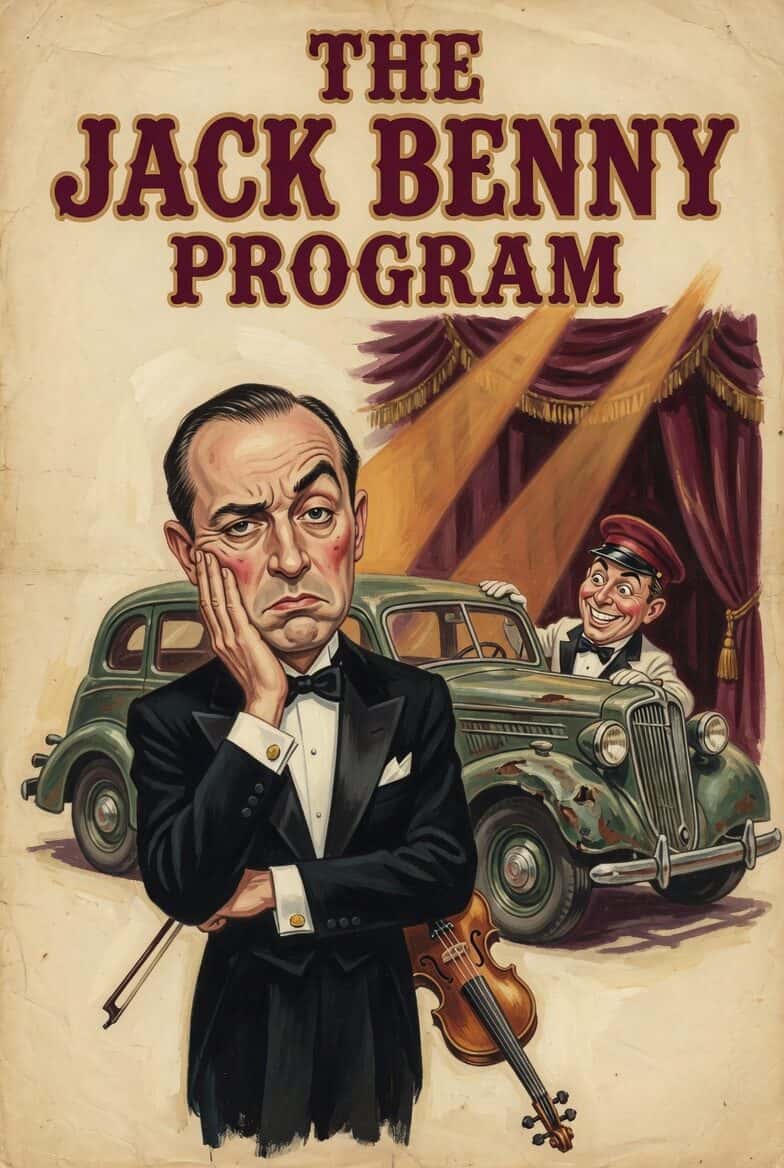
The sailor shows wanted me to read a line once, to play a comedy part of an orderly to an admiral. And he gave me a comedy line to read, one or two. And I read them very well. Why, I don't know, because I'd never read lines before. And he liked it, and he kept embellishing the part. By the time the show opened, I had the comedy part of the show. And that's when I realized that maybe I could be a comedian. Could you have made a living as a fiddler? If I had loved the violin when I was a little kid, as I do now, I could have been a fine, fine violinist. The reason I say that, and don't hesitate to say it, is because when I decided to give concerts 10 years ago, 12 years ago, I couldn't play anything. And I had to pick up like a beginner. And before I knew it, before eight months was over, I was playing in Carnegie Hall.
I gave a concert with your Toronto Symphony. Yeah, but are you really playing for real? Yes. When I give a concert, I play as well as I can. When I don't hear, I play as well as I can. But I think most people go expecting you to pull some boo-boos. Well, if I pull boo-boos, it's because I can't help myself, and that's what makes it funny. If I deliberately tried, it wouldn't be funny. Oh, I do on television sometimes. I'll try and play lousy. for a certain reason you see but when i give a concert i play big heavy numbers and i can't play them as well as a uh as a concert artist a legitimate concert artist but the humor is that i do try to play it that well and that's what's funny but you've squeezed a lot of laughs out of that that's right now had i started if i had been forced to practice like heifetz like stern like milstein no kid likes to practice they had to be forced made to practice if i had someone that could make me practice when i was six years old seven years old i would never have been a comedian and i might have been a great violinist but you see i got the best of it now because now i can still give concerts with the same concert orchestras the same famous conductor i just gave one in london with the london philharmonic with a great conductor and still give legitimate concerts and still get laughs and be the comedian and then do it for charity do you enjoy playing with the symphony of history and what you see me do here really that's my favorite bit of entertainment a concert for which i don't get a dime now going back to those old radio days as we say you you work that fiddle for laughs and i'm thinking of um You know, Professor LeBlanc. Oh, yeah, my violin teacher. Mel Blanc used to play that, you know. Marvelously. Yeah. Oh, yeah, those were funny shows. But your style in broadcasting was not so much political commentary or current commentary. It was family. You created a family of people, and the humor was personal. And I think that that was a great reason for your success, that people knew Rochester and they knew Don Wilson.
The new Phil Harris. Dennis Day, Mary. Was that your idea? Well, it developed. It just developed. It wasn't my idea when I first went on, exactly. I didn't know what it was going to be. It just developed. Is this the way your career's been, just evolving? That's right. It's just... I take the feud that I had with Fred Allen. Supposing Fred Allen and I had gotten together and said, let's have a feud. You know how long that would have lasted? About eight minutes. In about a month, the feud would die. But we didn't. The feud just started. And he picked it up, and I picked it up. We were in that feud for eight months before we even discussed it with each other. How did the feud come about? By my playing a fiddle and him making derogatory remarks about it. And I followed it, and then he followed it, and the first thing you know, we had a real feud going.
Had you known him very well prior to that? Oh, sure. We've been friends for years. He was probably the only real wit that I could have had a successful feud with. Maybe Bob Hope or George Burns, those would have been the only other two. But it was the disparity between the two styles that allowed the feud, because he was almost intellectual. Yes, and not only that, he was... brilliant writer he's a great wit and he was vitriolic he could be vitriolic he could be acidy you know but your style was such doing we were never afraid to make fun of yourself to do you sent yourself as a dope no and I was always try to be the underdog between Fred Allen and myself you know Like if I got the best of them at something, I'd be elated over that, you see. But it was always funnier when Fred got the best of me. You know, you could say you're a comedian and yet you're not a comedian. You're sort of a comic actor. I'm more of an actor, I think, than a comedian. Gleason is. Jackie Gleason is probably the best acting comedian we have in the business.
Bob Hope is better as a monologist Tell me has humor changed very much in your lifetime Or is human basic? I think humor is basic I think you've gotten to the point like everything has changed where you can be a little more risque You see I can do a lot of things there. I wouldn't do on television You know on the stage not only here, but in any theater When I do risque material, I try to find a reason for it. Instead of doing it just to reach the risque part, there's a reason for my saying something. If I say something is risque, it could have something to do because I think a thing is too expensive. Or I think, and it leads into something risque. I never try to tell a gag that...
A risque gag just for the fact that it's risque, unless it has a good basic reason, sometimes a basic truth. You know the one I told about finding the little pad along the pool? The half of a brassiere. Yeah, that actually happened. And that's how we got the joke. That actually happened. When we were laughing, I looked down, there it was. Because you wouldn't make up a joke like that. You couldn't, you know. A lot of jokes are done that way or come from a basic truth. They're drawn from everyday life. Right. You take a thing like that, now I found, now you try to find, oh, this particular gag, this writer that I tell you about gave it to me. He picked it up and he said, I don't know if a woman lost this or there's a rabbi missing. Now you look down, you get the whole picture, look down the pool and see if there's a rabbi down there.
And a rabbi, what's so ridiculous, a rabbi wouldn't actually be wearing that at a pool, you know. But has it been a purpose of yours to observe humanity, to get your humor? Do you study people? Have you done that? I must have, I guess. I don't say that I just studied them. But I wrote a whole routine once about the Fontainebleau Hotel in Miami. just by sitting there watching a show once. And I wrote a whole routine that ran about two minutes. That's a long time. It doesn't sound long when you say two minutes, but you just sit here and wait for two minutes. You see how long it is. All about the hotel, just by sitting there, going through the lobby and watching the rooms and watching the people and everything. Observing. Observing. That's right.
Tell me, what kind of a background did you come from? It's always interesting to ask you that. You always look for reasons for people. Yeah, you look for reasons. You can't figure it out. My sister would have never been in show business. I just have the one sister. My father and mother were never in show business. They liked music. Mother played piano a little bit. They would have liked... The sad part of my life has only been... You see, my father did live to see me become somebody in radio, a big star in radio. He never lived to see it in television, but he lived to see something happen. My mother never did. My mother died before I had reached any importance. And she was disappointed because she expected me to be a violin soloist. Did your father live long enough to see a high school in Waukegan named after you? No, my father never lived.
to see this school named after me. How does it feel when you hear someone going to Jack Benny High? Yeah, they call it the 39ers. I go there once in a while and I hand out the diplomas. And so it's very funny to me when the personnel who work there, when they answer the phone, hello, Jack Benny. Don't you mean Jack Benny High? And I stand and I listen to it. It's a beautiful school, very modern, you know. You've given Waukegan a lot of play. Yeah. Well, you see, you can do it with a small town. You can't do it if you're born in Chicago. I was actually born in Chicago at the Mercy Hospital, but my mother carried me in Waukegan. See, we lived in Waukegan. She only went to Chicago.
To give birth to me was all to the hospital. You were some while back mentioning being in the U.S. Navy, First World War. Had you done anything prior to that? Yes. I did a fiddle act, violin, piano act, and show business. You must have been very young then. Yeah, I was just a kid then. So you always wanted to do this kind of lark. Yeah, I wanted to. I was brought into it by a woman who used to do what they called... piano log she used to sing and talk at the piano and she took me along i was just a kid and gave me a little salary and i played violin we did a violin piano act but this did not please my mother my mother you see my mother wanted me to be a soloist but my mother and father never jumped on me never made me do it and that's the only way that's the only way anybody becomes high fences Child life was just awful. Benny is your first name, isn't it, actually? Yeah, that's right. And the way I used Benny for a last name was that when this woman brought me in show business, the act was called Salisbury and Benny. And so when I went out on my own, even though Benny was my first name, I used it so much that I had to use it as a last name. I had to find something to go with it.
I figured it went with anything. I didn't like when I first saw the name Jack Benny. It seemed ridiculous. Tell me, why are so many great comedians and humorists Jewish, particularly in America? I think what it has to do with also among, like, colored people, I think it's been persecution. And the thing that's kept Jews going and colored people, mostly Jews in this, was the fact. You had to have a sense of humor almost to exist, you know. And some of the great actors, some of the great musicians, look what's happening in Germany. The great doctors, great scientists. Look what we've lost in science because of Hitler, who killed off six million. We might have had a cure a long time ago for cancer. Hitler killed all of that. There were so many that were just killed.
could have young people. But humor does come out of suffering. A lot of it does. I think kids that are born very wealthy for some reason or other, it isn't always conducive to good comedy. Or you take, I never advocate a college. Am I right in advocating a college education? For people who are going to be in show business, I think if they go to high school, that's enough. I'd say if you went through high school, and most of them didn't. I didn't at all. I just went through public school. I lost a lot. And I miss it, too. I miss a good schooling. I miss a lot. And when people say to me, well, how much better could you do? Well, that's a silly question, because I could still do as well and still.
enjoy more of what I read and what I see and my concentration would be better and everything. Just the fact that I've been successful doesn't mean that I couldn't be anyway. And then maybe again I couldn't have been. You never know. You never know. So I just have to be satisfied and just shut up.