
The written record
Read the transcript
Read along with the recording · About 20 min to read
Now stand by for more Sweet Dick Whittington. Daddy, are you doing your homework? Yes, I am. Why? Dad's doing homework because he wears the gold jacket of a Century 21 neighborhood professional. At Century 21, all our salespeople are constantly reviewing the ever-changing real estate rules and regulations in order to help you. Do you have to? Mm-hmm. Why? Because I'm a neighborhood professional. Dad's one of more than 51,000 specially trained Century 21 neighborhood professionals in North America. And them all are working to meet your every real estate need. Daddy. I don't see why not. Will I get a gold jacket, Mark? Someday. But you have to start doing your homework now. Now? Now. There's more to a gold jacket than meets the eye. Century 21. Century 21. We're professional. Professional.
One thing you don't need in a used car is someone else's problems. At Michael's Volkswagen Renault Subaru, they get rid of those troublemakers fast and only keep the best. First thing they do when a car comes in on trade is to check it out with a fine-tooth comb, top to bottom, bumper to bumper, inside and out. Considering a used car, consider the source. Michael's Volkswagen Renault Subaru on Roscoe Boulevard at Canoga Avenue in Canoga Park.
Just a minute. Hey. Hey, you. Have you ever played this number before, bud? Played it? I made it. Benny! I expected you tonight, Jack. I expected you over, but I didn't expect to find you in the orchestra. I can't understand it. I've never played so poorly. Oh, cheer up, Jack. Sure you have. Thanks, kid. But I practiced all morning to limber up. I even washed my fingers in duds. Does doesn't do it. I'm dead. Better switch to Wheaties, kid. But, Jack, I thought Mary was going to come with you. Where is she? Oh, she stopped by the Musicians' Union to pay my dues. Do you belong to the Musicians' Union? Don't act so shocked. Well, then, if I heard it, I'd like to... Of course I belong to the Musicians' Union. I'm one of their charter members. You see, years ago, I had a little band. We all joined together. Oh, I know the group well. A fife, a drum, and a guy with a bandage around his head.
while I've had nothing. Well, obviously, that's a voice that I don't care what generation you're a part of. That's a voice that you know. I'm going to get sentimental on this, and I think most people who deal with any radio listening at all, and maybe you don't even remember what were the great days of radio. I certainly don't represent them, and I don't think there's anybody in radio today who represents the great days. Jack Benny represented the great days of radio. He was a very special man, and I'm not going to do a large eulogy or anything such as that, because I want you to meet a lady who has written just a remarkable book. And I was absolutely delighted with the book, and it's one of the few times I really got excited, because I remember when the book came in, I said, oh, really? A book has been done about Jack Benny, and it, I think, is the definitive book.
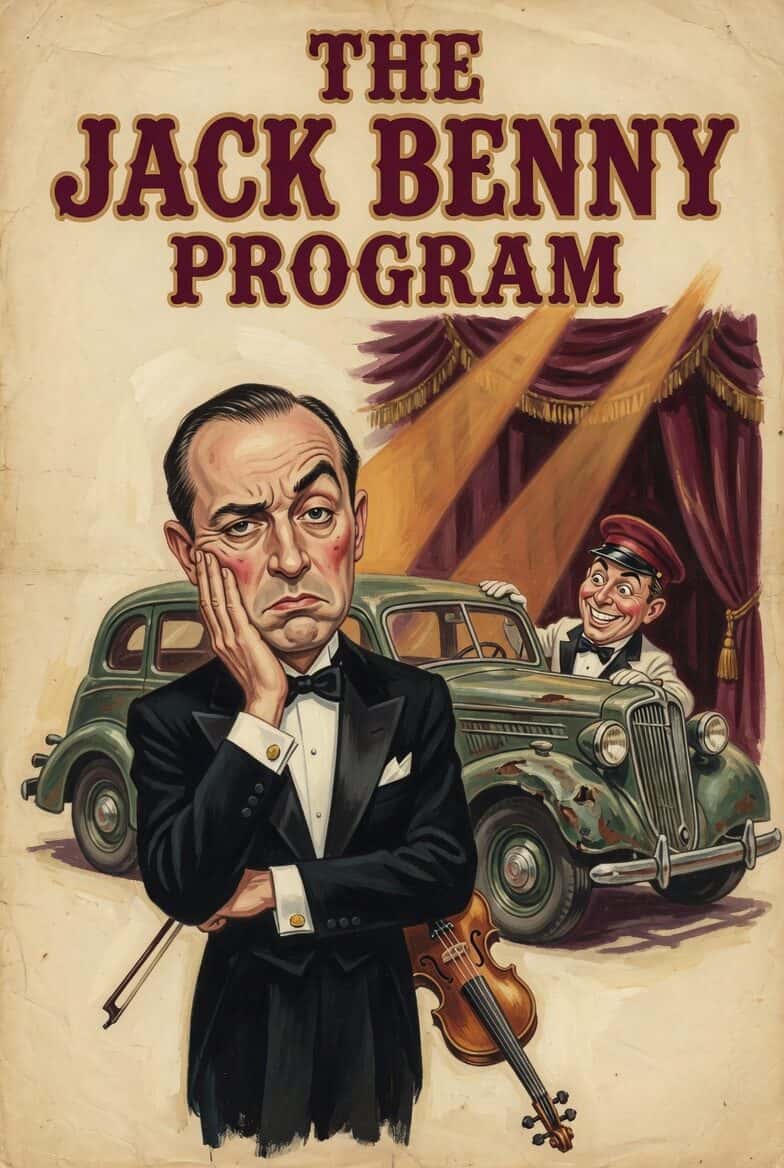
Jack Benny, very simply, I think, in my own estimation, and I think most people will agree with this, was the consummate comedian and will be so judged for the 20th century. Why? Oh, there are many, many funny people. There have been many funny people over the years, over the decades, during the 20th century. But Jack Benny had a unique ability, in my opinion, and that was he could take the most mediocre of material, and because he had a special way, of looking at material, he can make it live and make it be funnier with a hand gesture, with a look, or just a hmm. He can make you laugh. And how many people are like that today? I can't think of anybody. So we're not going to do a eulogy on Jack Benny. I'll just merely, first of all, tell you the cover, the cover I love, because it's, I think, one of the...
One of the best caricatures, if you can call it that, of the 20th century also. It is the most famous of Jack Benny caricatures, and maybe the most famous of all show business caricatures, that caricature of Jack Benny. And why should I dominate all of this? I want you to meet Marcia Borey, a lady who obviously had a very special affinity with Mary Livingston, whom I understand is a very shy lady. And so, Marcia, first of all, good morning. Hi, Dick. It's a pleasure being here with you. Thank you very much. Now, we will do back and forth love numbers here like this, but I understand that this is something I'm really very, very sincere about. I'm glad you wrote the book. Would you describe this caricature for me? Yes, this is the famous Boucher caricature of Jack that he loved so much that was on much of the personal jewelry that he gave to friends. But more important, I think, for the audience, it was the opening of all his television shows.
It's just a caricature of Jack sort of looking off to the side, an imperious look, his hands clutched together. But in essence, it's everything that Jack represented. It's got dignity. It's got class. It's got sort of an enigmatic, you're not quite sure what he's thinking of. But in essence, in these few pen lines, it's Jack Benny. Isn't it, though? And you just described it absolutely magnificent. That was just beautiful. What you did, Marsha... Yes. You... And I understand she's a very private lady. I've never met her, and I don't know her at all. But secretly, I've always felt about Mary Livingston Denny that this really was the woman who made Jack Denny into far more than just a comedian. That there was something, maybe a strength. And I think that in your book, you tell us this. You animate this.
rather strongly, along with Hilliard Marks, who was his producer and his professional mentor. As, for example, Johnny Carson has Freddy de Cordoba. Jack Benny had Hilliard Marks. Would that be a pretty good analogy? Yes, it's an excellent analogy. Of course, I should interject here that Hilliard Marks and Mary Livingston Benny are brother and sister, and that Hilliard Marks goes back 48 years with Jack Benny, as, of course, does Mary. close relationship between all three of them and i think because he was a brother-in-law a lot of people frankly sold him short you know he's mary's brother so he's producing jack show but but marx is is much more than that he's a very sensitive fine man and he and jack spent an awful lot of time together and uh but what you said before about mary is very true she was really the woman behind the man and uh what kind of woman is she because we never We never really saw Mary Livingston. I know that initially she did not want to participate in the program at all. She was very, actually she was adamant at one time and he was insistent that she become a part of the cast. Is that correct? Right. Well, actually it goes back to early vaudeville when Jack, when they were married, Jack went out on the road and Mary went with him. And at that time she was very, very young.
very inexperienced and didn't know from audiences and one day there was a member of the cast missing and they asked her if she would go on for a couple of minutes and she did and this was early radio and got a lot of audience reaction because she was so nervous that she giggled. Of course Mary Livingston's laugh became famous and as a matter of fact she began getting fan mail just addressed to the lady with the laugh on the Jack Benny show. So she went on a couple more times and then became a regular. without really realizing that there were an awful lot of people out there that were listening to her. And after years of participating on all of Jack's shows, she suddenly got up one day and said, I've had it. I'm not going to do it anymore. And he said, why? And she said, because I'm in a panic. Every time I have to go down to that radio studio or then TV, I just can't do it. It frightens me. And Jack was really quite surprised. It's interesting to live with someone.
and be so close, and not to even realize, because Jack, as you say, was a consummate artist. He was always at ease everywhere he went. And it never occurred to him that somebody would be frightened by a microphone or a television camera. But Mary actually is a painfully shy woman. In fact, she did the Johnny Carson show three weeks ago when this book came out. It was the first time she'd been on television in 15 years, which gives you some indication of... how much this book means to her and how frightened she's been. You know, it was very touching. I must say, I was there for the taping and in between doing the commercials, either Johnny or Freddy DeCordova would go over to Mary and sort of reassure her. And actually, she was a smash. She looked beautiful. She was very fluent. And she's just a very unusual woman. I must say that I did not know her all that well before I started writing the book. And actually, her first words to me when we met again to discuss the book were, I'm terrifically thrilled that you're going to attempt this, but I don't think there's a book in Jack. He was too nice. You know, we lived together for 48 years, and there's really nothing you can write that's dirty, and dirty biographies are selling today. And I said, well, Mary, if you'll forgive me for being presumptuous, I think that no one could live and die on this earth and spend 81 years here and not have a story to tell. I just don't think it's been found before.
So that's what I decided to do, to find the essence of Jack Benny together with Mr. Marks. And you did. You absolutely did. And may I ask this? Because I'm just fascinated with, as I'm sure many people who remember when she was participating in the Jack Benny shows, how difficult was it for you as an authoress? How difficult was it for you to get Mary to open up? Well, let me just... tell you something that I'm sure Mary wouldn't mind me saying now that that's all over with, but at the beginning it was quite difficult because Jack had only been dead about six or seven months when we heard that another book was coming out and actually was on the way out and Mary decided to lend her name to this biography and to participate. I don't think even she realized how difficult it would be for her, but she was in very deep mourning.
I also don't feel that she realized how deep she felt the loss. But at the beginning, it was very, very painful and very hard for her to talk about Jack. We would be sitting at her home and she would be sitting talking to me as I'm looking at you now. And suddenly she'd turn away and she'd cock her head and she'd be absolutely silent for a couple of minutes and she'd say, damn it, I thought I heard Jack come in. And then she'd sort of shrug her shoulders and say, there I go again. All my friends are... are very indulgent with me, but every once in a while I just, she said, I just can't believe he's not going to walk through that door. And she says, as a matter of fact, Frank Sinatra took me out to dinner the other night, and Jack always had this thing of if he liked a glass of water or if the steak was the best, he always said it was the best anyway. And Mary and Frank were having dinner with some friends, and Mary had some soup. And she suddenly turned to Frank and said, I can't wait to get home.
and tell Jack how great this soup is. He'll be thrilled. He'll be here tomorrow night. And suddenly everybody looked at her, and she's a woman who's pretty much in control of her emotions, but she started to cry. And she just confessed that it was very, very hard for her after being with him for 48 years to realize that he wasn't coming back and to excuse her if there were times when she might start telling us about something and then have to just, you know, flake off. So that's the way it went as we progressed because we spent a total of two years from the inception of the book until its publication. Is that right? Yes. Two years. That's incredible. Yes. Actually, eight months, I think, seven to eight months in the actual writing. But we did an enormous amount of research. You see, I was not an intimate of Jack Benny's. And I was interviewed along with quite a few other well-known Hollywood biographers. And all of them had known Jack very well.
I had not. I had met him socially, but I had not really done anything on him. And when I went to be interviewed, I spoke with Mr. Marks at the beginning, and I said, you know, I've read every major article on Jack Benny, and there's something missing. Everybody's repeating the same George Burns anecdotes, et cetera, et cetera, and you aren't getting down deep into this man. I said, he must have been a tremendously complex individual. You can't be a simple, ordinary man and be a star for 40 years. I mean, it's impossible. It's impossible. And although everything looked effortless and sounded effortless, I realized that I was dealing with a perfectionist, a consummate artist, someone who always wanted to do his best, and someone who did, and I wanted to know why. So it was I who insisted that we go back to Waukegan, Illinois, because I felt that in order to understand Jack Benny, I had to go back to where his roots were. And so Mr. Marks and I, early on, Went to Chicago first where Jack had a sister, his only family at the time. She has since passed away, but I'm happy to say she read our manuscript just before it was published and loved it. But at any rate, we spent time with Jack's sister, Florence, and then the next day we rented a car and we drove to Waukegan. And after spending some time with them, I excused myself and I just took the car and I went driving to neighborhoods that they had pointed out to me on the way as being places where Benny had lived.
studied or gone to synagogue to be confirmed and the fact that he used to love to look out at Lake Michigan when he practiced the violin because that helped him because he didn't really like to practice very much. So I sat on the banks looking at Lake Michigan and I went to the synagogue which is still there and I breathed in the air that Benny breathed and I walked through this typical Midwestern town and suddenly it came to me, you see. that the essence of Benny is that while so many other of his contemporaries changed and grew, he grew, but he never changed, in basic Midwestern simplicity and honesty and humility, which he retained all of his life. May I say this? Marcia Voorhees, my guest this morning, the lady who wrote this, the definitive Jack Benny book, I think that you love this man almost as much.
almost as much as his wife, Mary Livingston. I mean, I was watching your eyes, mostly, and I love what you've done, and I love the idea that you've gotten into your subject, not because, obviously, Jack Benny, as far as your book is concerned, is going to sell you a lot of copies of books. There's just no doubt about it, because I have said he transcends generations of comedy, because his comedy was so universal. Now, what I want to do, I'm going to break here for a moment, if I may, Marsha, because I want to get you a little loose and a little relaxed because I can see you a little tight. There's no reason to be in front of Sweet Dick. Oh. No, I want you to... I'm not tight. I'm just hunching over the mic because I don't know what the level is. Don't you worry about that. Can I sit back here? No, you can't. Okay, you say it now, you make me... No, you can hold the mic there. You can hold the mic. That's fine. I want you to do some things from your book about Jack Benny that we could not have heard of.
And these are words only from Mary Livingston. Just a taste upon some general things. And we have some excerpts from some priceless Jack Benny that we're going to incorporate through this hour. Now, it's 22 and a half minutes past 9 o'clock from KGIL. Marsha Borey, my guest. And the book, again, is simply Jack Benny. That's all it needs to be. And it's available, obviously. At Neiman Reeds Lumber City stores, service and customer satisfaction isn't just a slogan, it's a way of life. At Neiman Reeds, they stand behind all their merchandise, and of course, there's an extra plus. Free, friendly advice from Lumber City's experts. And here are some March Money Saver values for you. Three-piece paint roller tray set. This quality set consists of paint tray, birdcage frame, and roller cover. Regularly $3.39, now just $1.88 complete. Or a sanding block, ideal for hand sanding wood, metal, boats, and autos. Regularly $3.19, now just $2.44 each.
Watch for your copy of Lumber City's March Money Saver Catalog of Values. They're at Lumber City now. Open Monday through Friday from 8 a.m. to 9 p.m., weekends from 8 to 6. Neiman Reed's Lumber City. It's where the experts are. Are you tired of the hustle and bustle? Would you like to experience the old kind of bustle? Well, there's an old-fashioned Easter display at the Promenade Mall in Woodland Hills. And Jeannie, the high-wheeler lady, has her best bustle on. See antique bicycles, baby carriages, and gay 90s fashions on exhibit now through Saturday. The high-wheelers ride the mall Friday and Saturday, and the bush sanctuary birds add their beauty on Saturday. For a beautiful Easter exhibit, visit the Promenade Mall, just four blocks north of the Ventura...
on Topanga Canyon Boulevard now through Saturday. All right, sweetie, thank you. Now we'll get back to Marsha Borey and just a lovely book. Marsha, can I ask you, I have one more to do here, but I was going to ask you this. Do you think Mary Livingston might be listening today? Yeah, I hope so. I don't know. She usually doesn't get up before noon. Oh, I'm sorry to hear that. But that's why I'm... taping it so that we can... Oh, good, because I would love to talk to that lady on the phone one morning. I would just love to do that, and I was just thinking... Maybe she'd be arranged. I would like that. Well, she is very shy. I know that she is, but I would just like to do that. I don't know why I'd like to do that. I'd just like to do that. I'd just say hello and goodbye, and that would be it, but I'd just like to do that. Now, let me do this for Quaker State. Unless it's Quaker State, the motor oil you've been buying isn't America's best-selling motor oil, and that's for sure.
There's only one number one. That's Quaker State Motor Oil, refined only from Pennsylvania-grade crude to make sure your car gets the protection it needs. Take good care of your car. Use Quaker State regularly. And you know why we say Quaker State helps cars last, and that is for sure. What are you asking for this rhapsody and junk? I'm asking $95 FOB. FOB for old Benny.
How about it, Fred? Say, if you don't know, laughing at your next Sunday show, all right. I'd give $1,000 if I could think of an answer right now. If you don't know by now that I don't want that car, you ought to have your skull thinned. You don't want the car, and I think you don't. I'll be on my way. No hard feelings, I hope. No, Jack, I haven't anything against you, not Benny the man. I'm just not in the market, that's all. I hope I didn't offend you. Oh, no, Freddy, I'll just have to sell it to some other guy. Thanks, Freddy. Goodbye. Hey, what was that, Jack? That's what my car thinks of you, Alan.
That, of course, was the late Jack Benny and the late Fred Allen. They had a special kind of a relationship. And the way I understand through your book is that Allen had almost a reverence for Benny. Is that correct? Absolutely. I think it was a mutual admiration society. There were certain things that Fred could do that Jack could not do. He was a great writer. Fred Allen was a great writer. Yes, did all of his own writing. And Jack was a great editor, the best in the business. The difference being that Allen perhaps would originate some of the material, or all the material, whereas Benny depended on writers for a first draft, but then it was Benny's draft that went on the air. He edited, he honed, he refined, he switched lines. They would have, for instance, before they did a show, they would have...
a complete run-through just of a reading, with Jack reading all the parts. This was the first run-through. If in the reading of the script he found, for instance, a line given to him that he felt Rochester should do, that Rochester would get more laughs, he would insist on it. I love that about him. He was the first comic who, or actually comic actor, I prefer to call him, really, who was not afraid to let other members of his cast get the laughs, because, you know, and when people complimented him on it, he said, look, The next day the reviews will say the Jack Benny show was great. They won't say the Rochester show was great. But he said, I want Rochester, Dennis, Phil, Don, Mary, everybody to have the lines that will give the show the best laugh. And this format that he originated is something that even today I'm sure the Mary Tyler Moore people, Norman Lear, all of the great comedy material today is based in part on Jack's format.