
The written record
Read the transcript
Read along with the recording · About 14 min to read
Hi, folks. My name is Mel Blanc, and I'm known to many of you as the man with a thousand voices. Well, let's say about 400 of them, truthfully. I tried to gauge how many voices I actually did, and I wrote down the amount that I did, and I had to stop at 400. I didn't have that much time to go on and count more, but at least 400. And I might tell you about myself. I was born in San Francisco, California, making me a native son. And I was born on May the 30th, 1908. And when I was a young boy, I moved to Portland, Oregon, where I received my grammar and high school education. And I started in show business, actually, when I was in school and just a youngster. I always used to entertain the class.
I got big laughs from the teachers, big laughs and lousy marks, but it was a lot of fun learning to do these various things that I do now. When I was going to grammar school, I was taught the violin. It took about eight years of lessons on the violin, and I used that for small orchestras, and then I learned how to play the tuba, which I used with the larger bands. Tuba is the sousaphone, you know. And I eventually formed my own orchestra, and I played for the Orpheum Theater in Portland, Oregon, in the year 1931. I was the musical director, in fact, the youngest musical director that Orpheum had. I directed, I think it was eight acts of vaudeville, along with giving a band presentation for the audience.
And I made my radio debut in 1927 when I was just out of high school. I was a comedy singer, and my brother Henry was the accompanist. He played the piano. And when I completed my Orpheum Theater playing, I returned, rather, I came down to San Francisco and worked in a show for NBC. It was then called The Roadshow. I was master of ceremonies of this show for some time. That was in the year 1932, the early part of 1932. And I came from there down to Los Angeles and to Hollywood, and I was a miserable flop. I couldn't get a job. Instead, I got married. I married a very lovely girl. Her name is Estelle. And that was, let's see now, that's 30...
a little over 31 years ago, and we're still married. That's something for Hollywood, isn't it? And we have one son, and his name is Noel, and I'll tell you about him in just a moment. But I got married down here and then went back to Portland, Oregon, where I had my own radio show, and it was called Cobwebs and Nuts. And this actually was like a college education to me because I... learned to do these many voices due to the fact that I didn't have enough money to hire anybody else. And my wife Estelle did the female voices. Of course, she didn't get paid, but she felt it was her duty to help out. And after working in Portland six days a week for an hour a day, I decided to come down to Hollywood again.
either stay in Portland and have a nervous breakdown or come to Hollywood and relax. So I came down to Hollywood with practically no money, and I lived with my mother and father-in-law for about a year and a half. And finally, during that time, I got one job on KFWB with Johnny Murray. Johnny Murray was a wonderful guy, and he had a show called The Gafferson Sattler Show. And I worked with him for some time, and he paid me more than I was making in Portland for each show that I did with him. From there, I got a job on the network with a young man named Joe Penner. This was actually the first network show that I did, and Joe was a very wonderful man. And I worked with him for some time, and then I branched out and worked with various other shows.
on the network, including Jack Benny, but I'll get to him in just a second. And this was around 1937. I went into Warner Brothers, which was then Leon Schlesinger, and I asked for an audition, and I was postponed for about a year and a half. Finally, I got an audition for them, and the man said, his name was Treg Brown, he said, why didn't you come to me before? I'd been trying to get in for about a year and a half, but Treg enjoyed it, and he said, do you mind if you go through the whole thing again? I'll call in the directors. I said, no, I'd be very happy to. So they called in the directors, and they seemed to get quite a kick out of my various voices. And in fact, one of them, a fellow by the name of Tish Tash, who is Mr. Tashland, director now, He said, I got a job for you next week. Can you do a drunken bull? I said, why, sure, I can do a drunken bull. I'd be very happy to. So I got that job in 1937. That was my first job. Later, I started working regularly for them, and I started out with a little guy by the name of Porky Pig. And I'll do some of those voices for you in just a moment.
Getting back to my son, Noel, I now have a business which is a commercial advertising business which does humorous commercials and campaigns for various clients. And these are all done through the agencies. And we have several of them on the air right now. I imagine you've heard them. And they're all very humorous commercials. Then we have a jingle department from which we write crazy jingles. or some are summer-sensible. And then we have a various type of music and ad-libbing and talking for meetings, that is, for clients who have sales meetings, and it is called the sound of selling. In this, we do original music, and even the coffee breaks are thrown in for the guys to hear.
We introduce all, of course, the president and the various other officers of the firm. And it's enjoyed by all, and they don't run out as they usually do in a sales meeting. And then we also have a radio show, which is syndicated throughout the entire nation, and it's called Hollywood Flashback. In this program, which is a five-minute show every day, I... tell of my various experiences during the last 30 years in Hollywood with the people I have worked with and of the various other stars in the business of whom there are various stories connected with, and I tell usually their eccentric little stories, and it seems to be going very well. And now my son, Noel, who I told you about earlier, is general manager of Mel Blanc Associates.
and he is also the production manager, and he takes care of practically all the business here. He's really a right-hand man. Noel is a theater arts graduate at UCLA, and he seems to be doing very wonderfully. Does he do voice impersonations also? No, Noel can do voice impersonations, but he's more or less like me. I guess he heard me say that I don't like to copy anyone. and he is of the same opinion. He doesn't like to copy anyone. He likes to originate voices, and therefore he doesn't claim to be a voice man. But he is quite an actor and a very good voice man, if I have to say so myself. And eventually I'll get him started in doing voices, and I know very well that he's going to carry on where I leave off. Let's see now. Oh, the various voices I do for Warner Bros. cartoons.
And for Hanna-Barbera, Flintstones, and Jetsons, and Magilla Gorilla series, I'd like to tell you a few of these that I do, and maybe you can recognize some of them. First, there's a little guy by the name of Bugs Bunny. What's up, Doc? My name is Bugs Bunny. And then there's a little guy by the name of... Foghorn Leghorn. And he says, I say, boy, pay attention, son. Boy, I'm talking to you, son. My name is Foghorn Leghorn, and you're looking for a chicken? Why, sure, boy, there's one right over there. See that little house? Spells D-O-G. That spells chicken. Go get him, boy. And then, of course, there are two little characters that I had to do together, that Tweety and Sylvester. And Tweety is a little bird that says, Oh, I thought I saw a putty tat. I did. I did see a putty tat. Yo, buddy, who bought the putty tat? That putty tat is me. Of course, his little Mexican mouse, his name is Speedy Gonzales, they needed a fast voice for him, so I decided to use a Mexican dialect and give him this voice.
And then, of course, there's Pepe Le Pew. He's the little French skunk. And Pepe, incidentally, gets fan mail from the ladies. Pepe says, Uh, I am looking for the pussycat. Oh, the little one. She is shy. She wants to run away from me. Oh, my lovely pussycat, I am crazy for you. And then, of course, there are, oh, I do about 97% of all the voices on Warner Brothers cartoons. And I have started with Hanna-Barbera, in which I told you before that I did the voice of Barney Rubble and also of Dino. And Dino, of course, is the little dinosaur, the pet dinosaur that Fred Flintstone has. And Dino more or less speaks like a dog, and he says, and then, of course, Barney Rubble is the little neighbor that lives next door, and he says, my name is Barney Rubble, and I live next door to Fred Flintstone, and I have a lot of fun with Fred.
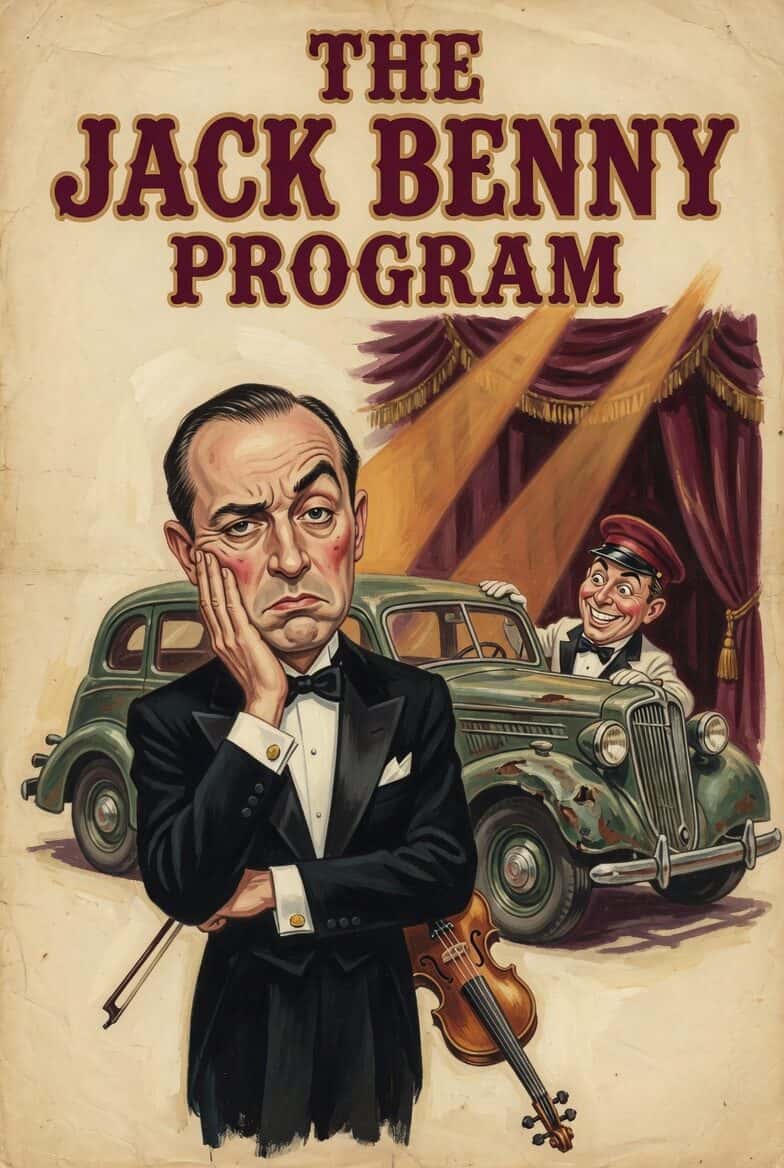
And then, of course, there are various other voices that I do. I can't think of all of them, but I'll tell you that I started with Jack Benny. I was talking about radio a moment ago. I started with Jack in the year 1940, and Jack had heard me on several of the cartoons that I did for Warner Brothers, and he called me in to do a bear for him, the sound of a bear growling. The bear's name was Carmichael. And Carmichael sounded like this. Well, after doing that for about three months, I finally said to Jack, you know, Jack, I can talk too. He said, no kidding. I said, yeah. So he gave me parts to do. And Jack is such a wonderful guy. He laughs hard and then he slaps the table and you know that he likes it by doing that. So I've been on the script ever since. And some of the voices I do for Jack.
which you are probably familiar with, are his train announcer. Whenever Jack leaves town, you always hear the train announcer say, Train leaving on track five for Anaheim, Azusa, and Kukamanga. And then, of course, I'm Jack's French violin teacher, Professor LeBlanc, who always says, Oh, Mr. Benny, the lesson is over. Please. Take the ball and chain off my foot and let me go home. What a tune your fiddle brings on. How I wish it had no strings on. Then, of course, there's one character which has become quite famous on the Jack Benny Show, and that's the salesman of Christmastime. And he's what Jack calls a kind of a mully character. Jack always comes to him and buys, say, a wallet and then wants to exchange it or write a new card.
This character, he talks kind of like this, and he says, but Mr. Benny, I already wrapped it. I gift-wrapped the package, and I can't get it now, Mr. Benny. Please, I can't do it. And then, of course, there's one other character that I do for Jack, and that is his Maxwell. This happened accidentally. The plug, the electrical plug for the turntable was not plugged in. And I saw that we were coming to a part in the script that called for the Maxwell dying out. So I thought that I would do it, even though the sound effects men couldn't do it, because I know Jack likes to hear the rehearsal the same way the show was going to be. So as it come to this spot, I started to do the Maxwell dying out, and it sounded like this. And these are several of the voices that I do that you might be familiar with. And I might tell you that there are many others.
but there isn't enough tape or time to tell you about them. But I will go on and tell you that my favorite hobby is watch collecting. I am a collector of antique watches. I have about 350 of them. I have one of the very oldest made. I think it was made by Peter Henlein, who made the first watch in the year 1511. I think that's about my oldest watch. Then I have... watches that ring the time to the minute to the quarter hour. They chime with double chimes when you press a lever. And then I have all various others which are quite unique and different and eccentric. And that just about concludes my life's history. And thank God I'm still going strong. And after my terrible accident, I'm very fortunate to be alive because I had every bone in my body broken except my left arm.
and I'm very happy to be here. I've been asked to tell you people how you come about doing these various voices, so I would like to try to explain it to you. For those of you who are just starting, say you youngsters, take a picture. Look at a picture of an animal or some various character that you think might have a voice if it could talk, and try to make a voice. that is similar to the looks of the character. This is the only way I can explain it to you. But say that you see a pig. I saw a pig for Porky. And I wanted to make a voice for him, so I thought, how would a pig talk if he could talk? And I figured that if he could talk, he would talk with a grunt. So I gave Porky Pig a voice with a grunt. And then Bugs Bunny, of course, was a...
a little character. I knew he was a little tough guy, and he always got the better of everybody. So I gave him a typical New York or Brooklyn or Bronx-y voice. And that's how Bugs Bunny got his voice, Doc. That's it, Doc. And then, of course, the various other characters, I did the same thing. I looked at the picture and tried to realize what this animal would sound like if he could talk, and then I would... play around with it, so to speak, until I got a voice that I thought was original and unique in a way and fit the character that was going to be in the cartoon. And then, of course, I got my various dialects from actual people who spoke that way. I would improvise on their voices. For example, I would go into a Japanese produce man, and I would point to a vegetable and say, what do you call that?
And he would say, oh, that's Hedretos. Oh, that's Hedretos. I said, oh, that's the same as this one over here. Oh, no, that's Dibrin. That's Kabach. That's Kabach. That's Hedretos. So this is the way I would go around getting various voices from these various dialects, people who talk with a dialect, and then I would improvise on it and try to make it comical and do as much as I could with it. So if you... We'll listen to various people and don't talk exactly like they do, but try to improvise on the voices that they do. Try to fit your voice into characters or pictures that you might see. I'm sure that you will be successful, too. And I say God bless you all, and as Porky Pig would say, That's all, folks.