
The written record
Read the transcript
Read along with the recording · About 13 min to read
January 14th, 1983. Hello. Today I'm sitting here talking with Bugs Bunny, Tweety Pie, Sylvester, Professor LeBlanc, the Happy Postman, and so many others. No, I'm not in a crowded room full of people and animals. All of the aforementioned are speaking to me through Master Voiceman Mel Blanc. Hello, Mr. Blanc. Hey, uh, what's up, Dan? How you doing, Doc? How did you get your start in show business? Well, I actually started in grammar school when I was just a youngster, about your age. And I used to entertain the kids at assemblies. And the kids would laugh, and the teachers would laugh, and the teachers would give me lousy marks, which I did normal. But I did many different dialects then. Not too many different voices, but I did mostly dialects. And this is actually what put me into...
using very many different voices. See, in each dialect, you can use different voices. Like one dialect, for example, a black fella come up to me and he said, you can't do a black dialect. I said, yes, I can. He said, well, let's hear you. Well, the guy that talk down here, the way he talk. And of course, the attorney, he talk up here, you see, that's a different voice all together. This is what you can do with each different dialect, get so many different voices. And I figured it out. I can do over 400 different voices with these different dialects and voices. When I had this accident just 22 years ago, I started one day, I was on a full body cast, couldn't move, you know, and I started to figure out how many different voices I could do. And I started early in the morning and fell asleep around midnight and I passed the 400 mark. So there's 400.
That was 22 years ago, and I've done many since then. Speaking of the accident, I've heard a lot of stories about that. What actually were all of the... Well, I was driving into work. I had just gotten back from San Francisco where I did some commercials up there. And I was just driving down Sunset Boulevard to Hollywood. A kid lost control of his car. He was driving his father's car, and he was 18 years old. And he hit me head-on and demolished my car. I was driving a beautiful Aston Martin, and he demolished that. And I was unconscious for 21 days. The fire department had to put me in a sack and carry me to UCLA, which was very close there on Sunset Boulevard. And, in fact, I was so far gone that over in Honolulu, they had me in the obituary. They thought I died.
because I had almost every bone in my body broken. And that's what happened with my accident. Well, I must say you made quite a comeback. Yeah, I guess God didn't want me, and he let me stay here. When did you first realize that you really had a talent for voices? Well, when I did a program in Portland, Oregon. See, I was born in San Francisco, California, and got married in Los Angeles. went back to Portland, Oregon, where I did a program six nights a week, one hour a night. And I did all the voices on it. And I asked them to bring in a woman's voice, and they said, no, we can't afford it. So I brought my wife in and had her work with me. Estelle is her name. And she did a very good job on this program. And I got to the point where I was working 16 hours a day, writing the script every night, you know.
for every night and my wife said to me what do you want a nervous breakdown you want to go back to los angeles i said let's go back to los angeles so that's how i got down here in 1935. speaking of your marriage you just celebrated your 50th uh wedding anniversary your golden anniversary congratulations well thank you that was uh we were secretly secretly married in riverside california didn't want people to know who we who we were our names in the los angeles papers So we secretly snuck out to Riverside, and we were married there in 1933. It was January 3rd, I think it was. So this year, to celebrate our 50th anniversary, we went back there. At the time we were married, we couldn't afford to stay in the hotel, but now we stayed at the beautiful hotel there and really enjoyed it. What was it like working with Jack Benny?
Well, he was a very wonderful man. He wasn't only my boss, but he was one of my best friends. Jack was a very, very liberal man. And when I had this accident, he was one of the first people I saw when I come out of my coma. I was in a coma for 21 days. And I looked up and I saw him. I said, Jack, what are you doing here? He said, I'll just come by to see how you're getting along. Well, my son told me later, he said, Dad, you know that Jack has been here every day for 27 days, or 21 days, rather. And he said, Jack has been here waiting for you and seeing how you were going to get along. So then when they brought me home after two months in the hospital, Jack used to come out to the house to see me maybe twice a week. And it's a very funny thing. I was laying in a full body cast. I couldn't move, you know.
So one morning Jack came to the door and Estelle says, Jack, Jack says, is Mel home? He was a very wonderful man. Then after several weeks he said, you know, I'm not going to be able to see you next week. I have to go to Puerto Rico where friends of mine are opening a hotel and I promised them I'd be there. So I said, Jack, go ahead. You've been here more than anybody. Well, five days later I got a call from Puerto Rico. It was Jack. He said, how are you getting along now? I said, Jack, I just talked with you. He says, yeah, but I just wondered how you were getting along. I said, just fine, thanks. Enjoy yourself. Have a good time there. Five days later, I get another call. This time from Chicago. There's Jack again. I said, Jack, I just talked to you in Puerto Rico. He says, yeah, I know, but I'm at my sister Florence Fenchel's house, and she just wondered how you were getting along. So that's the type of man Jack was. He was a very wonderful guy. What was it like working with...
George Burns and Gracie Allen. Oh, that was great. I did a program with them. I was the happy postman, and I'd deliver a letter to them every program, and I'd say, Here's your mail, Mrs. Burns. Remember, keep smiling. And what was it like working with Judy Canova? Well, with Judy, I did many different voices. I did ones very similar to Saul. Sylvester, you know, one of her braves. And I did her husband once as their mother and father. And the old man spoke like this. Oh, gosh, Ma. I think I see something in my soup. You know something, Ma? I think it sees me, too. That was one of the voices. Then I did a stack of different voices with Judy. How many voices?
Do you have in your repertoire approximately? Well, as I say, I figured out I do 400 different voices. I can do any one of them. Many are in dialects, but I wanted to learn a Japanese dialect, you know, so I went into one of these produce markets where they have fruit and vegetables. A little Japanese man there, and I pointed to one of the vegetables. I said, what do you call this? He says, oh, that's a hidoritos. I said, what? He said, hidoritos. I said, oh, the same as this over here, and I pointed to another thing. He said, oh, no, no, no. All two heads are different. That's a head of cabbage. Head of cabbage, a head of lettuce, you see. So I finally had to buy something from him, but I got his dialect. How do you put together a voice? Well, first they show me a picture of the character that's going to be in the cartoon. And I'll give you an example. They want bugs, they said, was a tough little stinker. And I thought, let's see, I've got to get a small voice for him. He's a small animal.
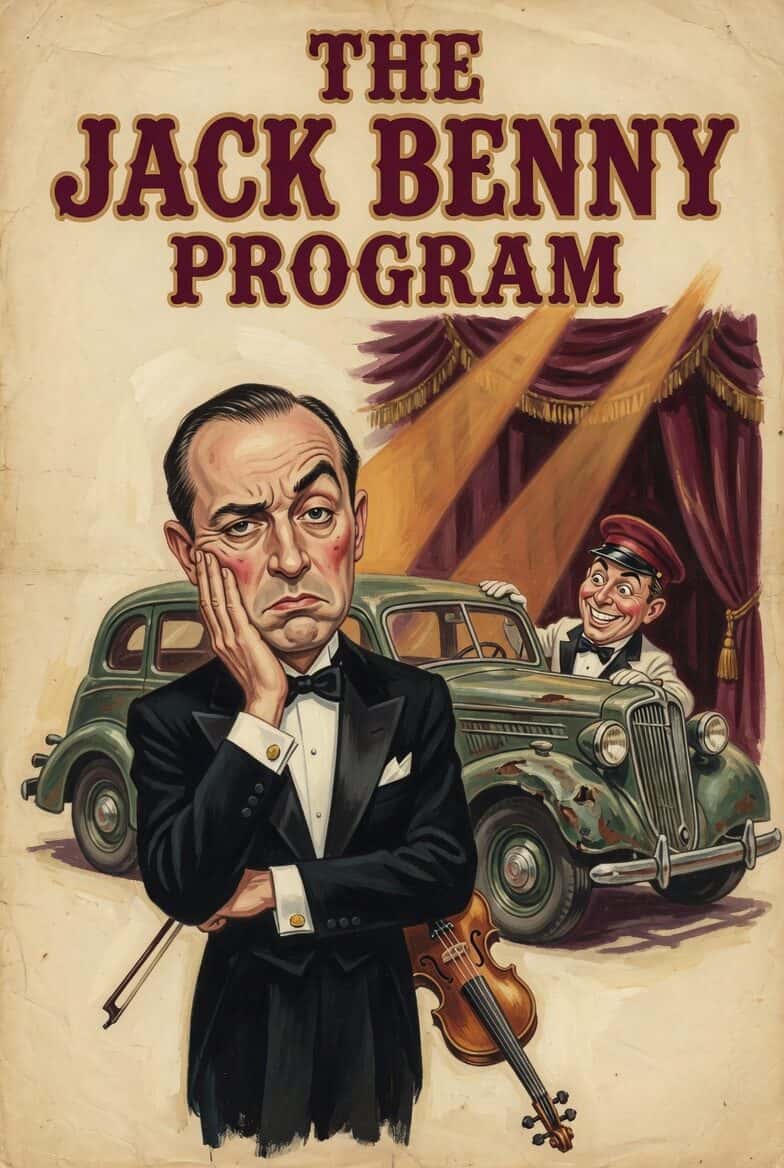
Where's the toughest place in this country that speaks the toughest dialect? About maybe Brooklyn or the Bronx. So you put the two of them together, Doc. That's how I got the voice for bugs. Well, speaking of some of your voices, I put together some of them. I put together some of my favorite from the Benny show. I, of course, couldn't do with the cartoons because those are visual as well. But you remember, of course, the famous train caller. Oh yeah, train leaving on track five for Anaheim, Azusa, and Cucamonga. Everybody beat me to Cucamonga. Well, this is the day that the famous train caller finally broke down. I gotta meet my gang. I'm supposed to meet here at the information desk. Oh, there they are.
Hey, Phil! Don! Oh, hello, Jack! Hiya, Jackson! Say, uh, what are you carrying there under your arm? Well, I heard it was pretty cold in New York, and I want to be on the safe side. But Jackson, a smudge pot! Got all the tickets? Well, not quite, Jack. At the last minute, Phil said he needed an extra one. Phil, who are you sneaking on this trip with you? Well, it's Frankie, my guitar player. I gotta take him along on account of the magazine. The magazine? Yeah, he reached on me. Now I have to buy another ticket. Hiya, Jack. Where you been? Hey, where's that Jackson? Well, I'll meet you later, fellas.
Now let's see, the ticket window ought to be like the cheese. Sorry, I'm taking the cheese. Pardon me, are you the ticket clerk? What do you think I am in this cage, a canary? The ticket on the cheese. Oh, and would you like the $60 ticket or the $140 ticket? What's the difference? Well, with the $140 ticket, you ride inside. I'm not as young as I used to be. As young as anybody used to be. I wanted a ticket to New York. Return trip? No.
Well, at the time, none of those towns was recognizable to the general public. In fact, after I started saying Anaheim, Azusa, and Cucamonga, people wrote in and said, where did you get the names of these crazy towns, these made-up names? So we had to write back and tell them that they were actually real towns. And, of course, that was before Disneyland was at Anaheim. And Cucamonga is where they actually started the first grape growing and wine industry in California. And Azusa was a town. It's A-Z-U-S-A, everything from A to Z in the USA. And they were surprised to hear that. And later on, of course, Anaheim became famous.
That's actually what happened in these three towns. They thought they were having phony names, too. Now, you did many voices for the Benny program, and I have here, one day, Benny really sort of put your talents to the test, so to speak. Okay, let's hear it. Wait for me! Wait for me! Didn't he often do this? No, every once in a while he'd do something like that. like the english horse winnie you know the writers wrote into the script we were visiting epsom downs which is the horse racing track in england and they always tried to give me something that i couldn't do but i never say no and they gave me an english horse winnie says mel blank does an english horse winnie now i tried to figure out you can't tell the nationality of a horse But I'd never say no, so when it came time for Q to do the English horse whinny, I did it like this. What do we have up next? Uh-huh. This is something I'm sure you'll remember doing. At Rochester Drive-On. Gee whiz, Jack, I hope you don't have trouble starting it like you always do. Don't worry about that. I mean, yesterday I had the motor tuned. How did you ever come up with doing that kind of a thing for the Maxwell? Well, I, uh, I don't know. I just...
tried to do different types of voices, you know, and different sounds. And that came along pretty naturally to me, the sound of a motor. And so that's how it came to the Q. It's a funny thing how I happened to do it the first time for Jack. The sound effects man had a record, you know, a regular turntable and a record that had the motor sound on it. And to make it slow down and stop, they would hold their finger on the record to make it slow down and stop. Well, one day I saw that they didn't, it came to that cue, and they didn't have the electrical socket put into the, the plug put into the socket. So I jumped up to the microphone and I made like a Maxwell. That fell down when I did that. He said, you're now my Maxwell. Okay, here's the next one. Jack Benny's famous Polly's character. Carbion, what else would you like?
Well, I'd like a little bacon and one fried EGG. Bacon and one fried EGG. What's the idea of the spelling? Why don't you just say you want a little bacon and one fried... Don't say it, Mary. Don't say it. Always spell it. You know, Polly lays an EGG every day, and she'd go crazy if she ever found out we were eating them. E-T-T. E-T-T. E-T-T. E-T-T. E-T-T. What sort of... prompted you to hold that sort of sarcastic tone for Polly? Well, I just spoke like a parrot. I listened to a parrot an awful lot. And I just, well, the script itself called for me to be that way. I mean, sort of antagonistic toward him, whatever he said to me. So I always said something like...
Benny the cheapskate, Benny the cheapskate. Sometimes Polly was even smarter than Benny. Yeah, that's the way it worked out. And of course, we always save the best for last. Probably the most famous routine in comedy history. And of course, you know what this is going to be, don't you? Si. It's me, sir. I have the captain of the French ship. And sir, they had a woman passenger aboard, so I brought her too. A woman, eh? Bring the captain in. I want to question him first. Naturally. Come on in with you. Get in. The captain of that French ship...