
The written record
Read the transcript
Read along with the recording · About 29 min to read
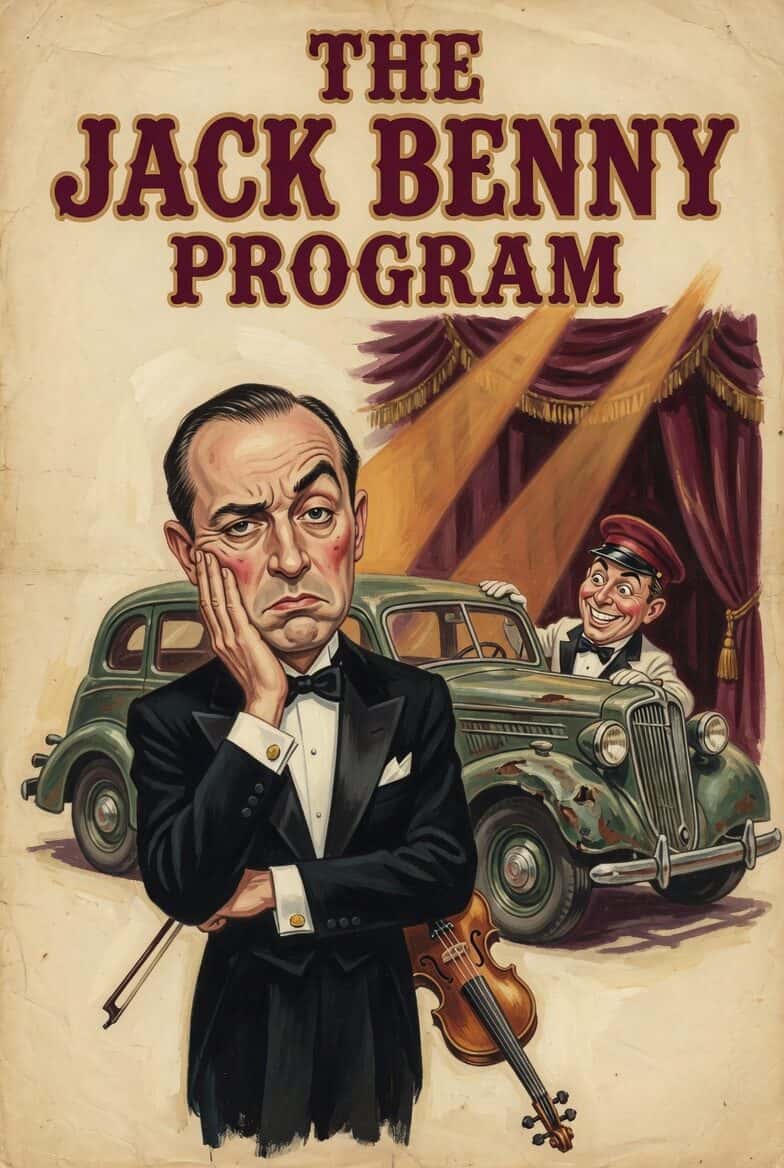
From National Public Radio in Washington, I'm Mike Waters, and this is Options. Do you remember the radio show that began this way? And now, around the world, the Jack Benny program. Milt Josephsburg does. He was one of the people who helped write that series. He put many of his recollections in a book called The Jack Benny Show, the life and times of America's best-loved entertainer. He talks about it, in this hour, with our host, Terry Gross, of public station WUHY-FM, Philadelphia. I'm told Milt Josephsberg has put in more years on more radio and TV shows than any other writer in broadcast history. In addition to The Jack Benny Show, he's written for Bob Hope, Lucille Ball, Milton Berle, Danny Thomas, Joey Bishop, and most recently he's been writer, producer, and script supervisor for All in the Family. Well, Milt Josephsberg, it's really a pleasure to meet you. I very much enjoyed your book. I'm really curious about your talents as a writer. You've written for so many shows.
style of comedy that Bob Hope, Jack Benny, and all in the family have are really very different. It's like different genres. I'm wondering if you consider yourself a person who has many different senses of humor. No, you adjust to each one of them, and I've got to clear up something, Terry. I didn't write for more shows. I wrote for more number one shows. Now, I may not have made them number one, but I got there. They may have been number one, and I helped them get back, or I stayed with them when they were number one. And I only wrote for comparatively few shows because most of the fellas wrote for many more. I held jobs long. I was like a court blaster. I stuck to people. I was with Benny for 12 years and then afterwards another dozen years or so. I was with Hope for seven years and with Lucille Ball for eight years. And with each one of them, you just adjust your writing to their style. Humor is humor. And you just convey it in a different style.
But you're always working through a personality, because all those people had their personality. And certainly, Hopes, for instance, was very different from Jack Benny's. Does a joke come to you, and then you fit it to the person who you're writing for? Yes. In fact, I tell you a very interesting thing. I had worked for Bob Colt for five years. It was my first experience as a comedy writer. And then I went to the Jack Benny show. And in one of our first meetings, we were writing. and we needed a joke for something. We needed some kind of a line for something, and I don't remember what it was, but we were throwing lines, and I threw one, and it was one of the first times I ever saw Jack fall on the floor. And in my book, I tell many times how Jack falls on the floor, laughs hilariously. Well, he fell on the floor, and he got up, dusted himself off, and says, all right, we still need a line here. And one of the things that...
I said, Jack, I thought you liked that. And Jack looked at me and he says, no, that was funny, but it's a joke. I then learned that you could not tell Jack a joke as a joke. You disguised it a little, and Jack went for it immediately. At that time, I lost that joke because I didn't have the sense to convert it into a Bennyism. What was the joke? Do you remember? I do not remember. I don't remember. I mean, I must have written half a million jokes. and many of them I have forgotten. You say, and I think this is really interesting, that he's the first comedian who realized that he could be funny by ridiculing himself. Yes, and I wish I could take credit for that, but I believe this was due to his very first, and possibly his best writer, a man long gone, named Harry Kahn. When all the other writers, when all the other radio comedians were doing jokes and vaudeville routines, Jack was the first one to do real character. And he built this character on his vaudeville act, and he added the cheapness, he added the violin playing, the bad violin playing, and all the frailties that we all have. Now, Kahn and Jack worked this out. Then Kahn was succeeded by four writers.
Yui Wedlock, Howard Snyder, Ed Boulogne, and Bill Morrow, and they honed that character a little finer. And then they left, and they were succeeded by Balls of Perrin, Tackerberry, and myself. And we fought with him for about ten years until Jack started doing radio and television, and we hired a pair of younger writers named Al Gordon and... uh hal goodman now those were all there was one other writer named al bosberg those were all the writers that jack used on a regular basis there are only about 10 of us over a period of nearly 40 years and most comedy shows use writers by the dozen every season So you were able to keep a sense of continuity as to the character that you were writing? Oh, yes, yes. The kinds of things that were in character. Yes, we took the character, we refined it. As a matter of fact, see, we joined Jack in 1943, and we speeded up his character. Those were the war years, and everything had a more hectic pace. And Jack's program had slipped. In the ratings? Yes, in the ratings.
One of the things is that he tried to play the army camps, and his writers at that time would not adjust and do like Bob Hope would do jokes whenever he'd play an army camp where some character would say, Hope, you're a first-class idiot, and he says, is that better than a second lieutenant? And 3,000 soldiers would scream their heads off. And this was no condescension on Hope's part. It was a very valuable thing that he was doing. But Jack tried it with his more leisurely pace and didn't succeed. Then when we four joined Jack, we speeded up his program, and he climbed back up in the ratings eventually, and it was always one and two between him and Bob Hope.
There were some other very unique characteristics that Jack Benny had as a comedian. I mean, it was really very sophisticated, I think, for him, when people were really into vaudevillian, pie-in-the-face type stuff, to be mocking himself with a sense of absurdity. You said, you know, playing on all the frailties that we all know that we have. Very, very much so. And I must point out that in the book, The Jack Benny Show, I have a chapter on the writers and a chapter on the stooges. Now, the Stooges, I gave Webster's definition on that chapter of the word stooge, and it boils down to someone who feeds lines to the comedian so the comedian is funny. Jack Benny was the highest-paid stooge in the world because the people who got the laughs were Mel Blanc, Sheldon Leonard, Benny Rubin, Frank Nelson, Bea Benederit, Sarah Burner, Sandra Gould, and I could go on endlessly. Jack was the foil for all of them. When Jack got a laugh, he was thrilled with it.
always the laugh went to the so-called stooge. Also with his violin, which was always there in one way or the other, there was a sense of culture about him, yes, although he always made mistakes of trying to give the proper name of a musician or a piece or whatever. Well, one of the things, and unfortunately it was one of the last times that I saw Jack, he told me he was raising a lot of money on concert tours. He would play, and they would sell tickets for maybe $50 or $100 for the Philharmonic Orchestra in various cities, and he raised many, many, many millions of dollars. But to make the audience realize that he was clowning, he tried to play a serious number at first. Now, what happens when a violinist plays, frequently a hair in the bow will snap off.
And what they do is they wait for a two-bar rest, at which time they snap the bow like they're stopping a whip, and the rest of the hair will come off. It won't dangle. Now, Jack says, damn it, whenever I do it, I get a scream. He says, with Heifetz, with Stern, with all of the others, they accept it. And he says, I don't want to be laughed at at that point. And Isaac Stern pointed out to him. Jack, they stop laughing at you. He says, and fellas like me will have to go back playing concerts at $25 for the benefit of Philharmonic and getting the hall one-third filled while you, with your mistakes, fill it at $100 a person. Right. You keep pointing out in your book that Jack Benny was a very gracious, generous person, always giving credit.
to the writers and to the other people who appeared with him, yet his characterization was as being miserly, greedy, stingy, you know, emotionally constipated. A peculiar word. How did that characterization get developed, and how did he react to it, you know, since that's not really the way he was? Well, the writers, all writers, adored Jack. And one of the reasons was that early in his radio career, he began to give credit at the end of a show to his writers. And some of the other comedians, like Ed Wynn and Jack Pearl, these are long-forgotten names, maybe, they came to him and said, Jack, you mustn't give writers credit at the end of the show. The audience listening to us, they think we ad-lib everything, and this detracts from our sense of humor. And Jack looked at them and said, fellas, I don't know, for three or four hundred years, actors have been performing Hamlet.
the audience doesn't think they're ad-libbing this or making it up as they go along. The program says, written by William Shakespeare, and I'm going to give my writers credit. And he always did. And one other thing, during an interview, he once pulled a very funny line, and Jack always denigrated his sense of humor, but someone asked if he was cheap, and he said, you know, everybody asks me that, and if you will check my writers' income taxes, you will find that in the past... years, I have paid over $10 million to my writers to make them make me out the cheapest man in the world. Well, how did that cheap characterization get developed? Actually, I cannot answer that. I do not know when it started. It was there when I started it. And I know there was a time when Jack wanted to abandon it.
And what happened is he felt that every other comedian was telling jokes about him being cheap, being a terrible violin player. And he wanted to cut all of these out. So we stopped for two weeks. But the other comedians kept doing it. And we said, why don't we get the benefit? And we began, we resumed doing it. But on a much lesser scale, we do a cheap joke every other week, a hair joke every other week, a lousy violin playing joke every other week. You talk a lot about how Jack Benny was always ready to draw the line. If something could be interpreted as insulting to an innocent person, he wouldn't do it. If something was risque in a way that offended him, he wouldn't do it. Can you give us some examples of that? Well, occasionally we'd do something slightly risque for those days. But one example, and I mention this in my book, The Jack Benny Show, Jack had been in England, and there was a young...
girl, 17 or 18, who was going to swim the English Channel. And it made headline news because she was going to swim in the nude. Now, I believe her name was Shirley May. And we wrote a joke where everybody told it was our first show of the opening season. And it had mentioned how this girl attempted to swim the channel nude with a coating of Vaseline over her body to keep out the chill. And We had why everybody went where they did on their summer vacation, and Jack had been in England. And someone said, why did you go over there, Jack, to play the Palladium? He says, no, he says, I went to grease up Shirley May. Now, at rehearsal, it got a tremendous scream, and the censor let us get away with it. Excepting, Jack thought it over and says, fellas, this is just a teenage girl. She may be terribly, terribly embarrassed. Let us get another opening. And we did. We acted as our own censors.
You say fellas, you know, that he said fellas. I always remember him going, well, fellas. Yes, yes. Did he say that in real life? Well, it's very funny. I mention this in the book, how no matter how old the writers are, they're always fellas or the boys. Writers could have been older than their comics landed, and they were still the boys. And today, very few, there is no staffs like in the old days, because you worked. For a personality, not for a show, on All in the Family, I am working for a show. I have a great cast. I'm friendly with all of them. And I must say that as well as I know them, I keep getting mixed up calling Carol O'Connor Archie Bunker instead of Carol O'Connor. And Jean Stapleton, I'll address her sometime as Edith. And Rob Reiner, I'll say, look, meathead when I don't mean that. And Sally, I'll call her Gloria. It's the first show that I ever worked for where the lead character did not play.
their own name or some variation. Even Lucy, I worked on her for two series, created one which they just began re-showing called Here's Lucy. I also worked on her show which preceded that, which was called simply Lucy. And prior to that, there was I Love Lucy. Each time she had a last name that was different, but each show she played Lucy. So if I wanted to address something, all I had to say was, look, Lucy, and I made no mistake. But I will go to Carol and say, look, Archie, don't you think, and he says, the name is Carol, Milt. And I'll say, okay, Carol, and then sometimes he'll say, my wife is calling me Archie now. He'll get around and laugh about it. Well, one similarity, in spite of the fact that the people play themselves between the original Benny radio show and the situation sitcoms now, is that there was a family of people.
I mean, on the Jack Benny radio show, there were a whole group of regulars, Dennis Day, Don Wilson, Mary Livingston. How was it decided that there should be these characters, you know, who'd make regular appearances in addition to... Well, in radio, it's very, very simple. In radio, you tried out a character, and if the character clicked, you knew immediately, in the very next week, that character was written right in with the writers. Television, they try to have families. The Mary Tyler Moore show had about six or seven great regulars. Rhoda has them. All in the Family, my own show, has them. And they start off with a basic family. Now, on All in the Family, every time they got a tremendous character that clicked, that character went on to their own individual show. They had once...
The whole family was sick. I wasn't there at the time, and they had Cousin Maud come in to take care of them. She came over so big, pushing Archie around, that the Maud show came. Then they had Black Neighbors, the Jeffersons. They went over so big, they have their own show now. Maud, who was begat by all in the family, begat the Good Times show with Florida. Her former maid has her own show. You develop characters. and if they seem to go over with the audience, you continue them. If not, you drop them. Who were some of the characters that didn't make it? Were there a lot of them? I'd rather not go into that, but I will tell you, some sad things happened, and in television more than radio. We once had a Lucy show on which quite a good actor played a bit, and it went over hilariously.
However, when we came to assemble the show and cut it, we found that we were three minutes long and the only clean cut was that actor. Unfortunately, the day that the show was to go on the air, this actor took a half-page ad in Daily Variety and Hollywood Reporter calling everybody's attention to his wonderful performance. I extend my sympathies to him. Ouch. What was the year that the Jack Benny Show moved from radio to television? I know you started off just doing one or two shows a season, but when did you start working on the TV shows? We started, Jack actually did his first TV show in 1949. The first TV show that he did that went on a network was 45 minutes long. It was 1951.
Jack thought a half hour was not long enough, an hour was too long, and it was the only 45-minute show that I know of, comedy show with a big star, that went on. Then we did two shows the following season, four the next, and I think six and eight until around 1955, the year that he went off radio. They began doing 20 shows a year. Now, all of your roles, you as the writer, Jack Benny as the on-air personality, was completely changed, I'm sure, by the change from radio to television. Not that completely. We had to think visually. We had to stop lines. Now, this is a typical radio line. Rochester, I'm going out. I'll go to the closet and get my own hat and coat.
In television, you don't need that. He says, Rochester, I'm going out. And he goes to the closet and gets it. So that is what we called a radio line, and we had to avoid that. Radio writers made and still make the, well, I won't say the best, but probably the best television writers because they write short, snappy dialogue, not like long monologues that I'm doing plugging my Jack Benny book. But we... Did jokes in radio that were priceless that could not be done on television, but we also did jokes in television that could not be done on radio. Can you give us examples of those? Well, one of them in radio, we had a thing where Jack had to borrow a cup of sugar or flour from the Coleman's. And he said, Rochester, throw me that measuring cup. And he said, oops, mister, and you heard a tin cup fall on the floor. Now...
Jack picked it up and started humming Love and Bloom or some other popular song of the day. And you heard his footsteps as he opened the door and walked out. Now you heard his footsteps on the sidewalk as he was humming softly. Suddenly you heard approaching, coming closer, a woman's footsteps, the staccato high heel clicking of a woman. And as the two sets of footsteps met each other, you heard the distinct sound of a dime falling into a tin cup, and Jack says, oh, thank you, madam. I love that. Now, this could not be done on television. Jack would have to be walking in such a way that his arm would have to be extended with the tin cup, and it's not a natural way to walk. You would have to see the approaching woman open her purse and reach in for a coin. You would have to see her dropping the coin, and they'd begin to snicker at that.
Now, on the other hand, a great joke that we did in television was Jack was getting ready to do a television show. This was a show within a show, and we were in the dressing room, and he went into the bathroom to wash his face. He was wearing a bathrobe, and his pants and shirt were hanging there. While he's in the bathroom, a telegram comes to him, and Rochester answers the door, takes the telegram, wherever it was, puts his hand in and takes a quarter out of the pants and gives the boy a tip for the telegram. Now, about 30 seconds later, Jack comes out and starts dressing and reaches for his pants to put them on, and now he hefts his pants and suddenly turns to Rochester and says, Rochester, who took a quarter out of my pants? Now, telling it, it is funny, but seeing Jack as he weighs his pants in his hands, suddenly realizing there's something wrong and knowing the exact coin that was taken out. It was very funny. And that certainly couldn't be done on radio because you have to see somebody. You were doing the motion. You were doing the hefting motion that Jack was doing. Right. Okay. Listen, if you're just tuning in, my guest in the studio is Milt Josephsburg, and he for many years was the writer for The Jack Benny Show and has written a book now called The Jack Benny Show, which is published by Arlington Press.
We're talking about some of the changes that took place with the transition of Jack Benny as a radio show and as going to a TV show. Now, suddenly you as the writers had to give some visual specificity to the sets that were always in your mind. Oh, I love that word. Specificity. Did you bicker about that a lot? We had fights. We actually argued for maybe two or three years before doing television. Everybody had their own idea of what the house looked like. And when we sat together and discussed these things, and when we discussed scripts, Jack only had one vote. He was one of the writers. There were five of us, including Jack. And Jack immediately, we threw out his ideas of what the house should look like because he was subconsciously using his own home as we all were using our own homes.
But Jack's home was not the kind of a home that the Jack Benny character would live in. He was too cheap to live in a house like that. We had arguments about where the hallway would be, where the stairs leading upstairs would be. We had arguments about how the house should be painted, the various rooms. Now, in radio, you could do a joke. Someone would come in, Mary would come in and say, Oh, Jack, I see you've painted your living room your favorite color. dollar green or jack you painted the room blue he says yes mary i thought it matched my eyes and they're bluer than the lips of a eskimo school boy at 60 below which would give us a joke when you came to television and you do a joke like that to just recover the room would cost a couple of thousand dollars and you couldn't recover the room without giving an explanation Viewers on television will say, how come the door was on one side one week and the other side the next? How come there was a picture on the wall for three weeks and then it was on the other wall? In radio, they just took your word for anything that went and you would do it. And you could drop it, I guess. You could say, why is the wall painted blue and never mention it again for the rest of the series. Yes. As I said in my book, now wait, I've got to say something. My publishers told me that I must always say, as I said in my book, The Jack Benny Show.
Last night I was having dinner with my wife Hilda, and she asked me a question, and I said, well, as I said in my book, the Jack, and suddenly I realized I was overdoing it. So please forgive me. But in the book, anyway, I have an incident where Mary, in a radio show, wanted to get a cold drink. She was at Jack's house. And he said, well, go get one out of the refrigerator. And she left, and Jack held a conversation with Dennis Day or Phil Harris. And Mary came back, she says, Jack, I couldn't get a drink out of the refrigerator. And he said, why not? She says, you changed the combination on the lock again. Well, this is a typical Jack Benny joke. Now, if we did it on television, then whenever we showed that, we'd have to have a combination on the lock and go through with opening it, and it would conflict with the vault that we had. So there's a lot of things that you really have to take more literally when you're dealing with television. Yes, and incidentally, Jack was a pretty good prognosticator. He... When we wrote our third or fourth show, we had a scene, and this was like our third year in television, we had a scene where Jack was sitting in his chair, and the telephone rang, and it was on the opposite end of the room, and Jack was to go answer it. In the center of the room, there was a hassock, and Jack had a funny little hop, skip, and jump, and he was supposed to hop, skip, and jump over that. Well...
When we reached this thing, we thought that would get a laugh. Jack put down a script, and he said, fellas, let's have a little discussion. He said, in all my life, I have never had a hassock in the middle of the room where I would trip over it going to answer a phone. Also, if the phone rang, I would walk around it. I would not jump over it. He says, now, I know that television is a great medium. And it's a visual medium, but there is still room for dialogue. He says, you go to see a Broadway play. He says, and they do much more talking than they do physical things. He says, and I want physical things, but I think we can do great dialogue. Now, in All in the Family, we do do physical things, but I feel that we do have excellent dialogue, which keeps the listener hooked, or viewer. Well, in a lot of the early television shows, there was...
So much visual humor of people tripping over things or making really contorted faces, yes? This was merely to show the audience that you were not listening to radio, that you were watching television. The early television shows were so frenetic that they almost become like the early side of movies where they move in such a quick, as though the camera was speeded up. But the Benny show had a different approach to that. Yes, we eventually, we did physical stuff, much physical stuff. visual but we regard on dialogue mainly now when people meet someone who they're used to hearing on the radio they uh sometimes really quite surprised by what the person really looks like now with jack benny he was in film so it was no great shock what his face looked like but there were other characters probably who would be making their debuts in a visual medium um did their faces fit the kinds of characters that you had built for them through words I have got to tell you a funny story which has nothing to do with my book or Jack Benny, but you just brought it back to mind. Okay. It fits our conversation, though. When I started with Bob Hope, we had an orchestra leader named Skinny Ennis, and we made up all kinds of jokes about him being skinny. He was not skinny. He was a very well-built man, but his name was actually Skinny, S-K-I-N-N-A-Y. That's a southern name.
Now, in the days of radio, nobody knew what the stars looked like, except the superstars, the Bob Hopes, the supporting players, they didn't. We were on the road playing an army show once, Bob Hope, and Skinny went out with Bob to entertain at a show. It was not the broadcast, they were doing regular shows then. And Skinny's wife, whose name was... Carmelita or something, I don't remember, Carmine, she tells a story, and you must understand that in those days when we traveled, the way groupies follow rock singers today, kids followed to get Bob Hope's autograph and everyone, and I would stop frequently and ask, are you anybody? But this time, the hotel was overrun with kids, and Skinny's wife told how she had just gotten out of a bathtub and was wash, drying herself in front of a full-length mirror and admiring the fact that she hadn't put on any weight and looking at her to see nothing was sagging. And suddenly, through the door, a 10-year-old boy walked in. And she suddenly started to cover herself and says, what do you want? And he says, your autograph, aren't you Skinny Ennis? And she got hysterical. She said she dropped the towel. She said the kid was old enough to look, but he ran out. But nobody knew what the stars looked like. In fact, on the early days of the Benny show, I had a breakfast with Jack and my wife Hilda, and someone came over and asked Jack for his autograph, and then gave my wife the book and said, well, you autograph it too, Miss Livingston. Oh, no. What about the other characters, though? You mentioned Dennis Day in your book, that you were a little afraid that he had had a very young, boyish personality on the radio, and that somehow the innocence that he was attributed with might not hold up if people got to see him.
No, it held up. It held up great. Dennis Still is a very, very popular nightclub entertainer and makes appearances on guest shots on different shows. As far as being a unison kid, he has 10 or 11 kids. I'm not sure which. I haven't seen him for three weeks. A lot of people didn't make the switch very well from radio to TV. One of the things for me that... What made Jack Benny so special was his gestures, you know, his facial expressions, that really soured look, the way he'd hold the two fingers on the side of his chin. Fold his hands across his chest and just stare at you. Were those his gestures? Did you develop them for him? They came naturally to Jack. Or at least they were there by the time I got to him. But I think they came naturally to Jack.
But you as a writer had to learn how to use them, right? During the show. Yes, and I'll tell you the expressions of hmm and the what's and the where. All of these. Actually, it took pretty good writing to know when to put those in because a misplaced one would not only not play but could be embarrassing. And we use them sparingly. But we use them pretty well, I think. How would it be embarrassing? Well... It's embarrassing when you make a gesture or something that should get a big laugh, and nothing happens. And that has happened to every comedian, and I've written my share of them. Okay, what about in the early TV shows, though? Were there cheerleaders in the crowd or big signs to cue the audience when to laugh? Good. I'm glad you asked me that. The first shows that we did, we did not have a live audience. We used what they called the Jolly Box, the laugh machine.
Now, when we finished filming it, the men who operated it said, Jack, you let us lay in the laugh track, and you will love it. We came at the appointed time, sat in this little viewing room, and they turned on the project and started to show the film. The film was on for maybe two and a half minutes, and Jack began to scream very angrily, stop that damn machine, turn it off, and a few words that I will not say on the air. And one of the men said, they stopped it, and they said, what's the matter, Jack? Weren't the laughs loud enough? He says, loud enough? He says, I come on and say hello again, and you give me a laugh bigger than I've ever gotten in my life. Now, what is so funny about me saying hello again? He says, maybe it's entitled to a few little titters or chuckles. And every joke that you have has a laugh that's five times too big for me.
I want the entire laugh track removed. I'd rather show it without a laugh track. Well, we quieted Jack down, and we said, Jack, you go home, and we will work with them. We were the first ones that had to tell these men, make the laugh half that side. Cut the laugh out here. Just leave a chuckle here. Jack worked very quietly.