
The written record
Read the transcript
Read along with the recording · About 81 min to read
It's now 6 o'clock. This is the Domino's Pizza voicemail system. If you'd like an anchovy and mushroom pizza, press 1. If you'd like pepperoni and goat cheese, press 2. If you'd like kosher salami and white chocolate, press 3. If you'd like a Caesar salad pizza, press 4. And if you'd like an Alka-Seltzer, press 5. Actually, you can get any of those at Spago, I understand. Hi, this is Modern Times. My name is Larry Josephson. And tonight we have a treat instead of the usual treatment or scenario. Our program will be largely devoted to Jack Benny. And we'll talk on tape and live on the phone with Joan Benny, Jack's daughter, who wrote a new book called Sunday Nights at Seven. And we'll also have a live visit from Phil Harris, who's the last surviving cast member and golfer. And he's going to be calling from Palm Springs.
and we'll hear lots of wonderful Jack Benny bits and programs, and talk about the meaning of Jack Benny, the last time that the whole family got together, except to negotiate a divorce. Really, the last time that we had a common culture, at least in my day, at least before the invention of yogurt. And driving down here on the West Side Highway, or what's to the left of the West Side Highway, really West Street, I passed a restaurant called Pasquale and Wong, authentic Italian and Chinese cuisine. Now, what could that be? Stir-fried ravioli? I don't know. Or maybe spaghetti with black bean sauce? Yuck. Well, before we start our reminiscence of Jack Benny and old-time radio, I have a couple of things I want to talk about. One, in the promo for this week's show, we announced that we were going to also remember Irving Berlin and interview Lawrence Bergreen, who...
I wrote a biography of Berlin and that's not going to happen because there's just so much Jack Benny stuff that we couldn't do justice to both. So we're going to have Lawrence Berggrin come back sometime in December and we'll do that program and lots of incredible Berlin stories and music. And before we get started with our tribute to Jack Benny, I want to note the passing of Mary Martin, who was one of the nicest people. I didn't know her, but... from what i read whoever worked on broadway and also one of the most talented and i came into possession of a very uh rare and strange recording at a uh what do you call it those things where you go go and buy things on the street you know i can't think of the name of it you know flea market thank you ed uh it is a private acetate recording kind of used to make in recording studios in the 40s of Mary Martin singing a special arrangement or special lyrics of Hello Dolly. And it's Hello Richard, which I presume is, and from the lyrics you'll see, is a 25th anniversary present from Mary Martin to her late husband, Richard Halliday. And he died some years ago and was one of the great tragedies in her life.
tried to figure out, first of all, what this thing really is, and also how it came to wind up in a flea market. And the only thing I can figure out is that perhaps this recording was so painful for her that she discarded it. Or it also could have been a sort of a dub that some engineer made. I don't know. But it is my way of remembering Mary Martin, who brought me a lot of pleasure from South Pacific on and Peter Pan and all the rest of it. I'd like to share this recording with you. Well, hello. It's so nice to have you mine my whole life long. Year after year. Richard, you've been dear. Richard, you're still glowing, still crowing.
That was Mary Martin singing a personal 25th anniversary. present to her husband, Richard Halliday, that was recorded at the Variety Recording Studios on West 44th Street, I would guess by the technology sometime in the late 40s. Anyway, and Mary Martin will be very much missed by me and millions of others. But on, we're going to remember tonight another show business great, someone who was central to my growing up. I remember every Sunday night at 7, We would all gather around the radio, mom and dad and grandpa and grandma and whoever was around, to listen to the Jack Benny program. The Jack Benny program, presented by Lucky Strike. Lucky Strike program starring Jack Benny with Mary Livingston, Phil Harris, Rochester, Dennis Day, and yours truly, Donald. I had many radio favorites, The Lone Ranger and...
Mr. Keene, Tracer of Lost Persons, Fred Allen, Henry Morgan, so many, many. But of all of them, Jack Benny occupies the warmest part of my heart. It's tempting to try to do a Ph.D. thesis and deconstruct Jack Benny or figure out the semiotics of Jack Benny, but it would be a waste of time and also destroy him because... i don't know why not only was so funny but also constituted a second family there was something warm about him even though his character was a pinch penny and a vein and sometimes irritable there was something about the gathering of that same family for 30 some years although i didn't hear it before the war because i was too young but certainly after the war, when he moved to CBS. I remember it most fondly. So I saw a notice in the Times a few weeks ago that Joan Benny, his daughter, had published a book, which is actually two books. It's an edited memoir that Jack Benny himself wrote, and then there's a wraparound of a reminiscence by Joan Benny.
And about two weeks ago, I spoke with Joan Benny about her late father. I'm talking with Joan Benny, who is, along with her very famous and much beloved father, Jack Benny, the author of a new book entitled Sunday Nights at Seven, The Jack Benny Story, published by Warner Books. Joan, welcome to Modern Times. Thank you. social problems here, marriage and divorce, drugs, the economy, what's left of it. But when I saw this book had been written and published, I said, I have to do this because of all the... And I'm a radio person. I was born in 1939, and radio was really my medium. And by the time television came along, I was already in high school and not terribly interested in it. And of all the radio programs that ever were, whether it's The Shadow or The Lone Ranger or any of them, or Lux Radio Theater, Jack Benny was my favorite. And it also was a centerpiece of our family life. Whatever else we were doing and whatever other projects we have, we would all gather around the radio for dinner Sunday night at 7 to listen to Jack Benny. And it was the one cultural...
experience that we all share as a family. My mother listened to the Metropolitan Opera, which my father thought was sissy music, and I listened to disc jockeys like Ira Cook and some of the others, Johnny Grant, all of those out there in L.A. where we both grew up. But Jack Benny was someone I loved dearly, and in coming down here, I was trying to figure out why. Why about Fred Allen was wonderful, Goodman Ace, There were so many great radio people in that golden age. But of all, I love Jack Benny the most. And I think probably the question is unanswerable. I don't know. But probably because his character was so human. And he was never mean or nasty. And in fact, as you point out in the book, he was really his own straight man. He was the butt of most of the jokes. Rochester or your mother, Mary Livingston, or...
Phil Harris or others would get the laughs and he would sort of set them up, yet he was the master. What was it like growing up in this household full of famous personalities and writers and producers and managers? How was that growing up in Beverly Hills in that time, which I guess was 1938 to 19... Right. What, 64? Yes, about that, as far as the weekly show was concerned. That's true. It was very exciting, and I look back on it and feel as though it was a dream. I mean, was I really there in those wonderful days of Hollywood when movie stars were movie stars, when they were bigger than life, and our closest friends were the Gary Coopers and the Jimmy Stuarts, and, of course, George and Gracie.
and Danny Kaye and his wife. And these were people who, oh, and Barbara Stanwyck, who was then married to Bob Taylor. And these were people who were over at dinner parties. Some of them kind of hung out. Van Johnson was a big favorite, a very close friend. And they hung out at our house, as people would say today. And they were, on the one hand, they were Uncle Bob, Aunt Barbara. They were my family's friends. And I treated them as such. On the other hand, I was always very aware that they were movie stars. I had their autographs. I had 8x10 glossies autographed to me. My favorite, by the way, was Van Johnson. He was the one who treated me more like an intelligent person. So many, in any walk of life, you know, your parents, friends kind of, you know, get lost little girl or a little pat on the head and goodbye. But he was interested in what I was doing in school and he was...
He'd tell me about what he was doing. I mean, he was the best. I was crazy about it. I had such a crush on Van Johnson. He's still working. I saw him on television the other night. He's just as nice as he always was. That's great. Let's go back to those wonderful days of the Jack Benny program, as it was called. One aspect that made it so great were the running gags and the cast of characters who were there every week. Don Wilson, Dennis Day. I love the running gags. You mentioned that, and I'm reminded of my all-time favorite show, which was Mel Blanc playing the part of the train announcer. And he would say, you know, train leaving on track 7 for Anaheim, Azusa, and Kookamonga. And there was one show where he, at the very opening of the show, he did that, Anaheim, Azusa, and Kook, and he stopped.
and now they went through the entire half-hour show, and at the very end of the show, you got a manga. I loved that. It was a great gag. Well, here we are at the station. Get your tickets out of here. I'll make everything according to your schedule. Train no leaving on track five for four and a half. Let's see, the ticket window ought to be... I guess my favorite was Rochester, because he gave it to your father. he not only didn't take any abuse, but he gave it back. He sure did. He sassed him. And you explain in here, actually, in your... This book is actually a melding of a manuscript that you found in a closet after your mother died, and your own reminiscences. In fact, your father's, Jack Benny's part is in boldface type, and yours is in regular type. And it explains that originally Rochester began as a stock...
Negro character, he ate watermelon, he was into razor blades and dice and gin and so forth. And after the war, he changed with, after blacks had fought in World War II with great valor, that society changed. And even before the Civil Rights Movement, Rochester became really an equal to Jack Benny. That's true. Yes, he was his butler and his cook and all of that, and drove the Maxwell, but really... socially an equal. And in fact, he was a very wealthy and successful actor, Eddie Anderson, who had a mansion and a butler of his own. Yes, that's true. In real life. My father always treated him as an equal. It was just a matter of the times in the 30s and 40s. And I don't think there were many problems. The only problem, and my father talks about it in the book, is that he had a problem with Rochester, who arrived late very often. And my father was a stickler for being on time.
and there were a few little hairy moments with Rochester and the few times that my father lost his temper. Your father says in his memoirs, in real life, Rochester often worried me because he was rarely on time for line readings, rehearsals, and the broadcast itself. A man after my own heart, I'm always... I've been 15 minutes late all my life. And your father, Jack Benny, says, I'm a nail-biter and a pessimist by temperament, and Rochester's tardy habits... did not calm my nervous system. Every time I called him on the carpet for being late, he came up with a good excuse. I remember once it was because his mother-in-law died and he had to make funeral arrangements. He told a story about a show in which Rochester played an extremely important part in the plot, and he said Rochester came so late to the Saturday rehearsal that he missed it. He started giving me his excuse, but I refused to listen.
I was so mad that I told Sam Perrin, who was now my head writer, that I must punish Rochester. I want you to write him out of the show this week, I said. Then the four writers set up a hue and cry and objected, and on Sunday they had their first rehearsal at 12.30, half hour after noon. The call was for noon, and Rochester didn't call, and he didn't show up. And he said, at his home, Rochester's butler, he had his own butler, explained that the master had left for the NBC studio long ago. At 12.45, we began rehearsing without Rochester. His character didn't make his entrance until about 10 minutes after the show's opening. I hoped he would arrive in the nick of time. He did not arrive.
Well, I lost my temper completely. I blew my stack. I stomped over to the control room. I opened the heavy door. I threw a look of withering scorn at my four riders who are now huddled in a frightened heap. Well, that's the best I can do, Jack Benny. I have you four idiots to thank for this. Then I departed and slammed the door violently shut. However, the door was so heavy that its closing was controlled by an air pressure valve which released the air slowly. Not only could I not exit, on a vicious door slam, but the door closed so slowly that it let out a long razz noise like a Bronx cheer. Even the door was against me. But I cracked up just the same, and then the riders felt it was safe to laugh. And we all laughed, and Rochester finally showed up, accompanied by two policemen in uniform. It seems that he had been driving along the Hollywood Freeway, and right in front of him, a five-car smash-up had taken place. He had been trapped for over an hour until traffic started moving.
Knowing that I would not believe this obviously trumped-up story, Rochester had persuaded these two Los Angeles policemen to come to the studio and testify that, once again, Rochester had a legitimate excuse for being so late. That's great. Rochester. Nothing important. I just wanted you to know that you put in all that stuff from my medicine chest. Yes, sir. I packed your nerve, Tommy. Did you pack my new gray suit? No. Las Vegas. What are the other new suits? I'm going to play golf in Las Vegas. I'm back to brown one.
I hope you memorize that nightclub act I taught you. As your agent, I've arranged for an audition for you at the Flamingo, and I think I can get you booked in there. What about it? I'm putting the rest of that money away for you to use as a nest egg. Did he socialize? Did he come over to your house? No, but he, like anyone else in the cast, they were really business friends. They were people I saw every Sunday when I went down to the show. And I got, as I said, the pat on the head and the kiss. But we didn't really see any of them on a close friendship kind of basis. They were professional relationships. The only one where there was a personal relationship was really Mel Blanc. And he was a...
family friend right and of course mary who was jack's friend a kind of eve barden character on the show was of course in real life his wife but not his girlfriend on the show he was always dating telephone operators or it was always hard to define her character on the show just what was she well i'm not really sure nobody really knows quite what her role was but knowing that in real life she was his wife and then on the show uh his friend a kind of uh sidekick really uh made it all that more interesting. Now, I think it's well known by this time that Jack Benny was not cheap. It was not vain, personally, and not 39. All true. But a lot of people believe that and sent letters. There are letters quoted in the book chastising your father for being so miserly with Rochester or chastising him about or asking him for money all the time.
How did he deal with money in real life? He didn't care a lot about it. He was a very focused man. He was like, I say in the book, like a horse with blinders or blinkers. It was straightforward to the show. Money matters were taken care of by a business manager. He didn't pay a lot of attention to it, and I don't think it really interested him. What interested him was next week's show. but it's safe to say that he lived well. He lived extremely well. He was a very generous man financially. He was also very generous professionally, but that's another story. Now, he never went away that he didn't bring gifts for my mother and for me. There's, of course, a story about when he overtipped a hat-check girl, and she gave him back the money and said, you know, don't disappoint me. I want to believe in the character. That's great. There's an...
really interesting section in the book about Phil Harris, who is probably my least favorite character, because the character of a drunk and a lech and all of those things, a musician in general, all the stereotypes that go along with the musician, was not very appealing to me personally, but you make him come alive. You say, first of all, that in real life he was a married man who... apparently did not play around more than anybody else. And your father says in his memoirs about Phil Harris, and yet with all the coarseness, there was a quality of sophistication, a worldliness about the Phil Harris character that made him different, not only from every other character on our program, but from every other character on radio. He was completely immoral. This is your father talking. This is about the character.
The character was so written and so played that you knew Phil Harris was probably the finest fornicator of all time. It gets better here. When he made his first speech, it was usually a simple, Hiya, Jackson. He somehow got across the idea that he had come to the studio right after having experienced a most satisfying orgasm. Now, this is Jack Benny talking, which is, this is not the way Jack Benny would talk on the radio, no. And it indicates a sophistication in judging character, which surprises me, because, of course, I, like every other member of the public, thought that Jack Benny was the character. I mean, I knew he wasn't 39, and I knew, I'd read... It's all right, it surprised me, too. When I read that, I didn't know he knew the word orgasm. That's right, that's right.
Bill. Just a minute, Quimby. I'm fixing up the music for the sketch you're gonna do. You're what? You heard me. I'm fixing up the music. Right now, I'm going over the trombone player's part. You? You're going over the trombone player's part? You don't know one note from another. Who has to know notes? What? I'm going over it with a damp rag. He spilled beer on it.
Well, that you can do, yeah. Well, Phil, that reminds me of something I've always wanted to ask you. Why did you form an orchestra in the first place? I had to, Dad. You had to? I had to. I wrote a little gem called That's What I Like About the South, and no other band would touch it with a fork. Well, the fork isn't in here at all, you know. Well, in this case, necessity was the mother of nausea. If you think that the Beatles only lasted, what, a dozen years and broke up, that the cast stayed together for all those years. Now, the cast in the early NBC years was a little different. There was a Kenny Baker did the Dennis Day part, and there were a few other changes. But basically, that cast stayed together for all those years. That's right.
As far as I know, I mean, were there feuds? So did the writers, by the way. I mean, it was a long relationship and a long ensemble. They went on for years. They all, as far as I know, everybody got along famously. They were all really very nice people. One of the standard artifacts of the Jack Benny show was the feud with Fred Allen. And in real life, they were friends. Very good friends, yes. But this feud was so real, and Fred Allen had such an acerbic personality and public persona that one actually believed that there were insults that were flung back and forth for years from about 1936 on. But your father says of Fred Allen, he says, And I admired Allen for his generous nature as a person and for his sharp and cutting wit as a comedian.
His marriage to Portland Hoffa, a soft-spoken and lovely lady, was one of the great romances of show business. In vaudeville, Fred Allen's was one of the smartest acts of his time. He was always miles ahead of most other performers. He was a genuine satirist. When we were together, we had wonderful evenings sitting around drinking coffee and reminiscing about our misadventures in vaudeville and remembering some of the weird acts of the period. But when you got him off vaudeville, Allen became somebody else. a bitter, frustrated, and unhappy man. I couldn't understand him. He couldn't understand me. I couldn't figure out why he was so unhappy about life. He thought life was some sort of miserable trap. That's another man after my own heart. Here was a man.
who was happily married to a fine woman and who had achieved success in radio and who was able to say what he wanted to millions of listeners and who commanded the respect of great humorists like James Thurber and Robert Benchley. Here was an educated and intelligent man who had read many books and who seemed to understand what the world was all about. What was wrong? I didn't know what he wanted or expected out of life and why he was so basically disgruntled about living. He was a religious, God-fearing man, and he lived a good, honest, clean life. I couldn't understand him. That was Jack Benny. Oh, you have to understand that when I talk about my father with his blinders, he was also, and I don't mean this as anything negative about his intelligence, he was a simple man. He was simple in his ways. He had very little ego. He kind of...
He ambled through life, and I don't think he thought in terms of psychology. I don't think he knew anything about psychology, and he didn't understand, nor did he even want to, that there were people who had a dark side to them because he was such a happy-go-lucky man that he just, it was outside of his realm. It was outside of those blinders that some people had other sides to their character. He kind of thought the whole world was like, like the way he was. Everybody was happy. Everybody was having a good time. He was the happiest man I've ever known. That's not to say he didn't have certain depressions over certain things, but basically, he was the total opposite from the tragic clown. Fred Allen answers that description far more, the tragic clown. Now, he was born Benny Kubelski in Waukegan, Illinois. There are a lot of jokes about Waukegan, and there are some wonderful photographs in the book, including...
your grandfather and grandmother, I think it was Meyer Kobelski was his name. Yes. And your grandmother, and you knew them, right? I knew my father's father. His mother had died long before I was born. Now, Jack Benny was born Jewish and didn't hide it, yet in that period of the 30s, particularly in the 40s, a lot of people changed their names. George Raft was Jewish. Edward G. Robinson, there's a whole, John Garfield, there's a whole. Hollywood collection, in fact, a large number of them were. And there were... What I always liked about it, growing up in a Jewish family in Los Angeles, is there were little jokes put in for us, like Rochester unable to pronounce Manischewitz. Yes. And so it wasn't hidden, but it was... Now, he changed his... There's a story in the book of why he... Yes, of course. The name change had nothing to do with being Jewish at all.
It had to do with another violinist whose name was Kubelik. And my father started out as a violinist and was told by Mr. Kubelik's lawyer that he'd better change his name. And so he took his first name and changed it to Ben Benny, Ben K. Benny. And then in Vaudeville, this was after the First World War, he started doing comedy as well as playing the violin. And there was another act in vaudeville who did an almost identical act and much more famous at that time than my father, whose name was Ben Burney. So my father got a letter from his lawyer. And so that's how it wound up, Jack Benny. Another running gag on the Jack Benny show was that he was a terrible violinist. But in fact, he was quite accomplished. He played with great orchestras, and at least he could get through. He was no Heifetz or Isaac Stern, but he could...
play with an orchestra and get through some pretty tough stuff. Yes, he could get through. His mother wanted him to be a concert violinist, and I think he probably had the talent as a young person. However, just like school, he was a daydreamer. He didn't really want to practice. He didn't want to study in school. I don't know what he was daydreaming about, but he certainly wasn't interested in pursuing anything very seriously, including the violin. And he played well enough to be in the pit orchestra of the local vaudeville theater, which is how he got started on his career in the first place. But then one thing led to another after the First World War. As I said, now he was doing comedy, and eventually the violin disappeared. Well, he didn't go back to the violin until he was in his 50s, which is quite a long time later. And he had lost a certain amount of hearing, as people do when they get to that age.
And so it was more difficult for him to hear the intonation. And he'd lost some dexterity. So he really never played. People are always asking me that question, you know, that he played the way he did for humor. And I have to answer quite honestly, not at all. He was playing as well as he could. I loved Mel Blanc. I went to school at a, believe it or not, I grew up to be kind of a rebel, but I went to military school. In the late 40s, it was a fashion after the war for kids to go to military school. And for two years, I went to California Military Academy, and one of my classmates was Noel Blank. And so I sort of felt I knew Mel Blank a little bit that way. And, of course, I followed his career. And he was probably the most talented. Forget probably. He was the most talented voice artist there ever was. No question. A real genius. And the range of his characters was.
from the Maxwell to that train announcer to the Mexican musician, Cy, and so many others. Another of my favorite routines, by the way, see Cy Sue. Right, right. People are always looking for the dark side of Jack Benny. It has been said, I'm sure you've heard this before, because of the way he poses and some of the way, there's a sort of a feminine side of his character. There were rumors that he was gay. There were rumors that he was a monster, that he was mean. I mean, I've heard, you know, growing up there. All total nonsense. Yeah, and it says, he even says in the beginning of his memoirs that he's basically an ordinary person who doesn't have a...
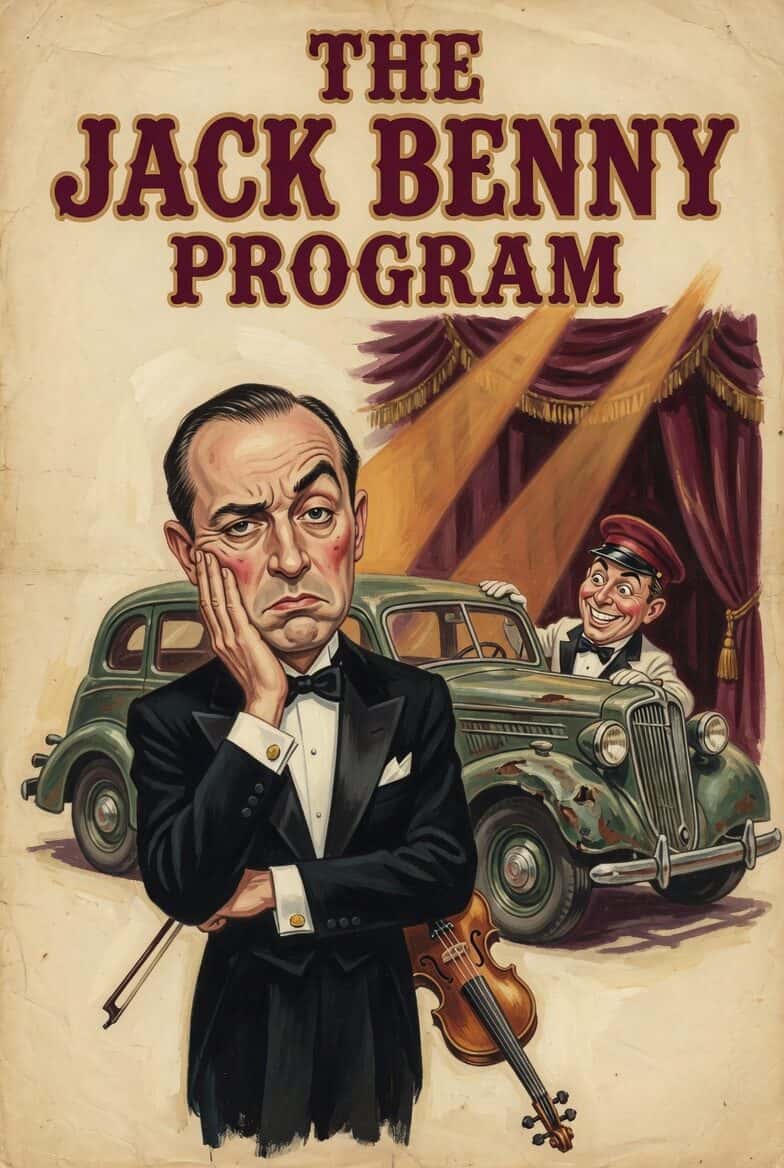
a lot of affairs or temper tantrums or whatever. Well, you know the mannerisms that you're talking about when people say there was a certain feminine quality to the mannerisms. That happened when he, in Vaudeville, doing a particular theater, whatever, I don't recall which one, the stage manager said, Jack, I want you to go out without your violin. and he did, and he didn't know what to do with his hands. He had always carried the violin, and all of a sudden there he was, naked on the stage with no prop. And that was the origin of all those mannerisms, was simply not knowing what to do with his hands. So the hand to the face and the crossed arms and all the things that we're all so familiar with, that was what happened. But you talked about, you mentioned the fact that he was a man without a dark side or no flaws.
In writing this book, when I first started, it took me a long time because I thought, who's going to buy a book about a nice man? People buy Dishy or Dirty or Salacious or whatever. Mommy Dearest. And Mommy Dearest, exactly. And who's going to want to buy a book about a man without flaws? So I deliberately, I interviewed many, many people for this book. Many of those interviews are left out, including Jane Wyman, Claudette Culber, and other well-known people whom I would have liked to include. The problem was everybody said the same thing. It was so repetitious. I couldn't get an unkind word. All I got from everybody was he was the nicest man we ever knew. He was the most generous man we ever knew. He was the most wonderful man we ever knew. It was constant, that kind of thing. And I tried. Now, I may not be the most wonderful interviewer. It's not something I'd done before. But I tried to get things out of people to find a flaw.
just to make the book interesting, just so that there was a little contrast. I couldn't get a flaw. It was very frustrating. He was simply wonderful. And the marriage to your mother, Mary Livingston, was... Absolutely. They absolutely adored each other. It was a wonderful marriage. As I said, it's very hard to find a flaw. There are a few little things, as he mentions and I point out, yes, he lost his temper once in a while. What else? Even I can't think of... He got angry with me a few times, and the few times he did, I must say, I gave him every provocation. Just to go back to the show, which is what so many Americans over, I don't know, 40 perhaps, remember so well. There was also Dennis Day who played an airhead in current parlance.
Yet, as I remember, he was a rather successful businessman on the side in real estate and stuff like that. Yes, I had heard that. As I said, I knew him really professionally. I didn't know much about his personal life. Of course, unfortunately, he passed away the summer before last, and I went to the funeral, and I've talked to Peggy a couple of times since. But I take it he wasn't more stupid than your father was cheap. Oh, goodness, no. Goodness, no. There were so many things on the show, you know, when we say, well, people don't quite know what to believe. But if you go through so many of the running gags, there was the fact that my mother was from Plainfield, New Jersey. That was an established thing on the show. Well, she wasn't. She was from Seattle, Washington. Mary had a sister, Babe, who was occasionally on the show. True, she really had a sister, Babe, and Babe played the part. And there was no particular reason why an audience who doesn't know would believe one and not the other. They were equally plausible.
And yet one happened to be true, one didn't. So unless you were really inside, it was very difficult to sort out what was actual and what was made up. In addition to Mel Blanc, there were also some other great character actors and voice people. I always thought that Mr. Kitzel was played by Mel Blanc, but I find out from your book that that's not true. Artie Auerbach. And there were also some great Hollywood... character actresses, radio actresses who played the telephone operator. Oh, yes, Iris Adrian was one of them. And I don't recall right this minute. Bea Benederat was in it. Yes, Bea Benederat, absolutely. And other people who did... Gertrude Gearshift and Maple Fox Saddle. That's right. Those were great, great names.
I loved Mr. Kitzel, too, who was a very out-front New York Jewish character. Pickled in the middle with the mustard on top. And yet there was a great use, particularly in the early years, before the war, of ethnicity. Rochester as a stage black, Phil Harris as a musician and all the stereotypes around drinking and sex, and Dennis as this sort of... airhead tenor. Yes. And then all the Mel Blanc characters, both animate and inanimate and animal and human, the parrot, the Maxwell. Monsieur LeBlanc. Right, the violin teacher. And there was also, who played the guard? There was the whole sequence of opening up. You know, I don't remember. I've tried to think of that. Maybe in my father's part of the book.
I don't remember the man's name. But there was this whole sequence of going down to the vault to get money. Oh, yes. Seemingly for hours, but it was... The echo chamber and the water in the moat. It was wonderful. I'll go into my... And the sound effects person or persons who worked that show were geniuses in their own way. Oh, that was my... As a child, that was my favorite thing on the show was watching the sound effects man. go up the stairs and down the stairs. Right, right. It just, you know, now in my house, my daughter watches MTV and I watch public television and somebody else is in the other room listening to the radio and we all have our separate cultures. Same thing in my house. The family never, it's very hard for the family to unite around any one event in the culture. I listen to Mozart, my daughter listens to The Talking Heads. Right, exactly. Or something like that.
and yet this was not always the case for those of you who were just born last week the uh It was a time when not only did we share programs like the Jack Benny program, but we also shared music, that we all listened to Perry Como or Patty Page or Frank Sinatra, the whole family. Well, you know, an interesting story, in writing this book, when on occasion I would be at lunch with some friends and somebody would say, you know, what are you doing? And I'd say, well, I'm writing a book about my father, never dreaming, having met a stranger at lunch, never dreaming that I might get a very good story.
from someone I'd never met before who had nothing to do with the business. And one occasion, a gentleman I had not met, oh, you're writing a book about your father? He said, I remember. And he gave me the most wonderful story. He had grown up in the Washington Square area of New York. And he said, I remember as a boy, we didn't have air conditioning. And in the summertime, or maybe the spring or fall, whatever, and he said, we would be out playing. And no matter how far you went, you never missed a word of the Jack Benny show because everybody had it on their radio. So it didn't matter where in the neighborhood, you could always hear those voices. Great. And I thought that was a lovely story. Yeah, that is nice. Tell us about some of the people that you met in your house who came through besides the Coleman's. Were they friends of the Coleman's? They were radio friends. They were radio friends.
the show went to television, then the Stuarts became, sort of took over that role. And the Stuarts really were our neighbors, the Colmans weren't. So again, it was back to what you believe and what was true and what wasn't. I'm talking with Joan Benny, who is the author, along with her father, Jack Benny, of a wonderful new book called Sunday Nights at Seven, The Jack Benny Story, published by Warner Books. I think this is a book where people will finally find that they really, I think when they finish this book, they'll feel they really know Jack Benny. Some of the other favorites of the show, favorite gags, I guess the most famous Jack Benny gag, which is right up there with Abbott and Costello's Who's On First and Bob and Ray's Slow Talkers of America, is the one where he is accosted by a robber, and the robber points a gun at him and says, your money or your life and there's this long silence and it's like the tension and the laughter builds and builds hmm sure is dark tonight no moon oh well hey bud bud huh you got a match yeah yes i have one right here don't make a move this is a stick up mister put down that gun shut up i said this is a stick up Now, come on, your money or your life? Look, bud, I said your money or your life. I'm thinking it over. I think the robbery in later years was played by Sheldon Leonard. Yes. He played those kind of heavies. Played the tout, too, the restructuring. Right, right. Hey, bud. Yeah. Go on, you can sit around. I know people... Oh, they still make me laugh. I mean, I hear those voices, and I just... They're so delicious. There's really no one...
who is Jack Benny's successor. In some ways, Johnny Carson is, in terms of timing and in terms of the double takes and all of that he does. And Johnny Carson is another favorite of mine. But the other thing about Jack Benny is he didn't tell jokes. That's right. In the sense that Henny Youngman or... you care to meet. Well, he was a comedian who never told a joke and who never took a pratfall, who never took a pie in the face. Most unusual for a comedian. Right, and who seldom had a punchline. That's right. The punchlines were actually delivered by his entourage. He even did one show where he never appeared. Really? I think I remember that, but remind me what was it? It was the opening show of a season, and the show centered around, I think everybody was going to his house for some celebration.
And so each of the characters was doing whatever they were doing during the show, but you never actually heard, and quite frankly, I don't remember whether this was television or radio, I think it was television, you never saw him until maybe the last 30 seconds of the show. And Bill Paley called him after and said, you know, what nerve, what absolute, you know, how did you have the nerve to do a show that you weren't on? And my father's answer was, people will remember it was a good Jack Benny show. It didn't matter that I wasn't on it. It was still a good Jack Benny show. Apropos of television and radio, I have to say that I really cared for the radio shows more than television because making him and the Maxwell and all the characters real took away some of the magic from it. They were great shows, but... Absolutely. I couldn't agree more. I think he was more successful than most in making that transition.
Obviously, Amos and Andy couldn't make the transition. Right, Fred Allen couldn't either. No, that didn't work. George Burns, it worked, and it worked for my father. But to me, radio was really his milieu, and I think had he started in television, it might have been totally different. But the fact was, he started in radio, so over all those years, for perhaps close to 20 years, people had their image of what the vault was, of what Dennis Day looked like. All these mental images, and when you actually saw it, nothing could be like what you had imagined. The vault was wonderful on television, but it couldn't possibly be what you imagined when you heard the echo and the creaking stairs and all this kind of thing. By the time the show went on television, Dennis Day was in his 40s. You had pictured him as a 20-year-old kid. So there were things, of course, that just couldn't possibly work as well on television. I think it was wonderful that it worked as well as it did.
How much of the Jack Benny character on radio was Jack, and how much were the writers? I would say it was 90% Jack. He had wonderful writers, but he was, as Harry Truman said, the buck stopped here. He was the final editor. He wrote with the writers. They wrote the initial show on their own for the first two days. They put the show together. But on Wednesday, that was Monday and Tuesday, on Wednesday he was together with the writers and they wrote together. They went over the show from the first sentence to the last sentence, the five of them, the four writers and my father. So he was absolutely responsible for everything that went on the air. So I know there was a famous contest which started out as the Why I Hate Jack Benny contest, a parody of all those Why I Love...
Rinseau soap or whatever. Yes, exactly. And he decided, he made a little twist, and he didn't want to use the word hate. In fact, he had a hard time accepting this idea in the first place, and then he said, well, why don't we call it something else? And after two hours, they came up with Why I Can't Stand Jack Benny, and Fred Allen presented the Morbon to the winner. Yes, yes. And read the winning poem, it turned out to be. This is a marvelous book for all of those of us who grew up listening to Jack Benny for whom Sunday Night at 7 was a time to be anticipated. I think Walter Winchell came on before in L.A. and was on KFI, as I remember. And I guess, no, that was the NBC days when it was on KNX. Right, it was on KNX. Somehow I remember the conjunction of Walter Winchell and Jack Benny, which is a strange combination. Anyway, I may have sort of mushed it all around in my mind.
This book, Sunday Nights at 7, The Jack Benny Story, published by Warner Books, by Jack Benny and his daughter Joan, whom I've been talking to for the past hour, is a treasure. There's also a forward, or a non-forward, really, by George Burns. May I make a comment about that? Sure. George Burns told me personally, and I'm going to tell you, that books make a wonderful Christmas present, and by all means, buy it for Christmas. We were talking about the book, and I said, George, how do you get on the bestseller list? Because he did it twice. He said, you tell everyone to buy it for Christmas presents. So I'm telling you, buy it for Christmas. Okay, well, I'll probably buy a couple of them and give them away to my parents and people in my family, because this is all art.
This is going to sound weird, but I think that we are more united around cultural artifacts like the Jack Benny Show than we are around religion or family things. I mean, we are a media country. We're media obsessed, and we get most of our information and most of our experience through radio or television or newspapers or magazines, whatever. And this man, this wonderful man, will always make me smile and feel warm. And thank you so much for coming by. Thank you, Larry. That was Joan Benny, author with her father, Jack Benny, of Sunday Nights at 7, The Jack Benny Story. In the next hour, we'll talk with Phil Harris and Joan Benny live with Irving Fine, Jack Benny's longtime manager on tape. And we'll hear an excerpt from not the Jack Benny show, but a dramatic program that Jack Benny appeared on with Claudette Colbert, Basil Rathbone, and Ernst Lubitsch. And, of course, we'll talk to you on the telephone. Do you gentlemen have anything else? No, not me. I've had enough. I'll bring you Jack in a minute.
Hey, say, Phil, how about coming over to my house for a little gin rummy? Well, I'd like to, Jackson, but I gotta go home and wash Alice's hair. Phil, you... you wash Alice's hair? I used to be on for Fitch. I gotta use that stuff up some way. What? Slip yours off. I'll wash that, too. Never mind. Say, Don, how about you coming over to my house? Well, I wish I could, Jack, but I've got to go back to the studio and make some spot announcements. Oh. Say, Dennis, would you like to come over to the house and play a little gin rummy with me? No.
Why not? You cheat. I? I cheat? I've been watching you. When you play, you deal off the top of the deck. What? The man I played with on the train always dealt off the bottom. Heaven's sake, kid, when will you learn? Here's your chat, gentlemen. Oh, I'll take it. Good, good. Well, fellas, I'm going home. Mr. Benny, do you want me to drive you? No, thanks, kid. It's such a nice evening, I think I'll walk. So long, boys. So long, Jack. See the weather's balmy. Spring is the nicest time of the year. Trees are green, flowers are in bloom. Makes a fella feel good. Where does Jolson get off saying he doesn't go nyeh? Excuse me, mister. Huh? Could you spare a dime for a cup of coffee? A dime? Well, let's see. I haven't got a dime. The smallest I have is a half a dollar.
I haven't eaten since yesterday. Well, look. Look, buddy, here. Here, take the half a dollar. Gee, mister, thanks. Thanks a lot. You're welcome. Gee, that was nice of me. He only asked me for a dime, and I gave him a half a dollar. I wonder if it's deductible. You're listening to Modern Times with Larry Josephson. Modern Times is made possible by grants from the National Endowment for the Arts and from KCRW Santa Monica and WNYC New York Public Radio. Modern Times is a co-production of KCRW, WNYC, and the Radio Foundation. Distribution is made possible by a grant from the American Public Radio Program Fund. You're listening to Modern Times on KCRW Santa Monica, a community service of Santa Monica College.
at 89.9 FM, National Public Radio for most of Southern California. Modern Times continues until 8 o'clock, and at 8 o'clock we present What Do You Know with Michael Feldman from 8 till 10. At 10 o'clock, episodes 10 and 11 of McTeague, the Frank Norris novel produced for radio by the L.A. Theatre Works and KCRW. At 11 o'clock, Joe Frank, Work in Progress. Midnight, we have... a half an hour of news from the BBC from 12 to 12.30. At 12.30, music with Todd Bisson, his program Bustin' Loose from 12.30 till 2, and at 2 o'clock, Trendsetters with Philippe Lever. More music to take you right on through the morning hours here on KCRW. Stay tuned for hour number two of Modern Times with Larry Josephson. Welcome back to Modern Times. My name is Larry Josephson. We're on American Public Radio, and we're celebrating...
the magic of the jack benny program and really all of the great old radio programs but since jack benny was my favorite and joan benny has written this memoir really two books in one uh an edited transcript of her father jack benny's memoir plus her own recollections we have with us on the line now phil harris who was one of the original cast of the jack benny program and played this character who was the stereotype of the drunken, promiscuous musician, but in real life was happily married to Alice Faye. Phil Harris, welcome to Modern Times. Hey, I've been listening to you. You and Joni just about covered everything, Larry. I don't think there's much left by a promiscuous musician. What does that mean? I don't know.
I don't know what words more than two syllables mean. You played a character who gave the impression that the character was out late at night doing things that perhaps weren't broadcastable on the radio in those days. I mean, you got nothing against them, though, eh? Oh, no, no, no, no. I mean, I used to take a drink, you know, if it was very important, something, you know, like a warm handshake, you know. Somebody got married or something. Well, they would... No, I'm just kidding you. Jack Benny said, he said, I tried every way in the world to kill you. I found you about five stories down in some slop land. I brought you up out of there. I had you drunk. I had you taste some women. I got you married. I had you two beautiful children. We went through. He said, there's no way to kill you because you see, Jack, what Jack did, he would find something about you.
and then magnify it. That was his whole gimmick. And no one in the world could drink as much as I was supposed. And then not only that, but one time we're on the car, we're going back to New York like we did every year on the Sunset Limited, and I'm back in the end of the thing, and we're having a few drinks because what the hell? You got to get in the compartment and lay dead for three days. So I used to get about half high. and go back, and I'm walking through the cars, and I feel a tap on my back. And he looked at me, and he said, Hey, Phil, you keep drinking like that, it won't be funny. You understand? I mean, I met him in 1933, and I think that's when Joni was born. I had my own show at that time. I was a nail polish for it. But I met him, and he'd been on, I think he'd been on a thing for Clico Club.
And they didn't understand his format. It was something about they couldn't understand why a guy was kidding the program. And then he went on for a year or something. And then we didn't cross for quite a while. And then I got a call. He wanted me to come to California. I think this is around 30, 39. I was at the Roosevelt Hotel in New Orleans. I used to play the Roosevelt at Netherland Plaza. I had a whole tour, New York Hotel. But at that time, I didn't have a radio show. I mean, so he said, come to California. I'd like to have you come on the show with me. George Burns, not Jack. So by the time I give up this job and get to California, Burns or Music Corporation, whoever, had already given the job to Wayne King. But Jack and Mary were there, and they invited me out to the Trocadero, and I went out for dinner. And I was sitting there, and Jack said, what program?
I said, I haven't got one. So he said, you're with me. And that's the way I started with him. And I spent 18 years of the most wonderful years of my life with a man that was an artist. Yeah, so were you in your way. Were you really the band leader or were you just played the character of a band leader? No, no, it was my band. He took my whole band. So you actually directed the band as well as appeared as a character? Yeah, from off the floor. Was there really such a person as Frankie Remley? Yeah, he was a left-handed guitar player, but we didn't let him. You know, we used to put dope on the strings. We wouldn't let him play too much. Tell us what it was like to be in that cast and to go to the...
First NBC and then CBS Studios every week. Well, that was later. That was later when I had my own show. See, I'd been with Jack for years. And I'll tell you something about the Benny Show. There'll never be another organization like it. You know, it was first started, two guys that contributed the most are Morrow and Boulogne. Boulogne, Bill Morrow and Ed Boulogne. They were writers? Boulogne, the writers, that's right. They created Rochester. They created... Carmichael the Bear, the cheap guy down in the basement and all. I will say that George Balzer and Taka Berry and Joseph Berg did a hell of a job. Then we used to have a guy come in at the last reading by the name of Al Boesberg, and he'd maybe punch it up with two or three gags. But see, Benny, it's office hours. In other words, you'd go to the writer's wood at, say, a clock in the morning in Beverly Hills, and he sat right there.
while nobody, no two took a piece home, a sequence of. He was there, and I've been around there. I've been in there. He liked me. I loved this man. I've heard a gag that they would do for me that would break the building down, and Jack would say, no way, because I can't. He protected his character. He took a character and made a jewel out of him, a diamond out of him, like the thing that put down. after Kenny Baker left, and we got Dennis, the thing that put him over at rehearsal, said something, Dennis, and Dennis said, yes, please, put him right in business. Same thing with Rochester. We looked all, Rochester was a friend of mine. He was playing at a place called the Green Mill down in Los Angeles here a little bit. It's Eddie Anderson. Yeah, Eddie Anderson, and so I went to Eddie, and I said, they're looking for Coleman Porter with an accent.
And that's how Rochester got the job. But I'll tell you, things happen with Benny that will never happen again. In other words, if you didn't stop the picture on Sunday or let them listen to the Benny show, there'd be nobody in the theater. The other great things that happened that'll never happen again, we're at Sunset and Vine, and I'm in the parking lot one morning, and he drives up, it's rehearsal Sunday morning. And he said, well, we're leaving Jell-O. I said, what? And Jell-O is like leaving home. You know, I mean, I said, what are you talking about? He said, we've got to. I said, what do you mean we have to? Well, I can't get any more money. And I said, well, is that the only thing? He said, yes, because they can't make it fast enough. Yeah, he actually happened again. Never. They couldn't make Jell-O. Now he's going from there to Lucky Strike. Lucky Strike was.
When you went with a cigarette, if you lasted 30, you had a hell of an act because they were using top bands for 13 weeks, this for 13 weeks. That was a kiss of death to get on the tobacco show. Well, you know, did you ever meet George Washington Hill, the legendary head of... Oh, sure, LSMFT. And he came to watch the show? Did he meddle at all ever? No, no, no way. Nobody meddled with Jack Benny. George Washington Hill was the legendary and tyrannical head of the American Tobacco Company. That's right. Strike Green has gone to war. Yeah. Phil, we have also on the line Joan Benny live, who has been standing by. I'd like to sort of...
introduce you two again once you probably haven't seen each other for several years. I'm not Ralph Edwards, and this is not your life, but Joan, good evening. Good evening. Hi, Phil. How are you? I'm fine, Joanie. Terrific. I have a little laryngitis you can probably hear. Yes, I can, but you sound all right to me. Well, it's great talking to you. It's been a while. Phil, have you seen the book yet? I've seen it, but I haven't had a chance to read it, Joni and her co-host have done a good job because if they just take, you know, if they just take parts of, my goodness, you know, I had 39 shows. You know, you weren't supposed, when you finish with the show, you're supposed to sit up on the table and get the hell out. For some reason or other, don't ask me why, but I kept those. And when Bing died in Gonzaga, the university in Gonzaga, I put 39 shows.
in Moroccan leather in his library. This is Bing Crosby you're talking about. Yeah, I did it for Bing. Yeah, that's great. I think what we'd like to do now is take some calls and let you both talk to our audience and share their reminiscences of the Jack Benny program. Later on, we're going to listen to an excerpt of a program he did for the Gulf Theater Guild program with... Claudette Colbert, Basil Rathbone, and Ernst Lubitsch. But right now, I think we'll take some calls. We're at 1-800-648-5277. If you're in the West Coast, 1-800-648-5288. If you're in the Midwest, in Iowa, or in St. Paul, and if you're in the New York, New Jersey, Connecticut area, you ought to have your head examined, but you can call us at 212-267-9692. You know who'd get a big kick?
She came out here, and I can't think of her name right off, but the head of his fan club was such a beautiful lady. Laura Lee. What's her name? Laura Lee. Yeah, I guess so. I don't know. But has she been on this show? No, I didn't know of her. Well, I'll tell you. She's a beautiful lady, and she puts out a paper every so often and talks about somebody that loves Benny. And she has quite a large... fan club. Still, you mean? It's still going? Oh, I just got the day. Yes, I did too. She lives in Fort Wayne, Indiana. Fort Wayne, that's right. That's really terrific. It went off the air in the middle 60s and the fan club is still going. Oh yeah, big. It's big. Phil, were there ever any tough moments during the rehearsals or in the course of that show when people got into fights? No.
It was like a family. It was lovable. Everybody loved one another. Well, my God, you're the top show. Every year we went to New York. Everything was red carpet. We'd do so many. I can remember in Chicago we were doing eight shows a day. Wow. And then doing the program on Sunday. Eight shows a day. Also in the theaters in New York. Eight shows we'd start. The first show would be probably 8.30 in the morning, and then they'd just run the newsreel, and then we're right back on. We're at Radio City Music Hall or the Brooklyn Paramount, or where was it? No, the Music Hall in New York and the Chicago Theater in Chicago, and maybe the Earl or the Mass Bomb, whatever it was, wherever we were. Oh, wow, I didn't know that. The greatest thing that he did was the March of Dimes every year. We did the March of Dimes, and we went all over.
And then you'd have five or six of your big movie people. Well, that's terrific. We have some calls now. Let's see who's on the line. Hi, you're on Modern Times with Phil Harris. That's French O'Tone, I think. We're on with Phil Harris and Joan Benny. Go ahead. This is technically a little difficult. Let's see who's on the line. Are you there? Oh, is it me? Yeah. I was at the University of Buffalo. Benny came by who was in residence there and him and Alexander. Oh, wow.
I'm also interested in what kind of music he played at home. Did he play chamber music at home with people? Well, he played with me. We played the Mozart piano and violin sonatas, and we played some Beethoven. We had great fun doing that because I was a pianist, so we did a lot of things together. And he did some chamber music. He enjoyed sitting in with some of the musicians in Los Angeles. You asked another question. Oh, the Stradivarius. That went to the Los Angeles, it was donated to the Los Angeles Philharmonic Orchestra. And why do they have a Stradivarius? I'm just curious to know. Is that sort of a thing where even if you can't play it? May I answer that? Yeah. I'll tell you something. Don't kid yourself. Jack Benny spent a lot of time before he passed away the last two or three years in Europe and here playing concerts.
All the time he was with me, he took, with my band, which was 18 years, he took at least two lessons a week from my first violinist. And I'm going to tell you something. When the man wanted to play, he could play. And that's why he wanted a good instrument, the same as anybody else. This man, he played in the symphonies in Europe, the United States, and no screechy. This guy, when he wanted to play, could play. Uh, Phil, when they played those little... da-da-da-da-da-da-da-da, those little scales, did... Uh-huh. Did Jack play those, or did somebody else play those? No, he played them. What the hell? I could play those. That was his signature. He played it all the time. He played it for us. He played it for laughs. That's what he did. Oh, I know, I know. That's the beginning etude. Every violinist has their first in the book of... Okay. Thanks for calling, sir. Uh, I have to tell you a little story. When we were producing this, uh...
One of our engineers, Bill O'Neill, told me a story that your money or your life bit somehow wound up in the possession of German radio after the war, and the engineer who was preparing it heard this long pause and cut it out. That's very funny. Yeah. So, anyway, it's just terrific to have you both here. Let's take another call. Hi, you're on Modern Times with Phil Harris and Joan Benny. Great having you. I want to share with you.
nice, and I appreciate it, but the Benny show, it was well written. I mean, family, and like I say, Jack knew what he wanted, and he protected them. In other words, one week they weren't up in an airplane, and the next week they weren't down and shoveling coal or something. I mean, he stayed strict. I said earlier in the lines that they would have given me that, like I say, could have stopped the show, and he says, don't do it. In other words, the man knew what he was And the main thing, outside of knowing what he was doing, would come time for us to have three months off after 39 shows. He used to go to Jules three months. He wasn't entertaining the people. He kept taking the lessons every week. And then his father would go to Florida and go all up and down the beach taking his pictures to every house. He was saying, this is my son, Jack Benny. I think it was about 1951 or 2.
Yeah, 52 is generally the date that it's said that network radio ended. There was the big show with Tallulah Bankhead, and that was it. So it must have been about that time. I have a couple little anecdotes, too. When we were preparing this show, our associate producer, Evan Spring, who's 22 years old, was laughing at these jokes just as if he were 42 or 62. It's really quite amazing how universal this material is. And I have to tell you, I collect old radios, brought home a big console at Water Kent from about 1923, 24, sliding doors, and it was a big monster radio. And I plugged it in, and I turned... This was about 1970-something, and I plugged it in, turned it on, and out came Jack Benny. It was like some radio station was playing some of the old shows, and it was like this magical experience. It's amazing to me how well those shows hold up. It really is.
Well, we had a good stock company. You take Sheldon Leonard, Elliot Lewis, Frank Nelson, Mel Blanc, Eddie Anderson. I mean, he had a great stock company, you know, and everybody loved him. And he was exactly opposite of what he's carrying. I mean, the man, he used to come to me maybe every two or three months. It was way back when we had Mert Blum as the manager. Mary's daughters, Sadie or whatever. The sister babe. And Jack used to come to me and say, go to him and tell him to give you some more money. I said, well, Jesus, I'm only saying, hello, Rochester, here comes Mary, you know. Only maybe had three lines. He'd say, go to... And then in the next breath, he'd say to me, if you got a quarter, I want to get some George Burns. He's smoking George Burns cigarettes. I mean, Robert Burns. And then...
smoking when Burns, his buddy, picking him up. Jack stopped smoking, I would say. I went with him, I think, in, what the hell was it, 37, 38. And I would say about the beginning of 40, Jack stopped smoking altogether. He used to have this cigar, like George Burns did, and he used to smoke cigars, Robert Burns. Oh, but he smoked cigars till the end of his life. Jack Benny did? Oh, yeah. I didn't know that. That certainly wasn't part of his public character. No, I didn't see him smoke either for years. Oh, he smoked cigars at home. Probably at home, but he never used them as a prop. No, not as a prop, but he did enjoy a good cigar. All right, let's take another call. Hi, you're on Modern Times with Phil Harris and Joan Benny. No, I can't imagine. My wife absolutely adored. She never missed a morning. Here's next year and I.
Every morning for years, she would turn Arthur Godfrey on the morning. So I finally said to her one time, because I never listened to it. I knew him. I liked him. I said, why do you get Godfrey on the minute you wake up? She said, do you know that every month or so he says something funny? She was a big Godfrey fan. All right. Thanks for calling. Thank you. What characters did you, what voices did you do, Phil? Well, I did quite a few. I was Baloo in the... Oh, I did... Now you get me. Did you do some of the characters in the Uncle Remus things, the Song of the South? No, I did Jungle Book. I did Baloo in Jungle Book. And I did Robin Hood. I did Walt Disney. That's great. We're talking with Phil Harris, who is...
The last surviving member of the cast of The Jack Benny Show. Phil, could I ask you how old you are, would you mind? I am 86. Holy moly, that's mazel tov, as we used to say. May I ask Phil a question? Sure. I thought you got married in 1948, you and Alice. Weren't you on your honeymoon on that trip that we took to Europe? No, honey, I was married in 41. Oh, Lord, I thought it was on that... And I think if I'm not mistaken, if you don't mind, I think I can tell you the year you were born. You got me off by one year. You're making me older than I am. 33? No. No, 34. 34? Yes. Well, I guess I'm the youngster. I was born in 39. But I feel older than you sound, Phil. I'll tell you that. Let me say that we're talking with Phil Harris and Joan Benny, who...
wrote this wonderful book, Sunday Nights at 7, The Jack Benny Story. It's a combination of a memoir written by Jack and with a wraparound by Joan of her growing up in Beverly Hills, being the daughter of Jack Benny and Mary Livingstone. We should also say that Alice is Alice Bay, who is a great star of 20th Century Fox films and has been married to Phil Harris since 1941. So this is For me, this is like a real privilege. I must say that my grandfather took me to the Hillcrest Country Club where he was a member and pointed out the round table where Jack Benny and George Burns and all the others sat. And I guess it never occurred to me to ask him to ask Jack for tickets to the show, so I never saw it. So in a way, this is, for me, capturing that experience. This is the closest I can come other than listening to the shows.
uh to meet you on the phone phil and you're active you're an active golfer and you're quite you get around i know you were just at a golf tournament tournament phil you there yeah so uh i i want to thank you both for giving us your time and allowing us to remember the wonderful jack benny show for me it would no matter what is to come in my life it will be the entertainment high point and and thank you so much with with jack and Mary in Rochester and everybody else. Let me say this. And thank you guys for having me on. Thanks, Joni. Thank you, Phil. And thanks, Larry, for having me on, too. By the way, I agree with Phil, but from a different point of view. I was so lucky to have been his daughter. Well, we're so lucky to have had Jack Benny and all that wonderful cast. And we're now going to listen to an excerpt from... Joan, thank you so much. We're going to listen to an excerpt from a...
program which was the Gulf Theater Guild program, I guess normally a dramatic program, which was to have been, in this episode, a drama starring Claudette Colbert and Basil Rathbone, directed by Ernst Lubitsch, the great Hollywood director, and Jack Benny sort of butts in, and he, earlier in the program, he wants to be part of it, and he's rejected by the director of the program, the radio program, and by uh rathbone and he sort of invites himself over to claudette colbert's house to take part in a rehearsal and we pick up the program there right this way mr benny i'll show you into the drawing room well thanks thanks mr rathbone is here already oh here one of those anxious guys eh say this is a lovely home lovely may i take your umbrella mr benny oh yes I should have left it out in the hall. You know, it looked like rain. Well, well, Mr. Rathbone. I'm Jack Benny, the movie star. How do you do? How do you do? So the two rivals meet, eh? Rivals? What do you mean? Well, perhaps I should let Claudette tell you, but it looks like I'm taking your place on the golf show next Sunday. Oh, that's ridiculous, old boy. Oh, no, no, it isn't.
You see, at rehearsal tonight, you and I are both going to read the part, and of course, the best man will win. The best man? Yes. Mr. Benny, when only two people are involved in a statement, the comparative is used. You don't say the best man will win, you say the better man will win. Oh. Now, if three or more people are involved, then the word best is the correct adjective. I see. So before we compete for this part, Mr. Benny, it might be as well if you first learned how to speak English. Well, thanks for the lesson, Madam Lazanga. For your information, Mr. Rathbone, I went to Waukegan High School four years, and I excelled in English. In fact, I got 99 every single term. Ain't that interesting? And getting back to the subject, the way the script is written now...
You play the part of Miss Colbert's husband. Is that correct? That's correct and final. That remains to be seen. I've heard of sore losers in my life, but this guy certainly takes the cake. Step right in here, Mr. Lubitsch. Miss Colbert will be with you shortly. Thank you. Oh, hello, boss. Ernst, old boy, how are you? Fine, fine. Hello, Mr. Lubitsch. What are you doing here? Well, I thought I'd just drop around to see... Now, listen, Ernst. I don't know what this is all about. I demand an explanation. Look, Mr. Rathbone. Explanation? Look, Mr. Lubitsch. I thought I was to appear opposite Miss Colbert. Look, Mr. Rathbone. Of course you will. Look, Mr. Lubitsch. Then what is all this about? Look, Mr. Rathbone. Now, look! Mr. Benny, when I spoke to you on the telephone, I thought I made it perfectly clear that... Good evening, everybody. Oh, look, here's Claudette. Oh, hello. Well, here we are. Put the coffee down here, Richard. Yes, madame. Can you tell us, Mr. Lubitsch?
No, thank you. Coffee, Dad? Yes, please, yeah. I'll have some, too. Oh, here you are, Dad. Thank you. Mmm. Gee, Claudette, this is the better coffee I ever tasted. Mr. Benny. Yes? The word is best. There are only two of us drinking it. Make up your mind. Well, we're all here, so let's get started with the rehearsal. Just one moment. Ernst. Let's get this settled for Mr. Benny's benefit, shall we? Is he or is he not replacing me in the play? Certainly not. That's ridiculous. Of course it's ridiculous. Why, it's absurd. You stay out of it. The butler, yes. Then, Mr. Benny, I'd like to know why you said that Mr. Lubitsch recommended the change. I didn't say that. I said that Miss Colbert suggested it. I suggested nothing of the kind. But Claudette. Please, please, stop all this bickering. Now, Jack.
If you'd like to watch the rehearsal, take a chair and be quiet. Yes, sir. Now, Claudette, is it all right if I have some of these walnuts here? Go right ahead. Help yourself, Jeff. Thank you. Mmm. Big one. Now, Claudette, you too, Barstow. If you both turn to page 12 in the script, we will proceed. Boy, these nuts are good. Now, Claudette, you're a wealthy society girl who is married to a New York stockbroker. That's you, bastard. But he does not love you, Claudette. And as the French say, it is a marriage of convenience. Gee, that was a tough one. Mr. Benny, will you stop eating those nuts? Well, Claudette said I could. Anyway, Mr. Lubitsch, I don't want to sit around here like a bump on a log. If I can't have the lead in the play, isn't there something I can do? All right, all right. If it makes you happy, you can play the part of the butler. The butler? Okay. Here's your script.
Thanks. Now remember, Claudette, you're the wife. Basil, you are the husband who doesn't understand that. And Jack... I'm the butler whom Claudette really loves. You are the butler, that's all. Okay, okay. Heavens to Betsy. All right, Claudette, now we start the scene. Remember, your husband is two hours late for dinner, and you are a nervous wreck. Yes, Mr. Lewis, I understand. Go ahead, call the butler. Yes. Oh, Smedley. Smedley. Yes, madame. Smedley, yes. Uh, what is it, madame? Are you sure my husband hasn't phoned? No, madame. But I can't understand it. What time is it, Smedley? It's half past eight. Shall I serve dinner, madame? No, no, Smedley. I'm not too upset to eat. I think I'll go to a movie. What's playing in the village? Buck Benny rides again. Eat a life, please. Oh, it doesn't hurt to give my picture a plug.
It doesn't change the plot any, does it? For heaven's sake. Read to me, it's written. All right, all right. Give me that again again, Claudette. Okay. No, Smedley. I'm much too upset to read. I think I'll go to a movie. What's playing in the village? Minotska. How's that? Much better. And Buck Benny rides again. It's a double feature. Jack, please. All right, I'll start over again. Shall I serve dinner, madame? No, Smedley. I'm much too upset to eat. I think I'll go to a movie. It's Boomtown playing in the village. Well, we got them all in. Very good, Clodess. Now, at this point, the husband enters the room. Not ready yet. Oh, Mr. Lubitsch, let me ask you something. When Basil comes in, or Basil... By the way, how do you pronounce that? Basil or Basil? Mr. Rathbone.
Well, when Mr. Rathbone comes in... Oh, just read the lines, Jack. I handle the rest. All right, all right. A fine director. What did you say? I said you're a fine director. I think you're wonderful. Ready, Bowser. Make your entrance. Right-o. Oh, good evening, darling. So sorry I'm late. Oh, Ronald, you're always late and you're always sorry. It's been like this for months. Let's come between us. If I only knew, maybe we could work things out. It's nothing, my dear. It's just that I've been so busy lately at the office. Let's forget it. Dinner is served. Oh, pardon me. I'm too soon. Mr. Ronald, I can't forget it. We must come to some understanding. This can't go on forever. Now, Gwen, let's be adult about the whole thing, shall we? Every night it's the same argument, this constant nagging, nagging, nagging. I tell you, I've been working at the office. But I phoned your office and they said you left at two this afternoon. Well, I had business at the bank. And besides, I forgot where I parked my car. Fine Sherlock Holmes can't even find his car. Stop interrupting, please.
Oh, it's no use, Ronald. I know you're lying. Look at you. Everything you say, everything you do gives you away. Now, Gwen. What's that on your collar? Is it lipstick? That ain't ketchup. Well, I don't want to stand around here like a dope. But you've got the right line right now. Say it. Oh, yes. Beg pardon, madame. Dinner is served. Jack, Jack, don't use such a thick accent. You should talk.
Big pardon, madame. Dinner is served. Now, Jack, don't be so highbrow. All right, the soup's on. Come and get it. I don't know how Garbo put up with him. Nothing about Garbo? Nothing. I can have her on my mind, can't I? Gee. All right, let's have that line again. Big pardon, madame. Dinner is served. Take it or leave it. Ah, dinner. Come along, Gwen. No, we're not having dinner, Ronald. Not until we've reached a definite understanding. Well, I'm hungry. Ronald, I can't go through another day of this uncertainty. I must know. Do you love me or not? Of course I love you. You're lying, Ronald. Lying. Very well, then. I'm lying. Gee. You might as well know the truth, Gwen. I've never loved you, never. I must be crazy. If you weren't so stupid, you'd have known it long ago. Ronald. Ronald, what are you saying? Gee. I married you for your money, that's all. Everybody else knew it.
And if you weren't such a blind, silly little fool, you'd have realized it yourself. Ronald, stop! Well, Gwen, now you know how things stand, and the sooner you give me a divorce, the happier I'll be. No, I'll never divorce you, Ronald. I couldn't live without you. I couldn't, I couldn't. Tears, tears, woman's tears. Oh, stop the dramatic. Ronald! I'm moving to my club. Smedley, pack my clothes. I wouldn't touch your dirty clothes. Jack, stick to the lines. You are servant. I don't care. Gee. Continue, Buster. Well, goodbye, Gwen. I'm going to the club. Our attorneys can get together tomorrow. Don't go, Ronald. Please don't go. Stop hanging on to me. No, I won't give you up. I won't. I won't. Stop it, I say. Let go of me. No, no. Gwen, take that. That's the last straw. Take off your coat, Rathbone. Jacques, Jacques, that's only a play. Ain't nothing. Put all those dupes back. Don't put them up. Oh, so I'm an old man now, eh? Why, you...
Jack, if you don't behave yourself, you can't be in the play. The heck with the play. If you think I'm going to stand by and see this cad strike the woman I love. The woman you love? Yes, Claudette. You might as well know it now. I've been crazy about you for years. Well, Jack, please. I don't care who knows it. I don't care if the whole world knows it. I love you, Claudette. And that's why I was carried away. I'd give anything to be in a play with you, but I'm afraid I can't go through with it. Goodbye, gentlemen. Goodbye, my love. My goodness, I barely know the man. That was an excerpt from the Gulf Theater Guild program. And I have Nicola Lubitsch and Bob Lyons of KCRW to thank for providing that. Actually, there are a whole lot of people who helped put this program together, and we'll mention them at the end. We're going to take some more phone calls, and we have Joan Benny back with us. We have this kind of...
Crazy phone system where we can only have so many people on from different places at once. We're at 1-800-648-5277. If you're in the West Coast, Alaska, Hawaii, fine. How are you? Oregon, whatever. We're at 1-800-648-5288 if you're in the Midwest. And we're at 212-267-9692 if you're in New York, New Jersey, or... So, hi, you're on Modern Times? Go ahead. Yeah. Hello. That wasn't Benet Venuta. That was his wife. Aren't you talking about his wife? I thought his wife was Benet. It was his wife. Benita. No, his wife was Benita Coleman. Oh, I see. Benita. I confused them. Benet Venuta is a very good friend of mine. She was married to Fred Clark, who was the next-door neighbor of the Burns and Allen show. Right, right. Mr. Benny. My father. Yeah.
Well, according to George Burns, he was one of the most handsome men in vaudeville. Of course, that was before my time. All right, thank you for calling. Thank you very much. And, Joan, welcome back to Modern Times. Thank you. We're talking with Joan Benny, who wrote Sunday Nights at 7, the Jack Benny story. And so let's take another call. Hi, you're on Modern Times with Joan Benny. Go ahead. Hi, I want to know that I am Benny. So you had to decide? No, it wasn't. Lasty wasn't on television. Are you talking about Lasty? Yeah, Lasty was on television Sundays at 7 o'clock. Oh. The Sunday nights at 7 actually refers to the radio show. I know, I know, but I... Right. All right. Thank you. Thanks for calling. All right, let's take another call. Joan, I wanted to also talk about some of the other characters, not exactly minor characters, but, for example, there was Artie Auerbach who played Mr. Kitzel. Yes.
And that was a great, we have an example of that, Mr. Kitzel queued up, and we'd like to both listen to that and share that with the audience to bring back the great, there's so many of these characters, not just Jack and Mary and Phil and Dennis and Don, but so many other people. Let's listen to Mr. Kitzel. Yes. Well, Mr. Kitzel. Who was your friend, too, who I just saw you talking to? My friend... Oh, oh, that was some poor man who wanted a dime for a cup of coffee, but I gave him a half a dollar. Bless your heart. Thank you. By the way, Mr. Kitzel, where are you going? I'm on my way to the baseball game. Oh, yes, yes, there is a game tonight. The Angels in San Diego. I didn't know you were such a fan. Oh, my, yes. But I'll tell you one thing, Mr. Benny. The baseball players are not like they used to be. You're right. Some of those old-timers were really great. Hmm.
My, when I think of such players like Christy Mathewson, Ty Cobb, Rabbi Maranville. No, no, no, Mr. Kitzel. You mean Rabbit. Rabbit Maranville. Rabbit? Him I never heard of. Well, I don't want to be late, Mr. Bennett. See you again. Oh, by the way, Mr. Kitzel, while I was in the drugstore, I meant to buy a package of Lucky Strikes, and I forgot to. Do you happen to have a... Of course, of course, sir. Good. I smoke Lucky's. Yeah, I have one of mine. Well, thanks, thanks. Believe me, Mr. Benny, I've been smoking Lucky's strikes for nigh on to 25 years. You have? Yeah. I'll never forget the first time I ever smoked a Lucky. The mildness, the smoothness. Oh, ho, ho.
You really like them, eh, Mr. Kitzel? Like them. Not only are they round and flame and fully packed, but there's never a riffraff in a lucky. No, no, you mean rough puff. Riffraff, rough puff. Like one and enjoy. Thank you. Well, goodbye, Mr. Kitzel. Sold America. That was Artie Auerbach as Mr. Kitzel. And we're on with Joan Benny and... who wrote Sunday Nights at 7, the Jack Benny story published by Warner Books. And let's take another call. Hi, you're on Modern Times. Go ahead. There? Yeah. This question is for Joan. A hundred years ago, I read that Jack's arm gesture began as the result of an injury on the set. And he had his arm in a cast or something like that. And he had to hold it that way. And it continued on.
Could she comment on that? Yes, I never heard that in my whole life. Okay, I read it somewhere. Well, that's possible, and it may even be true, but I never heard it. Okay, fine, thanks. All right, some more apocrypha here. Yes. We're at 1-800-648-5277, 1-800-648-5288 if you're in the Midwest, and 267-212-267-9692 if you're in the East Coast. They used to do those shows twice, right? They did them once for the East Coast and they did them over again for the West before they had tape recordings. Yes, very early on. All right. We do it live all at once here. Hi, you're on Modern Times. Go ahead. Go ahead. Yo. Let's take another one. As I say, the phone thing is tricky when we have a call out and a call in. One of these days. Hi, you're on Modern Times. Go ahead. Yo. Am I it? You're on.
Thank you. Oh, such a treat to hear this program. I've loved it, and I'm sitting here laughing, and I just, in the first place, was here that Joan Benny had a, I mean that Jack Benny had a daughter. And Joan, I'm so happy to know you're part of this family. Well, thank you. Never thought of anybody but Jack and Mary. Thank you. I appreciate that. What I wanted to tell you was that the things you're saying about how this is a family show and all, was always true in our family. 24 of the season would be on. And he'd say goodbye, you know, and we knew we wouldn't hear him for three months. We'd all sit around and just cry. We just lost a friend and didn't know how we were going to live through the next three months. Oh, isn't that nice? Yeah, and I remember my first time on a trip west, different, and the biggest thing, the one thing I still remember about the trip, because we said, Benny, he was having a Coke or something at a, you know, at the... Did you go and say hello to him? Oh, we didn't, but I always wish we had. We were too bashful at...
the time, but we loved it. Oh, that's too bad. He would have loved to have said hello. Where are you calling from? I'm calling from Rochester, Minnesota. Oh, is Rochester still there? Oh, but it's wonderful being introduced to all these folks again, and anytime I have a chance to listen to anything about Jack Benny, I do, and I laugh. It was back in the 30s. Oh, thank you, and thank you for your call. Oh, you're welcome. My pleasure. Thanks for being there. Thank you for calling and keep listening to Minnesota Public Radio. You bet. I love it. Okay. Thank you. Let's take another call. You're on with Joan Benny. Hi, you're on Modern Times. Go ahead. Hi, Mr. Spill. Thanks for your show today. It's really super. Ms. Benny... Well, I'm not sure that delighted is quite the word, but my father was always a man who looked to the future. And he really never dwelled on the past, and he knew that that's what he was going to have to do.
and he just took it in stride and went right straight ahead. However, one rather funny thing, I think he may be the only person who ever had, of all time, a 45-minute show. His very first television show ran 45 minutes, which was very odd. I think, I may have it in reverse, but Bill Paley wanted him to do an hour, and he only wanted to do a half hour, and they argued at such length that they finally settled on 45 minutes. Do you remember what they put in for the other 15? No, I don't. Well, they had to find some kind of filler. I don't think CBS was terribly happy about it, but at that time, whatever Jack Benny wanted, Jack Benny got. Where were the television studios? Well, the first television studios, I think, were in that same building where they'd done the radio shows, which was at Sunset and Gower. And then, of course, CBS built Television City, which was at Fairfax and Beverly Boulevard.
And they moved to there. All right, thanks for calling. Bye-bye. Hi, we have about eight minutes left. Let's take a couple more calls, and maybe we'll listen to a little bit more of the Jack Benny program as we go out. Hi, you're on Modern Times with Joan Benny. Go ahead. Hi, I just wanted to point out that younger generations get introduced to the Jack Benny show. Quite often because there's a Warner Brothers cartoon that's shown pretty regularly on the cartoon programs called The Mouse That Jack Built. Yes. Done in 1959. Yes, where all the characters play mice. Yes. Yes. And it's got a live-action Technicolor appearance by Benny at the end of the cartoon. Uh-huh. I've never seen that. I'll have to watch for that. Well, they used the voices, my mother's voice and my father and I think a couple of the other members of the cast. Right, Rochester and Don Wilson. Right, were the voices of the mice. Yeah. Yeah, and it's a great cartoon.
It's a way of introducing young people to it. I know I made my daughter watch it. Well, you know something? I'd like to see it myself because I don't remember it. Anybody who has a copy, I'd really love to have it. Yeah, it does run. Some of the TBS and TNT run it quite a bit, and some of the local stations that run cartoons. Well, I'll check it out. Thank you. All right. Thank you for calling. Speaking of cartoons, we should remember Mel Blanc, who just died last year. who was very much up there with all the other principal cast members who played, among many other things, the character Cy, also played the Maxwell.