
The written record
Read the transcript
Read along with the recording · About 21 min to read
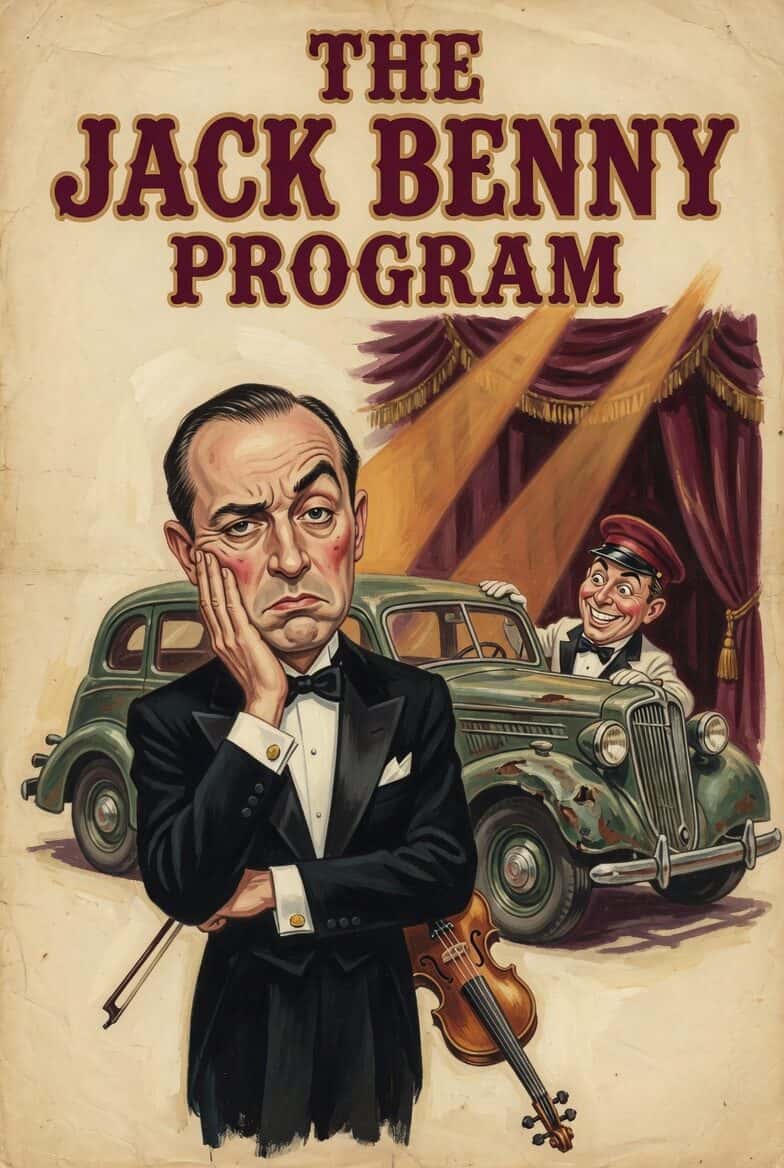
The combination is right to 45, left to 60, back to 15, and left to 110. There. Lucky Strike Program. Bill Harris, Rochester, down to stay. And yours truly, Don Wilson. Jack Benny entertained us for more than 60 years. Unlike many entertainers, Jack Benny will never be forgotten. For Jack Benny is an American legend. There may be some very young members of our audience who never saw Jack Benny in person or never heard any of the great radio shows. By the time this tribute to Jack Benny is over, even the young will know why Jack Benny became an entertainment legend in his own time. Jack did do movies and television, but he really was at his best in radio. It's as if radio and Jack Benny were meant for each other.
I was with Jack just a few months before his untimely death in December 1974. Unfortunately, I had a tape recorder along. Jack was actually born in a Chicago, Illinois hospital where his mother was brought for the event. Their home, though, was Waukegan, Illinois. The year was 1894, February 14th. He was born Benny Kubelski, the son of Orthodox Jewish immigrants from Russia. At a very early age, Jack was given two presents by his father, a violin and a monkey wrench. The violin was for if he had any talent, the monkey wrench if he did not. He took to the violin immediately and started taking lessons. Jack was actually considered somewhat of a child prodigy on the fiddle in his hometown at the time. While he was still in grammar school, he had a job as an usher at the local Barrison Theater and soon joined the orchestra there.
When he was only 16, Jack and a pianist in the pit of the Barrison Theater teamed up as a vaudeville duo. He hit the road in 1911 in a touring act billed as Salisbury and Benny, from grand opera to ragtime. During those days, Jack would make little side comments during the show and found to his amazement that the audience laughed. It didn't take him long to discover that his real talent was as a comedian, not a musician. He kept his violin, though. More now as a prop. However, there was another joking violinist around in those days by the name of Ben K. Burney. Benny Kubelski had been calling himself Ben K. Benny. So to eliminate any confusion, he became Jack Benny. Later, Jack teamed up with a Chicago pianist by the name of Lyman Woods. Shortly after the outbreak of the First World War, Jack enlisted in the Navy and was assigned to the Great Lakes Naval Training Station.
Then he was put in the Great Lakes Naval Review, a stage presentation for the Navy Relief Fund for widows and orphans. It was during this show that Jack fully discovered that his humorous asides got more audience response than his musical selections. It was an important milestone in Jack's life because it marked him as a man who could talk as well as fiddle. After the war, Jack returned to Vaudeville. but now as a comedian with a violin mostly as a prop. He was so successful that soon he appeared in several big musicals for the Schuberts and Earl Carroll's Vanities on Broadway. A roadshow tour took Jack Benny to Los Angeles. Two important things happened to Jack there. First, his act was caught by Harry Raff of MGM, and Jack was signed to a long-term contract, two pictures a year at $1,500 a week.
That was a lot of money in January of 1927. His first picture was just after the talkies had come in. Jack was used as a stand-up comedian. The studio put him into the Hollywood Review of 1929 in a sketch and in Chasing Rainbows in 1930 as a stage manager. Due to his film success, he was a smash hit at the London Palladium and in New York. MGM, on the other hand, had no plans for him. so jack asked for his release and returned east to vaudeville and broadway musicals hilliard marks who later became jack's close friend writer and producer of his radio and tv shows first ran into jack in those early hollywood movie days i went over one day and this third assistant director's job was open it was on riffraff i just finished the tale of two cities And it was riff-raff with Gene Harlow and Una Merkel and Spencer Tracy. And we were shooting, it was exteriors, and most of the film was shot on Terminal Island. It was a bit about the canneries and such, if you remember. And then I gave Jack material. And that's really how I started. Was there any thought in your mind then when you first met?
Jack Benny, that you later would be working for him? No, not really. He had two writers, Bill Morrow and Ed Boulogne, and very fine, competent writers, great writers. In fact, Bill Morrow went on to write for Bing Crosby after he left Jack. And Ed Boulogne went into motion pictures and was quite active on screenplays. and I only worked for Jack a short time, and then I went into the Air Force. The second important thing that happened to Jack Benny in Hollywood in the late 1920s was meeting a younger sister of the vaudevillian named Al Bernavici. Her name was Sadie Marks. She disliked show business and was selling hosiery in a Los Angeles department store, the May Company, when Jack first met her. In January of 1927, Jack Benny married Sadie Marks in his hometown of Waukegan, Illinois. Her stage name became Mary Livingston. Years later, Jack did a skit with Mary in a department store setting to demonstrate how he met her. Hello, kiddo. Where have you been all my life? Avoiding you. Good. I like my tomatoes with a little spice. Tell me, baby, what's your name? Mary. Mary what? Quite contrary?
Beautiful doll. What's your full name? Look, mister. My name is Mary Livingston. I was born in Plainfield, New Jersey. I know I should be in pictures, but I'm very happy here at the makeup company. Now, what do you want? Wait a minute, baby. Wait a minute. You got me all wrong. Oh, Mary, I'm not trying to get great. These guys seem to be all right. I hope they're going to be strong and let me see. You get a lot of strange customers around here, don't you? Oh, you're just self-conscious.
Mary Livingston may not have met Jack in exactly that way, but had made good script material, and their banter built some of Jack's funniest radio scripts. Everything Jack Benny had done to this time might have been good entertainment, but would never have made him an entertainment legend. His biggest triumph was radio. The new medium was just getting going in the early 1930s. Jack saw that other comedians were already on radio, such as Eddie Cantor, Burns and Allen, and others. He knew radio would be big, and he also had the foresight to move into the medium that was biggest at the time. That ability to change with the times never left him, and was largely responsible for his more than 60 years as a headliner in American entertainment. Yes, Jack Benny knew radio would be the medium of the future, and he had to find a way to get into it. Producer, Hilliard Marks.
And it all began when he was on Ed Sullivan's show. Ed Sullivan was a sports writer. And he asked Jack to appear as a guest. And Jack's opening line was, this is Jack Benny speaking, and as if anyone would care or who cares. And there was a, someone from the advertising agency thought he would be great. I have a show, and it was Canada Dry, his first sponsor, but that was only in the East. The last time I was with Jack, shortly before his death, I asked him if he agreed with the stories about Ed Sullivan giving him a start. Yes, because I had quit a big show. I was on the road with Earl Carroll's Vanity, and I realized that radio was a thing to get into. So I got a release from the show, from Earl Carroll. And I told him the reason. I said, I want to try and get into radio.
And so I was in New York for a couple of weeks waiting for the opportunity to get into radio. This was in 1931 or 32. And finally Ed Sullivan saw me or called me or something, asked me if I'd go on a show with him because he was doing a sports show, sports news on radio. And I said, all right, what do we do? Oh, he said, we'll just talk about sports. I'll ask you some questions about your business, you ask me. Some question, we'll talk. So I went on, and the next morning I had a call to be on my very first radio show. So even though I probably would have gotten into radio anything, because you have to anyway, because you have to, you have to get in to whatever is important at the time. Thirty years after his introduction on Ed Sullivan's show, Ed asked Jack back.
April of 1967. Ed Sullivan. Ladies and gentlemen, 35 years ago, I was doing a radio show on CBS here in New York, and I asked a very good friend of mine, Jack Benny, to be a guest on my program. And Jack proved to be such a terrific hit that CBS immediately signed him for radio. Now, the rest is history, and here Jack Benny is to celebrate the 35th anniversary of that original date. My friend and your friend, Jack Benny! So let's bring him on! You can leave now. I'm going to work alone. That was a nice introduction, but ladies and gentlemen, everything that Ed Sullivan said about me during the introduction is true. I mean, 35 years ago, Ed Sullivan had a radio show, and I appeared on it as a guest. And because of my appearance, I got my own radio show, and it led into pictures and everything else. So whatever success I've enjoyed.
I just want you to know that it's due to Ed Sullivan. Do you want to know something? He has never let me forget it. Now, I've been on this show at least a dozen times, and I've yet to get paid. Every time I ask him for money, he says, Jack, look what I did for you. Without me, you'd be nothing. Now, I'll tell you how I happened to be here tonight. About a week ago, I was in New York, and I ran into Sullivan, and he asked me to be on his show tonight, April 30th. So I said, all right, Ed, I'll be glad to. Now, how much money do I get? And he said, nothing. And I said, again, nothing? He said, Jack, you keep forgetting what I did for you. But I said, Ed, that was 35 years ago. How long do I have to be in bondage?
You know, it's Passover. We're celebrating the exodus. And he said, Jack, that's my offer. Take it or leave it. Then he raised his hand, the traffic parted, and we walked across the street. Still, I still can't get a dime. Oh, before, and I want to do something, ladies and gentlemen, that has never been done in this theater before. I'd like to introduce somebody from the audience. I'd like to have you meet my wife, Mary Bird, who is sitting right here in the audience, and have her take a bow. I'm glad that she stood up and waved because that makes her dress and the glove on her right hand deductible. Well, anyway, to... Yes, Ed. Wait a minute, Jack. Hold it. Please hold it. What is it? Well, I don't like the tone that this thing is taking. I don't mind what you say about me, but it's my...
Good job. Don't you understand, Jack? You introduce Mary, I introduce people to our audience. You introduce football players. Jack's talents were perfect for radio. Sponsors were not hard to find. After Canada Dry, there was Chevrolet and General Tire, but his association with Jell-O desserts is the classic one. His opening comment was often, Jell-O again, this is Jack Benny. Jell-O program, coming to you from Radio City, New York, starring Jack Benny, with Mary Livingston, Phil Harris, Kenny Baker, and yours truly, Don Wilson. The orchestra opens the program with For No Rhyme or Reason. From California to New York, from Maine to Texas, every home has one common problem, and that's meal planning. You want to keep the family happy. You want to keep their appetites interesting. Well, there's where Jell-O is a great big help. Jell-O is one dessert the family always likes.
Because, first of all, there are so many different ways to serve it. With fruits or nuts or whipped cream molded in shimmering layers of two and three lovely colors, or just served perfectly plain. A grand dessert any time. And second, and most important, Jell-O tastes so delicious. It's a new treat every time, for Jell-O brings you that extra rich fruit flavor. A wonderful real fruit juice. Ladies and gentlemen, let us welcome to New York that little ray of California sunshine. That shivering, quivering, ice-kissed comedian, Jack Benny. Hello again, this is Jack Benny coming to you through a suit of long underwear. And Don, it's sure great to be back in New York again, but boy, this cold weather is really too much for me. Oh, Jack, I'll admit it has been pretty cold, but it's certainly much warmer today. I know that, Don, but I defrost very slowly. You know, coming from California, my blood happens to be thin, but there is other.
I can hardly stand it. I know how you feel, Jack. After the sun goes down, it does get pretty frigid. Frigid? Why, Don, the other night I slept under six blankets. I felt like the bottom of wheat cake. But cold or no cold, it's good to be back in old Manhattan. Well, tell me, Jack, you've been in town now since Thursday. What have you been doing with yourself? Oh, I've had a lot of fun, Don. I saw some shows, went to a couple of nightclubs, and... Last night I was invited over to Fred Allen's apartment for dinner. Oh, Fred Allen, huh? Yeah, he and I are pretty good friends now. Well, I'm glad to hear it. Has Fred got a nice apartment? Oh, how could I tell, Don, with all that laundry hanging in the living room? But, Don, you should have seen the meal he put on. Now, you know me, Don. I mean, you know, and I don't want to sound catty. But after all, how often do I come to New York? Maybe once a year. Well?
Well, you'd think he could have had sardines some other night. Sardines? I wouldn't have liked him if he'd opened them with the key to the city. I got even with him, though. When I left, I took three spoons back to the automat. Wait till he finds that out. Gee, it doesn't seem possible that Fred would invite you to dinner and serve that kind of a meal. Well, he did. And wait a minute. Here's the payoff. No, the only ones there were Fred, Portland, Mary, and myself. And when we got through eating, Fred asked me to get up and make an after-dinner speech. An after-dinner speech? What was that for? Well, he was hoping I'd say something that he could use on his program next Wednesday. You know. Oh, I get it. I fooled him, though. I got up and recited the Gettysburg Address in French. Jack developed his own radio format. A combination comedy, variety, continuity show. A program which definitely established characters who were looked for each week.
and established situations which have cumulative comedy value. Jack was one of the first to kid his sponsors, and was definitely the first comedian who played straight for other people on the show, who had laughs turned on himself as often, if not much oftener, than he'd turn them on others. Then he became the lovable boob, the man with human frailties, a person that the listener could associate with. All the characters on the radio show were also created. so as to be able to relate to real people. This is the way Jack wanted it, and it worked superbly. I played a character that included all the faults and the frailties, the frailties of mankind. Every family had somebody like me. Either they had an uncle who was stingy, or one who thought he was very sexy and he wasn't. So every family has that kind of a person.
The different characterizations, you know, we made Phil Harris like a guy. Well, that's about all I can take. I'm going to the bar and start warming up for New Year's Day. When Dennis came in, you knew he was always vague about something. Now, look, now, let's go in the other room. What's up, Mr. Benny? What? You see this tie I'm wearing? My girl knitted it for me for Christmas. The tie? What are those things hanging on the side? She started to make a sweater and changed her mind. Mary. Always sort of ran my life, even though she wasn't supposedly married to me. I'm in my late 30s, or my early 40s. You're in your early 40s, or the gay 90s. And I would see to it that the material I gave them, characters personally, and particularly their speaking. Frank Morgan played one of the Benny characters, the department store floor walker. Frank enjoyed working with Jack because he did let others get laughs too.
If you were to read a Jack Benny script and read Jack's lines, you would find he had nothing in the way of jokes, ever. He gave all his jokes to his people who surrounded him, and he built on the people that worked with him, which was a very lovely thing. It showed a great security, because I've worked with comedians who, if you had a good joke, when you came back for the show, they had the joke, and you didn't have it anymore. But Jack never did anything like that, and I think that's one of the things that made his comedy different.
Pardon me, are you the floor walker here? Well, what do you think I am with this carnation? A float in the Rose Parade? Always running. How can you keep a job as a floor walker? My father owns the store. And you're working your way up. I know. I started as president. I got a call. This is when NBC was on the back end of the RKO lot. And I got a call to come over that Jack Benny had a spot that he was doing. And what it was, it was a five-minute insert from the West Coast. He was out here, I think, for a picture. And it was a five-minute insert for a program that he did in the East. And it was kind of a cute little idea. He's on the train coming out, and he meets this fellow. And, of course, he is.
bragging about the fact that he is Jack Benny and so on, and he's going to the coast, and he's going to get into pictures and so on. And this fellow, very courteous and very kind to him, and finally he says, my name's Jack Benny, and he said, possibly I can do something for you. You're a personable young man. Maybe I can get you into pictures. What is your name? And my answer was Clark Gable. And that was the spot. So I told the Benny writers that about 20 years later, and believe it or not, it came out I was Newt Rockne the next time, because they... picked it up and used it in the script at that time. But that's the first time that I worked with Jack, and that was in June of 1934. So I worked with him a total of, well, 37 years to the last show that I did with Jack. Well, the Benny show was coming out of the East at that time? Yes, yes. Now, when he came back out here, then I began working with him, and he called me one day. The only time that I couldn't work with Jack, this is the funny thing, I gave up other shows, I turned down other shows to work with Jack, and once, I was tied in, and I just couldn't do it. And what he wanted me to do at that time was a Negro porter on a train coming from Albuquerque. And the fellow that played that was Eddie Rochester Anderson and went on to become a regular character with Jack. Had I played it, it would have just been a spot that would have been in and been out, and that was it. But that was the beginning of how Eddie came on the show. Do you remember how you came on the show as a regular, developing the parts that you did? Actually, I...
Just worked with Jack in various things. If you remember, I was never identified as an individual person. It was just always, oh, Mr., Mr., and then I came in. If he ever used my name, he would call me Mr. Nelson. I was never a set character. I might be a psychiatrist one time, a waiter the next time, but I was always that fellow. And really, all that happened was that I was doing various things, and one day the boys wrote in a yes, and I happened to stretch the yes, and it got a laugh. And so they said, hey, try that again next week. And I said, try what? They said, well, you know, you stretch that yes out, and it got a laugh. So the character just grew that way. And so then they would say, well, what'll he do with a well? And they'd write the well in. And then they'd say, well, what'll he do with O-O-O-O-H? And so out of that came E-S.
So all those gimmicks came out of just their writing things in, and then I would mess around with them and see what I could come up with. The character that I think I probably most associate you with was the floor walker. Did the floor walker show up in shows more often than some of the other characterizations? No, not really. The Christmas shows. The floor walker would always be in the Christmas shows. Actually, the first of the... setting of the lines, are you so-and-so, came out of the Floorwalker bit. And I think the first line we ever used, I think Jack said, oh, Mr. and I said, yes. He said, are you the Floorwalker? And my response was, well, who do you think I am with this carnation in my buttonhole, a flowerpot? Or what do you think I am with this carnation in my flowerpot? That was the original line that we used on that character.
And then there were variations. I remember one, something about, what do you think I am with this carnation afloat in the Rose Parade? Oh, yeah, yeah, yeah. We used all kinds of things. We did one that turned into a very funny routine. Now, I'm sure you've heard that the biggest single laugh on the Benny show was when he said, your money or your life? And he said, I'm thinking, I'm thinking. I would say without doubt that's the biggest scripted laugh. But I think there was another laugh that was equally as big if... Not longer than that one. And that developed this way. Don Wilson had a line early in the show. And first, let me back up to my character. Jack says, oh, mister, mister. I say, yes. He says, are you the doorman? And I said, well, who do you think I am in this uniform? Nelson, Eddie? Well, he didn't like the joke. And he kept trying to get a new joke. Couldn't. And so we got to Showtime.