
The written record
Read the transcript
Read along with the recording · About 45 min to read
The sound of the Maxwell was actually done by Mel Blank. He did many other effects, and the show had regular sound effects men in addition. Yes, we had two sound effects men, and plus the fact with Mel that did the Maxwell. Oh, let me tell you a very funny happening. The boys tried to stop Mel on a character. They put in a sound effect of an English horse. And they waited for Mel to read the script and come to the one spot where he was to do an English horse. And he did the whinny and then ended, as they say, aww. You know, in an English dialect that was sensational, the fellas just broke up. Jack fell down. We could never stump Mel on a sound effect. But we had, like, going into the vault, and we needed the iron gate and the chains and such.
and going down, and the opening of the safe, and these people that worked on the sound effects, and we listened to it before at rehearsal so that they were perfect. You know, the hoofs, and they used to use the coconut shells, you know, the horse's hoofs, and many things they had to improvise. Mel, how did you first come in contact with Jack? Well, Jack had heard me in the cartoons. He'd heard my voice, and he had a bear that was down guarding his vault. The bear's name was Carmichael. So Jack called me in one day, and he said, Mel, can you do the growl of Carmichael the bear who had eaten the postman or the mailman?
gas man, whatever it was. It was the gas man that Rochester always said that Carmichael ate the gas man. He was never heard from again. That's right, the gas man. So Jack asked me if I could do this growl. I said, yeah, I think I can. He said, how would it sound? So I said, a little like this. He said, great, you're on next week. So for six months, all I did was the growl of a bear. Finally, I said to him, you know, Mr. Benny, I can also talk. So Jack laughed and got a big kick out of it and said, okay, I'll have the writers write something in for you. So the writers wrote these crazy things in for me. One of the first things they wrote in was the train caller at the depot whenever Jack left on the train. And the train caller would always start out by saying, train leaving on track five for Anaheim, Azusa, and Cucamonga. This went on for quite some time.
Jack had a parrot in the script. Someone had given him a parrot. And the parrot was supposed to talk, but naturally he couldn't get the parrot to talk on cue. So he said, Mel, can you do a parrot? I said, I think so. He said, well, how would it sound? I said, a little like this. So Jack said, great, we'll use that. Then one time, one of the writers tried to throw a curve to me. And he put in the script, we were visiting England, Epsom Downs, the racetrack there, the horse races. And he wrote in the script, Mel Blanc does an English horse whinny. Well, now, you know, it's pretty hard to tell the nationality of a horse. So I didn't say anything, and I waited for the cue, and I did an English horse whinny, and it sounded like this. I remember you were telling me about that. And then another time.
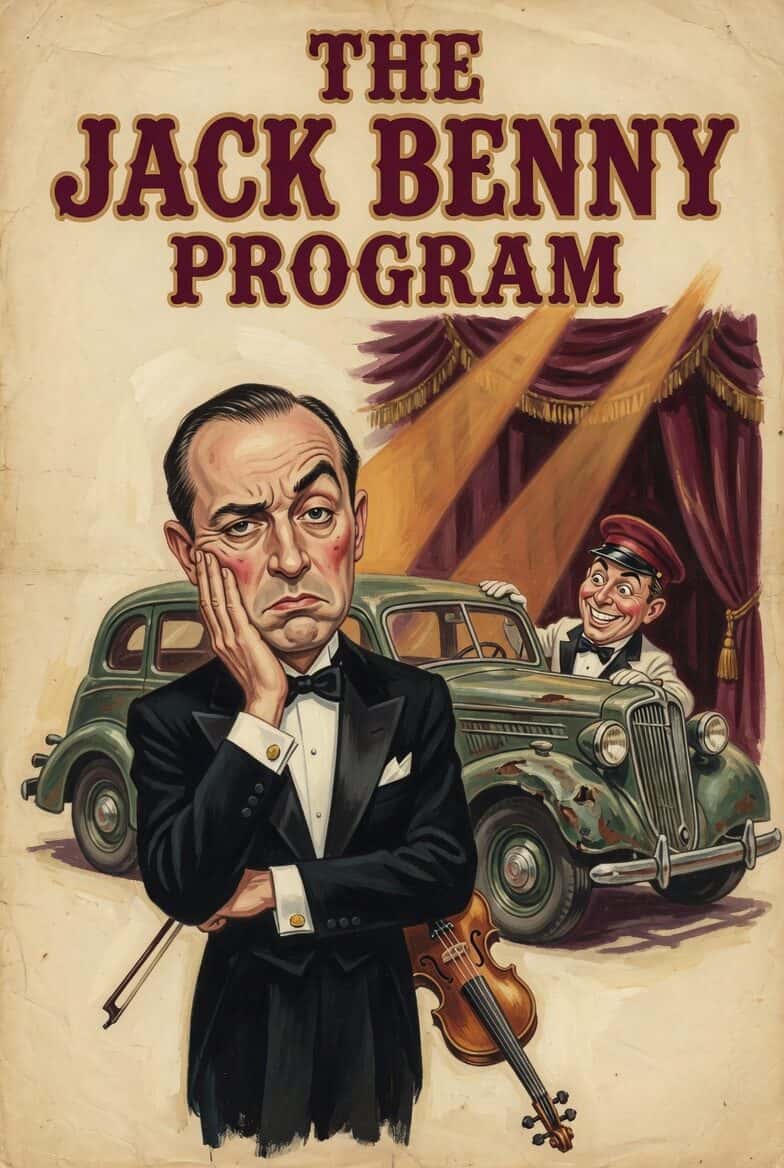
Jack liked to have his rehearsal the way the program was going to be, so he would know what to cut, what not to cut, or what to add or take out. And during this rehearsal, his Maxwell was supposed to poop out and stop. And when we came to the start of this stopping of the Maxwell, I saw that the sound effects man, who used to play it on a record and then slow the record down to stop, they didn't have the plug put into the socket. So before I had a chance to tell him, it came to that cue. So I did the sound of the Maxwell, and it sounded like this. Well, Jack got a big kick out of that. He said, keep it in. So I've been doing the Maxwell ever since. Any time the Maxwell car sound on the show, you were actually doing that. Yeah, that's right. Then, of course, the see-saw routine.
It says, what's your name? How did that come about, Mel? Well, it was from radio. We started in radio and went on into television. And it only had about ten words of dialogue in the whole thing, but it was one of his most popular little skits. And then you were also Professor LeBlanc. Oui, the French violin teacher. I could not learn him anything. What I told you, Fidel, brings on how I wish it had no strings on. Mr. Bernie, please give me my money. You and Frank Nelson sort of worked hand in hand on the show and the various characters. There was, of course, Dennis Day and Don Wilson and Jack and Mary and Rochester, and then everybody else basically portrayed either by you or Frank, weren't they? That's pretty close, yeah. There were several other characters, you see.
Frank does this one voice, which is recognizable anyplace. He says, well, you know, I can't imitate him, but he does that, who did you think I was, so and so and so on, you know. And this one character that he does is very popular, and every time people heard it, they knew exactly who it was, a floor walker or one of the guys in the bank or whatever it might have been. But I did more than... oh, maybe three or four voices on each show. I remember one time Jack probably was going either to New York or from New York to Los Angeles in the script, and he was at the train station, and you were trying, he was having a hard time getting a seat, and your train announcement kept coming on, finally to a point of exasperation where you wanted somebody to get on that train just to keep you company. Does that ring a bell?
Oh, yeah, won't somebody please get on this train? Yeah, I can't remember the words, all the words to the script. I did so many with Jack. Gee, the station is crowded. Rochester. Yeah, boss. Put on your red cap and carry my bags to the train. I got to meet my gang here. Train leaving on track five for Anaheim, Azusa, and Cucamonga. Gee, we're all supposed to meet here at the information desk. Oh, there they are. Hey, Phil, Don. Oh, hello, Jack. Hiya, Jackson. Say, uh... What are you carrying there under your arm? Well, I heard it was pretty cold in New York, and I want to be on the safe side. But, Jackson, a smudge pot. Well, I'm not taking any chances, you know. Say, Don, have you got all the tickets? Well, not quite, Jack. At the last minute, Phil said he needed an extra one. Phil, who are you sneaking on this trip with you? Well, it's Frankie, my guitar player. I've got to take him along on account of the magazines.
The magazine? Yeah, he reached to me. Now, for goodness sake, now I have to buy another ticket. Hey, Jack, where you been? I ain't seen you around. What? Oh, hello. Hello. Who was that, Jackson? Oh, he's a racetrack mouse that used to hang around Hollywood Park, you know. Well, I'll meet you later, fellas. Now, let's see. The ticket window ought to be... Train leaving on track five for Anaheim, Azusa, and Cucamonga. Oh, come on. Somebody must want to go to Anaheim.
Now, let me see. The ticket window ought to be... Hey, Jack. Hey, Jack. Come here a minute. Huh? Oh, it's you again. What is it? I didn't want to say anything while you were with your friends there, but where are you going? New York. What train are you taking? The Chief. Uh-uh. Why, what's the matter? Take the El Capitan. But I like the Chief. Come here a minute. Yeah? And take my tip, bud. The old Capitano beat the chief in the Kansas City by three lengths. What? According to yesterday's performance, it can't miss. Well, look, I'm sorry. I'm taking the chief. Why? Come here a minute.
Don't noise this around, see? No. But I found out the chief is a sleeper. Now, so long, fella. Okay, okay. So long. Now, let's see. The ticket window should be... ...leaving on track five for Anaheim, Azusa, and Cucamonga. Look, we're not asking much. Two of you, or even one of you. Nobody to keep the engineer company. Here's the ticket window. Oh, pardon me, are you the ticket clerk? Oh, what do you think I am in this cage, a canary? Well, don't get huffy about it. All I want is a ticket on the chief. Oh. Would you like the $60 ticket or the $140 ticket? Well, what's the difference? Well, with the $140 ticket, you ride inside. Well, naturally, I want to ride on the inside. After all, you know, I'm not as young as I used to be.
You're not as young as anybody, you shitter. Now, don't get fresh. All I want is a ticket to New York. Return trip? No, one way. Good. Now, and stop wasting time. I have to get to New York by Thursday. I'm sorry, but our trains are all booked up. Well, think, man, think. There must be one train that has room for me. The other two of the prop gags that Jack used successfully for years on radio was his violin lessons. and his vault in the basement. The violin teacher was in reality Mel Blanc, known as Professor LeBlanc. No, no, Monsieur Benny. Please, tune up the violin. I will make the A on the piano. No, no, no, you are flat. Pull the string up a little tighter. Okay. Tighter. Tighter. Oh, darn it, the string broke. Good, that's one down and three to go. Well, you better put a new string on, Professor, while I open the window. It's kind of hot in here.
There. Hey, Stevie, kick it to me. And then I'll... Benny in the window. Hello, Mr. Benny. Hello, Joey. Hello, Stevie. Hello, Mr. Benny. Some of us kids are going to play football. Can you come out and play with us? Oh, gee, I can't, Joey. I got to take my violin lesson. But I'll... Maybe a little later. Mr. Benny, you better close the window. It will be quieter. Okay. Here's your violin. We'll start with the piece I gave you last time. What was it again? The glow worm. Oui, monsieur. The glow worm. It is very pretty. Commence. Monsieur Benny, it is such a small worm. Do not kill it. Oh, I'm sorry. I'll take it again. Monsieur Benny, what are the blink-blinks? I'm stepping over the worm. Monsieur Benny, leave the jokes to the comedians. Say yes, sir.
Perhaps we'd better limber up a little more with the exercises. As you wish. Play it softer with emotion. Dip your bow in Juergen's lotion. Nero played while Rome was burning. Right now for a match I'm yearning. Now, Monsieur Benet, you are sounding worse than ever. But, Professor, I've been practicing two hours every day. How can you stand it? What? Now, look, that is enough of the exercises. Let us go back to the lesson. Commence. Now, Mr. Benny... Mr. Benny. Mr. Benny. Mr. Benny, please. The lesson she has ordered. Will you please pay me my money now and don't keep me waiting like always? Oh, yes, yes, Professor. How thoughtless of me. I'll go into my vault and get your money. Gee, I wonder who keeps it further underground, me or Fort Knox. I must ask him someday when I'm there to collect the rent. Who goes there, friend or foe? Friend.
What's the password? The British are coming. Oh, it's you, Mr. Benny. Yes, yes. We've had that password a long time now, haven't we, Ed? Yes, ever since that night you hung the lantern in the old North Church. Oh, yes. By the way, Mr. Benny, did that fellow on horseback ever make it? Why? I had two dollars on him. Well, excuse me a minute, Ed. I'm going to open the vault. How much money are you putting in? Oh, nothing. I'm taking some out. Oh, sickness in the family? No, no, everything's all right. I'm going to open the vault now. Shall I take a sleeping pill? No, no. Oh, Ed, you can watch. It's all right. See, the combination is right to 45, left to 60, back to 15, and left to 110. There. Why be half safe? Hilliard, what was the name of the actor that...
played the guard at the vault. His real name was Joe Kearns. We referred to him as Ed. And I can remember, you know, today they don't take time to establish things in comedy. You just don't have time. You're fighting the clock every minute. But I can remember one of the greatest was when Jack went down to the vault and Ed would always say, Halt, who goes there? And Jack would say, Oh, Ed, it's me, Mr. Benny. Oh, hello, Mr. Benny. You putting in or taking out, you know? And then they'd go into, Jack would say, oh, I'm putting something in or taking out, whatever the situation was and would be. And then Ed would say, well, Mr. Benny, what's happening on the outside? And I remember one line the boys wrote was, Jack said to him, well, Ed, you know, the war is over. And Ed said, oh.
Good. Who were in the north or the south? And that gave you an idea as to how long he had been down there. And one day he said that Jack said, I'm taking some money out. I'm going to take out a girl tonight. And Ed said, a girl? And Jack said, oh, well, I'll explain it to you later, Ed. And then wasn't there a bear named Carmichael? Carmichael was a bear. And that was when Rochester would always say, what happened to the gas man? blamed it on Carmichael the Bear. Because one day the gas man, the gas company called up to talk to the gas man. He was to read the meter. And there was no gas man, and that was the time that Jack had the Carmichael the Bear. And Rochester always blamed the disappearance of the gas man on Carmichael the Bear. I've heard that one of the longest periods of laughter came after Jack Benny being confronted by a holdup man.
with the line, your money or your life. Were you responsible for that? No, there was two writers. That was Joseph Burgett-Tackerberry were the two writers. And they were trying to lead in with a hold-up man who was outside of Don Wilson's house, I think. And Jack had said to Don to call before they left to go for dinner, to call the little woman. He always referred to Don Wilson's wife as the little woman. And he said, call her. And now they're outside, and Don is now arguing with his wife because he's invited Jack over and did not call her. And Jack would say, I told you once, I told you a thousand times, call the little woman. Finally, it was the stick-up man came by, and he held Jack up. He said, does it hold up your money or your life? Finally, he said, look, I said, is it your money or your life? And Jack said, I'm thinking about it.
Sure is dark tonight. No moon. Oh, well. Hey, Bud. Bud. Huh? You got a match? Yes. Yes, I have one right here. Don't make a move. This is a stick-up. Mister, put down that gun. Shut up. I said this is a stick-up. Now, come on. Your money or your life? Look, Bud. I said your money or your life? I'm thinking it over. Now look, mister. Come on, give me your wallet or I'll let you have it. All right, mister. Don't shoot. Don't shoot. Here's my wallet. Good. And I'll take that package you're carrying, too. Well, that's the most publicized laugh. But actually, and to really to be truthful, there has been so many other big laughs that that's not the only big laugh we've had. Well...
They think it is, or it was the biggest laugh I ever got, so we keep it that way. I think it's about as good a gag as I've ever had and was worthy of the biggest laugh. But there have been a couple that have been as big. The laughs have been as big. But this, I don't know, this caught on so fast. It went to practically every newspaper in the world and every magazine. And the biggest laugh... I know that we ever got on radio, Mary got, with three words. And the three words were merely looking at me and saying, oh, shut up. And the reason that was the biggest laugh is because the buildup for that was so long. And so, and I'm not opening my mouth, not saying a word. There's a big conversation between Don Wilson and an opera singer that we had with us.
And Mary knew that I knew nothing about opera or was supposedly knew nothing about opera. And so did the audience, because they were supposed to believe that I didn't know anything. So they were constantly talking about opera. The audience is waiting. They know that sometime I've got to butt into this thing. So I finally started talking. All I got, I got this far when I said, well, I think, and Mary said, oh, shut up. And that was the longest laugh that I can ever remember anybody. And that wasn't even a joke, just three words, oh, shut up. But if you take those three words and put them in the right spot, it's better than a joke. It's bigger than a joke. It's more important than a joke. If you can get three words like that that have no meaning at all.
except for the long buildup, which was probably eight minutes. And that was the longest laugh. I remember that we just couldn't talk after that. The audience kept screaming and laughing and screaming. And Mary, you know, had that dry delivery. And she just stood there and did the line. She said, oh, shut up. And that was bigger even than your money or your life. But I think your money, if I had to say which were the six, biggest laughs that we ever got in radio or television, I would have to say that that would be one of them. But if I gave it a lot of thought, I'd find others that were just as big and bigger. But they won't accept any other one to be the biggest laugh. The newspapers are the... And every place you go, I could go to Pakistan and somebody would say to me, Wasn't that the biggest laugh you ever got? I go along with it. I am here. This is confidential, you know. I am here as a personal emissary of Mayor O'Dwyer to ask Jack Benny to come to our Trouble City on March 15th. Why did they want Frank there on March 15th? Because when Benny pays his income tax, his tears alone will fill every reservoir in here. The feud between Jack Benny and Fred Allen became legendary.
Like most parts of the program, it was not planned, but happened by accident. Fred had a 10-year-old boy, a violinist, on his show. And the boy played the B. And when he finished, Fred made a derogatory remark about Jack. You think that was just an ad-lib remark? It was an ad-lib. It wasn't intended for a feud or anything because they were the best of friends. In fact, it wasn't. And then one of the writers, I think, heard Fred make mention of it because we had one writer, Daggerberry, that was out of his mind about Fred Allen. He thought he was the greatest comedian in the world. And truly, he was a great comedian. And I think he mentioned it to Jack. Now, Jack answered him. But you see, Fred had a tougher time because he followed us.
So he would have to prepare an answer to what Jack would say. But they didn't talk. I think the first time they really got together in regarding the so-called feud, it wasn't a manufactured feud such as with Ben Burney and Walter Winchell. This happened by accident with his boy. And then after that accidental beginning, you started... writing it into the scripts. Well, Fred would say such derogatory remarks about Jack. I mean, that you had to answer. He would, the ad lib was the one time that Jack talks about the tree that they planted in Jackson and Waukegan. And Fred said, and the tree died. And Fred came out and said, well, you can understand why the tree died. He said, well, the tree in Waukegan and the sap, the sap is in Hollywood.
Mary, that's the worst thing anybody ever did to me. I'll never forgive Fred for not showing up. Oh, Jack, stop complaining. You had a good program without him. I know, but how could he do a thing like that? All right. Don't walk so fast. I can't keep up with you. Okay. Hey, mister, would you like to buy a map to the movie star's home? Don't you talk to me, stupid man. Come on, Mary. Well, you might at least say hello to Portland. She's on the other corner. Oh, yeah. Hello, Portland. How are they going? Just started by an accident. Just like everything I've ever done. I've always explained that. Everything I've ever done on radio or television that was good started by an accident. Because if Fred Allen and I had said to each other, let's have a feud, I'm sure the feud would not have lasted over three or four weeks. It would have been lousy. But the fact that it just came up out of nothing.
Then it's funny, because then you are saying the right things, and you're ad-libbing. And when you feel that they've had enough of it, you stop. Now, there would be some shows that I wouldn't mention Fred Allen, or he wouldn't mention me. And then later on, we'd pick it up again, you see. But everything good started by an accident. You know what's a strange thing? On account of that feud we had, so many people think that Fred Allen hates and despises me. Unfortunately, Fred happens to be one of those people. Fred and Jack were great friends. They didn't see each other socially that much because Fred and Portland were in the east and Jack and Mary were on the coast. Now, when Fred and Portland came out, they were together or when we would go east.
Oh, no, Jack respected and admired Fred. Fred was truly a great comic, and he wrote most of his material. In the summertime, he would take time off and spend most of his summer writing material up at All Orchard, Maine, and that's where he would go. And, oh, there's so many nice things you could say about Fred. He was very charitable. He was quite a religious man, and there were a number of, friends of his that he knew from show business. And I know this to be true. Very few people are aware of it or were aware of it at the time. He would give the father envelopes to be distributed to these men in need. And no one knew who was the doner of these. He was a very charitable man. He was a very fine person. It was quite shocking when he passed away. Don, how did you first happen to get together with Jack?
It's not a very romantic story, but it was the pot of gold at the end of the rainbow as far as I'm concerned. I was thrown into a general audition. Jack was changing clients in the spring of 34, moving from Chevrolet, and Bill O'Neill, president of General Tires, bought Jack for the remaining 13 weeks to conclude that season. and I was thrown into the audition with all the staff announcers that were available at NBC and many of the freelance men that were around town. Went in the studio, and Jack was in the control room. I read a few pages of script with his writer, Harry Kahn, and then Jack came out and read a few pages of the script while Harry listened in the booth, and they selected me. It was just lucky, and it was the most fortunate day of my life, beyond any question of a doubt.
That association lasted for 35 years. Can you recall, Don, what the audition was like? Was it like program introduction, or was it some of the comedy lines? It was both. They had a commercial in there, and for whom, I can't tell you now. It may have been an old script from Canada Dry or Chevrolet, I'm not sure. And then two or three pages of dialogue. So it was a combination. I just could not pass up the opportunity to be with the great man of our industry for as long as he would have me. Now, Jack, at that time was already well-established on the network, wasn't he? Oh, yes, he was well-established. As a matter of fact, his first season out was for Canada Drive, which is the 31-32 season. His second season was 32-33, was with Chevrolet.
than filling in on the General Tire's account for those 13. And then General Foods and Jell-O picked us up, or picked Jack up in the fall, 34. Jell-O again. Jell-O again. Those six delicious flavors were mighty kind and delicious. Who was the announcer prior to the time of the auditions which we've discussed? If memory serves me correctly, Alois Habrilla was the announcer on the show for the... 33-34 season, and that was Chevrolet. Jack had had one or two other boys prior to that. George Hicks, I believe, was one. Tiny Ruffner, I think, was another. This was for Canada Dry, perhaps. The Canada Dry show was basically an East Coast release, wasn't it, or was that nationwide? To my memory, it was a transcontinental one. What was the Jack Benny show like in those days? Did it have the strong characterizations at that time?
Yes, the characters were well delineated. You'll remember, of course, there was Jack and Mary. Don Bester had the orchestra, and Frank Parker was the singer on the show. Now, while I was hired basically as their commercial announcer, as time went by, very short time, Jack started to work me into the dialogue of the show. So before the season was too far underway... I was reading a good many lines along with the rest of the cast. And as the years passed, many, many times, I didn't do any commercials on the show, perhaps except the integrated commercial which Benny originated. And that was where the fun was, kidding the product. Many people remembered the commercial and they may have forgotten facets of the show itself. It was an unorthodox approach.
That was the sugar coating on the bitter pill, as it were. Actually, Jack was one of the first to go into the truly integrated commercial, wasn't he? Yes, yes, he was. If not the first, he was certainly one of the very first. My memory is that as far as comedy was concerned, I don't recall having a predecessor in the field of kidding the product for the integrated commercial. What was the usual routine for the Benny show? How much rehearsal did you go through? I assume you came in and did a read-through. Yes, yes. We had our first script reading, usually, in those early days on Friday. Now, of course, these were subject to change, too. We would have a read-through on Friday night. Then on Sunday morning, we'd go in, get a new script, have another read-through.
Then Jack and the writers would retire, make the corrections, the deletions, write any new material that was necessary. And then we'd come back, perhaps right after lunch, get a new script, rehearse it, put it on mic, and do the show at 4 o'clock in the afternoon, East Coast time, for the 7 o'clock release in New York. And we did live repeats in those days. The band always rehearsed by itself. The show was virtually put together on the air so that the material, the jokes and so forth, were just as new to the members of the band as they were to the audience that came in. Don, was the Benny show always done before a live audience? Yes, always. And ideal conditions were a relatively small studio, comedy, radio comedy, even in the theater. Comedy plays better in the small.
than in a large one, as you know. And I recall, excuse me, during the war, we'd go out and we'd play auditoriums of various sizes, and Jack would see the setup of the chairs or the seats, and there would be quite a vacancy between the apron of the stage, as it were, and the first row of seats, and Jack always insisted that movable chairs be placed in there and that the G.I.s or the gobs We're seated in front of the brass, which were back of them in this case. But you must have your audience close so that you can get them in the palm of your hand. Have this talking across a depth of a width of an orchestra pit is not a good thing as far as radio comedy was concerned. And Jack was insistent that that space be filled up. And it was a wise bit of judgment. Jack had almost an uncanny ability.
to know what would be funny for him, didn't they? Jack had an innate sense of what was good, not only for Jack, but for all the members of the cast and for the overall benefit of the show. He was almost unerring. But he never put himself up on the pinnacle of being the know-it-all. If his writers would stubbornly insist that they do such and such a bit, And if they stood by their guns, Jack would give in. But what happened was, most times, Jack would have been proven correct. And he'd say, you see, I told you that wouldn't work. But he never lorded it over anyone in that respect. The characters which were developed, for instance, your character, heavy set, friendly, always kidding you about your size, good-natured.
These characters were ones that the average person could associate with, weren't they? I mean, everybody knew Don Wilson, an uncle, a brother, somebody like that. Everybody knew a Phil Harris type of characterization. That was one of the great things, and the thing that made radio so magnetic was the fact that not only... Did people know what you looked like in their own mind's eye, although they may never have even seen you or seen a picture of you? But they also knew the locale. They knew what Benny's vault looked like, as a matter of fact. And this was one of the great charms of radio, that the listener, through their own mind's eye, that individual's mind's eye, participated and would sit before that set glued, immovable, absorbing every dotted I, comma.
and a period that was in the script. It was a great, great medium. Did you ever mind the joking about your size? Did Jack ever say, Don, we sort of want to develop you along the line and kid you about this? Did he ever ask you if that would be all right? No, and had he asked me, I wouldn't have objected at all. As long as they paid for it, I didn't care. Did that start out in the very early shows? was the jokes about your size something that sort of evolved? Oh, that developed in the very, very early stages of my association with Jack. The big, fat laughing boy, you know. Jack gave a great deal of credit for the success of his shows to his writers. At the end of the program, he would give them name credit on the air, almost unheard of at the time.
It's fascinating how a group of writers went about creating the programs we enjoyed so much each week. Hilliard Marks. Well, each one received an assignment. We sit with Jack, and he expresses his theme, or the theme of the show. In other words, Jack would have an idea, say, well, now, next week, let's pretend that we're going to go to the Rose Bowl game, and I've got to get some tickets. That's right, that's right. Now... Not... We would not agree with Jack completely and fully each time. We never yesed him, and he would never want us to. He never would want us to agree with him, just so that we're yesing him. So we had our own ideas. Now, then it would be broken up, such as it is today. I work with Hugh Wedlock on our specials. Al Gordon and Hal Goldman work on their spots. But then we have a meeting first, and that's...
The show is broken down as to what we're going to do. Then we go our separate ways. And then we sit with Jack and complete the show in its entirety. And then we have a rehearsal and a reading where all the participants of the show read their designated spots. And then, after they're over, then we cut or add to... and edit the show completely and fully with Jack. Now, on the live radio days, you would do a read-through, and then you would do a mic rehearsal, and then you would do the actual live show. We would have a reading at 9 in the morning or 10 in the morning, then the entire cast and all the people, the characters, extra players, etc., would leave. That would be on a Saturday, and we would rewrite, almost sometimes rewrite the entire show if we didn't like it.
if Jack didn't like it. Then we would meet again, and I'd have, now this is going into producing, I'd have a band rehearsal from 10 to 11 or 10 to 11 or 11.30, then have Dennis Day come in and go through his number with the band. Then the cast would come in. Now the orchestra would leave. We'd never rehearse in front of the orchestra because they, alas, were spontaneous. And they never heard the show until the time when we went up on the air. That's interesting. So the orchestra didn't know what was going to happen in terms of the dialogue of the show until it was on the air. Neither did the audience. You see, they were like part of the audience. And, of course, we had one of the greatest characters, Remley, that would laugh, but he wasn't a laugher. He would only laugh, truly, at what he thought was funny. But, of course, Jack would play to Remley a lot.
Because he would, Jack loves, of course, let me digress for a moment of saying that we in the booth would bet among ourselves how many slaps a joke would get. Because Jack would hit his leg like so, or break up. And we would try to guess where he would break up. So now we would do the show, rehearse the dress, then break. then come back and do the show live. In the early 1950s, one of the long-standing cast members, Phil Harris, left Jack's show for his own. Phil was replaced with Bob Crosby. The Lucky Strike program starring Jack Benny with Mary Livingston, Rochester, Dennis A., Bob Crosby, and yours truly, Don Wilkman. I took Phil Harris' place when he left Jack Benny and took his own show on NBC. I was with Jack for about two and a half years, three years.
It was a tough job because I had to learn to drink. He had a lot of Phil Harris jokes that he didn't want to throw away that he'd already paid for. And then I did his first few television shows, too. Who's Jack Benny to work with? Well, he's probably one of the most extraordinary comedy editors that I've ever known in my life. By that, I mean he could take a script and say to you, this line is funny, this line is not funny, this line is such and such. And on various occasions, when he said this line is not funny, the writers would insist it remain in the script, and it wasn't funny. When he said this line is funny, we never failed to get a laugh. He had infallible judgment about what was funny and what wasn't funny. I think he's a great comedian, of course, but above and beyond that, I think he's the greatest editor of comedy that I have ever known in my brief period in show business. He knew what would go over for him, didn't he? He knew what was funny.
Period. He knew that the audience would dig that, that that would hit their funny bone. He just had an uncanny knack of knowing good writing and bad writing when it came to comedy. Jack Benny's theme song was called Love in Bloom. When I asked him about it, he said he really didn't like it. Because it has nothing to do with a comedian at all. It happened to be a number that I kept playing on the violin for a few weeks. not dreaming it was ever going to be my theme song. And all of a sudden, I'd walk into nightclubs or restaurants, and the orchestras there would start playing Love and Bloom. So they made it my theme song, practically against my will. There was no way I could stop it. So I left it that way. But it's a beautiful song, but it doesn't fit a comedian. But I couldn't do anything about it. Back in the 1920s and 30s, this is the way Jack...
Benny's theme song sounded the way it was being played in those days. After Jack's radio and television shows went off the air, he was able to take life a little easier. But he didn't stop entertaining. Jack started making personal appearances. And for those, he selected a talented young girl singer by the name of Kay Hart. Kay had worked with Jack over five years previous to his death. She knew the real Jack Benny, the offstage Jack Benny. I know everybody knows him through radio and television and all the things that he's done, but I wish they could know him personally as the man. What's he basically like, Kay, as that person offstage? He's very, he's not funny offstage. You see, he's a very quiet, very basic person who allows everybody else around him to think funny. And he sits back.
and he enjoys it all when he says that george burns is the only one that makes him laugh you know or george burns makes him laugh but he can't make george laugh that's true because i was in the company one time george came to visit us when we were in las vegas and you'd sit with george to have dinner and george would enjoy his dinner but you'd never get to yours because he would do nothing but tell one joke after the other they put celery on the table he'd do 20 minutes on the celery and therefore we were all in stitches laughing and he's eating and everything and everything's gotten cold they're taking one appetizer and entree away from us but jack really just sits there and um he enjoys the company of other people and when you're with him the irony of it is that i never think as funny as when i'm with jack you know there's something about being in his presence that situations arrive And you just say funny things that would never come into your head before. And he sits there and laughs. He just enjoys it. Oh, he'll say, I mean, he comes up with fantastic lines, but he doesn't set out to sit there and entertain you. You know, he's just Jack Benny the man, and I'm Kay Hart the girl, and you just chit-chat about everyday living, you know, the problems of the world and what's going on, and did he enjoy his golf game? Never show business.
And I really have to pick at him to tell me the stories of the old days and the things that happened with Fred Allen and all of those people. And I just enjoy that so much, you know. And he'll very graciously tell you all those stories, which is a thrill. He enjoys talking about nostalgia, doesn't he? Oh, yes. He loves to reminisce. Because when you think, there's a song I do in my show, and I talk about memories, about once upon a time. And I think it's so apropos. of his life because he's got so many fantastic memories and remembers everything. Everything that happens. Somebody said to him, we were at the Broadmoor, and somebody said to him, they came to visit, they were visitors from Chicago, and they said, do you remember that night we went to that Chinese restaurant? And he said, oh yes, I remember when we took the cab and we were blah, blah, blah. And he remembered everything, even down to what they ordered or if they had fantastic cuisine or what have you. So he's a remarkable man.
Sometimes I can't remember yesterday, you know, where I was yesterday, and he's just fantastic. As I was working on the preparation for this program, I told Jack I thought there should be a motion picture made of his life story. If I would ever finish a book that I started to write, then maybe they might make a story out of it. But I write, and then I get lazy, and then I don't write. And then sometimes I don't think I'll ever finish it, if you want to know the real truth. then maybe a picture would be made out of it because I don't know any other way. It would not be easy to make a picture of my life or even to write a book because I've had no problems. See, it's easy to write a book about somebody who's had problems like maybe Sammy Davis Jr., Joey Lewis, whose face was cut up by gangsters. See, they got something to write about.
And or people who have had setbacks and things like that. Well, nothing has ever happened to me. I've just gone along and worked and worked and worked and worked and worked. I'm married to the same woman, 48 years. Now, nobody wants to read that. While Jack never played himself in a movie on his life story, he did, as we mentioned in the beginning of the special, make a number of movies for MGM in the late 20s before going into radio. Years later, after he was a success, he made quite a few more movies, which he often panned on his radio shows. In this scene from the late 30s, Jack is playing a policeman who has followed a suspected murderer into a movie theater. Well, thank heaven that's over. Now, come on, men, we've got to catch that murderer before he gets away. Hey, Cap, there's a fellow with a gun sitting over there by the door. That's the guy we want. Come on. The feature picture. Look!
Yeah, there's the title. Jack Benny, an artist and model. Why, that's my old picture. We can't have that guy now. We'll have to wait until it's over. I know you're done. I'm not going to sit through this. I'll fight your retinue. Why am I the murderer? Why ask the police without a man and take him away? I'm staying for the picture. Play, Phil. Jack, the picture you did that I always sort of liked was The Horn Blows at Midnight. Yeah, a lot of people liked it. Do you know why they liked it? Because I panned it so much that everybody looked at it and said, gee, it can't be that bad. And then they look at it and said it isn't. I had somebody the other day in Portland said to me, gee, I saw the horn blows at midnight and I liked it. I said, well, you liked it because I didn't, you see. But I was on Merv Griffin's show about a year ago and I said, Merv, let's talk about things that...
I haven't talked about much on these talk shows. Why don't you do some research and find out how many pictures I've made, or I can find out, and we'll discuss my movies. Now, I actually thought I only made about seven or eight pictures. That's all right. I made 22 pictures. And most of them were good, and most of them made money. Because in those days, if you made a picture for a million dollars, that was a lot of money. Well, today it's 15, 16 million, you see. So they all made money. Some of them were good. One picture is today considered a classic, to be or not to be. Sure. The one I made with Lubitsch. In Europe, that is still today a classic picture. Then Charlie's Aunt, George Washington Slepter. I made a lot of good movies. But I've always kidded so much about one and always deprecating myself about that one picture that a lot of people think I never made any of it. Shortly before he passed away, There was some talk of Jack doing another movie. Kay Hart was among those encouraging him to do it. Jack had boundless energy, even at the age of 80. He was still going strong, right up to a few days before he passed away, the day after Christmas, 1974. In fact, Jack was a tough man to follow around at age 80. Hilliard Marks. We can't keep up with him. Sometimes we beg off.
He's a 30-year-old man. He's back to where he was walking on the stage in the Orpheum circuit. It's amazing. And I think, of course, to me, it's a great compliment. The people that know and I've been associated with Jack for so many years will say to me that, geez, you look great. You haven't changed a bit. How do you look so young? And I always say, well, because I drink the same water that Jack does, you know? And now, ladies and gentlemen, we come to the last Jack Benny show of the month. It's also the last program of the current series, and as a matter of fact, it's the last show of the season. So now I bring you a man I thought wouldn't last, Jack Benny! But last he did, for more than 60 years of entertaining us. Jack didn't look his 80 years, and I tried to find out his secret for a long and healthy life. I knew it wasn't the water. I must look a lot older than 39, but I still don't think I look anything like my...
my right age so i should be grateful for that i guess but uh i don't know you know what i think it is i think it's because i'm constantly working i think that has a lot to do with it now i imagine i haven't retired yet i imagine if i was in the haberdashery business selling neckties or something i'd be willing to retire you know after a certain amount of time but in show business It's difficult to retire because we don't know anything else. So if I try to do something else, because to retire entirely would be very, very difficult, I think, because I don't feel my age. And there are moments. And then I wouldn't know, actually, I wouldn't know what to do. It's to keep working until you can't, I guess.
Right now, we just played a couple of engagements. The audiences have been better than ever. Business has been fine. The audience has been laughing. I write better than I used to. I find everything much easier. And so therefore, I don't think I should get out of it yet. Thank you, thank you. Hello again, this is Jack Benny talking. And Don, I know that you're trying to be clever. on the final show, but how could you possibly have thought that I wouldn't last? After all, a man my age is just in the prime of life. I guess you're right, Jack. They've been priming you for 20 years. Don. Don. George Globo. CinemaScope's stomach. Now, Don, control yourself. But, you know, you may be right. After all, nobody can last forever. You're sure working on it, Bob.
Well, I see we have another candidate for the unemployment insurance. You better watch it, sister. Jack's right, Mary. He deserves a little more respect from us. After all, he's one of the pioneers in the broadcasting business. You're darn right. Why, when I did my first program, there were hardly any radios in the country. And darn few people. Darn few people. Darn few people. Plenty of people when I started. They may have had feathers in their hair, but they were people. Mary, if I were Jackie Gleason, you know what I'd say? One of these days. One of these days, pow, back to the May Company. If you were Jackie Gleason, I wouldn't have to go back. All right, all right. Oh, Jack, why are you so touchy? Can't you take a joke? Certainly I can take a joke, but here we're doing our last program of the season and everyone comes in and insults me. I didn't insult you, Mr. Benny. Huh? Oh, hello, Dennis. Hello, sir. Well...
You see, Mary, Don, Dennis knows how to treat me with respect. Certainly. I feel that when a man keeps you working all these years, he deserves respect. Well, naturally. A man doesn't get to be the star of a radio and television program unless he has ability and talent. Thank you, Dennis. No star can keep a loyal following of fans loving him through all the years unless he's an outstanding personality. Well... Can I go now, Mr. Benny? Ladies and gentlemen, although this is called the Jack Benny Program, I'd like to say that its success is due to the competent people I have working with me. my wonderful cast, the great supporting players I have, my producer, my engineer, my sound man, my capable writer, my fine musician. How can you read that stuff? Doesn't it make you sick? Good night, folks. See you in the fall. How do you end a tribute to Jack Benny? What else can we say about an entertainment legend? I think Jack would be pleased to know that he will know gone.
dying of cancer the day after Christmas in 1974. His entertainment will live on forever. When Benny Kabelsky was born, who in their wildest dreams would imagine that 80 years later, at the advent of his passing, that every magazine and newspaper would headline it on their front pages? The people who had never met him, who had only seen him or heard him, would feel the pain of a very personal man who was the undisputed master of comedy timing. You'd have to say that this was the only time when Jack Benny's timing was all wrong. He left us much too soon. He was stingy to the end. He only gave us 80 years and it wasn't enough. The life story of Jack Benny is used under license from the Old Time Radio National Archives Foundation and may not be duplicated or copied in any way. Copyright 1977, Radio Memories Incorporated.