
The written record
Read the transcript
Read along with the recording · About 24 min to read
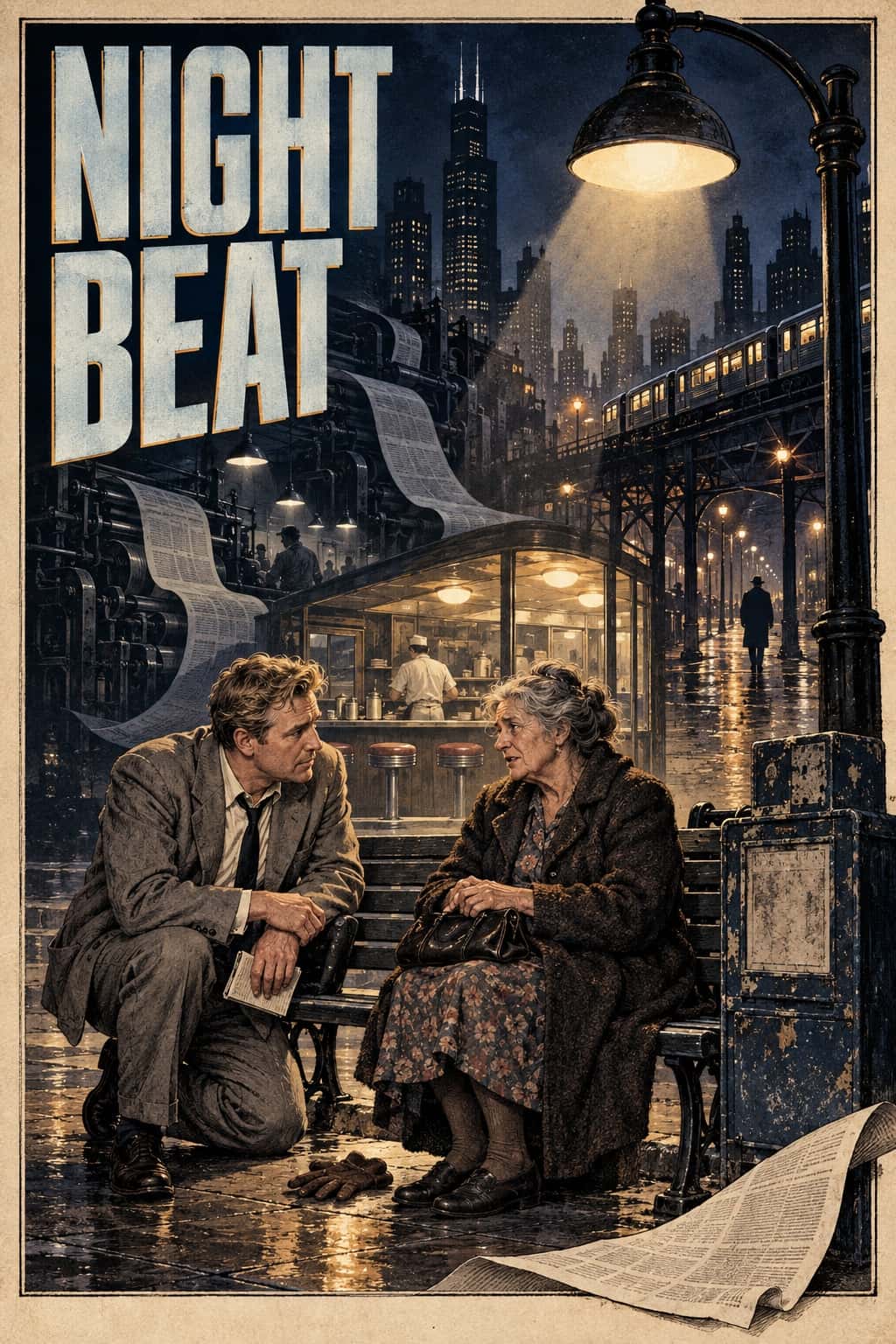
Tonight, Nightbeat returns to the air for a special broadcast honoring the men and women of the working press, who day in and day out find and write the newspaper stories that keep us informed and entertained. And so, to them, this special Nightbeat salute. Hey, this is Randy Stone. I cover the Nightbeat for the Chicago Star. Stories start in many different ways. This one began in a nightclub with jazz music and laughter. and ended in a church with organ music and death. Nightbeat, starring Frank Lovejoy as Randy Stone. On my job, you sort of come to terms with the night. You have to, because that's where you learn the lessons of the day. Lesson one, the night is for sorrow, the day, regret. Lesson two, you can't hide in the darkness, for the night has a thousand eyes. Lesson three to a hundred.
Don't go looking for the dawn with a gun, because it might come up like thunder and leave you dead on the doorstep. Sob stories fill the night. Unhappy love affairs, girls gone astray, bookkeepers who stole from their tills, men who died drunk and friendless. Last night I decided to pass them up and stroll under the bright lights and listen to laughter. So I picked out a couple of fancy bistros on the Gold Coast and started the rounds to watch champagne flow and eavesdrop on the happy stories of... success, promotion, love, and friendship. But it didn't work. Like an iron filing, I was drawn to the magnet of unhappiness. It happened in the Pelican Club. He was sitting alone, tall, gray-haired, rugged, a face full of some 50-odd years, I guess, and full of some other things no one could guess. It was three drinks at the bar before I made out who he was, a man who was once big in a way that only prohibition made them big. Mind if I sit down?
Who are you? Randy Stone, Chicago star, Mr. McMasters. Well, you're the first one. What first one? Who's recognized me. Oh, well, only from your pictures. It was a long time ago. Time? I know more about time than you or that old guy they always have around on New Year's with a beard and a haircut. I just thought there might be a story somewhere. Sure, sure. Sit down, sit down. I'll tell you a story. Once upon a time, there was a guy who had everything. Money, friends, a future. And a bunch of old women made a law called the Volstead Act. You remember it? Yeah, yeah, but I wasn't thirsty at the time. Well, a lot of people were, everybody. You see, the law was always supposed to be for the other guy, not for them. But there were no other guys. So this fella I'm telling you about got on the bandwagon.
He bottled millions of violations of the Volstead Act with a lot of money and a lot of trouble. Am I boring you? If you are, I asked for it, but you're not. Well, the trouble got him a lot of jail. 19 years of it. Started in 1931 and ended just two days ago. I see. Now this guy's out and he's going to stay clean. And they can pass a thousand stupid laws and he's not going to fall for any of them. He's going to do everything the way it says in the books and live happily ever after. How's that for a story? It's a good moral, but no drama, no suspense. Good. I hope it's real bad because I don't want you to print it. Stone, I'm flattered that you recognize me, but I paid back ten days for every one I took. All I ask is that you just let me alone in the papers. Okay, McMaster, as far as I'm concerned, you made your last copy in 1931.
Stole, it's nice to come out of prison and have the first guy you meet turn out like you. Let me buy you a drink. He tried to be happy and gay after that, and I tried to help him. But there was a sadness about him that stood in the way. I wanted to ask more questions about times and places, but I didn't. Why is it when you come across the best stories, you fall all over your conscience? I know I couldn't print anything about John McMasters, yet I was still thinking about him an hour later at police headquarters while batting the breeze with... Lieutenant Shirley White. The lieutenant was on his way out to cover a hotel shooting and I went with him. It was a showy place with glass doors and ebony handrails. The night manager was staining his alpaca jacket with nervous sweat.
Please, please be as quiet as possible. I don't want it to sound like an Elks convention in here. Just tell us what happened. We'll pussyfoot through our business. I don't know where to begin exactly. Somebody phoned down. It happened on the fifth floor. Said there was a shooting, so I went up there, but I couldn't hear any shooting or see any. You rarely can after it's over. That's rather obvious. Just tell us. Was there a shooting or wasn't there? Well, did you think I'd call you men all the way out here if there wasn't? You think I'm a crank or something? That I like to have loud policemen stamping through the lobby excitedly? Where was it? Where was what? Look, I'm going to ask you a question. I want you to answer in a single declarative English sentence. Now, you ready? Now, look here. I'm not a child, and you mustn't treat me like one. Where was her shooting? In room 521. All right. Come on, then. Don't you want to know who it was? Who? A man named John McMasters.
Upon McMaster's lying on his bed, the rumpled silk counterpane was slowly changing from chartreuse to a bright crimson. Two bullets had ripped ragged holes in him through flesh and bone. His face was a shade paler and a line sadder. But when Lieutenant White questioned him, he was just as self-contained as ever. Now, how old, John? A long time. Yeah, Kelly. You were just a flatfoot then. I was only the small fry department. You were strictly spent with the commissioner. He did a good job. Yeah. How'd it happen, John? This? Cleaning my gun. You'll lose it, John. You're not supposed to have a gun. Oh, you know me and the law, Curly. We sometimes didn't hit it off. Where is the gun? I swallowed it. You don't want to say, huh? No, I don't want to say. I don't know what makes you guys like you are, but I know it won't do any good to try and beat it out of you. Hey, Doc. Yeah? Get the ambulance ready.
We'll take him to the police hospital. No, you don't, Lieutenant. I've served my time and I'm clean. Being shot at even in this state doesn't make you a criminal. Now take me to a general hospital. John, I can get a warrant. And when you get it, come and see me. Bring me some ice cream, Lieutenant. I've always liked ice cream. English coffee. I didn't have a chance to exchange a word with McMaster, so I followed him to the hospital. They put him in a room. While I was waiting for them to set up an emergency operation to take the bullets out of him, Lieutenant White let me slip in alone for a couple of minutes. Well, not much of one, McMasters. A good reporter should find out a lot more, like who shot you and why. Well, I shot myself, and just for something to do. Look, McMasters, I'm not as old as you or as informed in the ways of crime, but I have a fair idea of how tough it is to come out of prison and start all over.
I want you to know I'd be willing to help you if there's any place that you need help within the law. Just to get a story? I have a job that says I'm supposed to bring in stories, sure, but that isn't what I mean. Stone, it's just the way I said earlier tonight. It's a pleasure to meet someone like you. And if there was anything I could tell you or any way you could help me, you'd be the first to know. Let's put it this way. I have nothing to say to you now. All right, come and see me tomorrow. Maybe I'll have a story for you today. ...was a riddle. His way of life, his long prison term, had equipped him with a certain stoicism that was almost impossible to penetrate. I could only stand and wait, at least I thought so at the moment. Lieutenant White was standing in the corridor when I came up. Find out anything, Randy? Nothing, Curling. Look, Randy, you're not pulling professional immunity on me, are you? I'm telling you the truth, Lieutenant. Say, do me a favor.
Oh, my badge and my ID card. And what's this for? Well, I'm carrying those on a policeman. When I don't have them, I'm just a citizen. Now, this isn't for print, but in that room, on that bed, there lies quite a man. You couldn't fight it. Everyone who had contact with John McMaster has felt the same way. Despite his background, despite his code, despite his record, there was quite a man. It occurred to me I should know more about him, so I went back to the star offices and poked around on the morgue file. His folder started 1912 and was fat with yellowed clippings all the way through 1931. The clippings didn't mention a family or much else except a lawyer associate, a man named Julian Glass. When I found out all I could from the clippings, I went back to his hotel to see if I could wangle another once-over of McMaster's room. No, no, no, I'm sorry. A reporter or not, it simply can't be done. The police left explicit orders. Yes, I know, but is there anything you need these days, like a new sport coat or a couple of golf clubs?
Mr. Stone, do I look corruptible? Well... Excuse me. Yes, madam, what did you want? Mr. McMaster's room, please. Oh, well, I'm sorry. Mr. McMaster was taken to the hospital shortly ago. What happened to him? Somebody shot him. He's still alive? I wouldn't know. Why don't you call... Oh, pardon me, ma'am. I can tell you about John McMaster. Who are you? Oh, Mr. Stone is a reporter. He's still alive at the county hospital, and as far as I know, he's under excellent care. Thank you. Would you mind telling me what your connection is with McMasters? I have no connection. Goodbye. Oh, just a minute. You must at least know it. Young man, you either get out of my way or I'll call a policeman. And she could do it, so I stepped aside and let her walk out of the hotel, but I followed not far behind her. She was middle-aged, gray-haired, and well-dressed, and she got into a good-looking car, and I got her number. Then I called her. Randy Stone, Lieutenant, can you give me a rundown on the license number? Oh, no, why? But you know where the key is. How about it? Oh, what the...
I can't go on. It's for a story I'm working on. If you help me tonight, maybe I'll help you someday. What would your reporters put out? It's Illinois 137596. I knew it would take some time for White to run it down, so I made my way back to County Hospital for a checkup on McMaster's condition. The reception desk seemed reluctant to talk about him and referred me to the head nurse who sent me to the surgical OD who took me to the chief doctor. He told me to look into a crystal ball. He's gone. We have no idea where. How could he be gone? Well, we started to give him a transfusion. He jumped up suddenly, knocked down two male nurses, grabbed his pants, and ran out of the hospital. Simple as that. I thought he was in a critical condition. He was. Now he's in mortal danger. Running around town, hemorrhaging from two bullet wounds. Well, I'd give him an hour, maybe two at the most, to live. John McMasters is a walking dead man. NBC is bringing you Nightbeat, starring Frank Lovejoy as Randy Stone.
Take it from me, cats aren't the only animals who have a corner on curiosity. Consider also the species Randersonus, reporter-type animal. The test? When the next big shot of the roaring 20s minus a quarter-two of blood from bullet wounds walks out of a hospital bed in the middle of the night, reporter walks too. Well, call it curiosity or just say I liked what I'd seen of the guy. All I know is I didn't want Big John McMasters to bleed to death walking around town, so I went out looking for him. And because I thought he might go to a friend's, I looked up his only known friend, another man of the same period, Julian Glass, attorney at law. He lived not in a glass house, but in Cicero, in the crummier half of a yellow duplex. Young man.
The drugstore delivers what I need most. The telegraph office, what I dread most. Obviously, you represent neither concern, and therefore, you are no concern of mine. Now, wait a minute. Are you Mr. Glass? I am he, and I am drunk and disheveled, and it's three o'clock in the morning. I'd like to talk with you. May I come in? You may not. This isn't exactly the hour for making calls, but I did stop by and pick up something to take the edge off. Eh? It's bonded. Oh. Inside. Okay. Eh. Your apology. Here you are, Mr. Glass. Ah. Now then, we'll make a bargain. As long as this lasts, you will last. Speak. I'm looking for a man. Ah, the entire world is looking for a man. Just one man. A man they so blindly presume who will break off these shackles that bind us and lead us forth into eternal justice. Yes, yes, sure, but that's not the man I'm talking about. I'm a friend of John McMaster's. You? You come from that place?
The signs are not on you. The pallor's not with you. No. Oh, you lied. I didn't say that I was a convict. I'm a reporter. McMasters is out of prison. I'm aware of that. But did you know he was in an accident tonight or he was attacked? I don't know which. Anyhow, he was shot and an hour ago he left his hospital bed. I thought he might have come to you. What made you think that? You're the only man I know who might be his friend. Has he contacted you tonight? He has not. Is he here? He is not. Mr. Glass, if he isn't hospitalized soon, he'll die. Why is the phenomena of death so persistently alarming? So you die. They all die. Usually from a bullet. Well, Mr. Glass... You've impressed me with the urgency of his situation. But John McMasters is not here, nor has he been here, nor has he contacted me. Well, I was just trying. I believe you. Your concern for him is a distressing irritation. What's the reason for it? As I said, I'm his friend. I like him. I think he deserves to live. You? His friend?
Now, his friends for the most part are gone, like the years, like Homburg Hatch and the Charleston and Lime Ricky, ones who are left broken and tired with old faces, faces like mine, like his, and they should be gone, too. Another age is here. Are you sure you're his friend? I once thought so. He once thought so. But now, I haven't enough strength to be his friend. Mr. Glass, I... Hello, people. Who's your friend, Julie? Mr. Glass to you. All right, Mr. Glass. Now tell me, who's this? This is Mr. Stone. Mr. Stone, this is Mr. Engle. Marty Engle. I'm an associate of Mr. Glass's. Mr. Stone, I haven't seen you around before. Obviously, you just met Mr. Glass. Or you'd never, never offer him a drink. I wouldn't? No. You see, I sort of look after Mr. Glass. We're all friends. I was his office boy once. There are no republics. And when I finally got my degree, I became his partner. More or less. Isn't that right, Mr. Glass? Marty, you don't have to do this in front of Mr. Stone. And since Mr. Glass has fallen on some bitter days, shall we say I've undertook to assist him? Perhaps I can help you? I don't think so, Mr. Stone. Then would you be good enough to leave? Marty. Shad, uh...
Mr. Glass, give Mr. Stone his bottle. Go ahead. Here. There you are, Mr. Stone. You were just leaving, weren't you? Julian Glass stood helplessly by watching. The look in his eyes held the same sort of sadness I'd seen in McMaster's eyes. But they were different, too. They held a weakness. The strong, sad eyes were somewhere else in the city, walking alone. And the lifeblood was slowly draining from the body that sparked them. I wanted to find McMasters more than I wanted anything in my life, so I went to the only other source I knew, the license number that belonged to a gray-haired woman with a kind face. Lieutenant White had done his duty. Come on, come on, tell me about the license number. Pleasure, Plank. Address? Monroe. What number? Look it up yourself. I drove out there with a feeling that I was racing death.
I was in the 900 block right in back of the Shawnee County Club, a nice big colonial house in a nice neighborhood. The sky was beginning to quiver and shake off the blackness of night. I parked in front wondering whether or not I should ring the bell, and then I saw a light in the back at the kitchen. Everybody seemed to be staying up that night. Come in. You must be the man from the floor. No, no, I'm afraid not. My name is Randy Stone. I'm from the Chicago Star. Oh, you reporters do work all hours. But we aren't being married until seven. Are you Constance Gardner? Yes, but you want to talk to Bob, not me. He's the one who's rich and famous. I'm nobody. I think I want to talk to you, Miss Gardner. Well, all right, Mr. Stone, but I have so many things to do. Hello, boy. Say good morning to your bride. Bob, you shouldn't be here. You took her something. Mr. Stone, this is my fiancée, Bob Meredith. Bob, Mr. Stone's from the papers. Hi. Hi. Mr. Stone, I want to interview you. Now, looking at her, wouldn't you say I'm the luckiest man in the world?
I'm glad to meet you, Meredith, and congratulations. Thanks. Constance, Constance, you simply must hurry. Why, Bob, what are you doing here? You know it's not right. Mother, I want you to meet Mr. Stone. He's a reporter. Mr. Stone, this is my mother, Mrs. Gardner. How do you do, Mr. Stone? It was the same gray-haired woman I'd met in the hotel a few hours before, and I had to hand it to her. She looked right at me like she was meeting me for the first time. We shook hands. Hers was steady and firm, and her eyes didn't believe mine, but... There was something in her look that pleaded don't. Mr. Stone, perhaps Mother can help you. Excuse us, please. Surely. I'll have to get rid of Bob and get some things done. Why, of course. That's my cue. So long, Mr. Stone. Going to cover this wedding? Well, if I don't, one of the other boys will. Nice to have met you. Bye. They look like a real nice pair of kids, Mrs. Gardner. They are. But I doubt if that means anything to you and your newspaper.
Well, you were trying to reach John McMasters at his hotel tonight. You obviously have some connection with him. I don't care about that or the story that goes with it, Mrs. Gardner. I'm only looking for him. Is he here? Of course not. He's in a hospital. You told me that yourself. Well, he left the hospital. He walked out. He's wandering Chicago somewhere right now in a serious condition. Oh, no. No. He must have had a good reason for doing such a thing. I want to find him and take him back to the hospital. Mrs. Gardner, if you know where he is or what he's doing, tell me. I only want to help.
Please, he may be dying. I believe you, Mr. Stone. Do you have any idea where he could be? There's something you should know. Something that shouldn't be written in the papers. Please. That lovely girl who just walked out of this room is John McMaster's daughter. In 1931, I adopted her and raised her as my own. No one knew about it. John promised he would never write us or bother us in any way, and he's kept his word. But you were trying to see him tonight. Why? Two days before he was released, a man came here. He said he knew Constance was not my real daughter. He said he wanted money to keep it quiet. It exposed her. Did you pay this man off? No. I contacted John and told him. He said not to worry, that he'd take care of it. He got shot tonight trying to take care of it, and he's out right now still taking care of it. Who was the man? I don't know, Mr. Stone. I never saw him before. He just said that John would know who he was. Oh? Was he big, tall, short? He'd been drinking heavily.
It seemed cultured. Julian Glass. A lawyer. He'd know about the trust fund and the adoption. He probably handled it all. Julian Glass was a drunkard, true, but he didn't strike me as a blackmailer. I was thinking of his friend, Marty Engel, as I drove out to Cicero as fast as I could. Three squad cars were already there, and then I noticed with a sinking heart that a hearse was also there. I was too late. A milkman filled in the details. It was awful. It happened so fast. Suppose you'll tell it fast. I'm delivering my milk. When I see this tall guy with the gray hair come staggering up to the steps. Sort of pale. He pounds on this door here. Mr. Glasses? That's right. A young guy with a briefcase opens the door. The police say his name is Marty Engle. Yeah, go on. The young guy, sort of wise-like, says, Hello, you come to pay off, huh? And the big guy says, Yeah, Marty. And he opens up and Engle goes down. But he ain't dead. Yet.
And then Julian Glass reeled into the picture, and he falls in front of Engel's gun, just as he pointed at the other guy. Glass stops two slugs, and he goes down. Then what? The big guy finishes off Engel. Then he goes over and looks at Glass. He sort of sighs, maybe a tear, and then he walks out. You try to stop him? You think I'm nuts? With two guys dead already? It was terrible. Terrible. I need myself a drink. That's what I need. I need myself a drink. And I don't mean milk.
It was pretty obvious that Julian Glass did have the strength to beat John McMaster's friend after all. He died for him. The police had already thrown a cordon around the neighborhood for the man three witnesses had described as the killer of Marty Engle. As for me, I got out of talking distance right away. It was easy to see it had taken McMaster's half the night and most of his strength to get to Marty Engle, but I was certain he still had some strength left. The sun was up by the time I drove out past Evanston, around the lake, into Wilmette, and stopped at St. Vincent's Church. The ceremony was just about over. I stood in the back as Constance Gardner and Robert Meredith were made man and wife. In the name of the Father, the Son, the Holy Ghost, I now pronounce you man and wife.
That was when I noticed the tall, gray-haired man leaning quietly against the door. Hello, Stone. What are you doing here? Covering your daughter's wedding, McMasters. I knew you were a smart guy and that you'd find out about everything. They don't like murder in this state, no matter what the reason. Marty Engle was trying to buy the kid of mine out of her life. He found out who she was when he worked for Julie Glass. I had to stop him. Poor Julie. He did all he could, but... I'd better get you to a hospital. No, I want to... Stone. Stone, hold me up. Don't let me fall right here and ruin a wedding. Hold me up, please. Sure. Thank you very much. Thank you so much. Bob, there's Mr. Stone. Oh, yes. Hello, Stone. Thanks for covering it yourself. You can tell all of your readers I'm the happiest bride in the world. And quote me, please. I'll do that. Oh, Mr. Stone, do I know your friend?
He seems familiar. No, you didn't know me at all. I'm sort of an associate of Mr. Stone's. I was glad I could be at your wedding. Oh, I'm glad too. Well, I told you you'd have a story this morning, Randy. Are you going to print it? Nope. Thanks, Stone. Like I said, you're the kind of a guy I'm glad to meet.
Big John McMasters died in a taxi cab on the way to the hospital. And there's no maybe about whether it was better that way or not. So I'm writing a story. It's all about laws that made criminals and laws that made them not criminals. It's kind of a wandering piece of copy that doesn't really get anywhere and never really solves anything. But it doesn't mention any names because I don't think that'd solve anything either. Maybe Julian Glass was right when he said... They're all gone now, and the ones who are left are broken and tired with old faces, and they should be gone, too. I wonder what he'd have to say now that he's gone with them. Copy, boy. Night Beat, starring Frank Lovejoy, is produced and directed by Warren Lewis. Tonight's story was written by John Michael Hayes and E. Jack Newman, with music by Frank Worth. John McMasters was played by Bill Conrad.
Frank Lovejoy may soon be seen in Warner Brothers' I Was a Communist for the FBI. And now here again is our star, Frank Lovejoy. Someone once said, a guy meets so many interesting people in the newspaper business and somehow they all turn out to be newspaper men. Well, in portraying a reporter on Night Beat, I've met my share of the press and I'd like to double that quotation in spades. Tonight I want to congratulate the new president of the National Press Club. Carson F. Lyman, and salute Frank Rogers, Washington correspondent of the Los Angeles Daily News, who was elected secretary of that organization. They're a great bunch of folks, these guys and gals of the working press, and I'm proud to be permitted to portray one of them. Good night. Nightbeat came to you from Hollywood. In 30 seconds, hear Marlena Dietrich in A Foreign Affair on NBC.