
The written record
Read the transcript
Read along with the recording · About 23 min to read
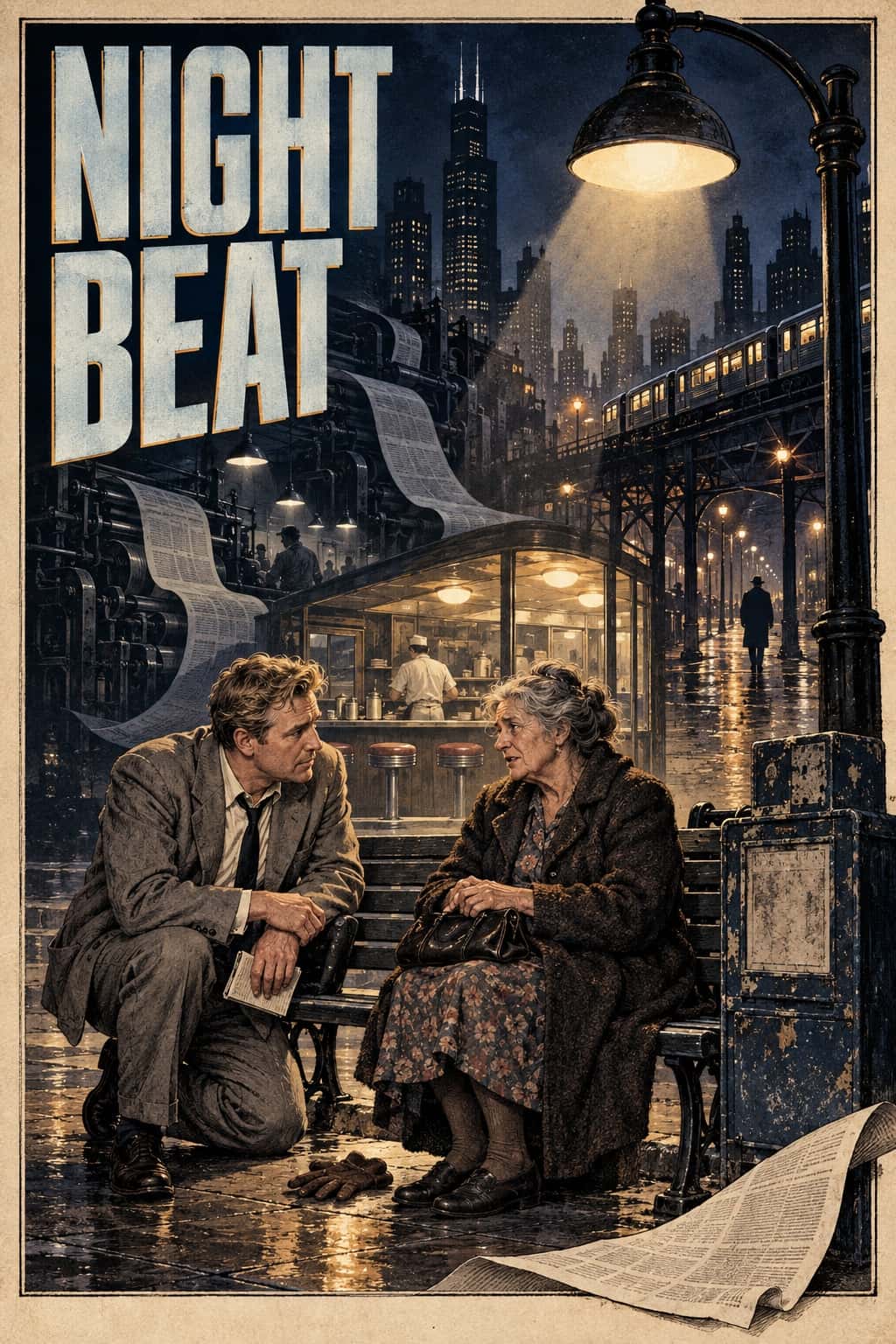
NBC presents Frank Lovejoy in Night Beat. Hi, this is Randy Stone. I cover the Night Beat at the Chicago Star. And it's just that, Night Beat. Plotting, pounding pavement, looking, always looking for that story that beats with the pulse of the city at night. There's a bite in the air, a penetrating drizzle goes through your bones. Tired, pallid faces look out at nothing through the streetcar window. I turn up my collar and try to remind myself it's spring, but there's nothing warming in the thought. The city's got her makeup off and her hair down, down deep. I wander through the loop, walk through the deserted cavern of concrete that by day is LaSalle Street, with tall gray buildings walling me in like giant tombstones. Just for a minute, I feel like a kid in a graveyard, and like a kid.
I reached for the light spilling out through the big plate glass window. There they were, the ones who inhabit the caves by night. A night army of clean-up women, busy like so many beavers with their mops and waxers, polishing the brass, the elevator doors, the mailboxes, the stairs. I watched the one nearest to me, dipping the brush, sloshing the suds, and wiping them up. She was old, white-haired, and small, not much bigger than a child. She seemed tired. She stopped and she looked up and saw me. She smiled. I winked at her. She took a deep breath like a sigh and she turned back to her pail. But she never made it. Let me in. Hey, you in there, let me in. The other little beaver saw us, crawled across the pail and rushed to her, blocking my vision. Then one woman stood up, terror on her face. It wasn't much of a story, just an item for the opus.
This is Martha Orloff, age 62, scrub woman, death by natural causes. Heart failure. Natural? What's natural about killing yourself with a scrub brush? The police came and took the body away and the little beavers went back to work and in half an hour you wouldn't have known it had happened. Yeah, you stand in the presence of death and you come up with a two-line obit. That's all it would have been if the other scrub woman hadn't stopped me on my way out of the building. Oh, mister, please. Yeah? Please, excuse, but... Somebody should tell him. Who? Mrs. Orlov's boy. Oh, the police will take care of that. I don't think a bright boy should learn his mother is dead to police. I would go myself, but they're very strict here. I would lose job. Okay. Okay. What's his name? I don't know. She just called him my boy. All right. I'll tell him. Mister, please. Now, what's the matter? I don't know what to do with her stuff. What stuff?
In her box. In the locker. Okay, let me see. Mrs. Orloff shared a locker with three other women. The police had taken her purse, but her cardboard treasure chest and her coat they left behind. I opened the box. In it was a crushed corsage she'd picked up off some littered corridor. The picture postcard did a quarter of fancy. The Eiffel Tower in the sunlight. And a pair of latex knee pads. They'd been issued to her, but she never used them. Even DuPont can't change the habits of a lifetime of grudging. I left the cardboard box in the locker, but I took a coat. It was a shabby coat, but it was clean. In one pocket was a sack containing a sandwich. Two slices of black bread with a little mayonnaise in between. In the other pocket, a pair of white gloves mended in the fingers and a door key pinned to the lining of the pocket with a safety pin. It's a funny thing.
Four million people in the town. They work to death, play to death, drink to death, and you rub shoulders with them every day. But you only meet a handful. I don't know why I felt drawn to Martha Orloff. Maybe it was because I was the last person she smiled at. I went over to her flat. She lived in Polish Town in a little walk-up tenement, the second floor back. It was very late. In deference to the fire laws, the 20-watt bulb burned uncertainly in the hall. A heavy smell of cabbage and cooking grease lingered in the air. I knocked again and louder. If anybody was inside, they should have heard me. I didn't want to wake up the whole building, so I untinned the key from her pocket. I opened the door and I flicked on the light. It was Mother Hubbard's cupboard. It was bleak to the bone. Two rooms with a kitchenette curtained off with faded crayons. A little canned milk, a little black bread, one boiled potato, no rug on the floor.
One caught with a lumpy mattress and one poor withered geranium trying to live without life. But no sign of any son, nothing in the place belonging to man or boy. But in the sideboard drawer there was something interesting. A package of money order receipts crisscrossed with rubber bands. Hundreds of them, all for the same amount. Two dollars and issued about a week apart and all made out to the polio fund. And with the receipts, a personal letter from one of Chicago's richest women thanking Martha Orloff for her charity. An old lady scrubs floors, and every two weeks, every week, two bucks go to the polio. Why? Well, the answer was right in front of me. All I had to do was look up. On the wall, a picture of a tickly, spindly boy about 12 years old with braces on both legs. Look, you're no good, bum. I told you, don't come...
Oh, I thought you are Stanley. What you doing here? Who are you? Never mind who I am. I'm janitor. What you doing in Mrs. Orloff's flat? I'm looking for a son. Stanley? Well, that's his name. That's who I'm looking for. Ah. You from the police? I'm a newspaper man, Randy Stone. I came to tell him that his mother died today. She died? Yes. This his picture? Yeah, that's Stanley. Die. I'm not surprised. She worked to death all the time. Scrub, scrub, what for? I tell her a million times, what for you work, Martha? Let that big hunk son take care of you. But no, he's a big lazy bum. Too good for work. Wait a minute, wait a minute. Are we talking about the same slip? Oh, that picture takes ten, twelve years ago. He's all pure now. He wore good like me, twice as strong as me. Well, that's fine. I'm glad to hear it. Well, would you notify him that his mother is dead? Me?
I don't tell that no good nothing. All right, okay, okay. Where do I find him? I don't know nothing about Stanley Orloff. I don't want to know nothing. He's just as good. Maybe he's dead. Just as good. All right, mister, you go now. Without another word, he walked me down the stairs, ushered me out, and closed the front door, leaving me out there with a cold and some puzzled reactions. I stood in the recess of the doorway and tried to make up my mind. Should I forget about Stanley Orloff or not? The police would reach him somehow or other, they'd tell him. But then I'd never fill in the sketchy picture I had of a kid in braces and a scrub woman buying a money order every week for the polio fund. Yes, an old lady dies in front of you and she's no longer a stranger. You've got an obligation, so you find her son and you tell him. But where do you look? Yes, the letter in the sideboard drawer for Mrs. Genevieve Hall. The polio fund should know where Stanley Orloff was.
I went back up. This time I was quiet. I opened the sideboard drawer, got the letter. Only, when I went to shut it, it stuck. I tried to force it. The kid's picture fell to the floor. I stooped to pick it up just as the door opened. What are you doing with Stanley's picture? What's that? A girl stood in the doorway. She was tall, high cheekbones and a broad form. Anybody else wearing a beacon bathrobe would have looked lumpy and misshapen, but not her. This is a very active placement. You're the man from the newspaper, aren't you? Yeah, Randy's son. I have to talk to you, but be quiet. Papa'd be mad. He thinks I'm in bed. What'd he tell you about Sammy? Did he tell you Sammy was no good? Uh, that's a pretty good summation. Everybody says he's a bum. Well, if he is, it's her fault. Her? His mother. I'm glad she's dead. He was waiting on him, babying him. Picking him up when he fell down. Why, he could walk a long time before she knew he could. And then when she found it out, you know what she told him?
Stand on your own feet now, she said, and be a man. I guess Stan Orloff wasn't more man than anybody on this block. Haven't you got your little drama, Miss Cass? Seems to me the heavy in the feet is a bug by the name of poliomyelitis. I don't know what that means. Probably smart talk, meaning you don't like Stanley like the rest of them. But you do. You bet I do. Stan could have been anything in the world. He's that smart. Just because he don't take any old job that's handed him, they say he's a bum. Because he wants to be something. To get out of this hole and live like a human being, they say he's no good. Oh, but it's all right for his mother to break her back to support him, huh? I don't like you. Well, miss, you're just going to have to get in line. I thought you were here to help Stanley, or I wouldn't have come up to talk to you. Look, I don't know Stanley Orloff. I don't know his mother unless watching somebody die constitutes an introduction. I came to give him a message, that's all. Now, if you'll tell me where to find him, I'd appreciate it. I guess I didn't mean that about his mother.
I guess they're mad. And I guess because I miss them. Where did he live? I don't know. He'd never tell me. Moved out of here two months ago. But he ran around with a fellow for a while. He didn't like him. We had a fight about it. The fellow runs the 8th High Club, but it's not a club. It's a pool room. Maybe you could find Stan there. What's the fellow's name? Brannigan. Ace Brannigan. Thank you. Oh, if you do find him... You want me to tell him that a certain tall, black-eyed girl is still around. He ran out of the flat like a frightened rabbit. I started to leave before I got thrown out. When I noticed that Mrs. Orlov's coat had fallen to the floor from the chair where I'd put it, it didn't seem right in a flat as frugally neat not to hang it up. I opened the closet door, and I suddenly felt guilty.
Guilty for having eaten the square meal and guilty for having a pair of $12 shoes. In the closet was one dress and one pair of shoes half-soled, an all-black straw hat with a pink flower on it, a pair of slippers with one toe out, and a bathrobe, and a clean flannel nightgown that had been mended so much it looked quilted. The wardrobe of Martha Roloff. I closed the door. I picked the kid's picture up and I started to hang it back on the wall. And then I saw it. A bank book pasted to the back of the picture with a scotch tape. A bank book belonging to Martha Orloff with a balance of $50,006. NBC is bringing you Night Beat starring Frank Lovejoy as Randy Stone. Three chimes mean good times on NBC. There's more mystery later this evening with two rough and tough crime fighters.
That's the amazing Mr. Malone, a daring private detective equally proficient at romance or solving murders, followed by The Man Called X, starring John Lund, who travels to all the dark and mysterious corners of the world, combating the evils of international intrigue as an intrepid soldier of fortune. Yes, there's action and adventure every Friday here on NBC. And now back to Nightbeat and Randy Stone. Martha Orloff, Martha. Yes, my little obits that had been growing so nicely into a human interest yarn had fallen flat into a cliché. How do you figure it? A scrub woman in Polish town with a bank balance of $50,006. But there were some angles that didn't fit. Like that glorifying letter from Mrs. Genevieve Hall praising her generosity. And those fiddling little weekly donations to the polio fund. I thought how ironic it was that I was sitting in a mansion on Lake Shore Drive waiting to discuss Martha Orlov.
If Chicago had an aristocracy, Mrs. Hall would have been at least abducted. She was strictly for his family. Her father built an industrial empire on the lake shore when Mrs. O'Leary's cow was still a calf. So, now, I try to be friendly with the press, but was it necessary to waken me in the middle of the night? I thought so. Well, young man, get on with it. I'm no girl, you know, to lollygagging in the parlor all night. What is it you want? Mrs. Martha Orloff died tonight. Orloff? Orloff. So? You wrote her this letter? She was one of your regular contributors, sent $2 every week. Oh, of course. That dear little Polish woman. You say she died? Yes, of course, Ernest. Tell me, what did you know about her? What do you mean, Mr. Stone? She was a generous, hard-working woman. And her son? He was stricken with infantile paralysis about ten years ago. He had a slow recovery, and the fund took care of him, like so many others. And those $2 donations? Well, that should be clear even to a journalist.
She wanted to pay us back naturally for what we'd done for him. She dedicated her life to it. We didn't want to take her money, but we couldn't refuse. I happen to know she went hungry many times, but she never failed to send the two dollars. Well, did she? I mean, did she go hungry? Well, of course she did. You're sure? What are you trying to do? Take a simple act of charity and fist it into... Oh, no, no, please. Mrs. Hall, I'm only trying to understand why Mrs. Orloff left a bank account of $50,000. Ridiculous. Well, see for yourself. Here's the bank book. Young man, I've been around a few years and I know human nature. You can show me 20 bank books and I still won't believe it. If she had any money, she would have given it to us. By last year when the polio fund fell short of its quota, she took it as a personal disaster. And do you know what she did about it? Instead of resting her tired old heart on her days off, she baked pies and sold them in her neighborhood. She made $25 that way and she gave every cent of it to the fund. Now...
Have you any more questions? Uh, yes, Mrs. Moreau. You take contributions from the working press? The night was almost gone, but I couldn't quit. I had to have the full portrait of Martha Orloff, and my story, my $50,000 story, and the elusive threads that would tie it up into a column of linotypes. I went into a little all-night beanery and had a bite to eat. While I was waiting for the coffee, I dug out the bank book again. $50,006. A lot of deposits. How did she do it? Now, wait a minute. There were a lot of deposits, all right, but it didn't add up. The book was practically full. There were pages of deposits, and there were just about as many withdrawals. One time, her account got up to $50, and then she drew it down to $6. She left it that way for a long time, 11 months. And then these three big deposits within the last month, $25,000, $10,000, $15,000.
Maybe Stanley Orlov had the answer to that one. The 8th High Club was sandwiched between a Polish theater and a second-hand store off Division Street. And militarily speaking, off-limits. Business wasn't very brisk. One lone pool player was shooting on a target game. On the other table, a bull-necked individual was rolling dice. And against the wall, in a tilted chair, a mildewed club member was dozing under his hat. And over them all, a green glow hung like mold. One dice player looked up. What's on your mind, Cap? I'm looking for dice. Yeah? Lots of people looking for dice. What's your point? For? Cap? My newspaper man. I'm looking for Stanley Orwell. Never heard of him. I was told I could find him here. No dice. I'm going to get that cushion, Fig. Yeah, yeah, do that. He looked at me in a cold, dead way. He was lying. That was obvious.
It was also obvious that the interview was over. The drowsy individual was sitting up now, very alert. The pool player had transferred his interest from the game to me. And since I prefer to make an exit under my own steam, I walked out. But it didn't matter, because now I had an angle on the bank book. The money was hot, Stan Orloff was hot, and he was hiding out. And Mrs. Orloff had stashed the dough for him, protecting him even to that. All I needed to wrap up the story was a record of three stick-ups corresponding in amount and dates of the three deposits. I grabbed a cab for the police station. It was a dull night in robbery detail. Sergeant Doyle was happy to break the monotony by dragging out his record. Olsen, Epstein. Now, Randy, know all of it. Well, how about suspicion of robbery? You ever bring him in for questioning? No. I don't get it. There's got to be an order. What do you want? Facts or fiction?
Let me see those unsolved robberies. If you're using this information to criticize the police force... Oh, Doyle, relax. Did I ever say anything against the boys in blue? Okay, then, now. The month of May. Here. Here's the height. Mink coat. Some jewelry. What was the value? Now, this stuff was recovered. Here's one. A chainsaw for 600 bucks. Not enough. Here's a gas station knocked over for 150 in the till. Never got a line. No, no, no, no, no. Three stick-ups. Big one. Want a big one? All right, here's a big one. Fifty grand. No, that's too big. Now, what about twenty-five, fifteen, ten? What do you want me to do? Make change? What's wrong with fifty grand in one piece? What are you working on, anyway? Hey, wait a minute, wait a minute. Yeah, yeah. Maybe it isn't three. Maybe it is one. Where was it? What? The big stick-up. Oh, that was a candy store. Candy store? Fifty grand?
That's right. And I don't mind telling you, that one robbery I'd feel very happy if we never saw. Never? Well, that's a twist. How come? Can't be sure. A guy by the name of Burke runs it, but it's a front. He's a bookie. We know he's a bookie, but we can't get anything from him. So a guy comes along and sticks him up for 50 grand, and Burke comes yelling to the cops. He said it was his life saving. Was there a suspect? Yeah, but we couldn't hold him. Insufficient evidence. Because you couldn't find the dough? Yeah, that's him. And his name was Stanley Orlop. You're a stubborn guy, Randy. There's no Orlop on the record. Oh. Well, that's all. All right, thank you, Sam. Oh, hey, what was his name? Who? The suspect on the candy store hike. Oh, let me see. Brannigan. Yeah, that was his name. H. Brannigan. Well, thank you. The meeting of the Ace High Club was still in session. The three members were just as I left them. Now, good evening, Mr. Brannigan. Well.
So now you know my name. That's real polite. I'll be brief. Are you sure you don't know where Stanley Orloff is? You're making me out a liar. Look, I told you before, I don't know him. Well, all right, if you should get acquainted with him, will you give him a message for me? Yeah? Like what? Would you tell him that his mother died tonight? I went back to Mrs. Orloff's flat. I let myself in quietly and waited in the dark. All the threads were there now. If my hunch was right, all I had to do was wait and the story would tie itself up. Pretty soon I heard what I was waiting for. Footsteps. One dragging a little, like a limp. I couldn't see them. I was in the kitchen, but I heard them. The man with the limp walked across the room to the sideboard. Ace. Ace, it's gone. What do you mean, it's gone? The bank book. I have it right here, stuck on the back of the picture. Are you trying to roll off a fast one? Why should I do a thing like that? I don't know.
Maybe you think that using your old lady's bank account is worth more than 10% of 50 grand. Or maybe because you're going to inherit all that dough, you've got ideas that belong to you. Oh, I wouldn't do a thing like that, honestly. Yeah, and it's your old lady who got lies for the whole setup. But how could she? She didn't know the account was still open. I told her I took her last six bucks months ago. Well, that book's got to be around here someplace. Then find it. Is this what you boys are looking for? Oh, it's you again. Still looking for a guy? I found him. Give me that bank book. It doesn't belong to you. It belongs to Stanley now. An interesting angle. An old lady dies and her son inherits the proceeds of a stick-up. Yeah, yeah. And it's all legal. Now, give me that book. I think I'll keep it. Police might find it interesting. They might jump to the same conclusions I have. That dough's mine and I'm going to have it. Well, sure it's yours, but you're going to have a tough time getting it. You'll have to go to the cops and tell them how you got it and how come it's in somebody else's bank account.
Are you going to hand it over, or do I take it the hard way? I didn't have any rebuttal for the gun he turned on me. I handed him the book as the door opened. I hope I hear you come back, Jim. It was the janitor. He didn't see Ace and the kid. They stepped back into the shadows. He held a piece of paper up. I'll just say you friends for Mrs. Orloff. Maybe you take care of this paper, huh? Sure. Sure, I'll take it. What is it? I keep it for her, because I'm on ground floor. She's always afraid there'd be fire, it'd get burned, and it's down. Scully, what you do here? You not satisfied you kill your mother? All right, Grandpa, you go. Who you are? Oh, this is terrific. What's so funny? Here, read it, Ace. The last will and testament of Martha Orloff. Huh? She leaves all her worldly goods, everything, to her favorite charity, the polio fund. And that means along with her other dress and her pair of shoes, the banquet.
What does it mean? It means, Stanley, boy, that you can't touch this, though. Either one of us. But it's... Yes, it's legal. You bet it's legal. As legal as an English barrister. Ace's face went white. He wasn't very bright, but he was bright enough to know that I had him by the tail feathers. What are we going to do, Ace? Do? Who's going to know about the world? But they know, and... Oh, no. No, Ace, I don't want any part of that. I don't want... Shut up and watch your step. Ace moved against the wall, his gun concealed, but he had a perfect beat on me. I opened the door, and there was the prettiest sight I've ever seen. Two big, ugly cops, and one of them was Sergeant George. Randy! You finally got me into the act. Which one of these guys is Olaf? Oh, that's him. Over there. Thanks. Stanley Olaf? Yeah? I'm sorry, but we got bad news for you. Your mother died from the bodies at the county morgue.
Well, 5 a.m., it's milk time. I should go home, but I haven't finished my column. There's one item left to write. What makes it tough, I've got a choice. One way I write it might make the front pay. Bookie, hoodlum, swindle. The other way, it only amounts to an obit. Oh, but what an obit. I was tempted to tell the cops about the 50 grand, but, well, they'd only give it back to the bookie, and then nobody wins. Yeah, I... Joe's thrown down a money trap. The suckers don't know it, but all their little two bucks on the nose and two bucks to play some show is really gonna buy something. Yeah, I got a full portrait of Martha Orloff now, framed in gold. $50,000. Martha Orloff, patron of Polio Foundation, leaves fortune. Copy, boy. Night Deep, starring Frank Lovejoy, is produced and directed by Warren Lewis.
Tonight's story was written by John and Gwen Bagney with music by Robert Armbruster. Featured in tonight's cast were Virginia Gregg, Myra Marsh, Paul Dubov, Ed Max, and Lou Merrill. Frank Lovejoy can currently be seen co-starring with Joan Crawford and Robert Young in Warner Brothers' Goodbye, My Fancy. Listen next week at this time and every week as Randy Stone searches through the city for the strange story waiting for him in the dark. Nightbeat came to you from Hollywood.