
The written record
Read the transcript
Read along with the recording · About 19 min to read
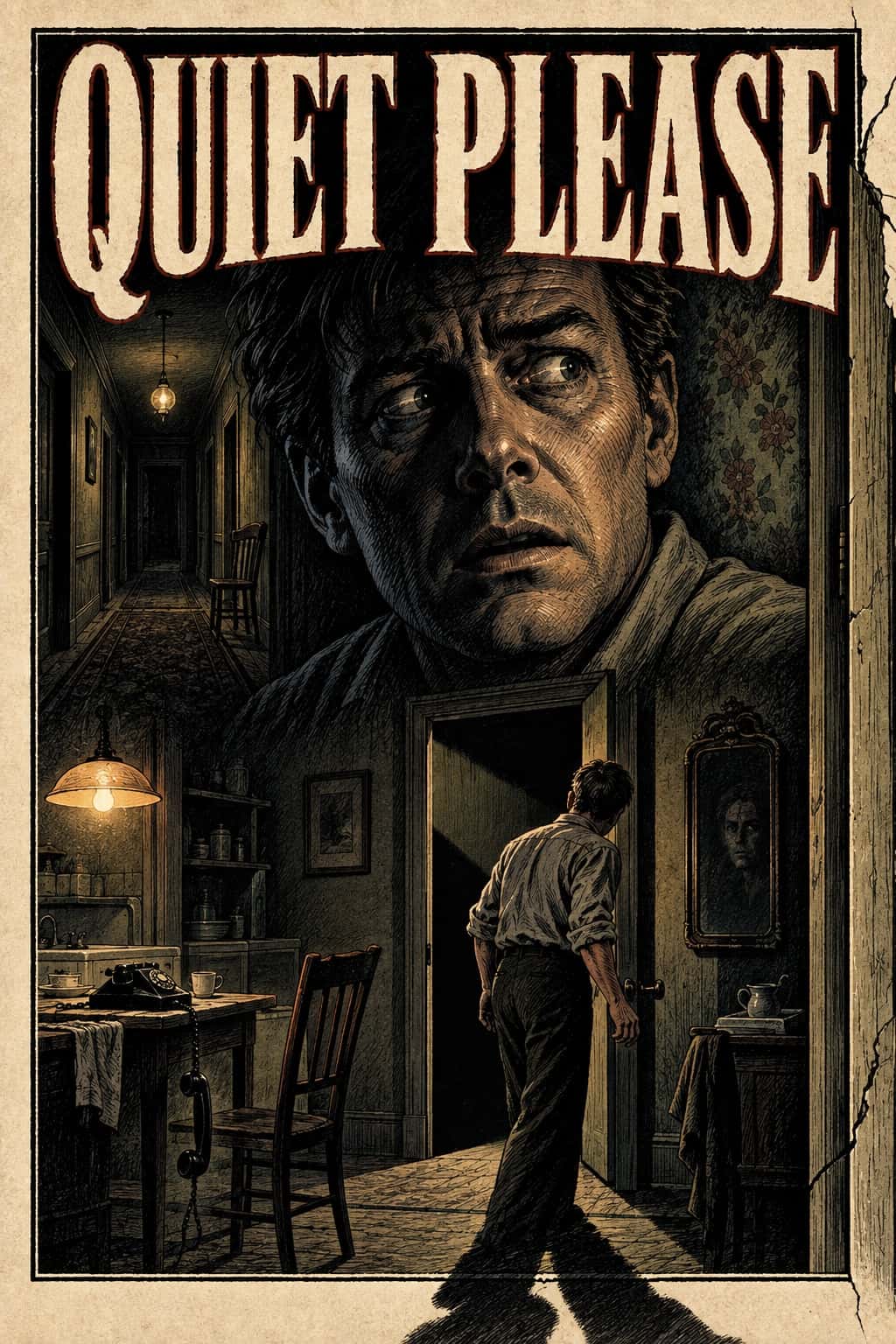
The Mutual Broadcasting System presents the second of a series of unusual drama stories written and directed by Willis Cooper and featuring Ernest Chappell. In this week's story, I Have Been Looking For You, we have as our guest the star of stage and radio, Miss Claudia Morgan. Quiet, please. Quiet, please. The story is entitled, I Have Been Looking For You. I have been looking for you. Your name? I do not know your name. Perhaps you are Anaïtis, or Ligia, or Bernice. You are Mary, or Alice, or plain Jane. You are Mercedes, Lebouchia, Colette. Where are you, love? I heard your voice when I was a child, when I was new in school, when I was a tender lad unknowing. I heard your voice as I passed the schoolroom door. Seven times seven are 49. Eight times seven are 56. Nine times seven are 63.
But I pushed the door ajar and looked. And there was only a schoolroom full of children and a teacher at the desk. The cadence of your childish voice hung in the sunny air in the schoolroom. But I couldn't find you. And wondering, dreaming, I closed the door. And went my way on to the confusion of another school. But your voice was with me. And I have not forgotten. Many times I heard your voice, love, as I knew it. There were other girls in my boyhood. Sweet, clean-limbed girls I remember now through the years. Helen with the yellow curls. Gladys, the tomboy on a bus. Paula in the library. Kate, Dorothy, and Jenna. And crippled mine. Then my playmates taunted me because I had no girl of my own. But I smiled a secret smile as I turned away and walked homeward along the elm shadows. The flower sweeps fleets at night. For always you were somewhere.
And I knew I should find you one day, somewhere. How many years have passed us now? How many summers? How many yesterdays? How many heartbeats? But I knew that I should find you. I saw you at a distance sometimes, a gay red bathing suit on a beach, a fluttering tartan scarf on the winter hillsides against the snow. But when I ran to greet you and call you mine, you were gone. You had vanished. A day came when I was a young man and went away to make my fortune. My heart ached as the little station grew smaller in the rapid distance. For I knew I saw you there waving farewell. Was it to me? And I thought frantically of leaping from the train and returning. But a cloud of dust swirled up behind the train. And when it was gone, you had vanished.
There was another glimpse of you, I thought, as the train roared through another little town, and a gay crowd on the station platform waved and paused. And I knew then, I knew that wherever I should go, you would be all for me. And tears came to my eyes, as I thought perhaps I should never see your face, but always follow you, and never leave you. Yes, I was young for love. But I loved you then as I loved you that first day in school. Seven times seven. And as I love you now. I knew you followed me. I heard your footsteps down the summer dark street. With the flickering old streetlights scattering shadows under the lilac bushes. And the scent of the lilacs has brought you back to me so many times. Why have I never seen your face? Or have I? Tell me.
I love you. I've seen your shadow past my window. I've heard the distant echo of your voice. And you were always near. My dreams have seen you, but you evade my seeking eyes. Do you remember a wide, white beach on a summer day? And the high, white clouds? And you were alone. And I was alone. I remember. I remember. I conjured you up out of the sound of the waves in the sand, and the rhythm of the surf was the beating of my heart. And the sound of the wind in the dunes was your far-off laughter that I heard. And I ran along the beach searching for you, for your presence was strong in my heart. And I cried out. I was heart-sick for you. Then I was afraid. I swam far out into the remorseless waves beneath you, and became weary and hopeless for you.
And the waves fought me, and they bore me down. Then I dreamed there was strong arms above me. And I opened my eyes to the sun and breathed again. And the salt on my lips I thought was not the salt of the sea, but the sting of a fading sea. But you were gone. Then I knew my life was yours. And I was very happy for a little while. And very sad. Where did you go, love? I dreamed of you in the sea. I dreamed that you were struggling. And I dreamed that I swam out to you. And took you in my arms and brought you to the shore. And I kissed you. But there was darkness somewhere. Darkness that hid your face from me. And when I awoke, I too felt the salt of your lips. Was I never to see you. Never to hold you in my arms in life. I sought to forget you. But you gave me that.
I thought that my mind was sick, that I dreamed in my waking hours. But which was the dream? And which reality? And how could I escape the vision? Always I was haunted, tortured by the thought that you were near me. Around the corner, waiting perhaps with a smile of welcome when I should find you. Do you remember? You must remember. I remember. When did you walk down an avenue in the snow? The lights were golden from the windows. And the bells chimed softly in the twilight of the evening. The streets were filled with cheerful people hurrying happily in the white darkness. And I was known until you hastened past me, a dim shape in the swirling snow. And I followed you until you disappeared in the storm. The cheerful, flat laughter of the people on the street mocked me again. Foolishness. There is no one. I am alone. We shall never find each other.
When I wept in my sleep that night, it was your hand that wiped away my sleep. I dreamed of a woman, and I kissed her eyelids as she slept. You went away. We were new to the war that Christmas season, and even as the reluctant bells rang in a new year, I went away. I remember the gloomy, cold station. I remember the unhappening two dozen mockery civilians away from the length of the city, to the drafty cars that were the focus. somewhere. There were few to see us off at New Year's Eve. A policeman who watched us silently as we straggled across the platform. And an old man who offered us a son, mumbled of his days at the wars of Siboney and San Juan, the girl he left behind him. And a group of related commuters turning away from us to study the blackboard train arriving. And as they closed the doors of the coaches, a fat woman pounding on the window, mouthing frantic goodbyes to a little man who turned away from us. But when our train began to move from the station, a glimpse of a woman standing alone under a dusty electric light on the platform. And then I knew, as I remembered once before, that I could never wholly go away from you, that we belonged to each other, though I might never see you again. I was close to death.
many times in the war. The castings passed when John Sutherland and I were alone one night with Rommel's armor on the side of the hill to watch. And at last we knew they were coming and one of us was to stay while the other went back and the others were missing. I was afraid to stay. But I argued with John enough to have him pride of my terror, saying I would stay while he should go back to what might mean safety. But he was tired, he said, and I was not. And he would stay. And so I went. Then 20 steps away from him, I heard the 88. It smashed him in half. I spoke to him and told him to stay. And I was wounded afterwards. That night I lay in the hospital camp and something happened. I had no voice to call. And in the last flight before my senses went, a nurse came hurrying to my side. It was you, I thought. But when morning came, I saw the same familiar nurse I'd known for days. She was asleep and I awakened her.
Did you watch over me all those years? Was it your voice I sometimes heard in the still night? Have you loved me so as I have loved you? What must we do? I have been looking for you for so long. Time went by. Such a long, weary time since I came home. Where were you, love? There was one moment. I was standing on the deck when our transfer came up today. I was looking for you. There were hundreds of boats around us, boats with great painted signs welcoming some of us home. There was none for me. But I hoped that perhaps among all those who had come to meet their men in the harbor, there might be. We were past the Statue of Liberty, nosing over to the North River where we were to dock. And the ferry boat from Jersey cut across our bows. I merely glanced at it, and I saw you. That was a happy homecoming.
But when I came back to New York, when I took off my uniform and went to work again, you were gone. I searched for you. I looked for you everywhere. Where were you? What had happened to you? I saw you, love. They said in the hospital that I would never get well. I heard the doctors talking. And at night, sometimes I'd talk to you. But I knew you didn't hear me. The cord was broken. I couldn't reach you. I saw you many times. I had buried myself in my work, they said. Whatever the work was, I'd forgotten. I'd forgotten everything except that I loved you. And I tried to forget that. Well, I was afraid that you were gone from me forever. And I should never see you. Never hear your voice again. Never know your nearness as I had grown to know. I tried to lose the thought of you among seven millions of people.
Among the high buildings and in the sounds of the city around me. And I almost succeeded. But then, I fell. Do you remember where I saw you? In the very center of the town, surrounded by men and women of a hundred races. In the midst of a babble of sound, in the midst of hysterical, never-ending motion. In colors and darkness and flashing, searing light. It was a summer evening, hot and humid.
And the threat of lightning and sullen thunder in the clouds that towered over the Jersey High. And the voice of the storm quickened, rumbling over the squalling sound of the city and the lightning crackled in the west. I was on my way home after a sudden day in the tiny office of Old Town Square. One of the beaten, hungry millions at the end of a colorless, unhappy day. And the subway. And the crowds. And the guards pushing the milling crowds into the airless, stuffy cars. The train starting far underground where only blind animals should live. Bodies pressed against feverish bodies. Tired eyes looking inwardly toward the comforts of home and cool drinks. And blessed rest. And outside the windows, walls too close. Sweating and dank with moisture. And the sudden flash of stations as we roar through them more and more speed. Bodies swaying against bodies.
suffocation, and the sudden fear that comes like a clutching nightmare deep underground. We're going too fast! Screams of blue sparks outside the open windows, the accurate smell of burning rubber, swift panic clutching hands, futile fists beating screaming faces, the scream of tortured brakes, lights flickering and dying, and in the last seconds before the crash... You. I saw you. I had turned, I remember, to escape a man's fingers clawing at my eyes. I saw you. Inches away from me. Yet a continent away. Blonde hair rippling in the fetid breeze. Red lips apart. Not in fear, but in rapt excitement. Almost smiling. I shouted your name. Did I know your name? You knew, didn't you? You saved my life. But you said you turned your head just as the crash came. Yes, I turned my head.
To look at you. The steel rod just grazed your forehead. If you hadn't turned your head. I looked at you. Providential, young man. It was you. I knew you were there. Among all these scores of frightened, screaming men and women. I knew you were there. And I saw you. In the last flickering of the light, I saw you. Then you were gone. Forever, I thought. I thought you died in the subway. For long months you were dead to me. My mind refused to think of you. I couldn't picture your face again. But now I know I was near you many times. I entered a restaurant as you left it. I left the elevator at the 14th floor one day. I got on at the 15th. I turned to look in a shop window as you passed by. I picked up a book at Ventana's that you just laid down and I knew I could. And the bus driver gave me change that had come from your purse.
And I knew. You sat behind me for the last eight months at Carnegie Hall in my dreams that night. The telephone booth at Grand Central. Your perfume still was there. All those long months. There were long times when I never saw you. Times I'm afraid when I all but forgot you. And then I'd see a picture in the newspaper. A happy group celebrating something at some nightclub. And there you were. There was your face, dim and smudged with ink. Pat turned away from me in the background, and I was off again. Off to walks in the park, hoping to hear footsteps that had grown familiar through the long years. Off to a pub call along 3rd Avenue, drinking a pint of Stello's, PJ Fox, listening to the cadence of a voice that might somehow be there. And off on the top of a fifth-hour bus, off on a step-down ferry, for an expedition through the theater crowds of children. Ah, my love, I have loved you.
I said I never knew your name. I'd lay awake nights, but I wouldn't go over all the girls' names I ever heard of. Doris, Elizabeth, Frances, down through Zipan and Yvonne. I'd make resolutions. I went out with other girls, found myself becoming bored with other girls. I looked for you and them, and I became short of speech and quarrelsome, and no girl ever went out with me. And I kept to myself more and more, more and more times in Central Park. till the very ice cream vendors greeted me as an old acquaintance. And more and more times along Fifth Avenue late at night, up past the cathedral, down past the entire city, hoping, listening, peering anxiously at every woman. I went away on long fifths by myself to escape the thought of you and heard your distant laughter. I thought I saw you framed in the window of a chain of past minds going in another direction. I didn't sleep much. Nights, I came home as late as I could.
I closed the door and shut the city out. I was afraid to sleep. I was afraid of the dream. The dream that came so often. An empty room. Dark, high walls. A little flight of stairs leading to an open door. And beyond the door, a dazzling light. And the light draws me to the flight of steps. My voice echoes in the silence of the gloomy room. Where are you, love? Where are you? I'm still there. You are there, beyond the door, in the room where the light shines. Your shadow falls across the flight of stars. You are only 20 paces away. I move toward the door. Come to me. Is that a hand? I turn to see. The room is empty. Another step. I can go no farther. I struggle, but there is something that holds me back. And a voice that whispers in my ear. Not yet. Not yet. I fight against the force that holds me, but I cannot move.
What is beyond the door where the light is? Do you wait for me? Why cannot I reach you? Please, come to me, Lord. I cannot move. I call to you. Help me. Come to me. Come to me. Then with the sound of a great gong in my ears, I awake, trembling, in the other. For the great gong calls to me. The dream came to me. A great bright bloom. The light. It dazzles my eyes. And I cannot leave. The door that leads to darkness. And footsteps beyond the door. And I'm frightened. Until I hear your voice. Where are you, love? And I answer. And then I know your voice. Coming to me from the darkness. And the light. But the footsteps. End. And the light burns my eyelids.
And the great gong. My hand was on the very lintel of the door. And the radiance of the light within struck my eyes and blinded me. And again I awoke. Did this mean that I was soon to find you? Am I to see? To hold you in my arms? I slept a little. And the dream did not return. It was raining when I awoke. A quiet summer's rain. And the light in the... street was the color of the light in the room beyond the door. Is that a sign? Is this the day? The dream. I dreamed of a voice around me. I asked him to come to me. Is this the day? Is the dream a message from somewhere extraordinary? Is this the day? I dressed peacefully, and I see that it's already eight o'clock. I shall meet him again. I shall wear my new scarlet raincoat.
I'll know him when I see him. Well, you know me. How so? Outdoors. Rain. Good luck at Texas, Madeline. Shall I meet him today? Who says the rain is business? This is the day. I know this is the day. I shall walk to the office. Who knows, I may meet her on the way. I smile at strangers as I stroll through the pelting rain down Madison Avenue. Here is a young couple, lovers. I, too, am a lover. And today I shall meet my beloved. And then the fulfillment of all my dreams from the time my childhood so very long ago. I step down from the curb. 68. Patrick is stopped before the upraised hand of the police in the middle of the street. I smile at them. And I do not see the taxi cab leaning around the corner against the light, the driver frantically tugging at his wheel. Very slowly, it seems to me.
and the cab coming straight at me. And as I looked up, the crew of wheels half a foot from me. You. The dark room, the stairs, and the door, and the dazzling light beyond. Nothing holds me back now. I go forward to the door, and the light welcomes me. I know you are there, love. In a moment, we shall meet. We shall begin our work together. Shall we not? Love, where are you? Love, I'm here. With you, sir. Yes, indeed. Right through here. Now, mind the little stairs through the door. Yes, it is bright in here, but you have to be able to see very well in here. The man that was killed by the taxi cab. No. There's no identification at all. This one? This was the woman, the passenger in the cab. She died of a heart attack at the very instant. No identification for her either. Yes, it is strange.
Both of them smiling as if they were the happiest people in the world. You have listened to I Have Been Looking For You, the second in the series Quiet Please, which is written and directed by Willis Cooper. Ernest Chappell was the man who talked to you. And our guest, Claudia Morgan, was the woman. Thank you, Claudia, for being with us. Others in the cast were Peggy Stanley, Chief Wayne Gordon, and Martin Wolfson. The music was composed and played by Gene Proctor. And now for a word about next week's Quietly story. Here is our writer-director, Willis Cooperfield. For next week, I've written you a fantastic story, which I hope may give you the strength to tell us any changes. The title is, We Were Here First. So, until next week at this time, Quietly yours, Bernie Chapman. This program came from New York. Stay tuned now for a fascinating story of strange events and their common sense explanations.
on the House of Mysteries, which follows in just a moment. This is the Mutual Broadcasting System.