
The written record
Read the transcript
Read along with the recording · About 20 min to read
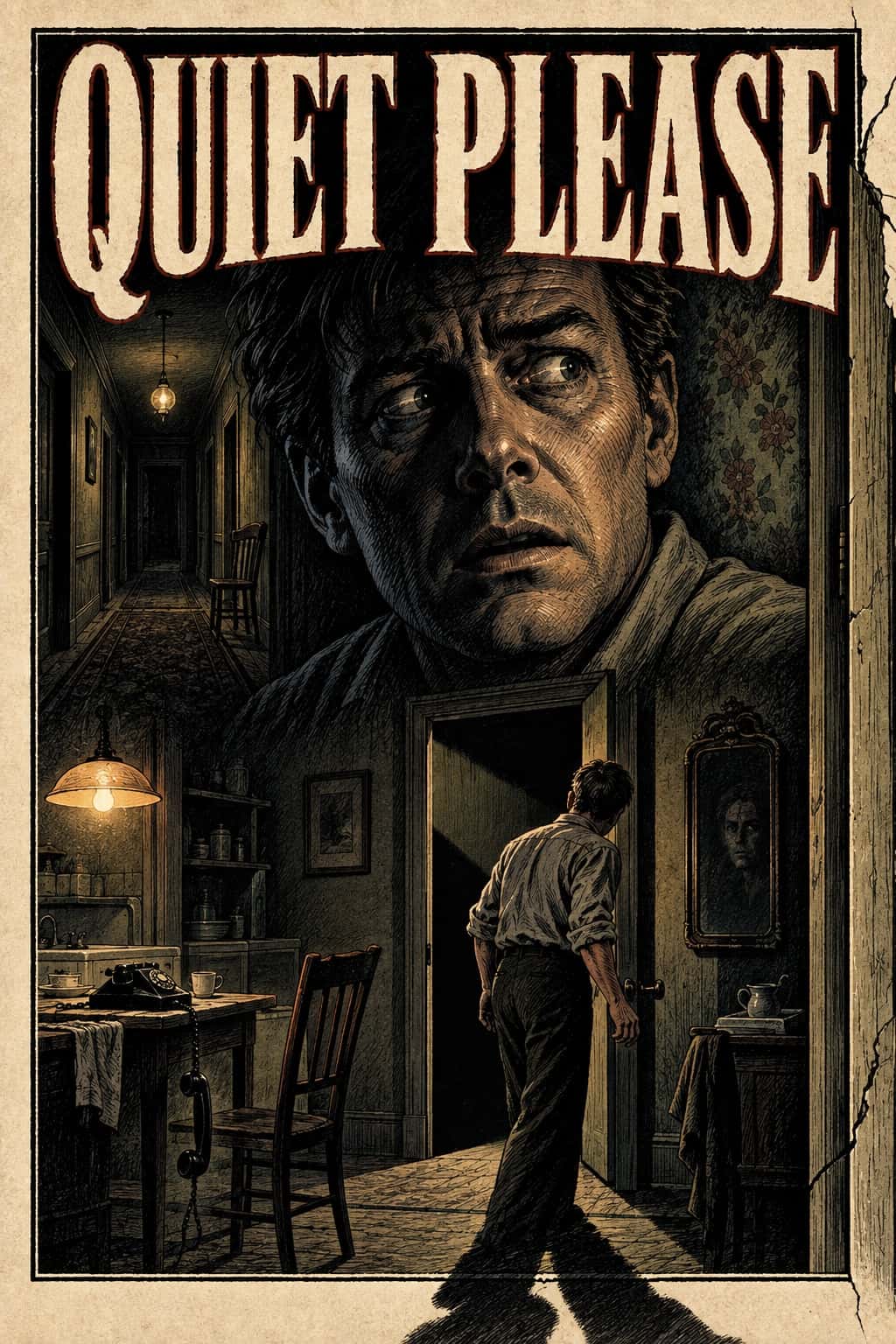
Quiet, please. Quiet, please. Today's story, written and directed by Willis Cooper and featuring Ernest Chappell, is called I Remember Tomorrow. Could you tell me this time, please? Oh, thank you. I didn't see the clock. Thank you very much. I just wanted to see how much more time I have before a certain thing happens. I wanted to see if I have time enough to tell you what's going to happen, because certain things should be done after it happens. And I'm rather afraid that it'll be up to you to do them. I, uh, I won't be here. Let me see how that better starts. Perhaps it would be best if I gave you their descriptions. The three men, I mean. You'll forgive me if I sound a little confused occasionally of so many things to remember. And so little time to remember them all. Oh, yes, the descriptions. There are three of them.
Louderbox. He's about medium size, probably 40 years old. Has red hair and a heavy red mustache. Louderbox seems to be the boss, or perhaps I should say leader. And the second one is Greg. Greg is a large man. Socky, I should imagine you would call him. He's around... 50, smooth-shaven, has sandy hair just turning gray. And Frank... I'm afraid I don't know his last name. Frank is all I've heard him called by the others, and I'm certain that's his first name. Frank wears glasses with heavy bows. He has black thin hair. And he's young compared to the others. 24-5, I should say. They're all very dangerous men, I'm afraid. Of course I didn't...
realize at first that they were dangerous men, but the events of the past few days have demonstrated to me that they are. And as I shall show you in a few moments, I now have incontrovertible proof that they are extremely dangerous. It is quite fortunate for you that they do not know I am talking to you. However, if you will do exactly as I ask you, I feel It's reasonable to be sure that there will be no serious results for you. For myself, I already know the outcome, and it's quite impossible to change that. But you, your task is to bring justice, to bring to justice the men who murdered me. Or should I say, the men who are about to murder me. Let me start from the beginning, there's little enough time. My name...
is Garrett Faber. I am by profession what careless newspaper writers call a scientist. By avocation, I am a gambler. A singularly inept and unfortunate gambler is an enthusiastic one. In addition, I am afraid I drink. Perhaps my unfortunate cards may be in a way faceable to my propensity for marketing. Conversely, it may be that I drink excessively to get the sums of money I lose at cons. I should do the martini now. Unfortunately, I shall have to wait until our colloquy is over. I left a large pitcher of martinis on this table yesterday when I left. Then I see by the empty pitcher that I drank its contents. As a matter of fact, I believe Frank did say I was finishing the pitcher when he killed me. Therefore, I have at least the consolation that...
The martini will be waiting for me when I get back to yesterday, even if I am to be murdered as I finish them. It's an interesting thought. I know, it sounds like what a lot of us call double talk, doesn't it? But you understand it all presently if you listen carefully. I find many interesting subjects to thought in this room. One of them is the partially dried stains on the carpet. Stains, blood stains, where I fell. May I look at the coffee again? One month ago today, no, one month ago yesterday, I was sitting in a certain saloon. I was quite thirsty. It was a warm day, and I unfortunately had no money for the purchase of any kind of liquor. My wife decores my habit of waiting around in the saloon for an acquaintance to come in and buy me a drink, of course.
But she divorced so many of my abbots that I... Are you married? Why would you ask that? Just so you understand. Well, it seems my acquaintances had other things to do that afternoon. And I, it appeared, was doomed to sit and perspire and envy the more fortunate patients of the saloon who had the wherewithal that I... I had about given up in despair... when the voice at my shoulder... Aren't you Dr. Garrett Faber? In some surprise, I am, sir. I am afraid you have somewhat the advantage of me, sir. My name is Johnny Lutterback, Dr. Faber. This is Mr. Gray. How do you do, sir? Frank, meet Dr. Faber. Meet me, sir. Dr. Faber, will you have a drink with us? Needless to say, I accept it with pleasure.
I, uh, there was a time when I did not so readily drink with strangers, but, well, perhaps it was a kind of conditioning of my mind that led me to assume that these men were casual acquaintances whom I did not instantly remember. At any rate, the afternoon wore on. Then we did become veterans. How about another double martini, Dr. Faber? Think up, doctor. More martinis on the way. You buy one for the doc. Hey, Patty, another double martini. And I am afraid that that was the last I remembered of that afternoon. The next morning, however, I recall distinctly. I had a transcendental hangover. I was not at home.
My three drinking companions were still with me. John E. Lauterbach. Mr. Gregg and Frank. Mr. Lauterbach is good enough to produce a bottle of something from which he poured me a large tumbler full. I drank a grape fully and the dark clouds in the room were spritz. A second tumbler full and Dr. Faber was almost himself again. If he's that kind of person, might be. I reached. For a third glass is what I want. That's enough for now, Dr. Faber. One more and you'd be on your ear again. You'll feel all right now. That's what I am. That's what I call you. Could one of you tell me where we are? Where we are isn't very important right now, Dr. Faber. It's where we're going to be, doctor. Yes. I'm afraid I don't quite understand. I'll tell you, Dr. Faber. Yes, you talk, Mr. Lauterbach. Sure, we'll listen.
Well, now. Doctor, you used to be one of the most brilliant physicists in the business. I once had a reputation? Yes. But bottles and that's a racket, doesn't it? I can testify, my friend. You haven't had a job in quite some time, have you? Not in quite some time. The gentleman thinking of offering me a job? He might. A temporary job? With a lot of dough attached. Would this be an honest job? It would require laying off hard liquor for a while. And staying outside. And a payoff that'll kill you, Doc. May I know more about this, uh, job? Doc, there, listen. We're not screwy. We know something about your work in the past. Well, I understand then why you use the word screwy. You may remember that the character of my work is the cause of life.
Dismissal. Dismissal. That's probably what put you on the bottle. What? We don't care about that, Doc. You aren't, Doc. Well, again, you were investigating time and space relationships, if that's the kind of a plan for it. That's essentially correct. The university took a rather dim view of some of the reports of my work that appeared in the public print. I remember that. They kitted the pants off of you. They did that, indeed. But we think you're on the up and up, Dr. Faber. Well, now, I'm most assuredly very grateful. That's why we want you to do this job for us. You ought to do it standing on your head, Doc. I'm afraid you haven't told me yet just what the job consists of. Perhaps I can't do it. Perhaps I should telephone my wife. We phoned her. Oh, you did? We told her you'd be busy on a new project for a few weeks and couldn't get home.
He also mailed her $200. You're repaying, C.C. I'm afraid I haven't been able to supply her any for some time. You figured you'd take the job, Doctor. And $200 is not much of an investment. Not when you're figured against what this job will make for you. Yes, and when I'm still in the dark. Well, uh... Mr. Lauterbach will explain it to you. Yeah. Go on, Mr. Lauterbach. Dr. Faber, according to your experiments and stuff, time is, uh... What is he said? relative. That's correct. You said it's something like air or water, didn't you? Well, that needs a little amplification. He said you could move around any time, like you move around in air and water and stuff. In theory, gentlemen, I believe that possible. Could you prove that theory, Dr. Faber? I was dismissed from the university before I had an opportunity to do so. You could prove it, though, huh? I have reasons to believe that I could. Yes.
May I ask the purpose of this discussion, gentlemen? Why, sure, doctor. Certainly, Dr. Sabin. Sure. We want you to make a time machine for us, doc. I see I was slavish. You gentlemen hardly seem to try to conceive of a time machine, much less. I see. Order one. I hesitated. I said I wasn't sure I could do it. You can do it, all right, Dr. Phillips. I said it would cost a great deal of money. We'll get up the money, Doctor. I said it would require considerable time. We can wait, Doc. The payoff's good enough. We can wait a long time. And so I naturally asked about this. Have a small drink, Doctor. Obviously, I accepted the challenge. Obviously, I constructed the time machine. Otherwise, how could I be talking to you from tomorrow?
How could I be speaking to you at 10.13 p.m. Eastern Daylight Saving Time on Monday, July 28th, when you are as obviously listening to me at 10.13 on Sunday, July 27th? I don't know where you are. Of course you may be listening to me in another time zone, perhaps at 6.13 p.m. Pacific Standard Time or 7.13 Mountain Time. You see, don't you, that time is relative. That's the whole secret of time travel. You're not going to be scared of the machine. To me, it is relatively simple, although it's immensely complicated, as you know, Matt. The machine lies before me on a table here or at a basket or a device looking something like a camera. But its fragility is deceptive. It cannot be destroyed. Now, observe here. Here is a hammer.
Nothing, whatever, happens. And for a very excellent reason. The machine cannot be destroyed now. Tomorrow, because it must go back with me before long to what is today, to you. If I could destroy it now, it would be impossible for it to go back and the whole experiment would have become impossible. You follow me? I have some things to show you. Let me go back to the afternoon when I first... I was certain that I had a rudimentary time machine that would actually work. I had consumed a great deal of liquor. I forgot about it and spent it very generous, and I found, strangely enough, that drinking did not seem to affect my workmanship. Perhaps without it, I might not have been able to build a device. I believe it's too late now. It works, and it has already performed its function. My...
shall I say, sponsors, were most curious that afternoon. How are you going to prove it works, Dr. Faber? Send something into the future? Send what? Not me. I rather think we will try an inanimate object, first gentleman. The pencil there. Yes, the pencil. Can't hurt a pencil, sir. Well, if this works. If it works. Oh, man. How long will it be gone? For the purpose of the demonstration, I shall send it away further. We're only a few seconds. How far away? Shall we say tomorrow? Yeah, tomorrow. That's far enough. Are we ready? Yeah, sure. There it is again. Let's see it. Doesn't seem to be changed. It isn't. Well, why should it be? Listen, how do we know that pencil was in tomorrow? Don't try. Well, where was it? Yeah. How are we going to know? Tell me that, Doc. How are we going to know?
We'll have to send somebody who can come back. Who's that going to be, Dr. Faber? Not me. Not me. Doctor, will you have a drink? I'll have two drinks. I will have a large number of drinks. You invented a doctor. You know more about it than we do. I will drink again and shake my head solemnly at your importunities, gentlemen. One of us might bust the thing, you know. Go on, Doc. We have to know for sure. Because I don't quite trust you, gentlemen. I don't know what you are up to, but slowly the suspicion grows in my alcoholic mind that you want this instrument for no good. And if I do use it and travel into tomorrow, I shall do it alone. I can be crafty and cunning myself, gentlemen. Crafty and cunning as I expect you are. And I shall do my first exploring.
Then deliberately I set out to drink myself into a condition where I shall be of no use whatever to my patrons, and their voices wavered off in a haze of my own make. Then after all it was night, and my head was reasonably clear, and I was locked in my room and lotted back in Greg and Frank where I assumed peacefully sleeping, and that was my time. That was the time to look at tomorrow. I looked at the calendar on the table. It said Thursday, July 3rd. I looked at the clock, 11.34 p.m. I fastened the chain on the door, and I turned on a small light at the table. And then I attached the time machine to my... Carefully, I set it for one month ahead. Carefully, I set the dial to allow me five minutes in the future. And with a last swift look around, it was not an unpleasant thing. I reached for the switch.
I turned it on again, and I was startled nearly out of my senses. Lights flashed outside. It seemed to be coming from the sky above, and the air was heavy with... Had I made an error in calculation? Was I the only witness of atomic destruction? A flash, a rocket, a pyrotechnic display of glorious sound and color. I watched it in terror for a moment. Then I remembered. Back to the table, turned on the light, and the desk calendar glared up at me. Friday, July 4th. That was it. I had made an error. I thought I'd set the machine for a month ahead, but it was only for a day. Tomorrow. Evening paper laying on the table. The date, July 4th, 1947. And I had my proof. I snatched up the paper and stuffed it in the pocket, and the fireworks outside died away. And the watch ticked on. 1947, said the calendar pad. I had succeeded. I had seen tomorrow today. And I had my proof.
I reached for tomorrow's newspaper. There was no paper. Perhaps I dropped it on the floor. Oh, there was no paper. There was no proof. I tried again with the machine. I found out some things. No matter how I said it, it would only go to the next day. Perhaps there's some kind of providence that prevents man from too far into the future. I found out something else. It was impossible to bring back anything from the future. I tried it with the newspaper, I tried it with a dozen other tangible things, but I was always empty-handed when I returned. Now, my friends didn't know this. They didn't know anything about all the tomorrows I had seen. I was determined to find out what use they intended to make of my machine first. And I found out. I had held out against testing the machine in their presence so far as they knew I'd never tried it. And they kept after me, day after day. And at last...
I set my price. And what do you want to use this machine for, gentlemen? Shall I tell him, Greg? Might as well, I guess. What about you, Frank? Well, you'll find out anyway. Well, I shall not test a gentleman until I know. What if we hooked it up and sent you out anyway? Yeah, whether you want to or not. How about that? It wouldn't work, gentlemen. What? You don't think I'm quite a fool, do you? What do you mean, Faber? I haven't shown you everything about its operation yet. Okay. Tell them, Mr. Lauterbach. You appear to have us more or less over a barrel, Doctor. Thank you. So, we're going to make a lot of money with it. You said that. Very simple. Too simple, Doc. Dr. Faber, we intend to step into the future, knock over a few banks... And come back to today with the money. You see, Doc? Yes, but you can't... But what? What I have discovered.
I didn't tell them my machine could move no farther into the future than 24 hours. And I didn't tell them that they could bring nothing back with them. Even if I'd sympathized with their remarkable scheme, I didn't dare tell them. I was caught. They'd find out sometime, then what? It was a good scheme, wasn't it? But, of course, there are physical laws that cannot be violated. If you take something from the future and bring it back to today, then it never existed in the future. Figure it out for yourself. It doesn't take a doctor's philosophy to work it out. So that was it. Now I had to demonstrate whether I wanted to or not. I thought fast. Perhaps I could set the machine so I could stay indefinitely in the future. I studied it hard. I thought I could do it. And they watched me. That was yesterday, today. Today to them. And yesterday to me. It was nearly half an hour ago. Or, if I trust the calendar, 24 and a half hours ago.
I set the machine for an indefinite stay in tomorrow. And they watched me curiously. They said, bring us back tomorrow's paper, doctor. Don't stay too long. Hurry back, doc. And Frank laughed as I pressed the release. Now it's tomorrow here. You've got to help. Because I can't stay here indefinitely. I'm going back. The machine works automatically. It'll take me back whether I want to go or not. You want to know how I know?
A little while ago, I was sitting here alone. Maura's paper was on the table beside me. And the door opened, and they walked in. I spoke to them. They walked on in, paying no attention. You better get that blood cleaned up, Frank. Yeah, it's too easy to spot. I'll get at it again. I looked down. There was a blood spot on. I was sitting. I spoke again. Where did the blood come from, Mr. Lauderman? Now we know the thing works, we've got to get some money. Oh, it works all right, Mr. Lauderman. First thing now is to get rid of his body. Whose body, Mr. Lauderman? Can't keep it there in the closet forever, you know. Somebody might come in while we're out. Who's dumping the river tonight? Has somebody been killed, Mr. Lauderman? Well, anyway, we owe him something. He got paid off, though. I sort of like the doc at that. Like whom? I hated to knock him off. Knock whom off? Well, we couldn't keep him around after he got the machine working and tested it out for us, could we? Of course not. He served his purpose. Are you talking about... I hate to do it, though.
When he picked up that pitcher of martinis and took a big slug, I thought he had a hunch that something was up. Ah, forget it, Frank. And he said, I drink to success, gentlemen. That was yesterday, Frank. And I knew. I knew why they didn't see me or hear me. You know now, too, don't you? I wasn't there. This was tomorrow to them. It was yesterday they killed me when I came back when I said, I drink to success, gentlemen. I wasn't there in the room when they talked about it. I was dead. So I know now, and you know, I've got to go back. I've got to go back and be killed. Nothing can stop that. But you, you've got to help me. You've got to send the police here. They've got to be captured before they can use my machine. Think what they can do with it. And their murderers, they murdered me. You will help, won't you?
Yes, you will. I know you will, friend. You did help. Yes, you did. It says so right here in tomorrow's paper. Look. You've got to help. They can do so many terrible things with my machine. No, I know they can't bring anything back from tomorrow with them. But they can kill. You will help. Let me read you what tomorrow's paper says about what you did. Didn't read it all at first. I'm terribly sorry. But, well, listen. Dived. as a result of wounds, suffered in the capture of the three men. That's you, friend. That's you that's to be killed tomorrow trying to help me. No, you can't change it. You can't change it any more than I can. The machine is buzzing again. I'm going back. I'll pick up my drink and I'll say, I drink to success, gentlemen. Well, doctor, did you make it? I drink to success, gentlemen. I've heard, I remember tomorrow.
A Quiet Please story written and directed by Willis Cooper. The man who spoke to you was Ernest Chappell. And Frederick Bell played Latterback. Kermit Murdoch was heard as Greg. And Frank Dane was Frank, who's composed and played by Gene Parrazzo. Now for a word about next week's story on Quiet Please, here is our writer-director, Willis Cooper. Next week's Quiet Please story about a man and a murder is called Inquest.
Until next week at this time, I'm quietly yours, Ernest Chappell. I came to you from New York. This is the Mutual Broadcasting System.