
The written record
Read the transcript
Read along with the recording · About 22 min to read
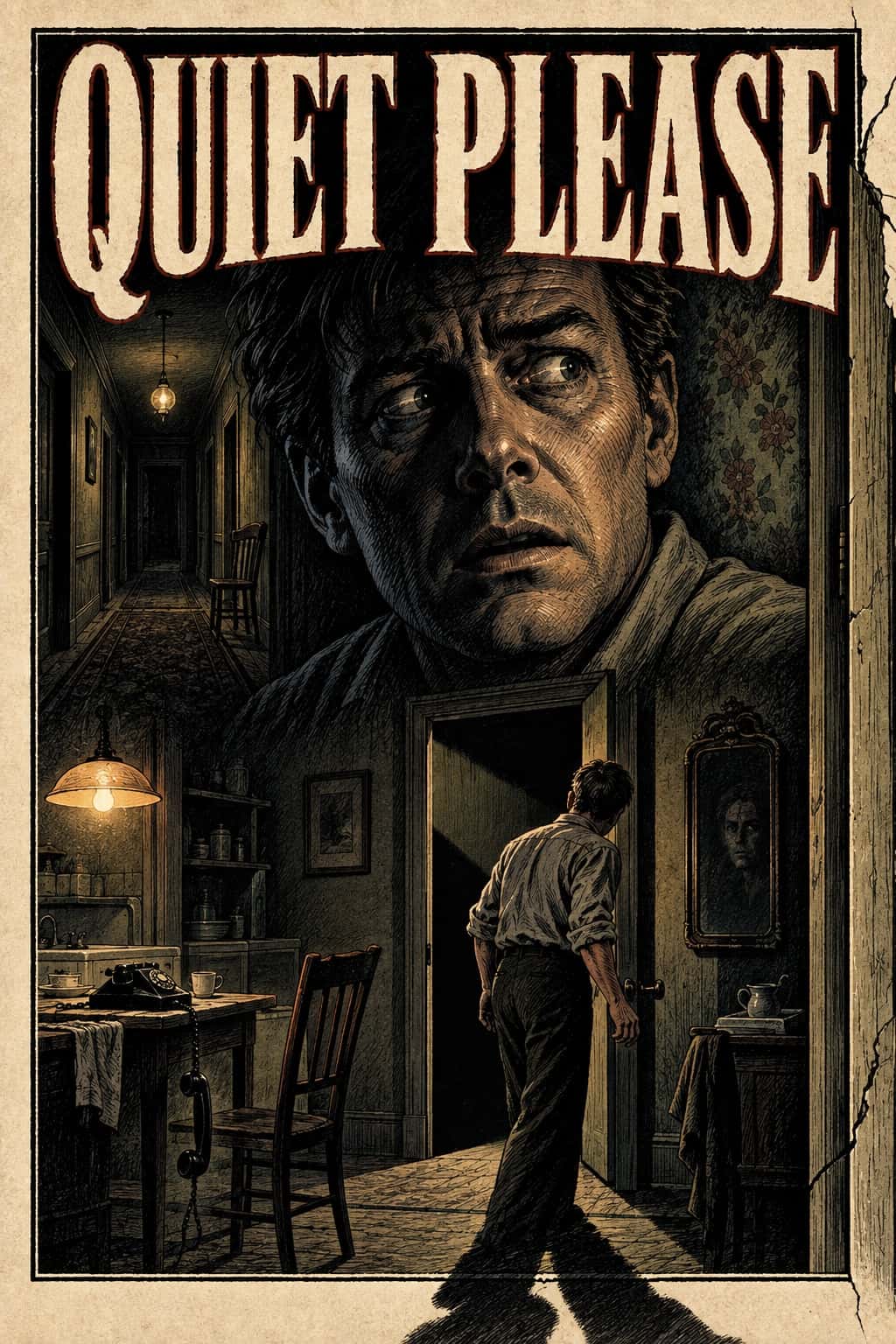
Quiet, please. The American Broadcasting Company presents Quiet, Please, which is written and directed by Willis Cooper and which features Ernest Chappell. Quiet, Please for today is called One for the Book. Once upon a time when there were more lieutenants than lieutenant colonels in the Air Force, and when you could tell a cadet by his blue suit like a mailman's, a thing happened. And if you think the boys from the bright blue yonder got snafu'd sometime in this last war, brother, I'm here to tell you you ain't seen nothing yet. Because this was the largest, the most comprehensive, the doggondest, I have to tell you. And the thing about it is this snafu isn't over yet. It won't be over for nine years. Listen, I'll tell you. Ever hear of Muroc Dry Lake? Well, you go out San Fernando Road and you turn off at Fremont Pass on the 6th instead of going up over the ridge route.
You got through Mid-Canyon, see, and on through Palmdale and Lancaster. Then you take a road off to the right by the S.P. station. After about 40 miles of Joshua Trees, you get to Muroc, and a big, tough M.P. tells you, turn around, go back where you came from. Because that's where they got the jets. Where guys are ringing them out so fast, they sometimes get where they're going before they've started. And they tore up the welcome mat a long time ago. But back in the early part of 1937, well, it was kind of different. Muroc... Which, incidentally, is not an Indian name. It's just the name Coram spelled backwards like on the radio. Coram Brothers was ranches that owned a joint. And it's just what you think it is, the bottom of an old dried-up lake. It's flat as a billiard table. Flatter than the one in the officer's club at Maxwell. And back in those days, you could take your car out in the middle and open her up to 80 and sit back and watch. Look, Mama, no hands. Which was quite a lot of fun, though. Some newspaper guy blew a tire and did 108 snap rolls with it. With the customary results.
Well, it ain't like that today. I mean, the lake's still there, but it isn't a lonesome place anymore. The lobo wolves and the coyotes and the rattlesnakes and the roadrunners have scrammed. They got an installation there that... Well, never mind. You're not going to see it, but it's a biggie. Down the lake itself is about the biggest landing field in the world. You could set down anywhere, practically. Well, the Air Corps decided back in 1937 to have them a big air maneuvers there at Muroc. So in came about everything they had that could fly. Martin V-10Bs from Langley, P-26s from Selfridge and Maxwell Randolph, and a bunch of skinny blue things they called PB-2As that came from... I don't have any idea. And over at Marchfield at Riverside, they had a flock of A-17s, attack jobs, two Cedars that Northrop made. They had holes in their flaps, I remember. First ones to have holes in their flaps. And there was a lot of other miscellaneous stuff. It was quite colorful. P-26s painted OD.
The bombers, black and yellow, they all had yellow wings. The PB-2As were blue and the A-17s shiny dural. Everybody had the red and white stripes on the rudder and the big old white star and the blue circle on the wings. All 300 of them. All we had, practically, in 1937. And anti-aircraft. Complete with the 1937 version of radar, a cluster of big horns on a trailer with a guy wearing earphones in the middle of them. You couldn't spit half a mile away if the horns was pointed at you on account that you bust the guy's eardrum. And there was a bunch of movie guys taking pictures. They had plenty of expense money. They didn't shoot crap so good. So, one way or another, it was quite a thing. And, brother, it was hot. It still is. It would get down to 40 or 50 in the early morning, and by noon it was up to 115 with the sun bouncing off that white lake bottom and mirages everywhere you looked.
I was a crew chief in a P-26 squadron from Selbridge, see? Oh, excuse me, I didn't introduce myself. Westlake's my name. Max Wesley, Captain USAF. I was a staff sergeant in 1937. Up there at Muroc, I got acquainted with a guy. Of all things, a sergeant in an anti-aircraft outfit named Bill Carrant. And I remember how this snafu started. Bill and I were sitting in a bar in Lancaster one Saturday, drinking beer, listening to Pancho Barnes, God rest her soul. Telling about buzzing a church people in Long Beach and a Jenny. And a couple of elements of B-10Bs went over. Bill Carenty said he'd buy another beer. I'll buy another beer, Max. I'm going out and sit on the porch and read. Read? What do you want to read for when you can drink beer? Free beer. I found a couple of magazines. Let's see. Go on, drink your beer. Super science stories. Miraculous stories. You like that kind of junk?
Well, what if I do? A lot of hooey. No, they're not. Guys flying rockets and taking off for the moon and malarkey like that. Yeah? Listen, in 20 years, the stuff in these books will be ancient history. What do you mean? In 20 years, people will be flying rockets. In 20 years, they'll be writing the same kind of guck, and people will be flying old-fashioned airplanes, but in real, we'll be shooting them down. You wait and see. Yeah. In another 20 years, airplanes, rocket planes, will be going so fast you won't be able to see them, much less shoot them down. How fast? A couple thousand miles an hour. A guy couldn't fly that fast. Why couldn't he? Well, he'd outrun himself. He'd come in for a landing, and 15 minutes later, you'd hear him. You can fly as fast as sound. You're nuts. Well, a bullet flies faster than sound. But there ain't anybody riding it. When they get a big enough bullet, somebody will ride it. Bring me another beer. Hey, get me one. I'll fly it.
You'd feel pretty funny starting out someplace on Saturday and getting there on Friday afternoon. Well, listen, it'll happen. In them magazines. These magazines told a lot of things that have come true, Bill. For instance? Well, I couldn't give you an instance right now, but they have. I'll take beer. Why don't you watch and see? One of these days I'll come bouncing in someplace in one of these rocket jobs and you'll be right... I'll tell you what I'll do. I'll kiss your foot at high noon right in front of everybody. Now, you want a beer, you're going to sit there reading about buzzing a man in the moon in a skyrocket. Or what? I did both. Then we bummed a ride back to the lake after a while, and I went to bed. Bill Carent was pretty disgusted when he got there and found out he had to stand guard because the sergeant that was supposed to be had broke out with the measles. And he put on his overcoat and stopped by my tent for a cigarette before he went off where it was cold. We talked, and he left, and I went to sleep. Well, I woke up in the middle of the night, see?
I couldn't get back to sleep. So I got up and put on my pants and shoes and a flying jacket. I went out to the anti-aircraft battery. I said, hey, Carrant. Hey, Bill Carrant. Who's that? Me. Westlake. Max Westlake. What are you doing up? I couldn't sleep. Well, I wish I could. I'm about froze. How much longer you got? Half an hour. Wouldn't have a bottle, would you? Oh, I'm sorry. Pretty night, ain't it? I'll give it to you. millions of... Yeah. ...fly at night, Bill? And I ain't going to. I ain't gonna fly at all. That's swell up there with the stars. I'll stay here. I wonder what's up there. I got no curiosity at all. I'm gonna find out some one day. In your skyrocket? What was that? Search me. Sounds like it came from up there. Probably one of your skyrockets. I don't think there's anybody up tonight. I don't see anything. I wonder what it...
Hey. What? Look up there. Where? Right there by the big dipper. What is it? I don't see anything. Say, you know what that is? That's a parachute. Why'd you say that's what it is? Only that's the biggest parachute. There goes a searchlight. They saw it over at A Battery. Gosh, that is a big one. Wonder who it is. That's a funny looking thing. Looks like a box or something. It looks like part of an airplane. There goes the crash truck. I didn't see any airplane, Bill. Maybe it was one of your Skyrockets. Shut up. Give me your field glasses. He's gonna hit awful hard. Give me the glasses. Oh! Oh, he sure did. Yeah, that's part of an airplane, Bill. They're pulling a guy out of it. In some kind of funny suit. What? Soup and fish? It's kind of like a diver's suit. Kind of like a space flyer's suit. I know where he came from. Where?
He bailed out a goofy stories magazine. I handed back the glasses to Bill Caron and I walked over to the infirmary. That's where they'd take whoever it was, I figured. And in a minute, the crash wagon came back and they carried the fella in. I sat there a minute and talked to Daniel Webster, the medic that had the duty. They were fussing around with the fella inside the ward, the doc and everybody. I sat there talking. There was a piece of metal lying on a stretcher that one of the medics had picked up where the thing crashed. I looked at it. U.S. Air Force, it was stenciled on it. U.S. Air Force and a number and XF-131. XF-131 mean, I said. Why, I said to myself, U.S. Air Force. This is the Army Air Corps. What's the U.S. Air Force? Something new? And what's XF-131? I know what a P-26 is and a PB-2A and a B-10B, but what's an XF-131? And then the doctor called me. I stood up, surprised.
Sergeant Wesley, come in here. Sir? I said come in here. Yes, sir. In here? Yes, sir. Ever see that man before? Why, no, sir. Sure? Well, he looks kind of familiar, but is he a... He's got a slight concussion, and I've given him a shot. Who is he, sir? Is he from here? You don't know him? Why, no, sir, but I... Sure looks familiar, but... What's your first name, Sergeant? Your first name. Oh, Max. What's the matter, sir? Sergeant, that man's name is Max Westlake, too. Huh? Only he's a major in the United States Air Force. What do you make of that, Sergeant? Eh? What would you have made of it? I looked at the guy more carefully. Then I saw how he looked familiar. I'd seen that push in the mirror every morning for 22 years.
There was a scar on the eyebrow where I drove the car into the lamppost. Only it was on the wrong eyebrow. Then I remembered I wasn't looking into a mirror. I said, Doc, I don't get it. He said, Don't you? And I said, Well, sir. So I went out. And just as I was going out of the tent, in walks Bill Carrant. And I must have looked funny because Bill grabbed me by the arm. What's the matter with you, Max? Huh? You look as if you're... Wait a minute, Bill. I think I've got something figured out. What are you doing for the love of... I'm taking off my shoes, Sergeant Garrett. What for? Well, not exactly high noon, Sergeant, but you're going to kiss my foot just the same. Huh? That's right. Why? Because, Sergeant Garrett, that guy in there, that guy that flew in here in a skyrocket, that major in there, is me. And so the snafu began. I got called over to the colonel's tent right after breakfast. He was sitting there with the doctor.
They looked up when I get my heels pretty close together and placed my hand, fingers extended and joined against my right eyebrow. Sit down, Sergeant. Yes, sir. Uh, the doctor tells me this fellow who bailed out last night has the same name you have. Yes, sir. Looks a lot like you, too, Sergeant. You know him, Sergeant? Yes, sir. Said last night you didn't. Well, I got it all straightened out in my mind now, sir. Well? He's me, sir. Sergeant, have you lost your buttons? No, sir, I don't think so, sir. Say that again, Sergeant. Sir, I said, no, I don't think so. No, what you said before. Oh, he's me, sir. Cross your knees, Sergeant. Sir? Cross your knees. Yes, sir. Reflexes are all right? Sergeant, do you mind explaining what you're trying to give us? I've got a tactical program on this morning, and I... Go ahead, Sergeant. Well, sir, it's perfectly simple. Aviation is progressing, sir.
So what? Well, sir, it's perfectly simple. This Major Wesley, who is me, flew in in something like a rocket plane or something quite a long time in the future. You understand, sir? Go ahead, Sergeant. And he flew so fast, he... Well, he just got here before he started, sir. Sergeant. Sir? Nothing. Go on. Well, sir, that's all there is. Sometime I'll be a major like he is. I mean, like I am now. What do I mean? I mean, if he's me, I'm a major. But I'm still a sergeant. I mean, I'll be a major, and I'll take off, and when I get here... I mean, when I got here, I'm still a sergeant. Sergeant, please. My head hurts. I'm sorry, sir, but that's what happens, sir. Somebody around here is crazy. Oh, no, sir, not me. Let's try that again, shall we? What, sir? Your theory. I just want to be sure I'm not hearing things, doctor.
Well, if you're hearing him, so am I. Go on, son. Someday in the future, I'm going to be a major. You're not a... Yes, sir. Someday I'm going to be a major, see, and I'm going to fly a rocket plane or something. How do you know all this, Sergeant? You got a crystal ball? No, sir. It's obvious, ain't it, sir? Not to me. You, Doctor? Well, you're going to be a major, sir. Yes, sir. Well, I must be. I'm over there in the tent, ain't I, Doctor? And I'm a major, ain't I? You see? And someday when I'm a major, sir, I'm going to get into this rocket plane, see, and... I'm going to take off and I'm going to go so fast that... Gosh, I sure must have been rolling last night. Sergeant, you must want to get out of the army awful bad. Sir, me? No, sir, I don't want to get out of the army. Well, what makes the colonel think that? Well, if I ever heard of anybody asking for a transfer to the loony bin.
This is it. Sir, I assure the colonel I am not nuts. Well, then, why the dickens are you telling me all this? Sir, the colonel asked me. Okay. Go on. You were taking off in a rocket ship. Or something like that, sir. Like I said, I was so fast that I just run out of time and I landed last night. You believe that, Sergeant? Yes, sir. Where did you... I mean, how did you fall on this theory? Well, sir... I read science fiction magazines and... Ah. You do. And I just deduced it. Rocket travel is perfectly possible. It's an interesting theory. Doctor, are you nuts too? I'm really not sure, Colonel. Well, what are you talking about then? I was just looking at this identification card I took out of the Major Westlake's pocket. What about it? It's dated.
November 24th, 1951. Fifteen years from now. And snafu and snafu. He didn't have any guardhouse or anything. He confined me to my tent. That is, he confined Sergeant Max Westlake to my tent. Major Max Westlake was still out like a light. He couldn't talk. And me, I didn't have anybody to talk to. But I thought. And the harder I thought, the surer I was I was right. And the second day I was in there, the... Colonel came to my tent and he looked about 18 years older. I stood up. Yes, Sergeant. Now, listen. I had the doctor take that, uh, that major's fingerprints. And I flew them to Washington to be looked up in the big file. Yes, sir. The dope came back this morning. Yes, sir. Now, read you what they say. Uh, the subject fingerprints are those of Staff Sergeant Max Westlake. And there is no record.
of a Major Max Westlake in the Army Air Corps. Find directions, so forth and so forth. Yes, sir. That's the way I figured it. Westlake, if you're running a Sandy on me... I'm not running a Sandy, sir. Come with me. Where are we going, sir? Right into the infirmary, Ted. You sit here behind this canvas wall and you listen to that fellow talk. And don't say a word. Just nod your head if he's right or shake it if he's wrong. Hear me? Yes, sir. All right. Listen. Major, where did you come from? Here at Muroc, sir. What outfit are you in? I'm chief test pilot here. I see. And what happened, do you know? Yes, sir. I was flying an XF-131. That's the newest experimental rocket job. Speed of about max seven. What are you talking about? Seven times the speed of sound. What the? Suddenly, the needle flew way over beyond the mark. I got scared, pushed the automatic cockpit release, and bailed out.
And, uh, how fast do you think you were going then? Well, I should say about 12 times the speed of sound. I see. And, uh, what was the date of your takeoff, Major? Why, December 21st, 1957. Now, look here. You see? You see, Colonel? You see? Snafu. Fubar. The Army never saw one like this before. They sent it to the General. Oh. Sit down, gentlemen. Yes, sir. Now, Westlake. Yes, sir. Yes, sir. Your brothers? No, sir. No, sir. Now, just a minute. Just a minute, I mean. Westlake. Yes, sir. Yes, sir. Stop. Yes, sir. Yes, sir. Sergeant Westlake. Yes, sir. Who is this Major Westlake? He's me, sir. Sergeant? We can't prove otherwise, General. That will do, Colonel. Yes, sir. Now, Major Westlake, who is this Sergeant?
Sir, I don't know. Well, isn't he your brother? No, sir. Well, who is he then? Answer me. I think he's me. Doctor, are these men crazy? Not as far as I can tell, sir. Well, what ails them then? Sir, I just work here. Well, now, Major, how come I don't know you? Well, that I couldn't say, sir. I don't know the General either. Young man, I have been in the Army 28 years. Yes, sir. At 29, I was at bliss with Lord George Langren when he had the 8th Cavalry. Yes, sir. And I know thousands of officers in the Army. Yes, sir. But I don't know you. No, sir. Young man, do you know the penalty for impersonating an officer? Sir, I'm not impersonating an officer. Here's his identification card, General. Is that your picture, Major? Yes, sir. It doesn't look like you. Well, sir, these pictures never look like the people.
That's right. Mine looks like a... Well, seems to be an order, all right. It is, sir. I know that. Those your fingerprints? Yes, sir. They're the sergeant's. Washington says, General. Now, how could that be? Well, sir, they have to be me. He's me. I mean, I'm... I'm us, I mean, sir. Colonel, has this man ever demonstrated... Has he... I mean, has he ever had attacks before? No, sir. He's always been rational, sir. He's one of my best men. He's rational now, General. That is, I think he is. Kind of, I mean. Sergeant, do you know that a board may be convened and that they're liable to throw you right out of the army? Sir, I'm not worried about that. Oh, you're not, huh? Why not? Because they can, sir. I have to stay in. Kindly tell me why. Because, well, don't you see, sir, I'm going to be a major and I'm going to fly a rocket plane. The XF-131.
What makes you think so? Well, I'm here, sir, after all. Well, I'm going to tell you something. I'm going to solve this problem once and for all in a military manner. Major Westlake, you are subject to orders, aren't you? Yes, sir, of course. And I want this to be a lesson to you other officers, too. You gentlemen are expected to use your intelligence and initiative and not come bothering me with all sorts of details that could just as well be handled in your own Ballywicks. You understand me? Yes, sir. Silence! That is a very simple way to solve this problem, as I said. Major Westlake, you are ordered to return to your base. Sir, I'm at my base. I'm stationed at Muroc Dry Lake. This is Muroc Dry Lake, sir. Well, how did you get here? I flew, sir. Oh, but how did you... I mean, how did you get here now? Sir, I just flew so fast I got here before I started. I didn't ask you, Sergeant. That's right, sir. I flew so fast I got here before I started. Doctor, do you have an aspirin on you?
See who that is. Yes, sir. Sir, I found something I thought might be important. Who are you? Sergeant William Terrence, sir. I'm sergeant of the guard today. What have you got there, sergeant? I don't know what it is, sir, but I found it out there where the major landed. Major Westlake? Yes, sir. Well, let's see it. Let's see it, sergeant. I never saw anything like it before, sir, and I thought I'd better bring it to the general. May I see that, please? Well, it's my Mach meter, sir. Your what? Mac meter, sir, an instrument that measures speed. Sergeant Westlake, please. Excuse me, sir. That's what it is, General. It measures speed in terms of the speed of sound. Mac one is sound speed. Mac two is twice the speed of sound. Let's see it. Very curious. Yes, very, very curious. All of a sudden it got jammed, General. You see the needle is jammed way over here on the pin. It indicated probably 12 times the speed of sound.
That was awful fast, so I bailed out. See if I can't unjam the needle. There's a ratchet underneath, sir. Oh, I see. It's like a speedometer, isn't it? It turns hard. Ah, there. Hey, where did Major Wesley go? Why, he was right here. I saw him. I seen him, sir. I was looking right at him. When you turned the thing meter back, he just turned all transparent and then he disappeared. What? Sir, I think the general... just unscrewed him right back where he came from. That was it. The general turned the Mach meter backward, and that's all. But I'd like to never have got out of all that snafu. Well, I'm a captain now, and it's only nine more years, and I'll be a major, and I'll fly an XF-131 here at Muroc, and my Mach meter will go haywire, and my gosh, have I got to go through all that again?
The title of today's Quiet Please story is One for the Book. It was written and directed by Willis Cooper, and the man who spoke to you was Ernest Chappell. And Dan Sutter played Sergeant Parent. Melville Ruick was a colonel. The doctor was played by Charles Eggleston. General, Floyd Buckley. As for Major Westlake, well, we leave that for a guess. As usual, music for Quiet Please is played by Albert Berman. Now, for a word about next week, here is our writer-director, Willis Cooper. Thank you for listening to Quiet, please. My story for next week is called My Son, John. And so until next week at the same time, I am quietly yours, Ernest Johnson. And now, a listening reminder. There's an exciting story waiting for you this afternoon on David Harding Counterspy. See what happens when a flood of counterfeit currency threatens to disrupt the entire financial structure of a South American country and the counterspies are called in to investigate.
Tune in David Harding, counter-spy, on your ABC station. This is ABC, the American broadcasting company.