
The written record
Read the transcript
Read along with the recording · About 13 min to read
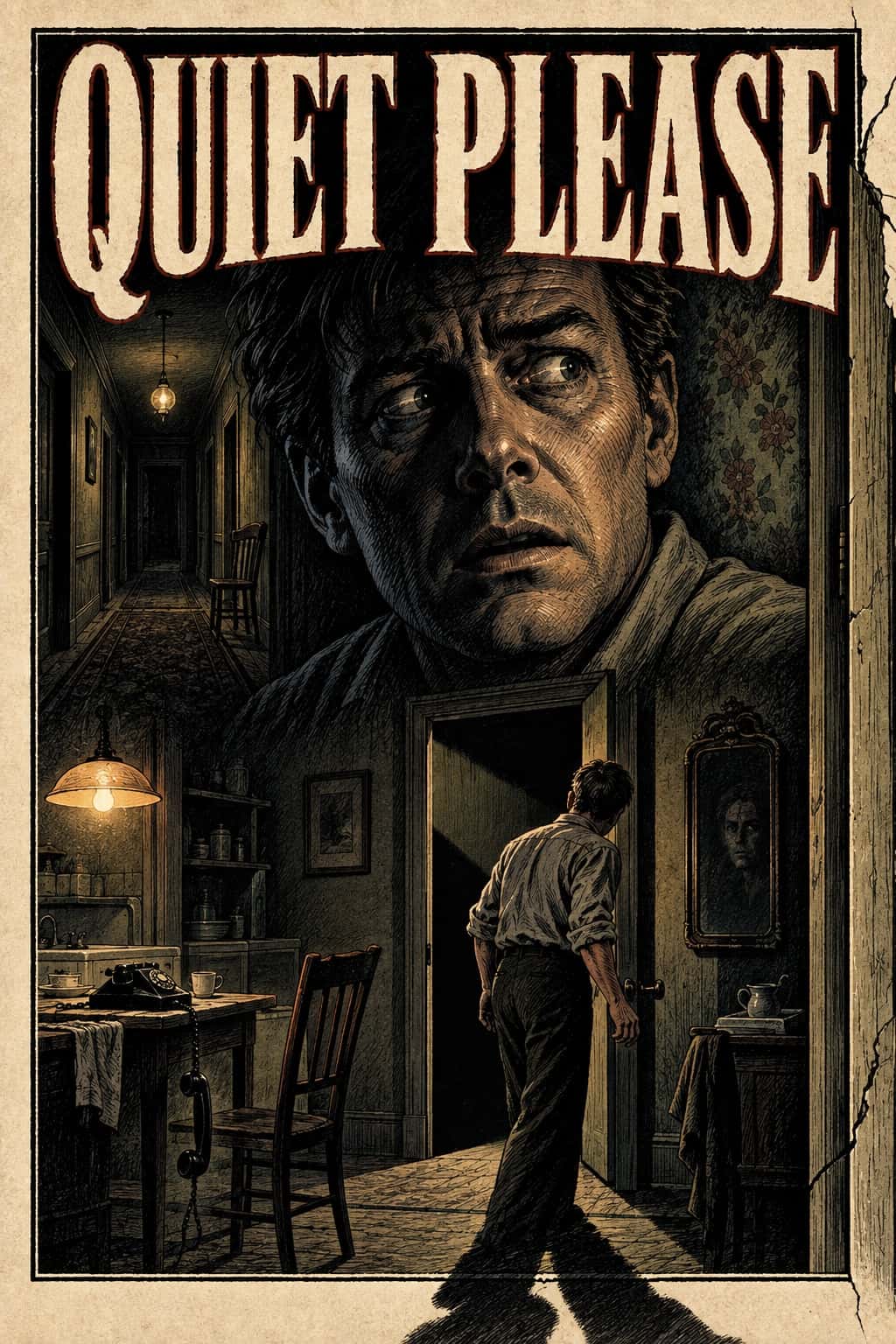
Quiet, please. Quiet, please. Broadcasting Company presents, is written and directed by Willis Cooper, which features Ernest Chappell. Quiet, please, for tonight, in the house where I was born. To the house where I was born. I come back just before decoration day. It's pleasant. Some years, go back once a year to the house where he was born. Just then remember. And then go back to where he came from. The house where I was born is old and weather-beaten under the gray paint. And the old porch is gone. The big bay window where I used to sit and watch the snow on winter afternoons faces right out into the street now. And the wooden steps go right up from the sidewalk to the big double front door. It was painted red when I lived there. Red with white trimmings. And there was a big caladium plant in the front yard. Elephant ears, my grandmother used to call it. Remember those things? My brother and I used to pull them up and make umbrellas out of them and grandma'd jaw still our ears hurt. Can't even tell where the caladiums were.
The old woodshed. The two generations of us that carved our initials on. I remember C.D.O. 1884. And my brother's initials 1905. That's gone too. And there was a dog. Here. Base burner with the eyes and glass in the doors where the coals glowed rent of a winter's night. The couch in the corner. The table with the cracked marble top where the lamp sat. The round lamp with the yellow silk shade with the fringe. The highly moral stories in happy days. and wishing we too could be big league baseball players like fearless and on a spring night like this just before decoration day mother sitting at the rosewood organ under the picture of horses playing battle hymn of the republic and there'll be a hot time old town tonight for the spanish war wasn't so long ago then my father that was battalion sergeant major hadn't come back from chickamauga and the scent of white lilacs coming in the windows and the white lilac bush that was her pride is long gone now But I can smell the white lilacs tonight, and I can hear the clopping of horses' hoofs on the pavement outside, the pavement they put down the year I started the school. And in the shadows of this bare old room, a glow comes slowly to life. There is the old lamp beaming cheerfully across the Brussels carpet, and the organ is playing, and I'm the little boy that looks up at her and plucks at her dress and begs, Mama, tell me a story. Mama, tell me a story.
Where are you, Mama? What shall I tell you about tonight, son? Isn't it almost time for bed? Where are you first, Mama? Please. Well, the stag at ease had drunk his silk. Where danced the moon on Monin's rill. And deep his midnight lair had made in dark Benotney's hazel shade. What's Monin's rill, Mama? Why, it's a little brook. A little creek way up in Scotland in the Trossachs where Roderick Doo lived. Well... Why do they call it Moanin' Drill, Mom? Boy, I suppose it was named after somebody named Moanin', son. I suppose it's a very tiny little brook where the water was ever so cold. And it comes down from the tops of the mountains, through the glades, and the places where the stags live. And I suppose not very many people know where Moanin' Drill really is. Because it's very probably guarded by the little people and the fairies. And I don't think they like other people to come and drink at their rill. Ah.
But they let the stag come every night if you want to. And then he goes away. And the little people ride on his back wherever he's going. And then they wake him up in the morning. And he takes them back to the rill. Does Mullen come there, too? No, no, I don't think so. Mullen's gone from there ever so many years ago. Doesn't anybody ever see him? No. Doesn't anybody know him, either? I guess not. That's awful. It is, isn't it? That's just about the awfulest thing that could happen, isn't it? What, son? Not having anybody nor you. I thought of that, but... Sing me along. Getting sleepy? Uh-huh. Mine eyes have seen the glory of the coming of the Lord. He is trampling out the vintage where the grapes of wrath are stored.
He hath loosed the fateful lightnings of his terrible swift sword. And mother's song fades, and the light grows dim, and I am in darkness again in the house where I was born. I was born as in a great city, and the wide streets are filled with crowds of people. But again, oh, many things. The open streetcar clanging its way up the street, and my father pointing and telling me that that's the first trip of the open streetcars up Broadway this summer. And a friendly policeman in a round-topped helmet spanking me jovially with his nightstick as we crossed the plaza on the way to the Central Park Zoo. The house where I was born. A brownstone steps into a high-ceilinged house with a fireplace in the front room. A great stairway. The long, inviting banisters. And a cat with a blue ribbon for a collar and the longest, sharpest claws in the world. And a telephone that you could talk even to Brooklyn with. A sign on the front alongside the tall doors. A sign that says, Swedish Restaurant.
Then still in the foot of the steps, the prints of my two shoes. And my initials, 1901. And I turn away from this house where I was born. For I've not done with no more journey yet. There is not one stone upon another. For the path of war led across its dooryard. Destruction followed for all the people who dwelt in it. But the scent of lilacs is strong in the evening air even here. And before my eyes, the scene of desolation dims. And the house where I was born lives again. It's a spring evening, and there seems to be music in the air. And I feel happinesses again, as I felt them that night when I first brought home my bride. What was her name? Bring me across the threshold, my love. Oh, darling, this is home. A fine home, a wonderful home. My people have lived here since... Since the Thirty Years' War. You are totally right. They don't build houses like this anymore, my love. And the mortar.
There is my great-great-great-grandfather's blood in that mortar. I know. He drew blood from his own arm and built it into the mortar so that there would always be something of him in the house. Well, it was also a charm, you know. The witch woman. I know. He paid her three pieces to tell him what to do. It will stand forever. How do you know so much about it? You have told me so many times. So I have. And real glass in the windows, too. Yes. And the stove with the hand-painted tiles. There's not another one like it in the whole village. And it's ours. And we'll take it to America when we go. Go to America? Why, of course I do. Oh, you do too. Could we not be happy here? We will be rich and I'll have two dresses and someday we'll have a motor car even. But why? Far from this house where you were born and where I hoped our children would be born. And the scent of lilacs is strong again in the air.
As the voice of a beloved woman fades away into shadow and forgetfulness. And the house where I was born is swallowed up in the night. And I am alone again. And the house where I was born is Adobe Shack. Somewhere in the Texas panhandle. Plains of the West stretch away endlessly beyond it. Bunkhouse roof is gone. Horned toads squat on the decrepit porch where I played cowboy in Indians. I look above the door. The brand is still there. The brand that looks in the early darkness like Raptor A. But it might be two up and two down or a running W. And there's a dry, dusty smell about the place and an echo of almost forgotten songs quiver on the air. For the Chisholm Trail went right past our place, all the way from Belton up to the North Fork of the Canadian and Abilene. And I've seen white-faced ballers by the thousands go past our gate, heard the riders' voices in the hot noons and the long... ...of horses' hooves. There's music to the ears of a lost...
Forgotten Texan who never come back to stay. The house where he was born. Flowers on the grave up there on a little hill under the cottonwood tree. There's a sod-roofed cottage in the peat. I'm 19. Returned for a visit with the old folks. Three years in America where I've become all Yankee. And my brother and I sit before the door and talk at evening about the strangeness of the new world and its customs. And the customs of other people beyond the various seas. And it's this very day. 35 years ago. And I'm betting you there'll be war in Europe before the year is out, my lad. Let's just talk to the start of every war the world has ever seen. I kind of was just waiting for somebody to set the world alight. Many a good lad will come to his end of putting it out. We'll never get in it. Yes. What about that? We're too far away. Let the English and the Germans fight it out. All very well to say. But you'll see. I'm not so sure about that either. Fight for the English?
They wouldn't like that very much, sure enough. Some very good Irish regiments in the British Army. The Enniskillen Fusiliers, the Royal Irish Rifles, and the Dublin Fusiliers. You stay out of it. You can't go and leave the old folks alone. Well, if I was as young as you... Cut it out. You talk as if war is just around the corner. And that's just exactly what I think, too. Well, all right. But I'll be back in the States long before your war arrives. And I'll stay there, too. I left the house where I was born. The smoky, damp little hut beside the road to the sea. And I have not seen it again, save when it comes decoration daytime. And I go back, unbeknownst to my brother, and look in at the door to where he sits. An old man puffing his pipe alone by the peat fire. And once, it was long years ago, the village priest sat with him. And I heard my brother speak of me. I could have been very different, Father. If my brother had come back from the war. A fine young lad, Father.
Could have done something with the place. And there was a day on the ranch in the Texas panhandle when a tall young man in Levi's and high-heeled boots saddled and bridled a horse and said goodbye to an old man. Shook hands with half a dozen cowhands and a Mexican cook through a road that was to be the first lap of a long, long journey. I remember I turned and looked back at the house where I was born when someone was singing an old song somewhere. And here again in the house where I was born. Stand again beside the walls of stone mortared with the blood of my great-great-grandfather. And in my arms. A little while, my dearest. Only till I can earn enough money to send for you. But you will. America really isn't so far away. You've been through all this before. In six months. A year. No, don't, darling. Such a little while. You will come to America. And we'll be so happy.
And so rich. It's such a little time to wait. You know it is. I love you. In the house where I was born, except in dreams, you know, such as this dream tonight, the ruins lift and form themselves for a little moment in the darkness. She came to America, and the day she arrived, two prints of a child's shoes and a concrete remain as a memorial that I once lived. The house where I was born has forgotten me. In the house where I was born, there's a pack of yellowed letters somewhere in the house. Lost behind a beam in the attic, maybe. A pack of yellowed letters with soldiers' mail. The place where the stamp should go. And my name and an APO number in the other corner. Names like Dead Man's Hill, Constant Way. Letters on an ancient palimpsest. Obscured by newer names written over them. Omaha Beach. The places where men have died. The 77s bursting. What the chaplain was saying to me. Sissy bent over me. Before decoration days some years ago. What shall I tell you about?
How are you, Mama? Well, at least.
They set a marble tomb above my shattered self. Seeking to do me honor thus. Compense the searing days. Crawling nights I died in. Lies here deep. Lies here deep. Oh, save God. Die the battle death. The sleep of death is not so very deep. Lately the spring has come. Yesterday a tiny root of some green thing has split the stones apart wherein I lie. Its tender questing fingers seek my hand. As mine sought flowers on some yesterday forgot.
The clang of arms. The measured tread of sentinels that guard my bed. My face is dead. But once you knew me, perhaps you wept to hear that Sergeant Deckard spoke my name. Is it you that I hear through the dust? Oh, my brother. Is it your little song that I hear? Oh, my mother. I am my tomb of marble. A tomb of stone. I am the chief of them all. Chief of the dead. I died. Came a mystery. Every mother. Every brother. Every soldier, his comrade, was content to lie here. Masked in uncertainty. Having the homage of all of you here in my marble tomb. I was content, I say. But now spring comes again as I saw it once before that day I died. Is it your hand that rests on the stone? Oh, my sister. Is it your tear that falls on the stone? The trumpets now. The volleys sound. The sabers flash against the sun I may not know. A tomb of stone. The cast were Betty Raggy. Cecile Roy.
This is ABC, the American Broadcasting Company.