
The written record
Read the transcript
Read along with the recording · About 17 min to read
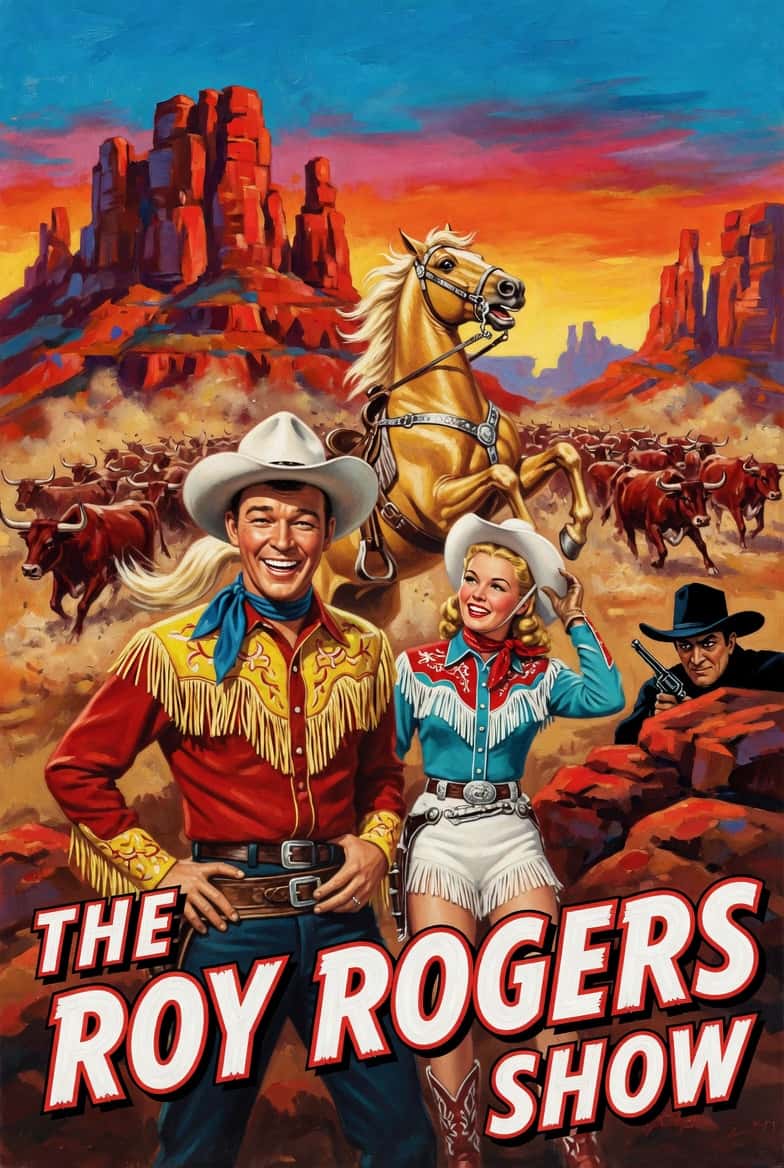
The following transcribed program is rebroadcast by the Armed Forces Radio Service to our fighting men overseas. Goodyear presents the Roy Rogers Show! Friends, tonight as usual, Goodyear brings you Roy Rogers. But because of the great news we've all been hearing, we want you to know that we will interrupt this program instantly for any late news flashes. Meanwhile, you'll hear Bob Nolan and the Sons of the Pioneers, Pat Friday, the Farr Brothers, Perry Botkin's Orchestra, Goodyear's guest tonight, motion picture villain Porter Hall. And now the greatest name in rubber, Goodyear, invites you to meet America's greatest western star, Roy Rogers. I've got a locket in my pocket, a plain golden locket. Got a locket in my pocket, right next to my heart. I've got a picture in this locket, the locket in my pocket. Got a picture in this locket, with which I'll never part.
The face in the picture is beautiful to see. And the girl at the face belongs to, she belongs to me. I've got a locket in my pocket. My sweetheart's in that locket. Got my sweetheart in my pocket. Right next to my heart. The face in the picture is beautiful to see. And the girl at the face belongs to, she belongs to me. I've got a locket in my pocket. My sweetheart's in that locket, got my sweetheart in my pocket, right next to my heart, right next to my heart. Howdy, folks, and welcome for me and the gang to tonight's Goodyear Get-Together. We've rounded up a few new and some old songs for the occasion, and one of the West's most amazing legendary stories. But right now, it's time for you to meet our guest for this evening, one of the swellest actors who ever foreclosed a mortgage on poor little Nell.
Mr. Porter Hall. Hi, Porter. Hi, that's a nice welcome after you asked me to come over to your get-together. Well, shucks, don't mind the folks, Porter. They've seen you as a villain in so many pictures that they just can't keep from booing at you. Well, I'm so misunderstood, Roy. To everyone who's ever seen me in pictures, I'm a no-good, low-down, unprincipled crook. Now, honest, Roy, you know I'm not that way at all. Much. Porter, I'm surprised at you. Well, I think I'd much rather play your part than my own. The heavy in the picture, oh, well, he always gets his own way, and you get most of the close-ups. You know, where you sneer and twirl your mustache and make everyone in the audience hiss at you? Well, that's the real trouble, Roy. I never know if they're hissing the character or the actor playing the part. Well, when Porter Hall was playing the part as a villain...
It isn't the actor they're hissing, you can believe me. But just to give you a break, Porter, we've got a sketch for you to play in tonight about one of the West's most amazing characters. And just to prove that you're the star and the hero, I'm not even going to play in it. How's that? Well, that's what I call really being a hero. Giving a whole story to a screen bad man. But what are you going to do, Roy? Well, first of all, Porter, I'm going to keep an eye on you and make sure you don't forget yourself and steal the ranch. Then I'm going to just sort of keep the get-together moving, like now when I call on the sons of the pioneers to dedicate a song to you.
Out in Arizona where the bad men are, the only thing to guide you is an evening star. The roughest, toughest man by far was Ragtime Porter Hall. He always sings ragging music to the cattle as they swing, packing forward in a saddle on a horse. Today, when congratulations are being offered all over the world to the millions who worked and fought for victory in Europe, Goodyear would also like to propose a toast. A toast of its own and to its own. A toast to the 24,783 of its men and women in the armed forces. It's well done to those in Europe. It's good luck to those in the Pacific. And here's a toast, too, to the 100,000 Goodyear employees at home who with their war work have contributed and are continuing to contribute to final victory. To them, good work.
And let's keep punching hard till the Japs get theirs. It's the Farr brothers' furious fiddle and galloping guitar in Cajun Stone. Hey, Roy, I'm sorry I'm late. Have I missed much? Well, hello there, Pat Friday. You have missed a couple of good songs, but you're in plenty of time for the story Porter Hall and I are going to tell tonight. Porter Hall? Do I know him? Are you my Uncle Every? Yes, Every Friday. I am now fabulously wealthy, and I intend to buy you the finest ranch in the West. Oh, but I already have a ranch. Oh, you have? As if I didn't know. But you deserve a much bigger one. Now, if you would just give me that piece of paper you're holding, which I assume to be the deed to your present property.
Here you are, sir. Aha. My proud beauty. Now I have you in my power. Doggone you, Porter Hall. Unhand that girl and give her back that deed. Aw, shucks, Roy. That isn't the deed to my ranch. It's just the song I'm gonna sing tonight. Curses foiled again. Not exactly, Porter, because if Pat'll forgive you and sing the song right now, you'll get the treat of your life. Folks, Miss Pat Friday's singing close as pages in a book.
Close as pages in a book. My love and I. We could share a single look. There I throw misty tunes. Won't come tumbling to the ground. We'll hold them as the strongest book is bound. They're bound. Close as pages in a book.
You know, you hear a lot about a cowman's pony, but there's another little animal. I guess the West would never have been made without him. You find him packing loads twice their own weight, where grubby prospectors work tirelessly in the desert sands. You'll find him high up in the mountains where a less sure-footed animal will plunge his rider 5,000 feet down a sheer drop. Oh, maybe their voices aren't as musical as a cowhand's song as he sings and quiets his herd, but... I've yet to see the true westerner who didn't cuss them and love them. The gentle, sure-footed, little braying burl.
Now it's Roy Rogers, the King of the Cowboys, in a new western ballad, Don't Blame It All on Me. If our love should fade like a cold winter's day, don't blame it all on me. The true love has flown, might have known friends will say, don't blame it all on me. There was a time, dear, when we were so gay. I heard you say, I love only you. Someday with the dawn, all our love may be gone. But don't blame it all on me. For after all, dear, I too have a heart. You have it now. Don't break it apart. Someday our romance may break up just by chance. But don't blame it all on me. You've got both Pat and me busting with curiosity about the yarn you and Porter Hall are going to tell. What's so different about it? Come on, Roy, don't just stand there with that twinkle in your eye. Well, kids, tonight's story is about the greatest cowboy who ever rode a bronc, shot a six-gun, or roped a steer. As a matter of fact, he's the man who taught broncos to buck, who invented the six-shooter, and considered the lariat.
One of his unimportant inventions. Oh, no. Wait a minute, Roy. Now, you wait a minute, miss. Don't accuse Roy here of exaggerating. But, Roy, anybody knows the six-gun was invented by Samuel Colt. That, Vern, is just a rumor. The six-gun was definitely invented by Pecos Bill. Pecos Bill? Never heard of him. Female tenderfoot. Bah! But who was Pecos Bill, Roy? He sounds as fantastic as this Hall character here. He's much more so, Vern. Pecos Bill is the most fantastic character the imaginations of thousands of cowboys ever dreamed up. And if you'll all just make yourselves comfortable, Porter Hall and I will tell you plenty about him. Now, I'm not saying that Pecos Bill is dead even today. To be honest, I don't know if Bill was ever born. They say he was born in Texas, and he was quite a baby. Weighed 73 pounds and stood more than four feet tall.
He got lost out on the prairie one day and didn't have anybody to play with, so Bill wound up living and playing with the coyotes. Well, just about Bill's ninth birthday, a cowboy who'd wandered off the trail came upon Bill just as the big kid was having a morning exercise. Hey there, son. What you doing? Playing, Parnassian. Don't you use your eyes. Can't you see I'm rattling? Now, hold on. That ain't fair. One young'un like you'll get only two bears? Let up on them quillies. Well, I don't like to be picking on somebody who ain't my own size, but shucks, there ain't more than two bears left around these parts. Gets a blade too rough. Most of them die of a busted neck. Well, what in tar place you doing out here in these hills anyhow? Running around shameless like that with no stitch of clothes on your body. Clothes? Don't you know us coyotes don't wear no clothes? You been chewing loco weed, youngster?
You ain't no coyote. You're a human being. I ain't no human being. I'm a regular natural-born coyote. Don't I live with them varmints? Don't I talk to them? Don't I howl like them? Ain't I got fleas? Now, looky here, Button. That ain't no proof you're a varmint. Why, sakes alive, ain't a human being these parts that don't howl and ain't got fleas. Well, don't you call me no human being. Well, that's what you are. Look. Ain't every varmint you ever see got a tail? Ain't they? Why, sure. All varmints got tails. That's natural. Down tootin' it is. Then if you're a varmint, where's your tail? Well? Well, don't blast it to lightning. You're right. I ain't got no tail. Of course you ain't. So you see, son, you're not a varmint at all. You're a human being. I don't want to be no human being. I don't want to be.
Lookie here, fella. You is a human being. And it's my duty as another human being to take you back to civilization. Well, that's just about the time that Texas started to make its place in the world. Just when Pecos Bill was dragged back to civilization. But with eating regular, Bill started to grow. And inside of a year, Bill was more than eight feet tall and weighed better than a half a ton. But Bill was lazy and hated to work. But, Roy, what kind of work did Pecos Bill do? Almost any kind of ranching, Pat. Roping, branding, and, well, you know, when he'd do the branding, he'd do it with his bare hands. He'd just grab a yearling, tuck it under his arm, and stuff his ears up so he wouldn't hear the calf's bawling. You know, Bill was kind of a soft-hearted cuss. You mean he wasn't tough, Roy? He wasn't a bad man? A bad man? Pat Pecos Bill was so bad that he killed off everybody in his part of Texas that had enough spunk to stand up to him.
Then he got so tired of the peace and quiet that he finally started heading west. Well, he finally run out into the, run into an old fella and stopped his horse. Howdy, stranger. Say, can you direct me to some place where I might find myself a real man? You know, the kind what takes a real joy in a killing. Well, just keep heading up this canyon about 200 miles and you'll find him right enough. Yes, sir, sure will. Oh, thanks, old-timer. Peckersbill is much obliged to you. Did you say Peckersbill? Yes, sir, you did. Peckersbill's my name. Hopper and daisies, I gotta get out of here. Get it? If he was really in a hurry, I wonder what took the old goat so long. Boy, for goodness sakes, don't stop there. What did Peckersbill do? Did he go the 200 miles up the canyon? Well, yes and no, Pat. You see, old Bill turned his horse and started.
But after riding only about 20 miles, a doggone horse stubbed his toe on a cottonwood tree and busted his leg. Well, all Bill could do was follow the code of the West. He covered his eyes with one hand and pulled out his rifle, which he used as a pistol, aimed it at the poor horse's head, and with tears running down his cheeks... Goodbye, old page. Someday we'll meet again, you and me, over on the t'other side of the great horizon.
Before Bill could squeeze the trigger, the horse looked up and with tears streaming from his big brown eyes, he said, Now, wait a minute, Bill. You ain't gonna shoot me just cause three of my four legs is busted, are you? Well, I reckon I was, but if you got any last words... You know I ain't one of them regular undersized scrawny little horses. Just leave me alone for a bit and I'll get well. Well, doggone if I don't believe you. Well, I'm going to take the saddle off you and leave you here. Then I'll leg it up to where that bunch of tough hombres are, and when you feel well enough, in about 20 or 30 minutes, just cart up and chine me. Well, I hadn't gone two miles further, saddle over one arm, when I spot a little rattlesnake no more than 18 feet long. So I put down the saddle, and I reached out and I grabbed the sneaking sidewinder, and after cuffing him good fashion a few times, The snake told me he'd give up. So I coiled the little fella like a lariat, stuck him on my saddle horn, and I started on up the canyon. Attaboy, Bill. Tell him the rest of the story. Stine, stop me, you movie cowboy, you. Well, a little piece further up the road, a catamount jumped me. A what? A catamount, a mountain lion. Don't you know nothing? Anyway, he knocked me to the ground, and that made me sore. Don't tell me you don't want to take down... ...me up like that. Take that. Take that. Hey, now.
No, no, Joe. Oh, so it was a joke, was it? Yeah, not so well, Bill. I'm a timid kid. Well, at least you're the dumbest cantamount I ever see. Just for that, I'm a throwing this saddle on your stupid back and riding you up the canyon. No. Yeah, using this rattlesnake for a whip. Now get over there, go on. Now let's get started. Else I'll now break you in two and only eat the best piece. Well, as soon as Bill got the saddle, he... Hey, just a minute, Roy. That's a fib. How come the horse and the catamount actually talked to Pecosville and Bill answered them? Well, heavens to Betsy, Pat. Wasn't the lad brought up with coyotes? Why, shucks, he had more trouble talking straight Texan than he did chewing the rag with them varmints. What happened then, Bill? Well, I read into the camp where all them hard-bitten owl hoots were sitting around eating chow. So I hauled up my catamount and I walked over to the cook pots and I looked in. Hmm. Yeah. Oh, what's this?
Nothing but six quarts left. Well, I'll start on those. Well, ain't so bad. But they make me thirsty. Give me that coffee pot. Look out, stranger. That pot is a-bottling. Shut up. Now, someone hand me that porcupine to wipe my mouth on and we get down to business. What is your business, partner? Who's boss of this gang? That's what I want to know. Those boss around here. Stranger I was, but you be. And did anyone ever hear of Pecosville after that, Roy? Well, sure, Pat. A few years later, someone bet him he couldn't ride a cyclone. Well, Pecosville was the kind of a fella no one could dare, so he went back to Kansas, waited for a twister, and when one came along, why, he climbed aboard. And was he killed, Roy? I mean, did the cyclone throw him? Throw a legendary character like that? Why, I...
Not at all, Vern. By the time that twister crossed Colorado, he had it as tame as a lamb. But then he got a little bit overconfident, you know. He rolled himself a cigarette, and when he couldn't find any matches, he reached up and grabbed a piece of forked lightning. Oh, I see, Roy, and the lightning electrocuted him? Shucks, no, Pat, but it tickled him and got him to laughing so much that he didn't look where he was going, so he slipped off the cyclone and dropped 97 miles to Earth. Oh, Roy, that doesn't seem possible. But it happened, Vern. And where Bill landed, he weighed so much and fell so far that he knocked the earth 150 feet below sea level. Folks called the place where he landed Death Valley, because they figured he'd never survive such a bump. Fact is, I was surprised as you were when Pecos Bill walked in here tonight. It's the whole Goodyear gang, led by Roy Rogers, the king of the cowboys in Skies Are Bluer. Skies are bluer in Oklahoma, Oklahoma, where my heart lies.
Songs are newer in Oklahoma, Oklahoma as the crow flies. That's where the yellow corn is brighter and cotton's whiter than snow. Just listen to the weed a-swaying. It sounds like it's saying hello. Bells are ringing and voices singing. Oil is gushing and the folks are rushing out to Oklahoma, USA. Oklahoma, Oklahoma, we're in Oklahoma. That's where the yellow corn is brighter and cotton whiter than snow. Just listen to the weed a-swaying. It sounds like it's saying hello. The hills are ringing and boys. Well, it looks as if our time for tonight is like the water in a stream in the middle of the summer. It's all run out. But we've got more time again next week, and we'd like you all to be back sitting with us at our Goodyear get-together. We have some songs and music and a little chatter, Western style, and a rip-roaring story about the old days that should please everybody. So till next Tuesday, this is Roy Rogers thanking Porter Hall for appearing with us tonight.
And saying for the whole gang, goodbye, good luck, and may the good Lord take a liking to you. Don't forget, smiles are made out of the sunshine and the frown from the rain. Now this is Vern Smith saying goodnight for Goodyear, the greatest name in rubber. If you like the songs and stories of the West, don't miss tuning in next Tuesday. Same station you're tuned to now, same time of the day on your clock. when Goodyear will bring you another get-together with Bob Nolan and the Sons of the Pioneers, Pat Friday, the Farr Brothers, Harry Botkin and his orchestra, and starring the king of the cowboys, Roy Rogers. Roy Rogers' program was transcribed. This is V.E. Day. Don't forget to buy another bond. A war half won is a job half done. This is the Mutual Broadcasting System.