
The written record
Read the transcript
Read along with the recording · About 11 min to read
People, LG, ATP, Colgate presents Bill Stern. With a Colgate Shave Cream Sports Newsreel. Bill Stern, the Colgate Shave Cream Man, is on the air. Bill Stern, the Colgate Shave Cream Man, with stories rare. Take his advice and you'll look keen. You'll get a shave that's smooth and clean. You'll be a Colgate Freshless Man. Good evening, ladies and gentlemen. This is Bill Stern bringing you the 393rd edition of the Colgate Shave Cream Sports Newsreel. Our guest tonight is America's King of the Cowboys, Roy Rogers. But before we bring you Roy Rogers in person, here is reel one. Stanley Hack. the third baseman of the Chicago Cubs, one of baseball's best-liked players. And Stan Heck tells me he likes Colgate Brushless, the shave cream of champions. For he recently wrote me, Dear Bill, Colgate Brushless shave cream is a light, fluffy shave cream that takes the fight out of the Heck whiskers, and they're plenty tough. I don't have to fuss with a heavy, greasy shave cream anymore. Your Colgate Brushless gives me a fast, close shave. It's painless and rinses off in a flash. Nothing to gum up my razor. Bill?
You've got me as a life customer for your Colgate Brushless Shave Cream. Signed, Dan Hack. Yes, man. As Stanley Hack says, Colgate Brushless Shave Cream gives you a fast, close shave that's painless. Colgate Brushless is light, and it's right. Being light and fluffy, it spreads easily. It stays moist, clear through your shave. Stands your whiskers up so your razor can shear them off close and clean, but nary a pull. Or string. So, just string along with Colgate Brushless Shave Cream. You see, Colgate Brushless, the shave cream of champions, is made especially for tough whiskers planted in a tender skin. If you've been promising to try Colgate Brushless Shave Cream, get yourself a jar or a tube tonight. If you're not 100% satisfied with the results, then just send the top of the carton back to me, Bill Stern, Cara Colgate, Jersey City, Zone New Jersey, and I'll see that you get double your money back. Now, could anything be fairer than that? As for Colgate Brushless, the shave cream of champions, tonight, it's light and it's right.
Reel 2, Profile of a Star. Our story begins in an average small town with an average small town family. A father, a mother, and a youngster. We can't say this was a very happy family because the father and the mother were always fighting. One day, the father disappeared. Soon after, the mother died. The youngster was immediately placed in an orphan asylum. Then, as the years went by, was put into a state school. All this time, that boy wanted only one thing. He wanted to be a baseball player. He was good, too. But without a mother or a father, nobody took much of an interest in him. When the youngster was 16, the boy began to look for a job in baseball. Finally, he found one with a semi-professional team in the Bush Leagues of South Dakota. His pay was three meals a day and $5 a week. The following year, the youngster moved up a notch. He went into Class D baseball crew. It was still very much the bottom of baseball, but at least it was a regular job with a recognized team. Nobody paid much attention to the youngster. He was just one more kid trying to make his way in baseball.
Without a father to help him or give him advice, it was tough going. When he did pitch a good game, the local papers would write it up, but they did that for everybody. The biggest day of the youngster's life was when an old, broken-down newspaper man from a nearby paper came especially to interview the boy. The kid was flattered. It was his first interview. Nor was the kid any the less flattered when the old guy came back a second time. But then, then the boy forgot. He forgot because he pitched a no-hit game. Immediately, reporters from all over came to write about him. It was the boy's first taste of fame. His picture was in the papers. It went to his head. Where before the boy had been grateful, now he became surly. The old broken-down sports writer who'd first interviewed the boy tried to warn him, but the boy wouldn't listen. He turned on the old man viciously. Get out of here, you chiseler. Just because I gave you my first interview, I think you can boss me around. Go on, beat it. After that, the boy went up the baseball ladder of fame. Story after story appeared about him. Newspaper men, however, didn't like him. He was mean, conceited.
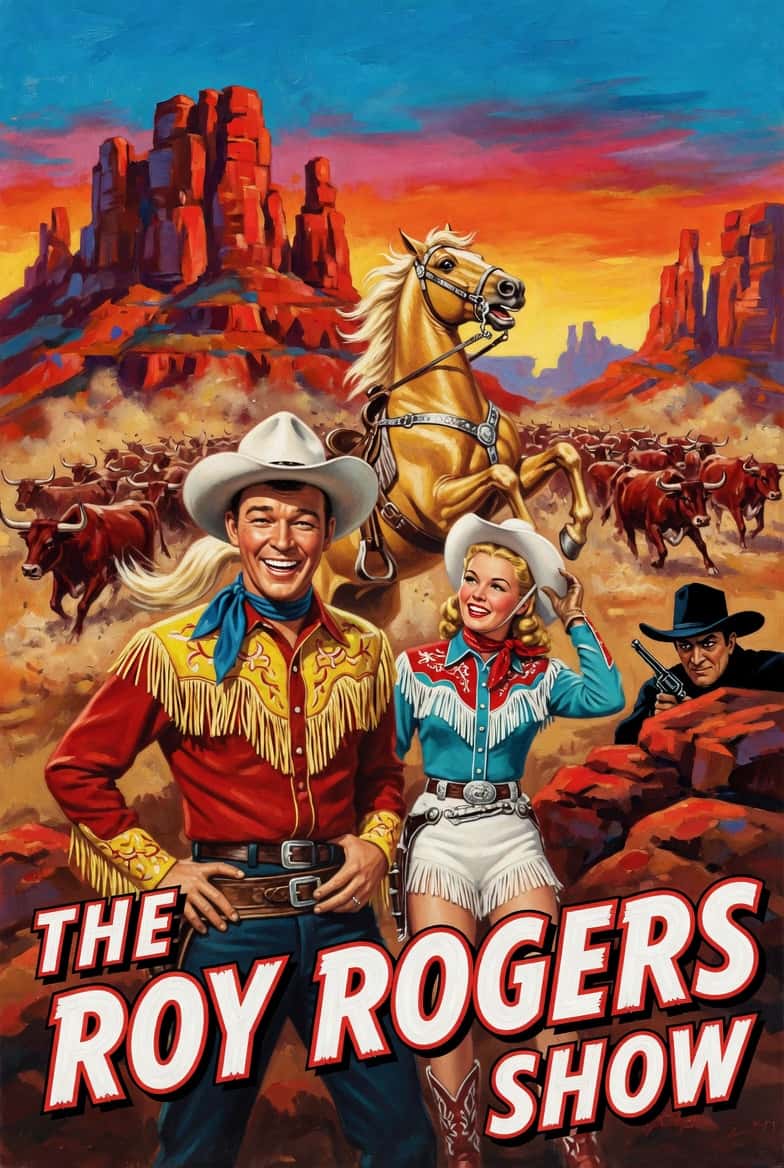
And above all, he seemed to take a great satisfaction in tormenting broken-down sports writers like the old gent who'd given him his first break. Recently, the boy hit the big league. He'd finally arrived. His pitching was great. Every one day, a famous youngster in the lobby of a hotel. First, say, a old writer from your local paper. First write-up, the ballplayer laughed. Remember him? That stupid old gazebo. Sure, I remember him. The New York reporter replied slowly. Glad you remember him, Sonny. He just died. And he was your father. Profile of Father's Day. Realtree. Colgate camera close-up of Roy Rogers. Here's America's King of the Cowboys, the famous movie star, Roy Rogers. Well, good evening, folks, and how are you, Bill? Roy, I'd like to ask you some questions about your famous horse. About Trigger?
I'll go right ahead. Well, tell me this. Does Trigger get any fan mail? Well, his fan mail is such that if you just address a letter to Trigger in Hollywood, he'll get it. Now, go on, Roy. Tell me more about that horse of yours. Well, he can walk on his hind legs, untie ropes, knock on doors, sit down on a chair, fire a gun, lie down and play dead, drink out of a milk bottle, and he can count and add and subtract. All in all, he does about 50 tricks, Bill. Tell me this, Roy. Is Trigger with you here in New York City? He sure is. He's here with me, too. Be with me in my outdoor circus starting Sunday afternoon at the polo ground. Say, tell me, isn't this your debut as a circus owner, Roy? Yes, and it's quite a show, Bill. We have animals, high aerial acts, clowns, dogs, ponies, even an elephant that rides a tricycle. Uh-oh, that I got to see. Say, Roy, it sure must keep you busy owning a circus and doing radio shows all at the same time. Bill, lately it's been even worse than that because besides doing radio shows and running my circus, I've been finishing my new picture.
Springtime in the Sierras. Boy, that's a lot of work for one guy. Say, Roy, tell me, how did you get the name Roy Rogers? That's not your real name, is it? Yes, Bill, it is. My real name was Leonard Sly until I had it changed legally. The movies gave me the name Roy Rogers, and I'm very proud of it, too, because, you see, they named me after the greatest cowboy star who ever lived, a man I hope will never be forgotten. His name was Will Rogers. He never will be forgotten. Thanks so much. Good luck and good night. Roy Rogers. Reel 4, Arthur Gary. It's true. A man gives some of the best cheers of his life for good shaving. And the best cheers go to Colgate Brushless, the shave cream of champions. It's not heavy, not greasy, but light and fluffy. And oh, brother, what a wonderful performance it gives. No matter how tough your whiskers or tender your skin, you can expect Colgate Brushless shave cream to deliver close, clean shaves without snagging or pulling. It adds up to sheer comfort.
And seeing that next Sunday is Father's Day, I was about introducing Dad to the Shave Cream of Champions. Yeah, present him with a jumbo jar of Colgate Brushless Shave Cream, a thoughtful, practical gift for a champion dad. Ask for Colgate Brushless, the Shave Cream of Champions, tonight. And now, back to Bill Stern. Real fun. Portrait of the blues. You ever stop and wonder how the blues were born? Listen.
Just a second, please. Ladies and gentlemen, you never think about music and sports being closely tied together, do you? And yet, you'd be amazed to know how important a part some great sportsmen have played in developing the blues. Let me show you what I mean. Boys, would you please begin that song again? Sportsmen have played a big part in the birth of the blues. For instance, do you know who the speedboat champion of the United States is? developing popular music. But America's racing champion is a guy named Guy Lombardo. How about a youngster who wanted more than anything else in the world to play baseball? The only way his father could stop him from becoming a ball player was to buy him a trombone. He's done a lot for music, too, even though his first love was baseball. His name is Tommy Dorsett. But speaking of great sportsmen who've helped to develop the blues, how about a boy who never played football in his life, and yet even though he'd never played football, he coached a team that's never lost a game?
Football is still his first love. But he's done a lot for music, too. Because, you see, his name is Kay Kaiser. We can't forget a boy who was trained to be an acrobat. His parents were circus performers. They taught him how to swing through the air with the greatest of beat. He was a great athlete then. Now he's as great a musician as he ever was an athlete. His name is Harry Kane. But in speaking of sportsmen who've done a lot to build the blues, ah, we don't have to restrict ourselves just to the men who lead the bands that play the music. How about the man who writes the music? Remember the former bantamweight champion of the world, Joe Howard? He wrote, I wonder who's kissing her now. But other sportsmen have written other music. Out in California, there lives a man named Jimmy McHugh. Jimmy McHugh, who's done more to promote national AAU swimming races than anybody else in America. Promoting swimming races may be his hobby, but he wrote a song called On the Sunny Side of the Spring. Yes, great sportsmen have had a lot to do with the birth of the blue. Do you remember a gentleman?
Harry Ruby? You should. He's the only man living in America who ever received a tryout with all six major league baseball teams in America. And he wrote a song called Oh, What a Pal Was Mary. And speaking of sportsmen of written music, you ever hear the story of a man who took up golf one year and a year later won the city of Chicago golf championship? His name was Isham Jones. People today forget that it was him. It had to be you. By now you must see what I mean. The birth of the blues in America has been helped tremendously by athletes who played the music. and helped by other athletes who wrote the music. But there are still others who made this music popular by singing it. Remember the guy named Jolson? And as we parade down through the years, recalling the great singing stars of yesterday, do you remember the boy who came along to take Al Jolson's place? The boy who gave up a career in tennis to stick to music? He wanted to be America's leading tennis player. Instead, he became America's leading singer, Rudy Vallee. And the next great singing star to come along.
probably did more for music than any man living, and yet music's only his second love. Race horses come first. Few people can sing a song the way that he can, and yet he'd give up music for sports tomorrow if he could. His name is Bing Crosby. It seems that all our great singers have been sportsmen, but the next singing sensation was a boy who wanted to become a prize fighter. He trained for fighting, even managed prize fighters, and yet he gave it all up for music. He's done a lot for music, too, for his name is Frank Sinatra. But by now you get the idea. Athletes have done a lot for the Blues. But the greatest story of the Blues is the story of George Gershwin.